Nergal, god of the Mesopotamian tradition
By Ralf Ittermann · last reviewed on
Nergal is a god of the Mesopotamian tradition.
War god, plague-bringer, co-ruler of the underworld. Nergal is the terrible double god of Mesopotamia: above, the face of war and pestilence; below, the dark rule over Irkalla at the side of Ereshkigal.
He begins as a solar, wild being, but through his marriage to the underworld queen becomes a feared yet necessary part of the cosmic order. Where Nergal breaks out, plague, war and the call of the dead follow.
As a war god, Nergal is at the same time underworld ruler beside Ereshkigal.
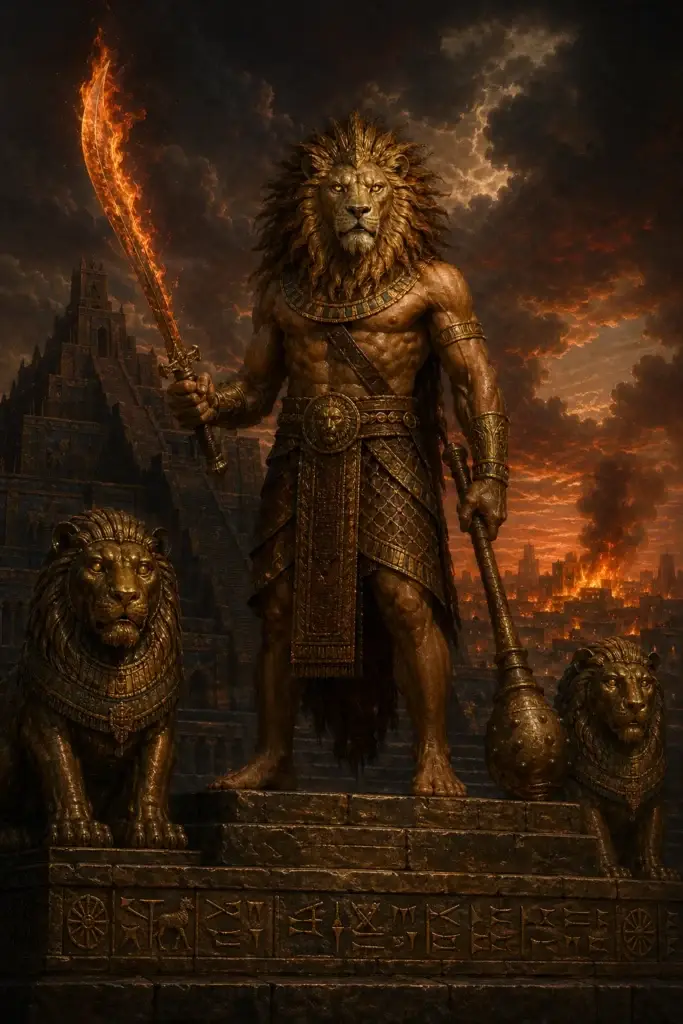
Quick overview: Nergal
Type: Mesopotamian principal deity, god of plague, war and the underworld
Pantheon: Sumer, Akkad, Babylon (consistently present)
Function: plague and disease, war, underworld rule (consort of Ereshkigal)
Main attributes: lion-headed mace, double sword, seven plague-demon companions
Main cult sites: Kuthu (principal cult site), Babylon, Ur
Astronomical identification: Mars (Salbatanu)
Context
Period of the texts
Nergal is attested from the Old Akkadian period (3rd millennium BC). His central myth, the marriage to the underworld queen Ereshkigal, is recounted in the Nergal and Ereshkigal epic (Middle Babylonian version, ca. 14th century BC).
In the Old Babylonian period he is further expanded through martial aspects; in the Neo-Babylonian Empire also as protector of kingship.
Area of distribution
The main cult site was Kuthu (today Tell Ibrahim, north of Babylon), the „city of Nergal,“ entrance to the underworld according to Babylonian belief. Alongside it Babylon (temple in the Esagila complex), Ur, Susa (Elamite), Mari.
In the biblical tradition he is mentioned as Nergal (2 Kings 17:30), in the list of gods that the Assyrian deportees brought with them to Samaria.
State of the sources
Central sources: the Nergal and Ereshkigal epic (Middle Babylonian and Late Babylonian versions), the Erra epic (Nergal as Erra/plague-bringer), various incantation texts (Maqlu, Shurpu), inscriptions from Kuthu and Babylon. Secondary literature: Lambert, Babylonian Wisdom Literature; Cagni, L’epopea di Erra (standard edition); Bottéro, La plus vieille religion.
Name and variants
Nergal is depicted in two aspects: above, as a muscular, bearded warrior with helmet, lance and weapons, surrounded by flames or plague symbols. Below, in Irkalla, he occupies a gloomy throne beside Ereshkigal.
His heraldic animal is the lion or a hybrid demonic figure. His colour is red, the red of war and disease. The Namtar (plague demon) accompanies him, as do pestilence spirits that mark his path.
Characteristics
Nergal regulates the balance between life and death through war and pestilence. In cases of illness he was invoked, not for healing, but for appeasement, so that he would withdraw the plague. In war, warriors prayed to him for victorious strength, yet also feared his unpredictability.
His main festival took place in Kutha, where priests offered sacrifices to moderate his wrath. Through his marriage to Ereshkigal, Nergal also becomes guarantor of order in the underworld; he is not simply a destroyer, but a necessary force in the cosmic structure.
Appearance and symbolism
Nergal is depicted as a muscular man with a lion’s mane or lion face, often surrounded by fire. His skin may be red or dark brown, and he carries weapons, sword, axe or bow, which show his martial nature.
A serpent often coils around his body or arm. His head may be double-faced, with one face turned to the upper world (war god) and one to the underworld (underworld king). The lion and the scorpion are his sacred animals. Fire and blood are his symbolic colours.
Profile: Nergal
The most important aspects of Nergal at a glance. The following fields summarise origin, function, appearance, worship, symbols and parallels.
Nergal is the son of Enlil and Ninlil, brother of Ninurta. In the central myth Nergal and Ereshkigal he travels into the underworld; after several conflicts and negotiations he becomes the consort of the underworld queen and shares rule with her.
In the Erra epic he acts on his own initiative as an uncontrolled plague power.
Plague-bringer and plague-averter (a double function like Apollo and Sekhmet). Patron of the high-summer heat fever (Akkadian idiša). God of war and battle. As the identification with Mars, also of high astronomical importance; his star (Mars) is interpreted in the Babylonian omen texts as bringing misfortune. Protective god of kingship in the Babylonian-Assyrian tradition.
Anthropomorphic, as a martial man with a high hat-diadem and long robe. Characteristic: lion-headed mace and double sword. Frequently accompanied by the Sebitti, seven plague demons.
On some seals in lion form or as a human-lion hybrid being. Skin colour red or dark red (plague fever, the planet Mars). In the Neo-Babylonian period also depicted with a bull-drawn chariot.
Sphere of influence: Nergal was invoked in times of plague and before battles; his summer high festival coincided with the annual plague season. Kings erected stelae before battles.
In incantation rituals he was invoked and feared in equal measure (double function). Kuthu was a pilgrimage destination for death and healing rites. In personal cult he also offered protection against criminals and highwaymen.
Lion-headed mace, double sword, high crown, seven companion demons (Sebitti), lion hybrid being, red star (Mars), high-summer heat. Plants: bitter melon, holly plants. Sacred number: 7 (the Sebitti).
Erra (Akkadian, identical plague-bringer aspects, his own epic), Resheph (Phoenicia/Ugarit, plague and war), Apollo (Greece, double aspect of plague-bringer and healer), Mars (Rome, identified astronomically and martially), Sekhmet (Egypt, plague-bringer and healer), Indra (Hinduism, war and cosmic battle), Tyr (Germanic, war god).
Practical defence
Apotropaic rituals against Nergal
Nergal’s destructive power (plague, losses in war, underworld doom) was bound in the Mesopotamian cult above all in the temple E-meslam at Kuthu through regulated monthly sacrifices: beer, sheep, incense of erin (cedar).
The Šurpu and Maqlû incantation series (Šurpu: Reiner 1958; Maqlû: Meier 1937) attest purification-fire rituals against Nergal-induced illness: the sick person was anointed with flax oil, and a clay figure (Nergal-bin) was burned.
Incantation formulas
The invocation „Nergal pi-im-šu-bal-li-ta“ (Nergal, let the word turn back!) is found in the Akkadian anti-witchcraft series (Maqlû VII, 32-46). In the Akkadian Erra epic (Tablet I, 100-150) the assembly of the gods calls upon Nergal himself for self-restraint. The temple hymn „E-meslam šuʼgar-ra“ was recited at the new moon to temper his activity.
Amulets and protective symbols
Apotropaic clay figures with a lion’s head (Nergal’s animal) were buried at door thresholds (cf. Wiggermann, Mesopotamian Protective Spirits).
Cylinder seals show the „Nergal symbol,“ a double-lion standard and a knob sceptre; Akkadian plague-defence stelae from Ur (3rd millennium BC, today in the British Museum) bear inscriptions to Nergal as a guarantor of protection.
Nergal, parallels in other cultures
Nergal resembles Ares (Greece) in his war aspect, and shares with Hades or Pluto the rule over the underworld. With Apollo he is linked by solar, radiant ferocity.
In Indian cultures one might see parallels to Rudra or Yama, wild gods who preserve order through destruction. His double role as destroyer above and ruler below makes him one of the psychologically most complex deities of antiquity.
Nergal as lord of the underworld
Nergal is one of the most important deities of the Mesopotamian pantheon and, over a long period, closely connected with the underworld.
His main cult site was the city of Kutha in southern Mesopotamia, of which he was the city god. The temple of Kutha bore the name E-meslam, and Nergal himself was frequently invoked with the epithet referring to this temple.
The most important mythological source for Nergal’s rule over the underworld is the myth of Nergal and Ereshkigal, transmitted in several versions, including a shorter one from Amarna and a more detailed one from a later period.
The myth recounts how Nergal descends into the underworld, the realm of the goddess Ereshkigal. After complications that differ across the versions, Nergal becomes the consort of Ereshkigal and thus co-ruler or ruler of the underworld.
This story explains how Nergal, who originally had other aspects as well, became permanently connected with the realm of the dead. Scholarship debates whether Nergal was an underworld god from the beginning or whether this function only consolidated over the course of the tradition.
It is notable that, despite his connection with death, Nergal was no mere god of terror. He received regular cult, was invoked and stood in a fixed relationship to other gods.
Mesopotamian religion knew no strict separation between revered and feared powers. Those who wish to follow the underworld ruler herself will find at Ereshkigal the other side of the myth.
Nergal as god of war and pestilence
In addition to his role as underworld ruler, Nergal carried a second, closely related profile: he was a god of violent death, of war, of pestilence and of the destructive summer heat. These aspects are logically connected, since all bring death on a large scale, and death leads into Nergal’s realm.
In hymns and incantations Nergal appears as a terrifying power that sends plague and fever. The Mesopotamian conception linked certain diseases with divine action, and Nergal was one of the deities to whom epidemics were attributed.
At the same time he could be invoked to ward off precisely these dangers, which is a typical pattern of Mesopotamian religion: the same power that brings disaster can also keep it away.
As a war god, Nergal was invoked by kings who placed their campaigns under his protection. Royal inscriptions name him among the gods who grant the ruler victory and cast down his enemies.
In this function he stood in part alongside or in competition with other war gods such as Ninurta, with whom he shares traits in some texts.
Astronomically, Nergal was identified with the planet Mars, whose reddish colour was associated in the Mesopotamian interpretation with blood, war and disaster.
This equation was so stable that it continued, through Greek and Roman mediation, into later astrological traditions. Scholarship sees in the Mars assignment a good example of how Mesopotamian sky observation took up and systematised mythological content.
Iconography and material evidence
The pictorial depiction of Nergal cannot in every case be determined unambiguously, because Mesopotamian divine iconography often relies on attributes rather than on individual facial features. In scholarship, Nergal is identified above all through certain symbols and accompanying animals.
A characteristic attribute of Nergal is a mace or a curved staff, partly decorated with double lion heads. The lion belongs to his most important symbolic animals and underlines his violent, predatory character. On seals and reliefs he occasionally appears as an armed, striding deity.
A special position is held by a famous clay sculpture that is often, though not without dispute, connected with Nergal’s circle: the so-called Burney relief, or Queen of the Night, an Old Babylonian terracotta plaque showing a winged goddess with bird feet between two lions and two owls.
The identification of this figure is disputed in scholarship; among others, Ereshkigal and Ishtar have been proposed. In any case, the relief points to the imagery of the underworld and nocturnal power to which Nergal also belongs.
Materially, Nergal’s cult is attested by temple inscriptions, votive offerings, incantation texts and royal inscriptions from several centuries.
The long history of his temple in Kutha and the spread of his name in personal names show that Nergal was not a marginal theological figure, but a deity present in everyday life, credited with power over life and death.
Nergal in biblical tradition and the history of scholarship
Nergal made his way into the Hebrew Bible. In the second book of Kings it is reported, in connection with the peoples resettled to Samaria after the fall of the Northern Kingdom, that the people of Kutha brought Nergal as their god and continued to worship him.
This brief note is instructive for the history of religion, because it shows how closely the god remained tied to his city and how cults migrated together with populations.
In modern scholarship Nergal has been studied since the decipherment of cuneiform in the 19th century. The earlier Assyriologists quickly classified him as an underworld god and a Mars deity.
More recent scholarship has refined the picture and emphasises the multilayered nature of the figure. Nergal cannot be reduced to a single function, but combines underworld, war, pestilence and solar heat into a coherent profile.
A debated point is Nergal’s relationship to other gods with whom he is partly equated or linked in the sources, for instance Erra, the god of plague and devastation, to whom a separate literary work, the Erra epic, is dedicated.
Whether Erra and Nergal were originally separate or are two names of the same power has not been conclusively settled in scholarship.
The significance of Nergal for religious studies lies in the fact that through him the Mesopotamian conception becomes tangible, according to which death, violence and the force of nature do not stand outside the divine order, but are administered by a nameable, invocable deity.
Further links
Sources and literature
Further standard works in the literature index.