Osiris, god of the Egyptian tradition
By Ralf Ittermann · last reviewed on
Osiris is a god of the Egyptian tradition.
Ruler of the realm of the dead, judge of the deceased, god of resurrection and fertility. Osiris is one of the oldest and most beloved deities of Egypt; he embodies both the hope for the afterlife and the annual cycle of death and renewal.
After he was murdered by his jealous brother Seth and dismembered, he was restored and revived through the magic of his wife Isis. Every Egyptian pharaoh becomes an Osiris in death; every deceased Egyptian hopes to attain resurrection through the Osirian mysteries.
At a Glance: Osiris
Type: God of the dead, god of fertility and resurrection
Pantheon: Egypt (Heliopolitan Ennead)
Function: Ruler of the underworld (Duat), judge in the Hall of the Two Truths, guarantor of resurrection
Main attributes: Atef crown, Heka and Nekhakha (crook and flail), Djed pillar, green skin
Main cult centres: Abydos (place of pilgrimage and mystery plays), Busiris in the Delta, Philae
Roman counterpart: Sarapis (syncretism)
Historical Classification
Osiris is attested from the Pyramid Texts of the Old Kingdom onwards, that is, from at least the twenty-fourth century BCE. This makes him one of the oldest deities of any documented cult.
His mysteries and his myth receive their richest elaboration during the Middle Kingdom (ca. 2055 to 1650 BCE), when they are also embedded in private stelae and Coffin Texts.
The largest pilgrim festivals in honour of Osiris took place at Abydos and are attested until the sixth century CE. Since the Ptolemaic period, Osiris, especially in his syncretism as Sarapis, merges with Hellenic and Roman deities and spreads throughout the entire Mediterranean.
Mythological Classification
Osiris, king of the dead and of the afterlife, is the central being of Egyptian mythology concerning death and resurrection. According to the classical account, Osiris was a fertile king of Egypt who was killed and dismembered by his jealous brother Seth.
His consort Isis gathered the parts and called him back to life. Osiris became king of the underworld and the archetype of the dying and rising god. After death, the pharaohs were identified with Osiris and thereby received immortality.
The veneration of Osiris extends across all of Egypt. Abydos was the principal cult centre and attracted thousands of pilgrims each year to participate in the mysteries. The temple of Osiris-Sokar-Ptah in Memphis served as a second religious centre. Further sanctuaries existed in Busiris in the Delta, at Philae and across the whole country.
In the Late Period and under Roman rule, the Osirian religion also reached the Mediterranean world, especially in the form of the Sarapis cult, which originated in Alexandria and spread as far as Rome, Greece and the Black Sea region.
The Osirian tradition is unusually broadly transmitted: Pyramid Texts (24th c. BCE), Coffin Texts (20th to 17th c. BCE), Book of the Dead spells, religious papyri, temple inscriptions, private stelae and harper’s songs.
The late Greek sources are equally essential: Plutarch’s treatise De Iside et Osiride (2nd c. CE) summarises the Egyptian myth for a Graeco-Roman audience. Egyptological specialist literature and later representations yield a coherently reconstructed picture.
Name
Egyptian: Wesir or Asar (Osiris is the Greek transcription of the Egyptian name).
The meaning of the word is disputed; possible interpretations are “the one possessing power” or “the one seated on the throne.” Epithets: Khenty-Imentiu (“Foremost of the Westerners”, that is, of the deceased), referring to his rule over the afterlife. Nefer Tem (the beautiful, the perfected one).
Wennefer (“the perfect one”, a later title marking the resurrection). Syncretic form: Sarapis (Greek Σάραπις), a Hellenised syncretism of Osiris and the Apis bull, particularly widespread in the Late Period and the Roman era.
Important relatives: son of Geb (Earth) and Nut (Sky), brother (and later husband) of Isis, brother of Seth and Nephthys. Father of Horus (begotten with Isis).
Description
Appearance
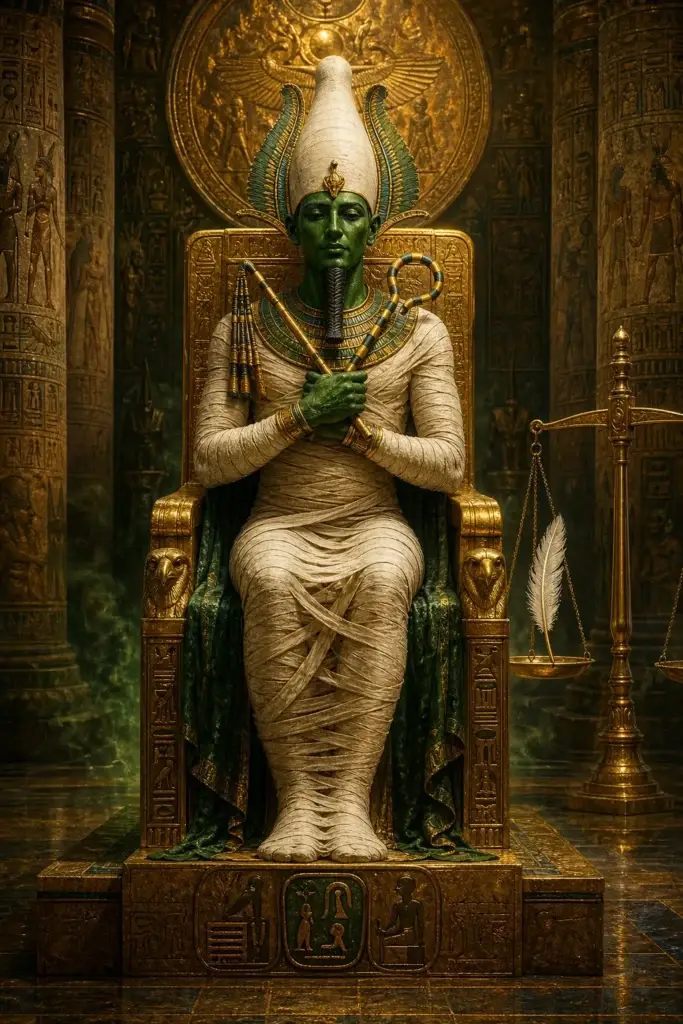
In Egyptian representations, Osiris is shown as a mummified human being, a mummified king in the full exercise of his sovereignty. He wears the Atef crown, a tall conical headdress with ostrich feathers at the sides (a symbol of dominion).
His body is tinted greenish or black: green for vegetation and fertile earth, black for the fertile silt of the Nile or for mourning.
The skin is partly textured or lined like a mummy’s. His hands are crossed and hold Heka (crook or shepherd’s staff) and Nekhakha (flail), symbols of pharaonic rule. From his loins springs a wheat stalk or a lotus stem, signs of his resurrection and of his role as a vegetation deity.
Nature and Activity
Osiris represents the hope of resurrection and eternal life. Unlike other gods of the dead, he himself has been resurrected, through the magic and love of his wife Isis. This makes him the model for every deceased person.
In the kingdom of the dead (Duat), Osiris sits enthroned and presides over the Hall of the Two Truths, where the hearts of the deceased are weighed against the feather of justice (Maat).
He is a just, loving, but also stern judge, and by no means a figure of malice or damnation. His dismemberment and restoration also make him a symbol of the dying and becoming of all nature.
Appearance and Symbolism
Osiris is depicted as a mummified figure with green or black skin: green for fertility and renewal, black for the fertile Nile silt and the realm of the dead. He wears the Atef crown and holds the sceptre of right (crook and flail, the tools of royal authority and of harvest).
His body is fully wrapped in mummy bandages, while his face remains uncovered. The green or black colour underlines his liminal position between life and death.
Profile: Osiris
The most important aspects of Osiris at a glance. The table summarises his origin, function, appearance, veneration, symbols and parallels.
Son of Geb (Earth) and Nut (Sky), one of the five creative children that arise in the Heliopolitan cosmogony. As the eldest son, he received rulership over Egypt from his father.
His brother Seth, envious of his power and of his wife Isis, killed him, a motif of the cosmic tension between order (Maat) and chaos (Isfet).
Ruler of the realm of the dead (Duat), judge of the deceased in the Hall of the Two Truths. Guarantor of resurrection after death.
At the same time god of vegetation and of fertility; his annual dying and rising symbolises the Nile flood cycle and the harvest. Every pharaoh becomes an Osiris in death; every pious Egyptian hopes for a resurrection akin to that of Osiris.
Mummified king with the Atef crown, crossed hands holding Heka and Nekhakha, green or black skin. Often enthroned or reclining. The Djed pillar, his symbolic spine, is an independent identity amulet.
Veneration of Osiris
Principal cult centre: Abydos, with annual pilgrim mysteries and festivals. Further sanctuaries existed at Busiris, Memphis and Philae. Osiris is honoured through private devotions and amulets (especially the Djed pillar).
Offerings: grain (emmer, barley), honey, wine and bread. Tombs were often equipped with hieroglyphic amulets and Osirian hymns. Kings and wealthy private individuals were buried with Osirian accoutrements in order to secure their resurrection.
Symbols of Osiris
Anubis (Egyptian, though guide and priest rather than ruler of the afterlife), Hades (Greek, ruler of the underworld but without the resurrection aspect), Sarapis (syncretism), Adonis and Tammuz (dying and rising vegetation gods), Dionysos (mystery cult) and Yamaraja (Indian, judge of the dead).
The Myth: Dismemberment and Resurrection
The Osiris myth is the central Egyptian myth of creation and redemption. Its basic outline is already attested in the Pyramid Texts, but its richest depiction appears in the Coffin Texts and the Book of the Dead.
The murder: Osiris becomes king of Egypt and marries his sister Isis. His brother Seth, envious of his power and obsessed with Isis, plans the destruction of Osiris.
He arranges a banquet, at which he presents a beautifully decorated sarcophagus and promises to give it to whoever fits exactly inside. When Osiris steps inside, he is locked into the sarcophagus by Seth and his accomplices and thrown into the Nile.
The search of Isis: Isis grieves and searches all of Egypt for her husband and finally finds the sarcophagus entwined in a tamarisk tree at Byblos. She brings the sarcophagus back to Egypt and hides it in a thicket of the Delta.
The dismemberment: Seth discovers the sarcophagus and, in revenge, dismembers the body of Osiris into fourteen parts and scatters them across the country (or, in some versions, into sixteen parts).
The reassembly: Isis, together with her sister Nephthys, sets out to collect all the parts. At each place of discovery, a sanctuary or a statue was erected. The body is reunified and mummified through the magic of Isis and Anubis (the guide); this is the first mummification, the model for all later Egyptian burials.
The resurrection: Through the magical spells of Isis, Osiris is temporarily revived, just long enough to beget the son Horus with Isis.
Osiris then ascends his eternal throne in the underworld and becomes the ruler of the dead and the guarantor of their resurrection. Horus grows up, fights his uncle Seth and secures the kingdom of his father.
Parallels in Other Cultures
Greek tradition
Hades shares with Osiris the rule over the dead, but is less a god of resurrection. Dionysos shares with Osiris the aspect of rebirth and of the mystery cult; both experience a death and a rebirth in a ritual sense.
Mesopotamian tradition
Nergal and his consort Ereshkigal rule over the realm of the dead (Kur), in a manner similar to Osiris and Isis. The Inanna descent motif (Inanna’s descent into the underworld and her renewal) has structural parallels to Osiris’s dismemberment and resurrection.
Levantine and Anatolian tradition
Adonis (Phoenician/Syrian) and Tammuz (Babylonian-Sumerian) are dying and rising vegetation gods, comparable to the resurrection aspect of Osiris. All three represent the cycle of fertility and decay in nature.
Germanic tradition
Baldr, the beautiful god in Norse mythology, is likewise killed by deceit and (with one exception) cannot return, a contrast to Osiris, whose resurrection is assured.
Hindu tradition
Yamaraja is the judge and ruler of the dead, but does not share the resurrection myth of Osiris. In Indian thought, resurrection takes place through reincarnation, not through the restoration of a body.
Christian tradition
The parallels between Osiris and Jesus are historically contested. Modern scholars are sceptical of direct “influences,” but structural similarities do exist: a passion narrative, resurrection, and ritual remembrance through mystical participation (the Eucharist, the Egyptian mysteries).
The Osiris Myth according to Plutarch and the Egyptian Sources
The coherent Osiris myth, as it is most often retold today, comes in its most extensive form not from Egypt itself but from the treatise De Iside et Osiride by the Greek author Plutarch, written in the early second century CE. The Egyptian sources, from the Pyramid Texts of the third millennium to the temple inscriptions of the Late Period, usually presuppose the myth as known and allude only to individual episodes.
According to Plutarch, Osiris was a king who brought agriculture, laws and the veneration of the gods to Egypt. His brother Seth, driven by envy, lured him into an elaborately crafted chest, had it sealed and cast into the Nile.
Isis, sister and wife of Osiris, searched for the body and finally found it. Seth, however, dismembered the body into fourteen parts and scattered them across all of Egypt. Isis gathered the parts, and with the help of Anubis and Thoth, Osiris was embalmed and revived, long enough to beget the son Horus with Isis.
The Egyptian sources confirm the basic outline but diverge in detail. The number of body parts varies, and the list of places where they were found is connected with local cult sites, each of which claimed to possess one member of Osiris.
Abydos was considered the place of burial of the head or of the whole god and became the most important Osirian cult site.
Scholarship, for instance Jan Assmann, emphasises that the myth was not merely a story, but the foundation of the Egyptian conception of the afterlife.
Osiris becomes the ruler of the realm of the dead, and every deceased person hopes to share in his fate. Those who wish to follow the fraternal conflict further will find the opposing parties at Seth and Horus.
Osiris and the Judgment of the Dead
At the centre of Egyptian hopes for the afterlife stands the idea of the judgment to which every deceased person must submit. Osiris is the presiding officer of this judgment.
The most elaborate pictorial representation is found in the New Kingdom Book of the Dead, especially in the famous vignette to spell 125, the so-called negative confession.
In this scene, the heart of the deceased is weighed on a scale against the feather of Maat, which embodies truth and cosmic order.
Anubis operates the scale, Thoth records the result, and a composite creature named Ammit, a devourer, lies in wait to consume the heart of any who are condemned. Osiris is enthroned at the end of the scene and receives the justified into his realm.
Before the judgment, the deceased recites the negative confession, a list of offences which he claims not to have committed. This confession is an important source for Egyptian ethics, because it shows which behaviours were regarded as reprehensible: lying, theft, violence, the displacement of boundary stones, the withholding of offerings.
The deceased who passes the judgment is called maa-cheru, roughly translated as “true of voice” or “justified.” He is thus regarded as an Osiris, meaning that he shares in the fate of the god who overcame death.
For this reason, deceased persons in New Kingdom and Late Period inscriptions often carry the name Osiris before their own.
Scholarship sees in this the democratisation of the conception of the afterlife: what in the Old Kingdom was reserved above all for the king became later accessible to every Egyptian who possessed the necessary rites and texts.
The Mysteries of Abydos and the Festivals of Osiris
For more than two millennia, Abydos in Middle Egypt was the most significant cult centre of Osiris. Here lay the tomb of King Djer of the First Dynasty, which in later times was interpreted as the tomb of Osiris himself and became the destination of numerous pilgrims and votive offerings.
From the Middle Kingdom, the so-called Osiris mysteries of Abydos are attested, a multi-day festival that re-enacted the death, search, recovery and triumph of Osiris in ritual form.
A central source for this is the stela of Ikhernofret, an official of Senusret III, who reports that on the king’s behalf he equipped the festival processions and took part in several ritual acts. The stela mentions a procession of the divine bark and an event interpreted as a battle or confrontation.
Another characteristic element of the Osirian cult was the Osiris figures made of earth and grain, the so-called grain Osirises. In temples, moulds were filled with fertile earth and grains of cereal and moistened so that the grains sprouted.
The germinating seed in the form of the god made the idea of revival directly visible. Such grain mummies were placed in tombs and have survived archaeologically in considerable numbers.
The great annual Osiris festival in the month of Khoiak combined the agricultural year, the Nile flood and myth.
Scholarship emphasises that in Egypt Osiris was never merely a god of the dead, but remained just as closely tied to the recurring growth of plants and to the life-giving inundation. This twofold meaning, death and renewal, constitutes the core of his cult.
Iconography and Material Culture of Osiris
Osiris is one of the most readily identifiable Egyptian gods, because his depiction remained remarkably consistent over long periods.
He appears as a mummiform figure, tightly wrapped, with only the hands free to hold crook and flail, the insignia of kingship. On his head he wears the Atef crown, a tall white crown flanked at the sides by feathers.
His skin is frequently depicted as green or black. Both colours are charged with meaning: green refers to vegetation and new life, black to the fertile silt of the Nile and at the same time to the realm of the dead.
Scholarship sees in this choice of colour the immediate expression of the god’s mythological dual nature.
A central symbol of Osiris is the Djed pillar, a pillar with several horizontal bars at the upper end. It is regarded as the backbone of Osiris and as a sign of duration and stability.
The ritual raising of the Djed pillar, attested in temple scenes, symbolised the raising up of the god and thus the victory over death. Djed amulets are among the most common finds in Egyptian tombs.
Materially, the Osirian cult is tangible through a large number of Late Period bronze statuettes that worshippers deposited as votive offerings in temples. Added to these are the grain mummies mentioned above, the stelae from Abydos and countless sarcophagi and papyri with depictions of Osiris.
This abundance of objects makes Osiris one of the archaeologically best documented gods of Egypt and allows the development of his cult to be traced across nearly three millennia.
Osiris in the Graeco-Roman World and his Afterlife
With Greek and Roman rule over Egypt, the Osirian cult spread beyond the borders of the Nile valley. A key role was played by the figure of Serapis, a deity promoted in the Ptolemaic period, who combined features of Osiris with Greek conceptions.
Serapis, and above all Isis, found adherents throughout the Mediterranean world, and with them the conception of Osiris also travelled.
In the Isis mysteries of the Roman imperial period, of which the novel Metamorphoses by Apuleius provides a literary impression, Osiris was present as ruler of the beyond.
Sanctuaries for the Egyptian gods have been documented archaeologically from Britain to the Black Sea. Scholarship debates how far the originally Egyptian content was understood or reinterpreted in the process.
Plutarch’s treatise De Iside et Osiride is not only a source for the myth, but also a witness to its ancient interpretation. Plutarch read the myth philosophically and allegorically, as a confrontation between ordering and destructive forces. This allegorical reading shaped the European image of Osiris into the modern era.
With the decipherment of the hieroglyphs by Jean-François Champollion in the early nineteenth century and the growth of Egyptology, Osiris once again became a culturally effective figure. He appears in Freemasonry, in the esotericism of the nineteenth century and in modern popular culture.
From a religious-studies perspective it is important to distinguish between the historical Osiris of the Egyptian sources and the manifold later appropriations that claimed him as a symbol of rebirth, secret knowledge or immortality.
Research Literature
Frequently Asked Questions about Osiris
Who was Osiris in Egyptian mythology?
Osiris (Egyptian Wesir) was the Egyptian god of the afterlife, of rebirth and of vegetation, one of the central divine figures of Egyptian religion.
In the Osiris myth he is king of Egypt; he is murdered and dismembered by his brother Seth, and his sister-consort Isis gathers his limbs and revives him sufficiently to conceive their son Horus by him.
Osiris thereupon becomes ruler of the afterlife. Every deceased pharaoh was placed into the sarcophagus as an Osiris and given the Osirian epithet.
What is the symbolism of Osiris dying and rising again?
The Osiris myth is one of the oldest documented dying-and-rising narratives in the history of religion. It has archetypal parallels to Adonis, Tammuz, Dionysos and, in Christianity, to Jesus Christ, all of them dying and rising deities connected with cycles of vegetation and of the year.
In the Pyramid Texts and in the Book of the Dead, the deceased is identified with Osiris in order to share in his resurrection. The annual flood of the Nile was regarded as the tears of Osiris, death and renewal of life in a single image.