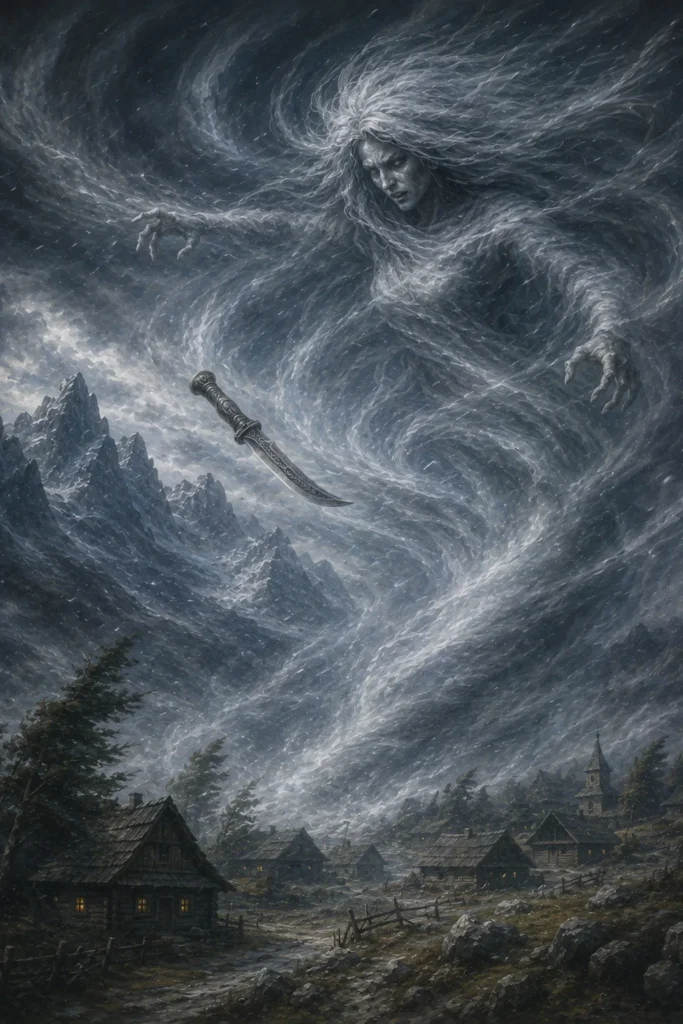
Upiór, the undead with the two hearts
By Ralf Ittermann · last reviewed on
Upiór is demon of Polish tradition.
Two hearts in one body: the root of the word vampire.
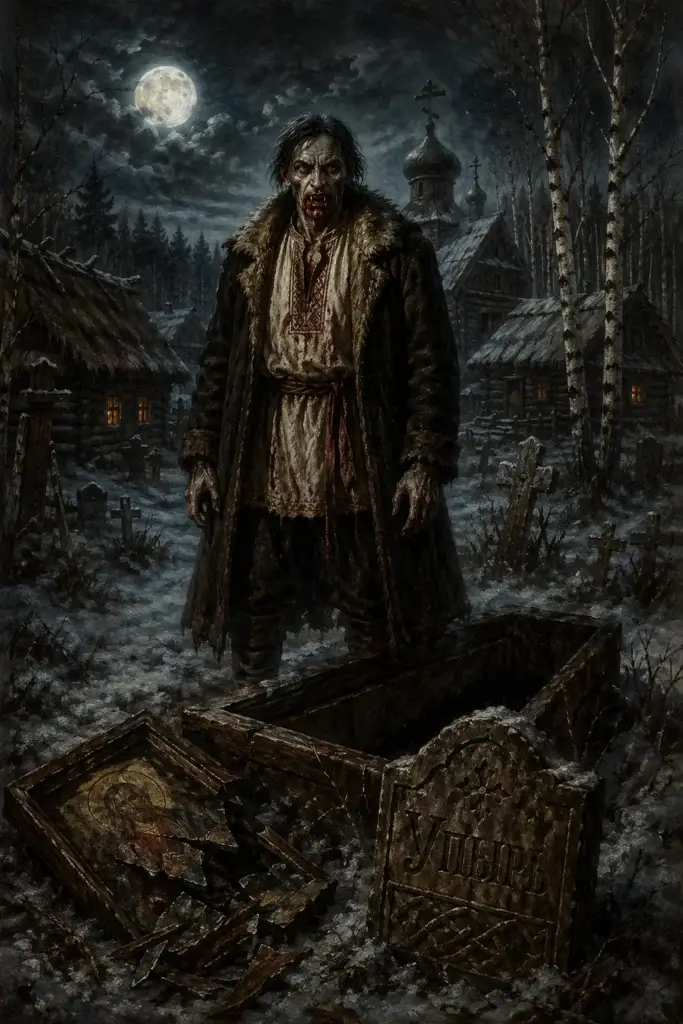
Upiór is the bloodthirsty undead of West Slavic-Polish tradition and the linguistic root of the very word vampire. Anyone born with two hearts or two souls, or who died a sudden, unnatural death, for example as a suicide, a plague victim or an unbaptised child, becomes an Upiór.
Animated by its own restless second soul, it rises from the grave at night and drains the blood and life force of the living. Its hallmark remains the dual nature: two hearts or two souls, and in some accounts a double row of teeth.
Type: Bloodthirsty revenant and word origin of the vampire
Origin: West and East Slavic folk belief surrounding the bad death
Texts: studies by Perkowski, Barber, Summers and McClelland
Period: West and East Slavic tradition, one of the oldest vampire words
Appearance: revived corpse with two hearts or two souls, sometimes a double row of teeth

Context of the tradition
Period of the Texts
West and East Slavic tradition: the word is among the oldest vampire terms in the Slavic linguistic area.
Area of Diffusion
Poland and the entire West and East Slavic region, with linguistic relatives extending into Czech and Russian.
Sources
Good: the foundational studies by Perkowski and Barber, along with Summers and McClelland.
Name and variants
Proto-Slavic: ǫpyrь is the root, related to the Czech upír, the Russian upyr and the Serbo-Croatian vampir, the linguistic origin of the Western European word vampire. A common interpretation of the root is ‘one who pushes or bites’. The Polish form is Upiór, alongside also wąpierz.
Appearance
Appearance
A distinguishing feature of the Upiór is its dual nature of two hearts or two souls, sometimes also a double row of teeth: one soul is said to pass on, while the second remains behind and animates the bloated, blood-filled corpse.
Effect
The Upiór steals blood and life force and is considered in many traditions to be especially bloodthirsty and aggressive. It rises from the grave at night and haunts the living.
Profile: Upiór
The key aspects of the undead being with two hearts at a glance.
West and East Slavic folk belief concerning the bad death, with Poland as the core region of the tradition.
The living in general: the Upiór haunts people at random during the night to steal their blood and life force.
A bloated, blood-filled corpse, marked by two hearts or two souls, sometimes a double row of teeth.
An especially aggressive blood-drinker, driven by the second, restless soul that remained in the corpse.
Decapitation with the head placed apart from the body, staking, burning the corpse, and filling the mouth with earth or garlic.
Two hearts, one restless soul
Upiór, also wąpierz, derives from the Proto-Slavic ǫpyrь, with relatives in Czech upír, Russian upyr, and Serbo-Croatian vampir; the Western European word vampire is thus linguistically cognate with it. The origin of the root is unexplained.
One becomes an Upiór by being born with two hearts or two souls, or by dying a sudden, unnatural death, for example as a suicide, a victim of plague, or an unbaptised child. One soul is said to pass on, while the second remains behind and animates the corpse. Closely related is the Polish Strzyga, who is likewise born with two souls, hearts, or rows of teeth.
Origin of a world word
As the linguistic origin of the term vampire, the Upiór is central to the whole of Western vampire culture. It is present in Polish literature, including the work of Adam Mickiewicz, and in modern popular culture.
From a religious-studies perspective, the Upiór is a classic case of the bad death: sudden, unnatural, unbaptised, linked to the idea of a soul not fully separated from the body. The two-soul motif is considered a possible remnant of pre-Christian Slavic beliefs about the soul.
Decapitation and concern for proper burial
Well documented are decapitation with a blade of cold iron, preferred in the West Slavic and German-Slavic regions, with the head placed apart from the corpse, along with staking, using aspen in Russia and otherwise hawthorn or oak, as well as burning the corpse. The mouth was filled with earth or garlic, some of the dead were buried face down, and for people born with two hearts, special precautions were already taken at the actual burial.
In Slavic folk belief generally, garlic and salt served to protect house and grave, as everyday means of defence against the restless dead.
The origin of the vampire in comparison
The Upiór is the West Slavic counterpart to Strigoi and Moroi, to the Greek Vrykolakas and the South Slavic Vukodlak, and at the same time the linguistic ancestor of the word vampire itself. Within the Germanic-Nordic sphere, it is comparable to the Nachzehrer and the Gjenganger.
Frequently asked questions about the Upiór
Why does the Upiór have two hearts?
The dual nature of two hearts or souls explains why one soul remains in the corpse and animates it as a vampire.
Is Upiór the same as a vampire?
Yes, linguistically they are cognate: the word vampire comes from the same Slavic root as Upiór.
How does one get rid of it?
Through decapitation, staking, burning the corpse, garlic, and proper burial.
Further links
Literature (selection)
Further standard works in the bibliography.
As a Polish vampire, elsewhere also spelled upier, the Upiór is more than a regional figure: its name is embedded in the word vampire itself, making it the linguistic root of the entire vampire concept.