Khnum, ram-headed creator god of Egypt
By Ralf Ittermann · last reviewed on
Khnum is a ram-headed Egyptian creator god who forms humans and their vital force on his potter’s wheel. Khnum is among the oldest gods of Egypt and holds the position of a ram-headed creator within the theological tradition.
His name “Khnum” (also Khenmu, Chnoubis among the Greeks) derives from the verb “khnem” (“to join, to unite”) and points to his function as a creator who joins the limbs of the emerging being together on the potter’s wheel.
Khnum is the potter god in the precise sense: on the turning wheel he forms not only the human body but also the “ka”, the invisible giver of life that every being receives before its birth.
His most important cult site is Elephantine near Aswan, where he governs the rise of the Nile flood; in the late-period sanctuary of Esna he assumes a cosmogonic central position as the self-existent creator of all beings.
Myth and Lineage
Khnum is among the oldest Egyptian gods. His worship is attested since the Old Kingdom; on the Narmer Palette (around 3100 before our era) there is possibly already a ram’s head present that can be attributed to Khnum.
In the Pyramid Texts Khnum appears as the potter who “forms” the deceased king and provides him with his limbs (Spell 522). This early attestation shows that the connection of Khnum with the creation of the human body was already pronounced in early times.
Khnum’s consort is a different goddess depending on the local cult. In Elephantine he forms a triad with Satet (the bow goddess) and Anuket (the gazelle goddess); Satet and Anuket are the personified rushing waters that release the Nile water from the first cataract.
In Esna, Khnum’s consort is Neith or Menhit, the lion-headed war goddess; with her he begets the son Heka, the personification of magical power. In Antinoe it is Heqet, the frog-headed goddess of birth, who was regarded as Khnum’s consort and carried out the act of creation with him.
Khnum appeared in four theological aspects that were systematically worked out in the late-period theology of Esna. He was Khnum-Ra (solar being), Khnum-Shu (air being), Khnum-Geb (earth being) and Khnum-Osiris (being of the depths).
These four aspects are not four different gods, but four manifestations of the same Khnum that act over the course of the day and in the four parts of the world. The Esna temple shows this fourfoldness on the walls of its hypostyle hall as the theological core program of the city.
Khnum’s son in Esna is Heka; in Elephantine these are not the bodily sons, but the sanctuary sub-deities connected with Satet and Anuket.
In late-period theology Khnum also appears as the father of the king: on the potter’s wheel he forms not only the human body of the king but also his “ka”, the divine giver of life.
This process is shown in impressive reliefs on the temple walls of Hatshepsut’s mortuary temple at Deir el-Bahari and in the temple of Amenhotep III at Luxor: Khnum at the turning wheel, facing the queen, forming the emerging royal countenance.
Symbols, Iconography and Attributes
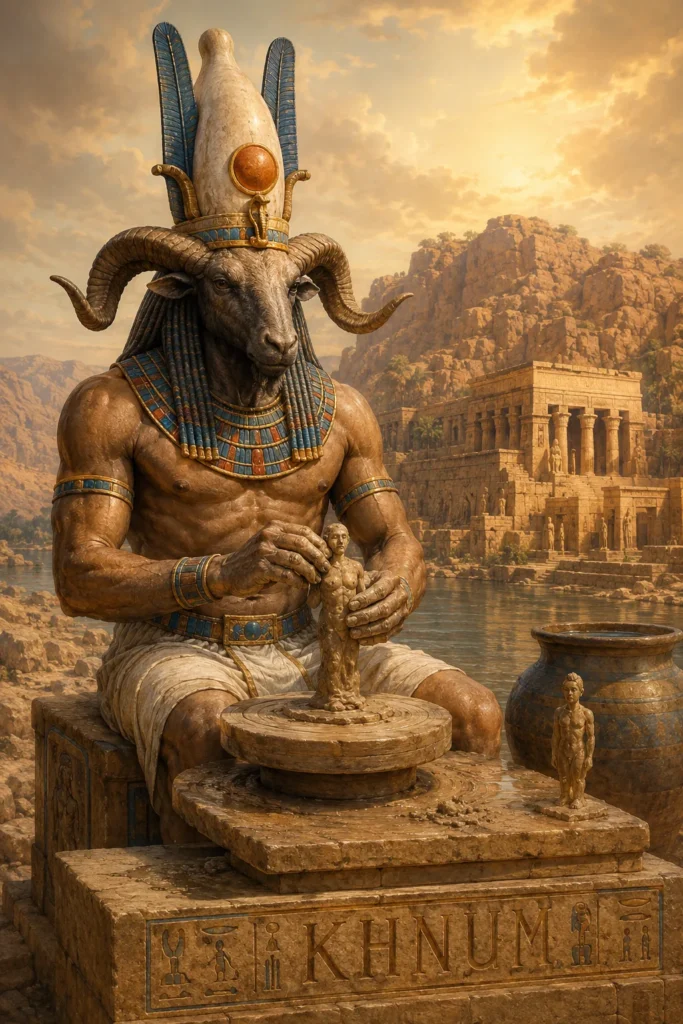
Khnum is typically depicted as a man with a ram’s head. The ram is the wool-bearing ram of the Nubian “ovis longipes”, whose long, twisted horns project horizontally. This horn shape distinguishes Khnum from Amun, who has the ram with downward-pointing horns (ovis platyura).
The differentiation of the ram forms is instructive for the history of religion, because it shows that Khnum is connected with the older, originally southern Nubian sheep breed, while Amun is identified with the later, differently horned ram.
On his head Khnum often wears the atef crown, sometimes the tall feather crown with sun disk, which marks his cosmic dimension. In the Esna texts he also appears with the four ram heads of the four aspects at once; this four-headed depiction is attested in the late-period sanctuary and represents a theological speciality.
His most important attribute is the potter’s wheel on which the emerging beings are formed. Reliefs in Esna, Luxor and Deir el-Bahari show Khnum at the turning wheel forming a small human (or the “ka” of the emerging child); before him lies the finished product, often a double figure (human and ka).
His sacred animal is the ram, which was kept in the temples and mummified after death. In Elephantine a ram necropolis has been found in which hundreds of mummified animals were buried.
On the temple grounds of the late period, dedicated ram stable complexes were built in which the sacred animals were cared for by their own priests.
Sculptural images of Khnum survive from the Middle Kingdom onward. From the New Kingdom comes a significant statue of Amenhotep III with a Khnum connection, which is kept in the Luxor Museum. From the late period numerous smaller bronze statues survive.
On the temple walls of the Esna temple (predominantly Roman imperial period) Khnum is depicted several times in fully figured form, with detailed rendering of the woolly ram hair and the twisted horns.
Cult and Worship
The oldest and most important Khnum cult is that of Elephantine, the southernmost island of the Egyptian Nile valley at the first cataract. Here lay the temple plot on which the sanctuary is verifiable since the Old Kingdom and which was expanded several times in the Middle and New Kingdoms.
The German-Swiss mission, active since the 1960s, has systematically excavated the sanctuary and has been able to verify temple buildings from the early period, the Middle Kingdom, the New Kingdom and the late period.
The stelae and inscriptions show that on Elephantine Khnum governed the “first cataract” and thereby steered the rise of the annual Nile flood.
The second major cult site is Esna (ancient Latopolis), about fifty-five kilometers south of Thebes on the west bank of the Nile.
The temple of the Roman imperial period, today almost completely preserved (with the temple halls erected under Tiberius, Claudius, Vespasian, Domitian, Nerva, Trajan, Hadrian, Antoninus Pius up to Septimius Severus), is one of the most monumental Khnum sanctuaries of Egyptian religion.
The pronaos (entrance hall) is covered with extensive theological hymns; the columns bear the four theological aspects of Khnum in elaborate formulation.
On Khnum’s feast days special rites were carried out. The most important festival was the “potter’s ship festival”, in which a small model ship with the image of Khnum was carried through the temple courts. The ritual recalled the constant creative activity of the god and symbolically represented the annual repetition of creation.
In Esna a special “victory rite” was performed at the New Year festival, in which the image of the Apophis serpent was made of wax and burned, a practice connected with the Esna theology of preserving the world through daily renewed creation.
The hymns from the Esna temple, found and edited by Serge Sauneron (six volumes, 1962 to 1975), are among the theologically most profound texts of late-period Egyptian religion.
They treat Khnum as the one who was “before the beginning”, who “formed all gods and humans from clay” and who “blows the breath of life into the nose” of every being.
The parallel to Genesis 2:7 is striking, without a direct influence having to be assumed; the agreement in motif points to a wide-ranging ancient Near Eastern topos of creation from clay through divine breath.
Important Sanctuaries and Temples
The temple of Elephantine survives only in remnants, yet the German-Swiss mission has reconstructed the layers of the various building phases in detail.
An important element was the older Khnum shrine from the Middle Kingdom, built under Senusret I. In the New Kingdom Thutmose II and Hatshepsut expanded the temple; in the late and Ptolemaic period it was developed further once more.
On the island there is also the famous “Famine Stele” concerning King Djoser (Ptolemaic period), which addresses the annual Nile flood mythology and Khnum’s role in it.
The Esna temple is the main monument of the Khnum cult and one of the best-preserved Egyptian temples of all. It lies more than nine meters below the current street level, which has contributed to its preservation.
The building phase extended from Ptolemy VI to Decius in the third century of the Christian era; this makes Esna the last Egyptian temple still expanded in late antiquity.
The columned hall (pronaos), with its twenty-four columns and richly decorated ceiling, is the most impressive part of the structure. On the ceilings are astronomical depictions, on the walls theological hymns, on the columns the royal offering reliefs.
A third cult site is Antinoe (Antinoopolis) in Middle Egypt, which emerged from the city founded by Hadrian for Antinous. Here Khnum was worshipped together with Heqet as a goddess of birth. The archaeological remains are fragmentary, yet numerous inscriptions and stelae attest to the significance of the cult in the Roman imperial period.
In the Nubian region, south of the first cataract, lay the temple of Bigge, which was consecrated to the nearby island of Philae; there too Khnum played an important role as a water god.
Further Khnum chapels are located in Karnak (in the court of the temple of Amun-Ra), in Deir el-Bahari (in the mortuary temple of Hatshepsut), in Luxor (in the birth chamber of Amenhotep III), in Edfu (in the birth house of Horus, the mammisi) and in many smaller sanctuaries along the Nile valley.
In all Ramesside mortuary temples Khnum is depicted as the creator of the royal ka; these reliefs are the most important source for the iconography of the act of creation on the potter’s wheel.
Mythological Narratives
The central Khnum myth is the creation of humans on the potter’s wheel. In the Esna hymns this act is described in detail: Khnum takes clay from the bank of the Nile, forms from it the body of the emerging human, completes each limb with care, finally the lips, the tongue and the hearing.
Then he takes the divine breath from the hand of the goddess Heqet (or, in another variant, from his own hand) and blows it into the nose of the creature; with this breath the human is brought to life. The birth of every child is the repetition of this original act of creation.
The Famine Stele from the island of Sehel, presumably a Ptolemaic creation with a retro-projection into the third millennium before our era, describes a seven-year drought under King Djoser that Khnum had caused because his sanctuary was neglected.
The king turned to Khnum in a dream; the god appeared and promised the restoration of the Nile flood, provided that his temple was rebuilt and the sanctuary endowed with land.
This stele served as the legal basis for the privileges of the Khnum temple of Elephantine and at the same time shows the theological notion that the Nile flood is steered by Khnum.
In the myth of the royal birth, Khnum is the one who transforms the divine father (Amun-Ra) into the emerging royal embryo on the potter’s wheel. This motif is depicted in detail in the “birth chambers” (mammisis) of the Ptolemaic temples of Edfu, Dendera and Philae.
In the birth chamber of Hatshepsut at Deir el-Bahari the oldest such depiction survives: Khnum at the turning wheel, Heqet beside him, the emerging royal child and its ka as a double figure.
The theological statement is clear: the king is not merely begotten by his parents, but formed from divine substance by Khnum and Amun-Ra together.
In the Esna hymns there is also a cosmogonic narrative in which Khnum is presented as the creator of all beings. He is said to have formed humans of all skin colors from various kinds of clay, the animals from other materials in each case, the plants from root substances.
This expanded theology of creation is remarkable for the history of religion, because it explains the ethnic diversity of humanity theologically without ordering it hierarchically.
Relationships within the Pantheon
Khnum stands in complex relationships with other Egyptian gods. With Ra he forms the double form Khnum-Ra, which in late-period theology emphasizes the creator element of the sun god.
With Amun he occasionally merges into Amun-Khnum, especially in Thebes; with Ptah, the Memphite creator god, there is a philosophical complementarity: Ptah thinks and plans, Khnum forms and carries out; with Atum, the Heliopolitan creator, he shares the function of the primeval god, with Atum creating through self-generation and Khnum through workshop labor.
With Satet and Anuket he forms the Elephantine triad. Satet is the archer who “sprays” the flood water, Anuket the personification of the wild stretch of river below the cataract. Both goddesses are worshipped together with him.
With Neith in Esna, Khnum shares the function of creation, with Neith embodying the “when” (time, movement) and Khnum the “what” (form, matter) of creation. With Heqet, the frog goddess of birth, Khnum carries out the act of birth of every human.
With the pharaoh there is a special relationship. Khnum is the actual bodily creator of the royal body and of the royal ka. At every change of king, the new ruler is depicted as formed by Khnum, animated with the breath of the gods and endowed with royal dignity.
This theology makes the royal birth a theologically high-ranking event that is celebrated in detail in the temple reliefs of the mammisi.
Reception
In Greco-Roman antiquity Khnum was identified with the Greek Kronos, because both were regarded as old creator gods. Plutarch (“De Iside et Osiride” 56) mentions Khnum as the “potter of the gods”. The identification with the Hermetic “demiurge” is attested in the late Hermetic texts and in the Hibis temple of the Kharga Oasis.
The magic of late antiquity knows a “Chnoubis”, a serpent with a lion’s head and seven rays that appears on healing amulets especially against stomach ailments; it is connected with Khnum through name and iconography, but developed into an independent healing being.
With the end of the pagan temple cult in the fifth and sixth century of the Christian era, the living Khnum cult disappeared. The Coptic tradition knew echoes in the notion of God as creator of the human from earth, which is connected with Genesis 2:7; whether a direct Khnum tradition persists here is disputed.
In the Middle Ages, Arab travelers reported on the abandoned temple remains in Esna and Elephantine; the memory of Khnum as a potter god survived occasionally in Coptic folklore.
The modern rediscovery of the Khnum cult begins with Champollion’s first publications on Esna, followed by the German-Swiss excavations on Elephantine since the 1960s. Sauneron’s Esna editorial work (1962 to 1975) is one of the most thorough religious-historical investigations of an Egyptian temple.
Erik Hornung analyzed Khnum’s position in Egyptian theology in “Conceptions of God” and in the “Valley of the Kings” series. In the more recent research of Daniel von Recklinghausen and Christian Leitz, Khnum has been worked out in detail as a model case of a late-period theological principal deity.
Religious-Studies Classification
Khnum belongs to the category of potter gods who in many religions bring forth the creation of humans from clay.
Comparable notions are found in the Sumerian Enki, who forms the human from clay; in the Hebrew creation account (Genesis 2:7), in which Adam is formed from earth and animated by God’s breath; in the Greek Prometheus myth, in which humans are formed from clay; in the Vedic Tvaṣṭṛ, who forges living beings; and in the Chinese Nüwa myth, in which the creator goddess forms humans from yellow clay.
This convergence shows a universal topos that appears in numerous cultures independently or through diffusion.
The theological particularity of Khnum lies in the differentiated conception of the “ka”, the vital force that is formed and animated in parallel with the body.
This Egyptian notion is striking for the history of religion, because it provides a clear concept of an immortal component of life that is connected with the body but can also exist independently.
The later Greek notion of the psyche and the Christian notion of the soul have structural similarities, without being directly derived from the Khnum-ka concept.
In his works on the Egyptian “creator topos”, Jan Assmann identified Khnum as a model case of a “craft-based” theology of creation. While the Heliopolitan tradition describes Atum as self-generating and the Memphite tradition Ptah as a thinking creator, the Khnumite tradition shows the creator as potter and craftsman.
These three concepts do not stand in competition, but illuminate different aspects of the same divine creative activity. In “Der Eine und die Vielen”, Erik Hornung emphasized that Egyptian religion knows no single creator, but many local manifestations, whose theological diversity constitutes the religious depth of Egyptian culture.
Sources
Pyramid Texts, Spell 522 and 660 (Khnum as fashioner). Esna temple inscriptions, edition Serge Sauneron, six volumes, Le Caire 1962 to 1975. Famine Stele of Sehel, edition Paul Barguet. Birth chamber in Deir el-Bahari, edition Édouard Naville. Mammisi reliefs of Dendera and Edfu, edition François Daumas.
Strabo, “Geographika” XVII, 1, 47 (Elephantine); Plutarch, “De Iside et Osiride” 56. Henri Frankfort, “Kingship and the Gods”, Chicago 1948. Erik Hornung, “Der Eine und die Vielen”, Darmstadt 1971. Jan Assmann, “Ägypten. Theology und Frömmigkeit einer frühen Hochkultur”, Stuttgart 1984. Christian Leitz (ed.), “Lexikon der ägyptischen Götter und Götterbezeichnungen”, Leuven 2002 to 2003.