Diana, Roman goddess of the hunt and the moon
By Ralf Ittermann · last reviewed on
Diana is the Roman goddess of the hunt, the moon and the wild forests. She protects women in childbirth, animals in the woodland and travellers on unpaved paths.
Her ancient main cult lay in the grove of Nemi by Lake Nemi, a sanctuary that was regarded as the federal sanctuary of the Latin cities even before the Roman state had formed.
Later Diana was largely identified with the Greek Artemis and, in this fusion, was considered the sister of Apollo and the daughter of Jupiter and Latona.
Profile: Diana
Diana: the most important aspects at a glance. The following fields summarise origin, function, appearance, veneration, symbols and parallels.
Diana had her oldest cult in the grove of Nemi, the federal sanctuary of the Latin cities, where she was worshipped as Diana Nemorensis. In the oldest Italic layer she was goddess of wild nature, springs and female maturity. Under Servius Tullius she entered the urban religion with a temple on the Aventine.
Diana is the goddess of the hunt, the moon and the wild forests. She protects women in childbirth, animals in the forest and travellers on unpaved paths. At the same time she is regarded as mistress of animals, spring deity and protectress of herds.
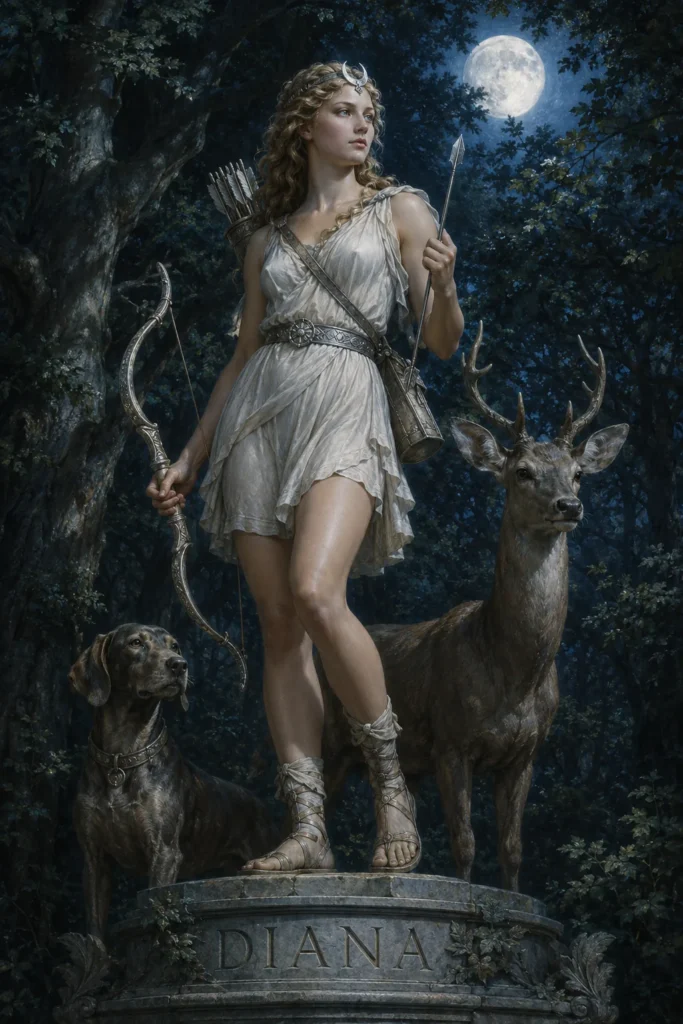
Diana usually wears a short, hitched-up garment and sandals and is often out with a dog or deer. Bow and arrows mark her as a huntress, a crescent over the forehead or in the hair as a goddess of light. To this is added the torch.
The sanctuary at Nemi was the most influential rural cult; thousands of clay votive offerings show women with children, pregnant figures and animals. In Rome her temple stood on the Aventine, where on 13 August the Servatorius was celebrated, on which slaves were not to be forced to work.
Bow and arrows, crescent and torch are her central signs. Companions are dogs, deer, roe deer and, more rarely, bears; snakes point to healing springs. As votive offerings served a wreath of wild olive branch and clay figures of pregnant women.
Diana was identified with the Greek Artemis and is regarded as the sister of Apollo. With Luna, Hecate and Trivia she often merges into a multiform figure. In the provinces she was linked with local goddesses, for example as Diana Abnoba in the Black Forest and Diana Arduinna in the Ardennes.
Myth and origin
The name Diana is traced in linguistic history to an Indo-European root meaning “shining” or “heavenly bright”. This accounts for the close connection to the moon and to daylight. In the oldest Italic layer, Diana was a goddess of wild nature, of springs and of female maturity.
Only through the religious reform under Servius Tullius was she taken into the urban religion, when a temple of Diana was built on the Aventine that was at the same time meant to serve as the federal sanctuary of the Latin cities.
This political function was a deliberate gesture by which Rome asserted precedence over the other Latin communities.
The oldest Roman cult centre, however, lay at Nemi, a volcanic crater lake in the Alban Hills. Here the Latins venerated Diana Nemorensis, the mistress of the grove.
Cato already reports on the importance of this sanctuary, and Strabo describes the unusual priestly ritual in which the officiating priest, the Rex Nemorensis, could be challenged by a runaway slave and replaced in single combat.
This archaic practice preserved traces of older initiation rites and later fascinated the study of religious history, in particular James George Frazer, who opened his work “The Golden Bough” with the grove of Nemi. The question of whether the Rex Nemorensis actually existed or was a literary construct still occupies scholarship today.
Virgil repeatedly names Diana as the patroness of rural piety. In the “Metamorphoses” Ovid devotes to her the famous episode of Actaeon, who catches sight of the bathing goddess and is turned into a stag as punishment.
Roman tradition mostly adopted such tales in close dependence on Greek models, yet linked them more strongly to cultic realities from Latium. Catullus dedicates to her a hymn of his own, Carmen 34, which describes the goddess as a bringer of light and a protectress of young girls.
In Italic popular religion, Diana long remained present as the mistress of animals and of the uncultivated landscapes. Inscriptions from the hinterland of Latium show her as a spring deity, as a protectress of herds and as a helper in childbirth.
These rural components remained tied to the public Aventine cult and, in the literary tradition, were often pushed into the background in favour of the Hellenistically coloured images of Artemis.
Symbols and attributes
Bow and arrows are Diana’s central identifying sign and point to her role as a huntress. In the pictorial tradition she is usually depicted with a high-girt garment and sandals, often walking alongside a dog or a stag.
The moon, visible as a crescent above the forehead or in the hair, marks her at the same time as a goddess of light. The combined symbolism of hunting weapon and moon sign appears on numerous coins of the late Republic and the imperial period.
A further attribute is the torch. It stands out especially where Diana appears as the goddess of nocturnal illumination and of the paths through dark forests. In the Nemi cult, the pilgrims carried torches around the lake, whose water was regarded as a mirror of the moon.
The combination of moonlight and torchlight shaped the later iconographic tradition into the Renaissance, in which Diana almost always appears as a figure who walks by night, accompanied by a glow of light.
Diana is frequently accompanied by dogs, stags, deer and, more rarely, bears. These animals mark her dominion over the forest. In Aventine reliefs, snakes appear alongside them, indicating her chthonic side and the connection to healing springs.
For women who asked for help in childbirth, the wreath of wild olive branch was also a common votive gift. Consecrated terracotta figures of pregnant women, found in large numbers at Nemi and at other sanctuaries, likewise belong to the material traces of her cult of childbirth.
In the provinces she was frequently syncretised with the local nature goddess, for example as Diana Abnoba in the Black Forest, Diana Arduinna in the Ardennes or Diana Nemetona in the Danube region.
These local forms often carry their own attributes, such as pine branches, spring bowls or regional wild animals. The provincial iconography shows impressively the ability of Roman religion to bring local nature cults together under a single overarching deity.
Cult and worship
The sanctuary of Nemi was the most influential rural cult of the goddess. Thousands of terracotta votive gifts recovered by archaeology show women with children, pregnant figurines and animals.
These finds prove that, alongside her role as a goddess of the hunt, Diana was invoked above all as a helper in childbirth and child-rearing. The archaeological campaigns since the nineteenth century have opened up the sanctuary as a rural pilgrimage centre of pan-Italic importance, with extensive buildings, hall complexes and temple precincts.
In Rome itself the temple stood on the Aventine. According to Livy it was founded under Servius Tullius and was regarded as a gathering place for the plebeians and the slaves. In front of this temple the most important festival was celebrated on 13 August, the Servatorius or dies natalis.
On this day slaves could not be forced to work, and a procession of lights moved from Rome to Nemi, lasting the whole night. This linking of the urban and rural cult by a processional road of lights is an unusual festival form, particularly striking within Roman religion.
In Capua and at other Italic places, Diana Tifatina was venerated, with her own grove and spring. In the provinces, above all in Gaul and Germania, she frequently appears in local syncretisms. In Britain, Spain and on the North African coast she is attested epigraphically as a huntress and nature goddess.
At Ephesus stood the sanctuary of Diana Ephesia, who was regarded as identical with the great oriental mother goddess and who plays a prominent role in the apostolic account of the New Testament.
In popular religion, too, Diana long remained alive. An ecclesiastical provision, wrongly attributed to the Council of Ancyra (314) and attested only around 900, forbids women who claimed to ride “by night with Diana”.
This passage is an important piece of evidence for the persistence of Dianic ideas beyond the end of the pagan cults and stands at the origin of later notions of witchcraft.
This provision, the so-called Canon Episcopi, has condemned the nocturnal ride with Diana as superstition, which shows how tenacious the popular religious veneration was.
The Vestals, who served Vesta, brought offerings into Diana’s temple on Diana’s feast days. This cultic interweaving of Vesta and Diana reflects the close kinship between purity, virginity and the goddess of light.
Juno too was invoked together with Diana on Diana’s feast days in Lavinium and Tusculum, which underscores the function of both goddesses as helpers in childbirth.
Important myths
The tale of Actaeon is the best-known episode of Dianic mythology. In the “Metamorphoses” Ovid describes how the young hunter Actaeon, on his way, comes upon the bathing Diana by chance. Outraged at the violation of her purity, she turns him into a stag, which is torn apart by his own dogs.
The tale contains an old taboo of the divine, the prohibition of the unauthorised gaze, and in the Middle Ages it was allegorised in Christian terms as a warning against unchaste curiosity. Titian and later painters captured the moment of transformation in famous pictures that vividly condense the motif of the sacred threshold.
A second episode concerns Iphigenia. According to a tradition reported by Servius, Diana saved the daughter of Agamemnon at the last second from the sacrificial death at Aulis and carried her off to Tauris, where she became her priestess.
In the Roman reading, the tale is linked to the Nemi cult, since the human sacrifice typical of Tauris is ended by Diana herself and the goddess develops into the guardian of a just, measured sacrificial practice.
Euripides’ treatment of this myth in “Iphigenia in Tauris” was frequently performed in Roman times and shaped the understanding of Diana as a goddess who rescues people rather than sacrifices them.
A third tale reports the cow of Diana on the Aventine. According to Livy, a Sabine farmer raised a particularly large cow, of which an oracle said that the people to whom the animal was sacrificed would gain dominion over Italy.
The Sabine brought the cow to the temple on the Aventine, but was outwitted by a Roman ruse into letting the animal be sacrificed. By this Rome obtained the prophesied supremacy. The tale joins the rural symbol of the cow with the political significance of Diana as the patroness of Rome.
A fourth mythic memory attaches to Hippolytus. The youthful son of Theseus, who venerated only Diana and despised Venus, was killed by a bull demon and was revived by Diana through Aesculapius and carried off to Aricia in the Nemi valley.
There he is said to have been active as a hero under the name Virbius. The tale links the Aventine cult with the Nemi grove and presents Diana as a goddess who carries her followers beyond death.
Relationships within the pantheon
Diana was understood early on as the sister of Apollo, in exact parallel to Artemis and Apollo in the Greek system. Both are regarded as children of Jupiter and Latona. Apollo embodies the radiant day and solar side, Diana the lunar and nocturnal side.
At cult sites such as Delos and in Roman syncretisms, the two siblings frequently appear together. Augustan religious policy deliberately made use of this sibling pair, since Augustus himself regarded himself as a protégé of Apollo.
With Trivia, the goddess of crossroads, Diana is closely merged. In this function she becomes a chthonic goddess of the night, of magic and of thresholds. Catullus, Virgil and Horace use the epithet Trivia as a poetic variant.
The series Diana, Luna, Hecate, Trivia often folds into a single multiform figure that was popular in the imperial period. Instructive here too is the invocation of Augustus in Horace’s “Carmen Saeculare”, which gathers the triad of goddesses under the name Diana.
In relation to Venus, Diana appears as the defender of chastity. Both goddesses are invoked in contrast to one another in questions of love and marriage.
With Juno, Diana shares the aspect of assistance in childbirth, which is why both were asked for protection together at deliveries. These aspects show that Diana was not isolated within the Roman pantheon, but was situated within a network of female functions.
Reception and influence
The Renaissance rediscovered Diana as the embodiment of grace and closeness to nature. Titian painted her repeatedly, most famously in “Diana and Actaeon” and “Diana and Callisto”, both now in Edinburgh.
In the sixteenth century she became the favourite goddess of French court culture, above all under Henry II and Diane de Poitiers, who deliberately placed herself within a Dianic role model. The Château of Anet became a Dianic refuge with numerous pictorial programmes, including the famous statue Diane chasseresse, which today stands in the Louvre.
In the Baroque period Diana appears in the French court opera, for example with Lully, and in the paintings of Domenichino and Rubens.
In the eighteenth century she takes up less iconographic but more landscape-painterly space, because interest in wild groves and moonlit scenes grows. The Romanticism of the nineteenth century deepens this image and makes Diana a symbolic image of untamed, pre-civilisational nature.
In the history of religion of the nineteenth and twentieth centuries, Diana became a key figure. Frazer opened his work “The Golden Bough” with the question of the priest of Nemi and from it developed a comprehensive theory of magical kingships.
Margaret Murray and her successors made Diana the eponymous goddess of an alleged European underground religion, a construct that scholarship today regards as historically untenable, but which has deeply shaped modern neopagan currents.
Stregheria, an Italo-American witchcraft movement of the twentieth century, invokes Diana as the supreme deity and proves the enduring appeal of the ancient figure.
Religious-studies classification
Robert Schilling describes Diana as an Italic goddess with two focal points, the rural grove cult and the state and urban function on the Aventine. The two poles are separate in social history but connected to one another in cult.
Kurt Latte interprets the old Diana as a Latin chief goddess and sees in the Nemi cult a place of federal oath-taking for the Latin cities before Roman hegemony.
Mary Beard, John North and Simon Price emphasise the social component. The Aventine temple was a gathering place for plebeians and slaves; the rural cult appealed to women, herdsmen and travellers.
The goddess thus reflects strata outside the senatorial core, which explains her long vitality in popular religion. Jörg Rüpke stresses the intermediate character of Diana, who joined urban and rural, Hellenistic and Italic, public and private elements with one another.
The continuity in religious history into the Middle Ages is broadly attested. In “Storia notturna”, Carlo Ginzburg traced the traces of Dianic ideas in the folk-magical practices of northern Italy and showed that the witchcraft notions of the early modern period arose from a network of such traditions.
Norman Cohn too, in “Europe’s Inner Demons“, analyses how ecclesiastical diabolisation overlaid these rural ideas.
The archaeological research of the twentieth and twenty-first centuries has opened up the sanctuary at Nemi, Aricia and the Aventine through large excavations. The finds, in particular inscriptions and votive gifts, document a continuity over centuries and show that the cult was carried on into the Christian late antiquity.
Sources and further reading
Ancient sources: Virgil “Aeneid”, Ovid “Metamorphoses” and “Fasti”, Livy “Ab urbe condita”, Catullus “Carmina” 34, Horace “Carmen Saeculare”, Strabo “Geographica”, the Servius commentary, Pausanias “Periegesis”, Pliny “Naturalis historia”.
Scholarly literature: James George Frazer, “The Golden Bough”, London 1890 to 1915. Robert Schilling, “Rites, cultes, dieux de Rome”, Paris 1979. Mary Beard, John North, Simon Price, “Religions of Rome”, Cambridge 1998. Jörg Rüpke, “Die Religion der Römer”, Munich 2001. Carlo Ginzburg, “Storia notturna”, Turin 1989. Christopher Smith, “The Roman Clan”, Cambridge 2006. Kurt Latte, “Römische Religionsgeschichte”, Munich 1960.