Kannon, Bodhisattva of compassion in Japan
By Ralf Ittermann · last reviewed on
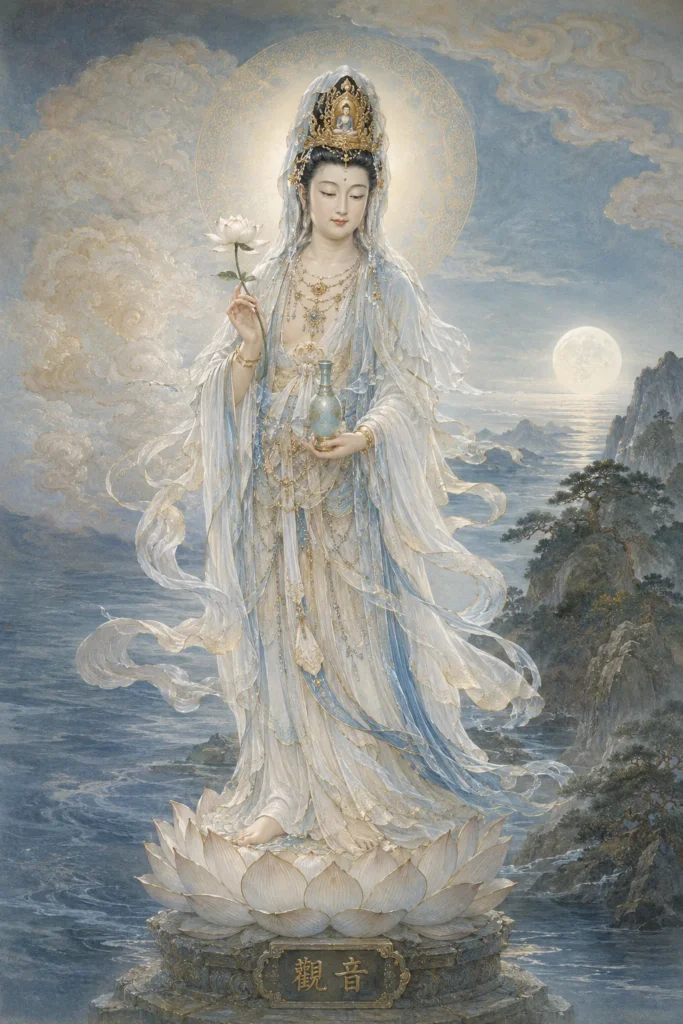
Kannon, at its core a bodhisattva, is often venerated in Japan as a goddess of compassion, who turns toward those who suffer in many forms and grants comfort. Kannon, with the full name Kanzeon-Bosatsu (Japanese) or Guanyin (Chinese), is the central figure of compassion and boundless mercy in East Asian Buddhism.
As the Japanese name for the Indian bodhisattva Avalokiteśvara, Kannon unites several layers of religious history: the Indian Mahayana tradition, Chinese folk religion, the Japanese Tendai and Shingon schools, and medieval popular piety. In no other figure of the Japanese pantheon is the soteriological idea of vicarious compassion embodied so directly.
Profile: Kannon
Kannon: the most important aspects at a glance. The following fields summarise origin, function, appearance, veneration, symbols and parallels.
Kannon is the Japanese form of the Indian bodhisattva Avalokiteśvara, Chinese Guanyin. Since the Tang period (7th to 9th century), Guanyin was increasingly venerated as female in China. The first images of Kannon in Japan date from the Asuka period (6th to 7th century).
Kannon embodies compassion and boundless mercy and rescues living beings in changing forms; the Lotus Sutra lists 33 manifestations. Miracle tales tell of the rescue of shipwrecked people, the persecuted and the sick. As Koyasu Kannon she is invoked in matters of childbirth, and in the rite of Mizuko Kuyō for aborted and stillborn children.
In the Sanjūsangen-dō in Kyoto, one thousand life-size statues of the Senju Kannon stand in ten rows, with a seated main statue 3.35 meters high at the center. Temples of the Heian period mostly show Kannon as androgynous and youthfully male, while folk religion tends toward the female reading.
Kannon is venerated on three pilgrimage routes: Saigoku with 33 stations in Kansai, Bandō with 33 in Kantō and Chichibu with 34 in Saitama, together 100 pilgrimage sites. Important temples are Kiyomizu-dera and Sanjūsangen-dō in Kyoto and Sensōji in Tokyo.
The symbols include the many arms of the Senju Kannon, the eleven heads of the Juichimen Kannon and the wish-fulfilling jewel (chintāmaṇi) of the Nyoirin Kannon. The Bato Kannon wears a crown with a horse’s head and protects horses and farm animals. The mantra “Oṃ maṇi padme hūṃ” is widespread in Tibetan Buddhism.
Kannon is often paralleled with Mary; in Nagasaki the “Maria Kannon” arose, Madonna figures in the form of Kannon. In Tibetan Buddhism, Avalokiteśvara as Chenrézig is the patron protector of Tibet, the Dalai Lamas are regarded as his incarnations, and Tara is his female companion figure.
Etymology and Identification
The Sanskrit name Avalokiteśvara is composed of “avalokita” (looking down, observing) and “īśvara” (lord) and means “the lord who looks down.” The Chinese translation Guanshiyin (observer of the world’s sounds) was later shortened to Guanyin. The Japanese reading Kanzeon (written 観世音) or Kannon (観音) follows this line.
In the Mahayana sutras, Avalokiteśvara first appears in the “Sukhāvatī-vyūha” (1st to 2nd century) as the chief attendant of the Buddha Amitabha; the “Saddharma-Pundarika-Sutra” (Lotus Sutra) devotes a separate text to him in its 25th chapter (“Samantamukha-parivarta”), which circulated independently in East Asia as the “Kannongyō.”
From Indian Bodhisattva to Chinese-Japanese Figure
In the Indian tradition, Avalokiteśvara is male, often depicted with gestures of gentleness and protection. In China, a change of gender took place from the Tang period onward (7th to 9th century): Guanyin came to be venerated increasingly in female form, a development much discussed in the study of religion.
In “Kuan-yin. The Chinese Transformation of Avalokiteśvara” (2001), Chün-fang Yü showed that this transformation is connected with the adoption of indigenous Chinese goddesses, with the Lotus Sutra cult, and with the folk legend of Princess Miao-shan.
In Japan, the gender attribution long remained ambivalent. The official Heian temples show Kannon mostly as androgynous, often youthfully male; folk religion tends toward the female reading, especially under the influence of the Chinese Guanyin cult.
Joseph Kitagawa and Inken Prohl emphasize that this duality poses no theological problem but corresponds to the fundamental idea of the bodhisattva’s infinite capacity for transformation: the Lotus Sutra enumerates 33 manifestations in which Kannon rescues living beings.
The 33 Transformations and the Six Kannon
The “Samantamukha-parivarta” describes 33 “gates” or forms of appearance in which Kannon meets beings, depending on which form can bring them salvation.
In Japan this catalogue was fixed liturgically and linked with the 33 pilgrimage sites of the Saigoku pilgrimage route in the Kansai region, a pilgrimage circuit documented since the 11th century that to this day attracts hundreds of thousands of believers each year.
Alongside this, Japanese iconography recognizes six principal forms, the “Roku-Kannon,” which in Shingon and Tendai Buddhism are each assigned to one of the six realms of existence (hells, hungry ghosts, animals, asuras, humans, gods).
The most important are: Shō-Kannon (Holy Kannon, the basic form), Senju-Kannon (the thousand-armed), Juichimen-Kannon (the eleven-faced), Nyoirin-Kannon (wish-fulfilling jewel and wheel), Bato-Kannon (horse-headed Kannon, protector of animals), and Jundei-Kannon (purity).
Iconography and Symbols
The most common Japanese depiction is the Senju-Kannon, the “thousand-armed” Kannon, who with her many arms can draw beings out of the multitude of human distress.
The most famous group of sculptures stands in the Sanjūsangen-dō in Kyoto (temple of the thirty-three-fold resounding, founded in 1164): a thousand life-size Senju-Kannon statues in ten long rows, at the center a 3.35-meter-high seated principal statue, created by the sculptor Tankei (1254).
The sculpture group is regarded as one of the most significant ensembles of Buddhist art in the world.
The eleven-faced Juichimen-Kannon shows eleven heads that look in all directions and symbolize all-encompassing compassion.
The most famous statue of this type stands in Hokke-ji in Nara (8th century) and is regarded as a portrait of Empress Kōmyō. The Nyoirin-Kannon, seated with one leg drawn up and holding a wish-fulfilling jewel (Chintāmaṇi), is one of the forms that foster meditation and is frequently seen in Shingon temples.
Bato-Kannon, with a horse-head crown, is the only wrathful form of Kannon and the patron protector of horses and livestock.
Myths, Legends, and Miracles
The Japanese “Konjaku Monogatari” (early 12th century) and the “Sambō ekotoba” (984) gather numerous miracle tales in which Kannon appears to rescue people from mortal danger: the shipwrecked in storms, the pursued before robbers, those lost in the mountains, the sick and the dying.
This narrative literature shapes the folk-religious image of Kannon to this day and has its parallels in the Chinese “Guanyin-jing yan-ji” (collection of Guanyin miracles, 4th to 8th century).
The most popular Japanese legend is that of the “Asakusa-Kannon”: in 628, the brothers Hinokuma Hamanari and Hinokuma Takenari are said to have found a small Kannon statue in their net while fishing on the Sumida River. From this find grew the Sensōji temple in Tokyo-Asakusa, today the oldest and most visited temple in Tokyo.
Pilgrimage Routes and Cult Sites
Three great Japanese pilgrimage routes are dedicated to Kannon: the Saigoku-Sanjūsansho with 33 stations in the Kansai region (main center: Kiyomizu-dera in Kyoto), the Bandō-Sanjūsansho with 33 stations in Kantō (main center: Sensōji in Tokyo), and the Chichibu-Sanjūshisho with 34 stations in Saitama.
Together they form the 100 Kannon pilgrimage sites (“Hyakkasho”), whose complete accomplishment is regarded as an extraordinary religious merit.
The most important individual temples are Kiyomizu-dera in Kyoto (778, Senju-Kannon), Sensōji in Tokyo (628, Shō-Kannon), Sanjūsangen-dō (1164), Hase-dera in Kamakura (standing eleven-faced), Ishiyama-dera on Lake Biwa (Nyoirin-Kannon, where Murasaki Shikibu is said to have written the “Genji-Monogatari”), and Hase-dera in Nara (eleven-faced).
A special role is played by the great-Buddha-statue complex of the Kannon statue of Sendai (100 meters high, 1991), which ranks among the largest statues in the world.
Significance in the History of Religion and Syncretisms
With the rise of Pure Land Buddhism (Jōdo-shū, Jōdo-Shinshū) in the 12th and 13th centuries, Kannon became closely bound up with Amida (Amitabha): Kannon and Seishi (Mahāsthāmaprāpta) are regarded as the two chief attendants of Amida who accompany him at the “Raigō” (welcoming appearance) of a dying person.
This triad shapes the iconography of the Raigō pictures, which became one of the most important religious image genres in Heian and Kamakura Buddhism.
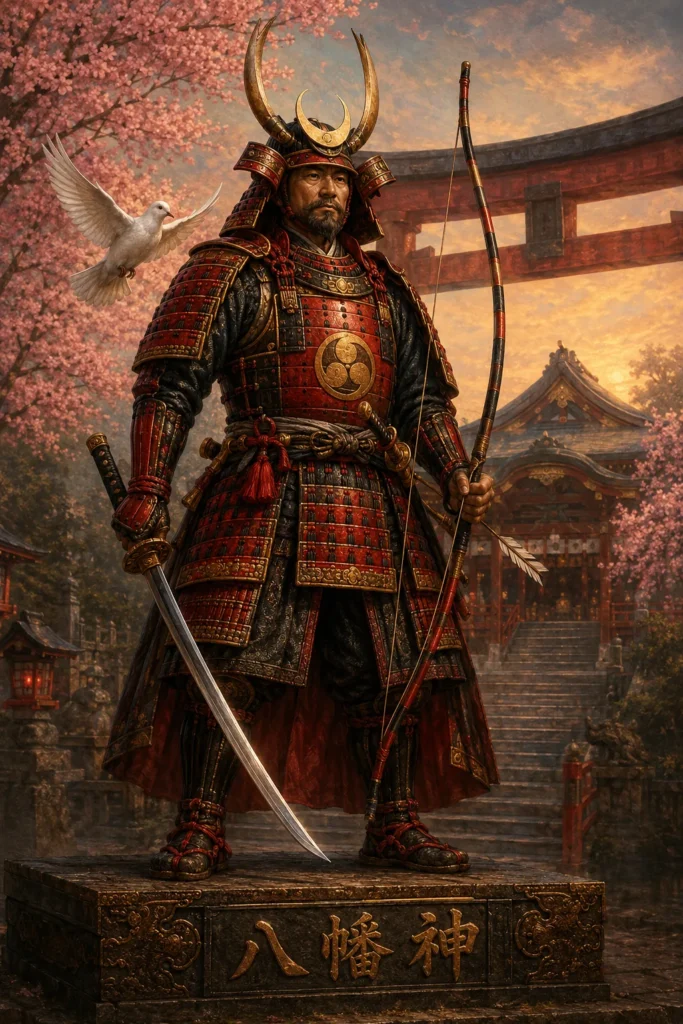
In honji-suijaku thought, Kannon was repeatedly identified with kami, especially with Kumano-Gongen and with Hachiman in his bodhisattva form. In the Shingon school, Kannon belongs to the Lotus realm of the Garbhadhātu mandala.
In Zen Buddhism, Kannon is understood above all as an object of meditation and as the epitome of non-dual compassion; Dōgen devotes the chapter “Kannon” in the “Shōbōgenzō” to him.
Kannon in Modern Religiosity
Helen Hardacre and Inken Prohl have shown that Kannon retains an unbroken central position in modern Japanese religious history. In the “Mizuko-Kuyō” rites for aborted and stillborn children, Kannon is the most frequently invoked figure; this practice has spread strongly since the 1970s and has been intensively discussed in research (William LaFleur, “Liquid Life,” 1992).
In the movement of the “New Religions” (Reiyū-kai, Risshō Kōsei-kai, Sōka Gakkai), the Lotus Sutra, and thus the Kannon chapter, remains central.
Cross-References
In interreligious comparison, Kannon is frequently paralleled with Mary; the city of Nagasaki knows the “Maria-Kannon,” Madonna figures in the form of Kannon that were venerated as Mary in the hidden world of the age of Christian persecution (16th to 19th century).
In Indian Buddhism, the Tibetan Tara is closely connected with Avalokiteśvara and is regarded as his female companion figure. In the tradition of Tibet, the Dalai Lama is the incarnation of Avalokiteśvara.
Sources
“Saddharma-Pundarika-Sutra” (Lotus Sutra), chapter 25, German translation by Margareta von Borsig, Freiburg 2009. “Sukhāvatī-vyūha” (1st to 2nd century). “Kannongyō,” independent tradition of the 25th Lotus chapter. “Konjaku Monogatari” (early 12th century), translation by Marian Ury, Berkeley 1979. “Sambō ekotoba” (984). Dōgen, “Shōbōgenzō,” chapter “Kannon,” translation by Gudo Wafu Nishijima.
Chün-fang Yü, “Kuan-yin. The Chinese Transformation of Avalokiteśvara,” New York 2001. William LaFleur, “Liquid Life. Abortion and Buddhism in Japan,” Princeton 1992. Joseph Kitagawa, “Religion in Japanese History,” New York 1966. Helen Hardacre, “Shinto.
A History,” Oxford 2017. Inken Prohl, “Religiöse Innovationen,” Berlin 2006. Klaus Vollmer, “Shintô und Buddhismus,” Munich 2002. Bernhard Scheid, “Religion-in-Japan,” Vienna, ongoing. John Holt, “Buddha in the Crown. Avalokiteśvara in the Buddhist Traditions of Sri Lanka,” New York 1991.
Avalokiteśvara in India and Tibet
The origin of Avalokiteśvara lies in Indian Mahayana Buddhism of the first to third centuries CE. In the early texts of Pure Land Buddhism (Sukhāvatī-vyūha) he appears as one of the chief attendants of the Buddha Amitabha, together with Mahāsthāmaprāpta.
In the “Kāraṇḍa-vyūha-Sutra” (4th century) he is raised to an independent cosmic savior figure, whose mantra “Oṃ maṇi padme hūṃ” is to this day the most widespread mantra of Tibetan Buddhism.
The iconographic diversity, with two-, four-, or thousand-armed forms, arose in this phase and was carried on to Central Asia, China, and finally Japan.
In Tibetan Buddhism, Avalokiteśvara, as Chenrézig, is the patron protector of Tibet and is regarded as the country’s central bodhisattva. The Dalai Lamas are traditionally understood as incarnations of Chenrézig. John Holt (“Buddha in the Crown,” 1991) and Lokesh Chandra have comparatively reconstructed the developmental history of Avalokiteśvara across the Buddhist cultures.
The Japanese form Kannon is thus the result of a more than thousand-year migration of this conception of the divine from northern India by way of Central Asia and China to Japan.
Early Adoption in Japan
The first Kannon images in Japan date from the Asuka period (6th to 7th century). The famous Kudara-Kannon in Hōryū-ji (early 7th century) is a slender, almost oversized wooden figure in the Korean-Paekche tradition and is one of the oldest surviving Japanese Buddhist sculptures.
The Yumedono-Kannon, a hidden statue likewise in Hōryū-ji, was kept veiled for centuries and was made accessible again only in 1884 by Ernest Fenollosa and Okakura Tenshin. These early statues document the great importance of the Kannon cult already in the early phase of Japanese Buddhism.
In the Nara period (710 to 794), Kannon became the principal figure of numerous state temples. The monumental dry-lacquer statue of the thousand-armed Kannon in Tōshōdai-ji, which the Chinese monk Ganjin and his workshop created in the 8th century, shows the combination of Chinese workshop tradition and Japanese appropriation.
The Heian period, with the rise of Tendai and Shingon, brought a further differentiation of the Kannon pantheon, in which the six Roku-Kannon forms were liturgically articulated.
Sanjūsangen-dō and the Workshop Tradition
The Sanjūsangen-dō (“hall of the thirty-three bays”) in Kyoto, founded in 1164 by Taira no Kiyomori on behalf of Emperor Goshirakawa, houses the largest surviving Kannon ensemble in Japan: a thousand life-size Senju-Kannon statues in ten long rows, a 3.35-meter-high seated principal figure, and 28 accompanying sculptures of the guardian gods.
After a fire in 1249, the complex was rebuilt between 1251 and 1266, with about 124 of the original statues preserved and integrated into the new building. The remaining statues were newly created by the workshop of the sculptor Tankei (1173 to 1256) and his pupils.
Tankei belonged to the Kei school, which shaped Japanese sculpture in the late 12th and 13th centuries and reached its stylistic peak particularly in Kamakura Buddhism.
The statues of the Sanjūsangen-dō are made of multi-part assembled hinoki wood (“yosegi-zukuri” technique) and finished with lacquer, gold, and gemstone inlays. In 2018, all thousand statues were declared National Treasures of Japan, a unique step in Japanese heritage conservation.
Kannon and the Soteriology of Women
A significant theological line is the veneration of Kannon in the context of Buddhist soteriology for women. The Lotus Sutra (chapter 25) promises that Kannon grants a son to women who wish for a son, and a daughter to women who wish for a daughter.
This passage gave rise in Japanese folk Buddhism to a tradition of its own of invoking Kannon in matters of childbirth. The “Koyasu-Kannon” (“child-protecting Kannon”), a special form with a child figure, is represented in numerous temples and is sought out by expectant mothers to this day.
The already mentioned Mizuko-Kuyō rite for aborted or stillborn children has spread strongly since the 1970s. In it, small statues (“Jizō” or “Kannon”) are provided with little children’s clothes, toys, and stone pendants in order to care ritually for the children who did not come into the world.
William LaFleur (“Liquid Life,” 1992) analyzed this practice from a sociology-of-religion perspective and pointed to its psychological protective function for the affected families.
Kannon among the "Hidden Christians" (Kakure Kirishitan)
A complex of particular interest in the history of religion is the “Maria-Kannon” tradition of the “Kakure Kirishitan,” the hidden Japanese Christians during the persecution period of 1614 to 1873. In Nagasaki and on the surrounding islands (especially Ikitsuki and Goto), concealed Christian communities, officially registered as Buddhist families, preserved their veneration of Mary through the identification of Mary with Kannon.
Small Kannon statues, often with a hidden cross on the back, were venerated as images of Mary; the “Mizuko-Kannon” form was particularly suitable because the child figure on the arm recalled images of the Madonna.
This tradition became public only after the lifting of the ban on Christianity in 1873. Many families then returned to open Catholicism, while others preserved the syncretistic practice and remained with the Maria-Kannon form.
The cathedral of Nagasaki and the museum of the Kakure Kirishitan in Sotome document this special form of Japanese-Christian religiosity, which at the same time represents an extraordinary episode in the religious history of Kannon.
Kannon in Contemporary Religiosity
Helen Hardacre and Inken Prohl have repeatedly emphasized that Kannon is at present the most important “accessible” Buddhist figure in Japan. While the Dharma Buddha (Tathāgata), as an abstract philosophical entity, remains little concrete for many worshippers, Kannon is immediately accessible through the vividness and emotional charge of the figure of compassion.
The “33-station pilgrimage routes” are experiencing a continuing revival, reinforced not least by touristic and wellness components, without losing their religious substance.
In the Japanese “New Religions” (“Shin Shūkyō”) such as Reiyū-kai, Risshō Kōsei-kai, and Sōka Gakkai, the Lotus Sutra, and thus the Kannon chapter, remains central as the principal scripture.
In the Sōtō Zen and Rinzai Zen tradition, too, Kannon is firmly anchored as an object of meditation and as a symbol of non-dual compassion. In the great temples of Pure Land Buddhism (especially Chion-in in Kyoto), Kannon remains the companion figure of Amida and shapes the liturgical practice of accompanying the dying.