Ebisu, Japanese god of luck and of fishermen
By Ralf Ittermann · last reviewed on
Ebisu is the Japanese god of luck and the patron of fishermen and merchants, to whom a cheerful, kindly character is attributed. Ebisu, with the full name Ebisu-no-Kami (also Hiruko-no-Mikoto or Kotoshironushi-no-Kami), is in Japanese Shintō the deity of fishing, commerce, and luck.
He belongs to the “Shichifukujin”, the Seven Lucky Gods, and is among them the only genuinely Japanese kami; the other six derive from the Chinese or Indian pantheon.
Ebisu is traditionally depicted with a sea bream (tai) under his arm and a fishing rod in his hand; the laughing, round face and the padded robe make him one of Japan’s most popular folk saints.
Table of Contents

Identification and Dual Nature
In the history of religion, Ebisu cannot be traced back to a single mythical figure but is identified, depending on the tradition, with various kami. The two most important identifications are Hiruko and Kotoshironushi.
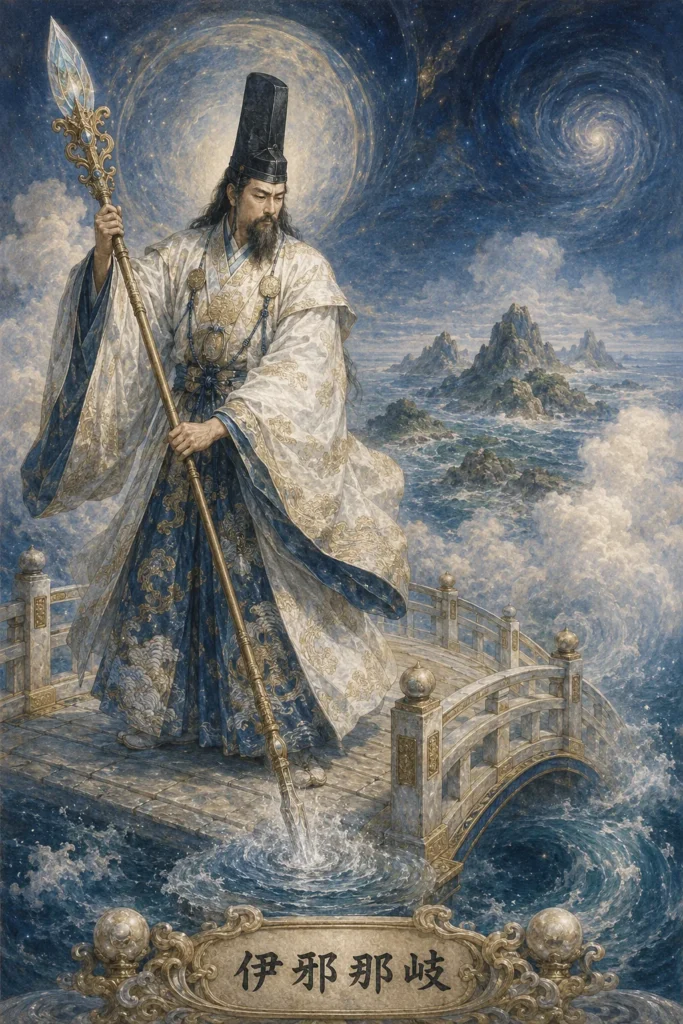
Hiruko, the “leech child”, is the first, malformed child of Izanagi and Izanami in the “Kojiki” and “Nihon Shoki”. Because it still could not stand after three years, the parents set it adrift in a reed boat and abandoned it to the sea.
In the medieval tradition, this abandoned child was associated with the sea and with fishing and finally deified as Ebisu. The most important shrine tradition of this identification is Nishinomiya-jinja in Hyōgo.
Kotoshironushi, a son of Ōkuninushi, is regarded in the “Kojiki” as the kami who consents to the transfer of earthly rule to the heavenly gods and withdraws into the sea.
From this episode a fisher kami was derived in the Middle Ages. This identification is authoritative at the Imamiya-Ebisu-jinja in Osaka. Both traditions coexist in parallel to this day, without any official harmonization having taken place.
Myth and Origin
The Hiruko narrative stands at the beginning of the “Kojiki”: Izanagi and Izanami circle the heavenly pillar, but because Izanami speaks first, the first birth goes wrong. The child is set adrift in a reed boat.
The mythical narrative breaks off here; medieval Japanese popular thought continued it and had Hiruko make landfall on the coast of Settsu (today Hyōgo), where he was taken in by fishermen and venerated as Ebisu. This narrative is not attested in the oldest sources, but appears in medieval shrine legends.
In the history of religion, Ebisu thus belongs to the widespread class of the “Hyōchaku-shin” (“beach gods”), who are venerated as beings washed ashore.
Nelly Naumann investigated these beach deities in several essays as a typical phenomenon of Pacific fishing religiosity. Related figures are found in the Ainu tradition (with the whale god Repun-Kamuy) and in the Ryūkyū religion.
Iconography and Symbols
Ebisu has been defined in the visual arts since the early Edo period (17th century) by a clearly fixed iconography: a rounded, smiling face, a tall black cap hat (“Kazaori-eboshi”), a padded robe in red or blue, in his right hand a fishing rod, in his left a large sea bream (tai).
The bream is a symbol of luck (Japanese “medetai”, “auspicious”), the rod symbolizes honest, patient labor. Sometimes Ebisu sits on a ball of rice or on a rock.
A distinctive feature is the frequent depiction with a bandaged or wrapped ear: Ebisu is regarded as hard of hearing, which is why worshippers ring the shrine bell especially vigorously and on his feast days often knock on the shrine walls to make themselves heard. This practice, called “Ebisu-no-mimi-ate”, is a living folk custom.
Veneration and Important Shrines
Ebisu is venerated in over 3,500 shrines, with two main shrines of differing tradition. Nishinomiya-jinja in Nishinomiya (Hyōgo) is the main shrine of the Hiruko tradition and the center of the “Tōka Ebisu” festival, which annually draws hundreds of thousands of pilgrims from 9 to 11 January.
The highlight is the “Fuku-otoko” (“Lucky Man”) race on the morning of 10 January: men run from the main gate to the main hall, and the first to arrive is named “Lucky Man of the Year”.
Imamiya-Ebisu-jinja in Osaka is the main shrine of the Kotoshironushi tradition and likewise holds the “Toka-Ebisu”, along with its own rites of the merchant guilds.
Other important shrines are Kyōto-Ebisu-jinja, Kanda-Myōjin in Tokyo (Ebisu as one of the principal kami), Mihogahama in Shimane, and the Tōkyō-Ebisu-jinja in the Ebisu district (whose name derives from the district).
The Ebisu district in Tokyo was named after a brewery that introduced “Yebisu beer” in 1890 and named its location after the god of luck. The railway station, the street name, and the surrounding quarter carry this name to this day.
Ebisu among the Shichifukujin
The Seven Lucky Gods (Shichifukujin) have formed a firmly established iconographic group since the late Middle Ages (15th century), venerated in New Year’s images and as a joint shrine constellation.
Apart from Ebisu, these are: Daikokuten (Mahākāla, India, prosperity), Bishamonten (Vaiśravaṇa, India, warrior protection), Benzaiten (Sarasvatī, India, the arts and water), Fukurokuju (China, longevity), Jurōjin (China, longevity), and Hotei (Budai, China, contentment). The group unites Shintō, Buddhist, and Daoist elements and is a key example of the Japanese syncretism culture of the Muromachi period.
At New Year’s celebrations, a “Takarabune” image is laid out in many homes: the seven gods on a treasure ship, which is meant to appear in the dream of New Year’s night. This tradition is documented in detail in the “Edo-meisho-zue” (1834).
Rituals, Offerings, and Festivals
The most important festival is the Tōka-Ebisu on 10 January (with an eve and an after-celebration on the 9th and 11th), at which worshippers offer sake, sea bream, beans, rice, and small lucky charms (“Fuku-zasa”, lucky bamboo with small rice balls and gold coins).
These bamboo branches are handed out to the pilgrims in exchange for donations and are set up in shops, where they are meant to secure business fortune for a year.
In autumn (20 October or a similar date, depending on the region) the “Ebisu-kō” takes place: merchants then hold a banquet for their business partners and thank Ebisu for the past year.
At fishermen’s festivals along the coast, Ebisu is offered the first catches of the season. In the Edo period it was customary to set up an “Ebisu-da-iko” (“Ebisu lamp”) during the fishing season and to dedicate the first bream to Ebisu in the morning before it was taken to market.
Classification in the History of Religion
Ebisu is interesting in religious studies for several reasons: as a typical beach kami, as a central figure of the urban merchant piety of the Edo period, and as the only genuinely Japanese representative among the Shichifukujin.
Helen Hardacre and Bernhard Scheid have documented in several works Ebisu’s role in the development of Japanese business religiosity. Klaus Vollmer investigated the connection between the medieval Hiruko narratives and the oral storytelling tradition of Japanese fishing villages. Nelly Naumann analyzed the kinship with the beach gods of the Ryūkyū Islands (“Niraikanai” complex).
Structurally, Ebisu has parallels to Hermes (Greece) and Mercury (Rome) as protective gods of merchants, to Poseidon and Neptune as sea gods, and to Lakshmi (Hinduism) as a goddess of luck.
In the pantheon of East Asian gods of luck, his hard-of-hearing good nature is a profile of its own that distinguishes him from the grim power of a Bishamonten or the elegant grace of Benzaiten.
Ebisu in Popular Culture
In Japan, Ebisu is a ubiquitous advertising and brand motif: Yebisu beer (1890), the Tokyo Ebisu district, numerous restaurants, mascots, lucky cards, and comics. The round, friendly figure is a standard motif of the Japanese “Engimono” (lucky-charm genre).
In manga and anime he appears regularly as a supporting figure, and in games such as “Persona” and “Touhou” with his own manifestations. The connection with 10 January as a lucky day shapes the business year calendar to this day.
Sources
“Kojiki” (712), Book I (Hiruko episode). “Nihon Shoki” (720), Book I. “Engishiki” (927). “Edo-meisho-zue” (1834). Various medieval shrine legends (“Nishinomiya-engi”, “Imamiya-engi”). “Saikaku Oridome” and other Edo-period merchant literature with references to Ebisu.
Nelly Naumann, “Die einheimische Religion Japans”, 2 volumes, Leiden 1988 and 1994. Klaus Antoni, “Shintô und die Konzeption des japanischen Nationalwesens”, Leiden 1998. Helen Hardacre, “Shinto.
A History”, Oxford 2017. Joseph Kitagawa, “Religion in Japanese History”, New York 1966. Klaus Vollmer, “Shintô und Buddhismus”, Munich 2002. Bernhard Scheid, “Religion-in-Japan: Ein digitales Handbuch”, Vienna ongoing. Inken Prohl, “Religiöse Innovationen”, Berlin 2006. Reiko Chiba, “The Seven Lucky Gods of Japan”, Tokyo 1966.
Ebisu and Whale Religiosity
A particular strand of the Ebisu tradition concerns his veneration as a whale god in coastal regions where whaling was practiced.
In Wakayama, Kochi, and Nagasaki the whale itself is regarded as “Ebisu-sama” or “Ebisu-no-Maru”; in some village traditions a beached whale is ritually received as Ebisu and interpreted as a gift from Ebisu to the entire community.
This conception belongs to the complex of the “Hyōchaku-shin”, the beach deities washed ashore, and belongs to the oldest layers of Ebisu religiosity. Nelly Naumann documented the maritime deep layer of this tradition in several detailed studies.
In Taiji (Wakayama), the traditional center of Japanese whaling, there is to this day a whale memorial sanctuary in which the souls of the captured whales are ritually appeased (“Kuyō”).
The local Ebisu shrine is closely connected with the whale cult. This tradition stands in tension with the modern whale conservation movement and is the subject of religious-sociological studies of the Japanese whaling controversy.
Ebisu and the Urban Merchant Cult of the Edo Period
With the urbanization of the Edo period (1603 to 1867), the veneration of Ebisu shifted from the coastal village into the growing cities of Edo (Tokyo), Osaka, and Kyoto.
In this phase the urban Ebisu cult arose, in which the deity was understood less as a protector of fishermen than as a protective god of commerce and business piety.
The Sakai craftsmen and the Hokkaidō rice lodges (Hatago houses) of the Edo period maintained the “Ebisu-kō” (“Ebisu association”), an annual banquet on 20 October at which merchants, craftsmen, and business partners gathered.
Saikaku Ihara, the most significant Edo-period storyteller of the merchant genre, worked numerous Ebisu anecdotes into his works (“Nippon Eitaigura”, 1688; “Seken Munesan’yō”, 1692) and showed how deeply the deity had grown into the self-understanding of urban business people.
Over the course of the 18th century the “Ebisu association” became an informal economic institution in which business relationships were religiously ratified.
The Festival Culture of the Tōka-Ebisu
The main festival Tōka-Ebisu on 10 January (with Yoinomiya on the 9th and Zankyo-Ebisu on 11 January) is one of the largest urban shrine festivals in Japan. In Osaka around one million pilgrims come to the Imamiya-Ebisu each year, in Nishinomiya around 500,000 to the Nishinomiya shrine.
The central rite is the distribution of the “Fuku-zasa”, bamboo branches with attached gold coins, small rice balls, lucky symbols, and bream. These bamboo branches are set up in shops and are meant to secure business fortune for a year.
The “Fuku-otoko” race on the morning of 10 January in Nishinomiya is among the religious events in Japan that are most intensely observed by the media.
Male worshippers run from the main gate to the main hall (a distance of around 230 meters); the first, second, and third to arrive are named “Fuku-otoko” (“Lucky Men of the Year”) and receive gifts from the shrine.
This practice has existed since the late 17th century and is one of the few modern shrine festivals that are regularly broadcast live in the mass media.
Ebisu Iconography in Edo-Period Folk Art
The Ebisu iconography that is canonical today, with bream, fishing rod, and eboshi hat, was fixed in the early Edo period and reproduced in countless woodblock prints, Otsu-e (folk paintings from Otsu), netsuke (belt toggles), and inrō (medicine cases).
Hokusai and Hiroshige created several Ebisu pictures that found wide distribution in printed graphics. Japanese folk art has made Ebisu one of the unmistakable “Engimono” figures (lucky charms), whose image appears in the entrance areas of shops, on New Year’s gifts, and on congratulatory letters.
A tradition of its own are the “Ebisu-Ningyō”, small cloth or clay dolls produced in the Edo period as toys and as lucky charms. The tradition lives on in the modern “Kappa-Tengu-Ebisu” toy culture and is documented in folk-art museums such as the Nihon Mingeikan in Tokyo.
Syncretic Identifications with Daikokuten
An important theological constellation is the close connection of Ebisu with Daikokuten, another of the Seven Lucky Gods. Both are frequently depicted as a pair: Ebisu for the economy of the water (fishing, commerce), Daikokuten for the economy of the land (agriculture, rice stores).
In many Japanese households and shops, Ebisu and Daikokuten figures stand side by side as a pair on the kamidana, the house altar. This connection is significant in the history of religion because it establishes a deliberate complementarity in the theology of luck.
In some traditions Ebisu is venerated as the son of Daikokuten and Daikokuten as his father; this goes back to a late Edo-period construction in which the Seven Lucky Gods were ordered genealogically.
This genealogy is not anchored in the oldest sources but has become entrenched in folk-religious practice. Reiko Chiba documented the developmental history of these constellations in “The Seven Lucky Gods of Japan” (1966).
Ebisu and the Concept of the Marebito
The religious-studies research of Origuchi Shinobu (1887 to 1953), one of the most significant Japanese ethnologists, placed Ebisu within the complex of the “Marebito” (“foreign guests”). According to Origuchi’s theory, Marebito are divine beings who periodically come from an otherworldly realm, bring blessing, and depart again.
Ebisu, who as the abandoned Hiruko comes from outside and makes landfall on the coast, is a classic Marebito. This theory is admittedly not tenable in all its details in modern ethnology, but it has lastingly shaped Japanese religious research and placed Ebisu in a broader context of the history of religion.
Joseph Kitagawa and Helen Hardacre took up the Marebito theory in several studies and pointed to the significance of the “foreign” and the “washed ashore” in Japanese religiosity.
In this reading, Ebisu is not only a god of luck but also a symbol for the possibility of salvation from the foreign, a conception of profound importance in the history of religion.
Modern Branding and Urban Symbolic Value
A peculiarity of Ebisu’s religious history is the intensive branding in the modern era. The “Yebisu beer” introduced in Tokyo in 1890 (the old spelling with “Ye-” was not modernized) is among the oldest brand names in Japan.
Ebisu Station, the Ebisu city quarter, and Yebisu Garden Place bear the name of the god of luck and are examples of the productive tension between commercial branding and religious symbolism. Similar effects appear in restaurant and business names (“Ebisuya”, “Ebisu-tei”), which are widespread in Japan and rely on the positive connotation of the name.
In contemporary popular culture, Ebisu is a recurring figure in anime, manga, and games. The friendly, hard-of-hearing good nature of the traditional iconography is frequently quoted in a parodic or ironic manner.
Despite the commercial and entertainment-oriented charging, the religious core of the Ebisu complex remains alive, as the annual mass pilgrimage festivals at the Tōka-Ebisu show.