Yong-wang, Korean Dragon King
By Ralf Ittermann · last reviewed on
Yong-wang is a Korean Dragon King who rules over the sea, the rain and all waters. Yong Wang (Korean 용왕, 龍王), literally “Dragon King”, is the principal deity of water in Korean folk religion. He rules over the seas, rivers, lakes and wells and is regarded as the patron of all water-dwelling creatures.
His worship came to Korea from China only with Buddhism (4th to 7th century) and is closely connected with the comparable Dragon King traditions of China and Japan, yet in Korea it developed its own local forms.
Profile: Yong-wang
Yong-wang: the most important aspects at a glance. The following fields summarise origin, function, appearance, veneration, symbols and parallels.
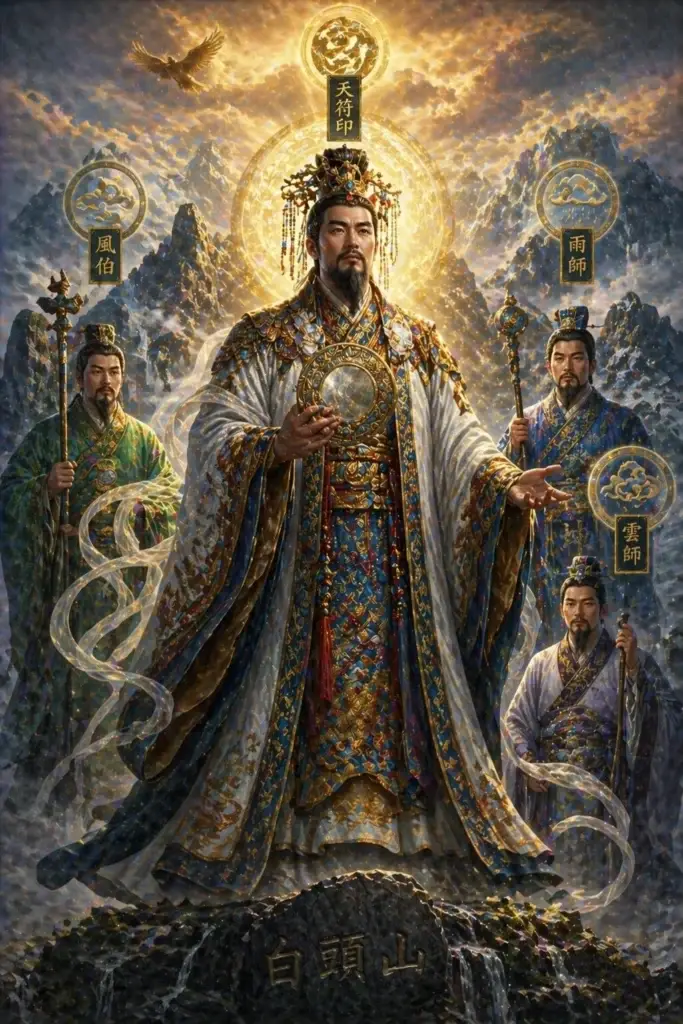
Korean dragon king and chief deity of water in folk religion. The veneration came to Korea from China with Buddhism (4th to 7th century) and met existing notions of a water deity there. Early on it was linked with royal ideology; the kings of Silla called themselves “sons of the dragon.”
Yong-wang rules over seas, rivers, lakes and wells and is the protector of all water creatures. Fishers ask him for a rich catch and protection from storms; farmers in regions with little rain called on him for rain.
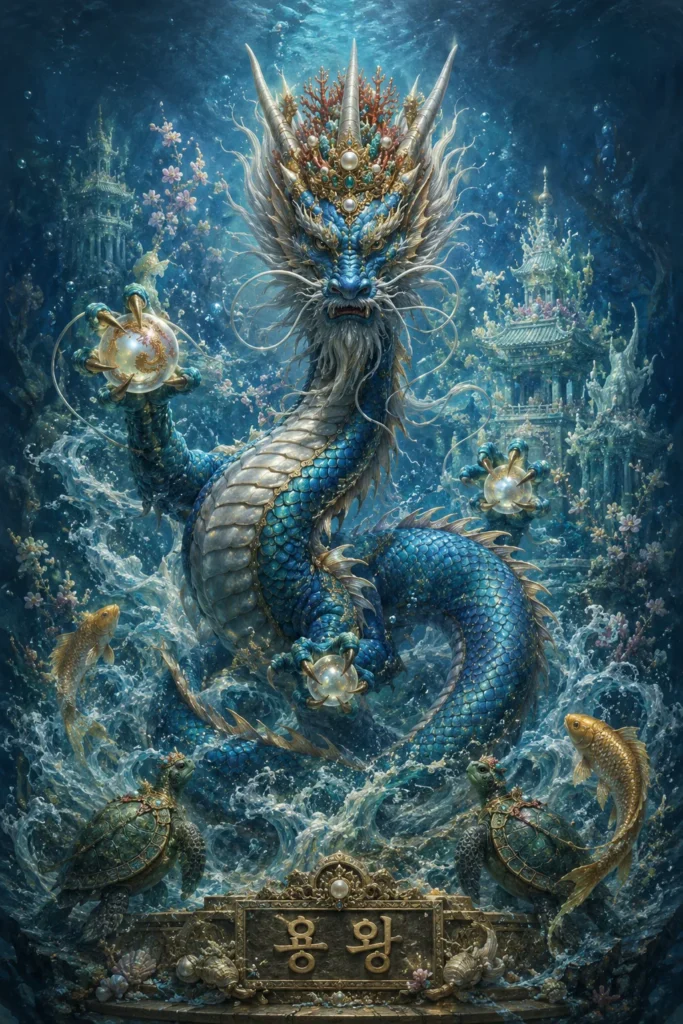
Traditionally he appears as a royal figure with a dragon crown and splendid robes, in some places with a dragon’s head and human body, or as an old man with a long beard among dragons. The yongwang-do shows him on a throne under water, surrounded by aquatic animals and two female attendants with pearls and bowls.
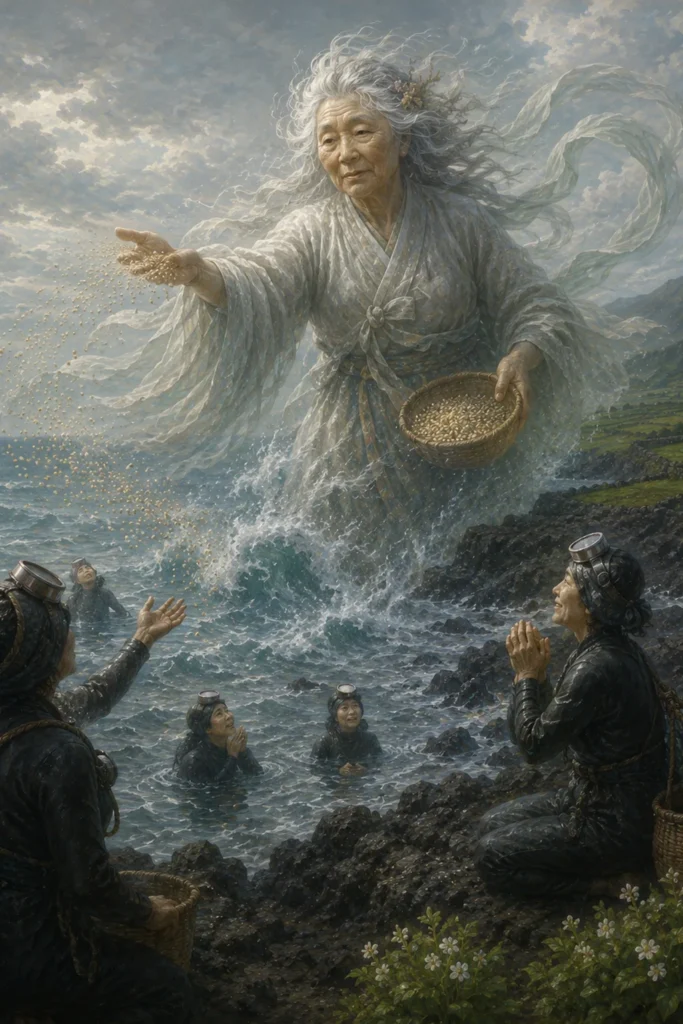
Shrines (yongwang-dang) stand on coasts, especially in Gangwon Province, as well as at rivers and wells; in monasteries there is the small hall yongwang-gak. On Jeju the festival Yeongdeunggut honors the goddess Yeongdeung Halmang together with him and asks for a safe fishing season.
His court includes turtles, carp, octopuses and jellyfish, who serve as ministers and messengers in tales. The dragon is regarded as the chief symbol of royal power. In the tale of the hare and the turtle, the turtle is his messenger.
The notion goes back to the Chinese Long Wang, ruler of the four seas. In Japan his counterpart is Ryujin, who is more closely tied to the shrines of Shinto. In Mahayana Buddhism the eight dragon kings, who appear as listeners to the Buddha’s teaching, correspond to him.
Sources and Origin
The notion of the Dragon King has its roots in Chinese mythology, in which Long Wang acts as ruler of the four seas and is venerated in temple complexes.
With the introduction of Buddhism and Confucian learning into Korea in the 4th to 7th centuries, the idea of the Dragon King reached the Korean realm, where it met existing folk-religious notions of a water deity.
The “Samguk Yusa” transmits several episodes in which dragons and Dragon Kings play a role in the early history of the Korean kingdoms. The mythical kingdom of Silla is even co-founded by a Dragon King who carries the mother of the fourth king, Talhae, out of the sea.
James Grayson and Maurizio Riotto have shown in surveys of religious history that the veneration of the Dragon King in Korea was early on linked with royal ideology.
The kings of Silla called themselves “Sons of the Dragon”, a practice that was widespread in the East Asian monarchies but took on a particularly prominent form in Silla. This political appropriation of the dragon shaped the Korean pictorial tradition well into the Joseon period.
Iconography
Yong Wang is traditionally depicted as a royal figure with a dragon crown and magnificent robes. In some pictorial traditions he appears as a hybrid figure with a dragon’s head and a human body, in others as an old man with a long beard surrounded by dragons.
His court consists of further water animals such as turtles, carp, octopuses and jellyfish, which in popular tales act as his ministers and messengers.
A remarkable pictorial tradition is the “yongwang-do”, the Dragon King panel, found in the Buddhist temples of Korea. It shows Yong Wang on a throne under the water, surrounded by his water animals, often accompanied by two female attendants carrying pearls and bowls.
These panels have been standardized since the 17th century and follow their own iconographic convention, which differs from the Chinese models.
Sanctuaries and Rites
The most important Yong Wang sanctuaries of Korea are located on the coasts and along the larger rivers. On the east coast, especially in Gangwon Province, numerous shrines (“yongwang-dang”) are erected on cliffs and on offshore islands.
On the south coast, particularly on Jeju, there are distinct Dragon King sanctuaries with local ritual traditions. Many rivers and wells also have small Yong Wang shrines that are maintained by local residents.
The most important rites for Yong Wang are petitionary rites of the fishermen, who pray before the season for a rich catch and for protection from storms. Farmers in rain-poor regions also called upon him for rain, in especially dry years with elaborate processions and petitionary dances.
Boudewijn Walraven, in his studies of Korean shamanic practice, has documented how Yong Wang is invoked in the “gut” rituals, above all in the coastal regions, where the shamanesses frequently call upon him.
Yong Wang in Korean Folk Narrative
A particularly well-known tale is the “Story of the Hare and the Turtle”, in which the turtle, as messenger of the Dragon King, lures the hare into the underwater realm in order to obtain its liver to heal the ailing Yong Wang.
The cunning hare escapes through a clever claim. This tale belongs to the “Pansori” repertoire, the sung narratives of Korean folk tradition, and is widely known in popular culture.
A second, less well-known tradition concerns Queen Heo Hwang-ok, who in the myth of the Karak dynasty comes to Korea by sea as the daughter of a king from the land of Ayodhya (India) and is wed to King Suro.
In some versions her ship is guided by the Dragon King. This tale is today the subject of scholarly debates about possible early maritime connections between Korea and South Asia.
Buddhist Integration
Like Sansin, Yong Wang too was integrated into the Buddhist temple topography of Korea. In many monasteries, alongside the main Buddha hall, there is a small hall called “yongwang-gak” in which Yong Wang is venerated.
This hall is usually built closer to a watercourse or a spring and stands in clear spatial separation from the main area. The integration is structured analogously to the Sansin-gak.
Don Baker has pointed out that the Buddhist appropriation of the water deity was also justified theologically, in that Yong Wang was depicted as a disciple or servant of the Buddha.
In some sutras, above all in the “Lotus Sutra“, Dragon Kings appear as listeners to the teaching, which provides a canonical basis for veneration in the Buddhist context. In Korea this tradition became the standard form.
Connection to Jeju and the Seonangsin Tradition
On the island of Jeju, the veneration of Yong Wang has a particularly pronounced form. The island is covered with numerous sanctuaries, many of which are dedicated to the Dragon King or related water deities.
The shamanesses of Jeju, the “simbang”, maintain a rich tradition of Yong Wang rites. A central festival is the “Yeongdeunggut” in the second lunar month, which honors the goddess Yeongdeung Halmang (an ancient water goddess) together with Yong Wang and petitions for a safe fishing season.
On the Korean mainland, Yong Wang is connected with the “seonangsin”, the protective gods at village entrances, which are erected in the form of stone cairns or painted poles.
At river crossings and at wells, similar protective objects are set up, which are often directly associated with the Dragon King. Boudewijn Walraven has documented this local diversity in detail in his fieldwork.
Political and Cultural Symbolism
The dragon was the principal symbol of royal power in Korean royal ideology. The robes of the Joseon kings were adorned with five-clawed dragons, a privilege reserved in the East Asian tradition for the Son of Heaven.
Yong Wang therefore had, as a background figure, an indirect political significance, without occupying a position of his own in the official Confucian pantheon.
In modern Korean culture the dragon lives on as a symbol. It appears in brand names, in sports clubs, in films and in advertising. The direct religious veneration of Yong Wang is found in the coastal regions and on Jeju as well as in many monasteries and at rivers and wells in the interior.
In industrial cities it has declined, yet in the fishing harbors it remains alive. Antonetta Bruno has shown in her work how the cult combines with modern tourism culture, for example when the annual Yong Wang festivals are marketed as tourist attractions.
Research and Comparison
Research on Yong Wang is part of a broader East Asian study of Dragon Kings that compares Korea, China and Japan. In the Chinese tradition, Long Wang is more strongly bound to the imperial court religion; in Japan, Ryujin is more closely connected with the shrines of Shinto.
In Korea, Yong Wang shows the typical mixed form of folk-religious practice, Buddhist integration and political symbolism. According to James Grayson, this mixed form is characteristic of Korean religiosity as a whole.
Within Korean scholarship, the works on the Jeju tradition (Hyun Yong-jun, Yoon Yong-min) and the religious-sociological studies of coastal fishing (Kim Sun-young) have proved especially important.
Internationally, Yong Wang has been studied less comprehensively than Sansin or the principal shamanic deities, which is due above all to the source situation, which is shaped by folkloric oral transmission and is hard to access in Western archives.
Yong Wang in Silla and Goryeo Royal Ideology
The connection of the Dragon King with royal rule is most strongly tangible, iconographically and textually, in the Silla period (57 BCE to 935 CE).
The “Samguk Yusa” reports in the chapter “Munmu-wang Bobgi” that King Munmu of Silla (reigned 661 to 681) decreed on his deathbed that he be buried in the sea, so that after his death he might protect the realm from Japanese pirates as the dragon of the East Sea.
His grave, the “underwater tomb” Daewangam on the east coast near Gyeongju, is a place of pilgrimage to this day. His son Sinmun had the Gameunsa temple built in the immediate vicinity, whose main crypt, according to archaeological findings, was constructed in such a way that the Dragon King father could swim into it.
In the Goryeo period (918 to 1392), the royal family Wang systematically adopted the dragon symbolism. The mythical foundation story of the dynasty’s founder Wang Geon, set down in the “Goryeo Sa” (“History of Goryeo”, 1451), traces his ancestry over several generations back to a Dragon King of the West Sea.
This genealogical dragon construction was effective in religious-political terms: it bound the royal family to the water deity.
Buddhist Sutras and the Eight Dragon Kings
In the Buddhist context, Yong Wang appears not as an individual figure but as a representative of the eight Dragon Kings (“pal yongwang”), who appear in numerous Mahayana sutras as protective beings of the teaching.
The “Saddharmapundarika Sutra” (“Lotus Sutra“), canonical in Korean Buddhism since the Silla period, names in its first chapter the eight Dragon Kings as listeners to the Buddha’s sermon. The individual names Nanda, Upananda, Sagara, Vasuki, Takshaka, Anavatapta, Manasvin and Utpalaka have migrated into the Korean temple tradition through Sanskrit transcriptions.
A particular Korean form is the “Dharani Sutra” cult in honor of the Dragon Kings, attested in the mountain monasteries of Songgwangsa and Tongdosa. The “Yongwang-gyeong”, an apocryphal collection of Dragon King sutras of doubtful Indian origin, was an important devotional text in the late Joseon period.
Robert Buswell has documented, in “The Zen Monastic Experience” (Princeton 1992) and in his work on Korean Buddhism, the interplay between the canonical sutra tradition and local Yong Wang veneration.
The Chilmeoridang Yeongdeunggut on Jeju
The most important major ritual event in honor of the water deities takes place on Jeju in February and March of the lunar calendar.
The “Chilmeoridang Yeongdeunggut”, carried out by the Kim shaman family at the Chilmeoridang shrine near Gunhae, lasts several days and is divided into a greeting of the goddess Yeongdeung Halmang on the lunar calendar date 2.1, central rites on 2.14 and a farewell on 2.15. The shamanesses perform “gut” sequences for a safe fishing season, a good harvest of seaweed and shellfish, and for the well-being of the Haenyeo, the female diving fisherwomen of Jeju, who dive to the seabed without breathing apparatus.
UNESCO added the ritual in 2009 to the “Representative List of the Intangible Cultural Heritage of Humanity”. Hyun Yong-jun documented the ritual in detail in “Jeju-do musok charyo sajeon” (Seoul 1980).
Laurel Kendall and Kim Kwang-Ok have analyzed the cultural and socioeconomic significance of the Yeongdeung rites for the Haenyeo communities. At the center stands the close connection of the female diving fishery with a water deity conceived as feminine and maternal, who alongside Yong Wang takes the leading role.
Sources and Literature
Primary sources: Iryeon, “Samguk Yusa” (1281), chapters on King Munmu, on Tarhae, on Ganyangbu and on the Dragon King tradition; “Samguk Sagi” (1145); “Goryeo Sa” (1451), chapter on the genealogy of Wang Geon; “Saddharmapundarika Sutra” (Lotus Sutra, Korean editions of the Tripitaka Koreana); “Yongwang-gyeong” in the late Joseon editions. On the Heo Hwang-ok tradition: “Karak-guk-gi” in the “Samguk Yusa”. Secondary literature: James H. Grayson, “Korea: A Religious History” (Oxford 1989, 2002) and “Myths and Legends from Korea” (Richmond 2001); Maurizio Riotto, studies on Korean mythology; Robert E. Buswell, “The Zen Monastic Experience” (Princeton 1992) and “The Korean Approach to Zen” (Honolulu 1983); Don Baker, “Korean Spirituality” (Honolulu 2008); Boudewijn Walraven, “Songs of the Shaman” (London 1994); Hyun Yong-jun, “Jeju-do musok charyo sajeon” (Seoul 1980); Laurel Kendall, “Shamans, Nostalgias and the IMF” (Honolulu 2009); Antonetta Bruno, “The Gate of Words” (Leiden 2002); David A. Mason, “Spirit of the Mountains” (Seoul 1999), with supplementary sections on water deities in the mountain monasteries.