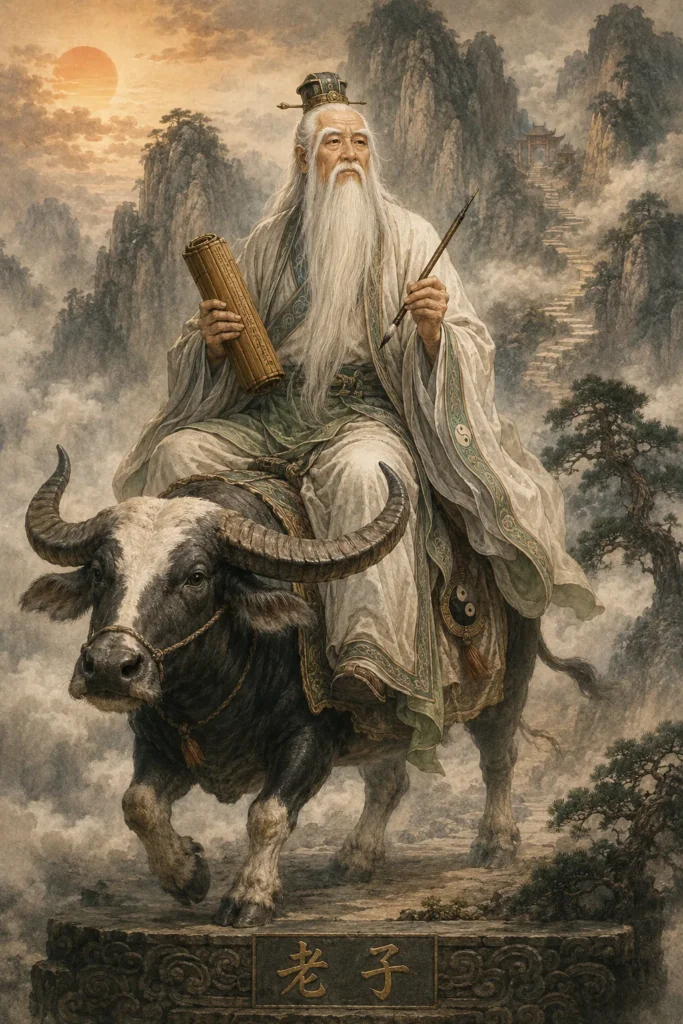
Laozi, Founder of Daoism
By Ralf Ittermann · last reviewed on
Laozi (老子, also Lao-tzu, Lao-tse) is regarded in the Chinese tradition as the founder of Daoism and as the legendary author of the «Daodejing», one of the most influential texts in the history of Chinese religion and philosophy.
His historical existence is disputed in modern scholarship; the sources on his life are sparse, contradictory and in part shaped by myth. The study of Laozi in religious studies today centers less on the historical person than on the reception history of the texts attributed to him and on his later deification.
Profile: Laozi
Laozi: the most important aspects at a glance.
In Chinese tradition, Laozi is regarded as founder of Daoism and legendary author of the Daodejing. His historical existence is disputed. The most detailed ancient biography is in the Shiji of Sima Qian, who hands down three versions and himself did not know which is correct.
As author of the Daodejing, Laozi stands for concepts such as Dao (the Way) and De (virtue). In religious Daoism he acts as Taishang Laojun, one of the three chief deities. In some regions he is venerated as a cosmic principle, in others as a personal deity for healing, protection and wealth.
The deification began in the 2nd century CE: the school of the Celestial Masters, founded by Zhang Daoling around 142 CE, venerated him as heavenly teacher and manifestation of the Dao. Emperor Xuanzong (712 to 756) bestowed an honorary title on him. Today he is present in Daoist temples in China, Taiwan and Hong Kong.
The Daodejing, with 81 short chapters, is attributed to Laozi. His guiding concepts include Dao, De, wuwei (effortless action), ziran (naturalness) and “pu,” the uncarved wood as an image of original simplicity.
Laozi stands in a series with Zhuangzi (4th century BCE), the second great Daoist author. The comparison with founders such as Confucius, Buddha or Socrates is regarded as methodologically delicate, because the notion of a single founder does not apply in the same way in the Chinese tradition.
The source situation regarding the historical person
The most detailed ancient biography of Laozi is found in the «Shiji» («Records of the Grand Historian») by Sima Qian, completed around 90 BC. Sima Qian reports three different versions about Laozi and admits himself that he does not know which one is correct.
The most popular version makes Laozi an official at the court of the Eastern Zhou dynasty who, in the 6th century BC, is said to have been a librarian or archivist.
He is said to have met the young Confucius (551 to 479 BC) and to have given instruction to the future master.
Finally Laozi, disappointed by the decline of the empire, is said to have left the country toward the west and, at the request of the border guard Yinxi at the Han-Gu Pass, to have written down the Daodejing in 5000 characters.
The second version identifies Laozi with Lao Laizi, another Daoist teacher of the Zhou period. The third version places him about 100 years later. These multiple versions show that Sima Qian himself had no reliable biographical data and compiled the material from various oral and written traditions.
Hans-Georg Möller, in «Laotse» (1995) and «The Philosophy of the Daodejing» (2006), has shown that the sparse data of Sima Qian have a legendary rather than a historical substance.
Historicity in modern scholarship
Modern sinological scholarship discusses the question of Laozi’s historicity intensively. Russell Kirkland, in «Taoism: The Enduring Tradition» (2004), has taken a critical position according to which Laozi as a historical person is barely tangible and the texts attributed to him are rather the product of several generations of Daoist-minded scholars.
This position is supported by text-historical research: according to the current view, the Daodejing is not a uniformly composed work but a compilation whose oldest layers reach back into the 4th or 3rd century BC.
The bamboo texts discovered in 1993 at Guodian (Hubei Province) contained fragments of an early version of the Daodejing, dated to the late 4th century BC. These finds have revived the discussion about the origins of the text and show that the Daodejing was edited and supplemented over the course of several centuries.
A single historical author is therefore unlikely. The tradition of attributing the work to Laozi belongs to a typical Chinese pattern of pseudepigraphic attribution to a legendary founder.
The Daodejing
The Daodejing («Classic of the Way and Virtue») is a text of 81 short chapters that unfolds fundamental Daoist concepts in a poetic, aphoristic form.
The central terms are «Dao» (Way, original cosmic reality), «De» (virtue, inner power), «Wuwei» (non-action, effortless effectiveness), «Ziran» (naturalness, so-of-itself) and «Pu» (the uncarved wood, original simplicity). Together these terms form a philosophical and religious system that was developed further in numerous later commentaries.
The most important classical commentaries on the Daodejing come from Wang Bi (226 to 249) and Heshang Gong (1st century BC or 2nd century AD). Both represent different readings: Wang Bi reads the text philosophically and ontologically, Heshang Gong religiously and practically with reference to meditation and breathing techniques.
The tension between a philosophical and a religious reading shapes the reception of the Daodejing to the present day. Livia Kohn, in «Daoism and Chinese Culture» (2001), has shown how this dual nature of the text made possible its extraordinary impact in the most varied cultural contexts.
The deification of Laozi
In the 2nd century AD the religious deification of Laozi began. In the early Daoist school of the Tianshi («Celestial Masters»), founded by Zhang Daoling around 142 AD, Laozi was venerated as a heavenly teacher and manifestation of the Dao.
He is said to have appeared to Zhang Daoling in a vision and handed him the sacred texts. Thus Laozi was no longer merely a legendary philosopher but a cosmic figure with an active religious function.
This deification was expanded over the following centuries.
In the Daoism of the Tang period (618 to 907), Laozi was regarded as Taishang Laojun («Most High Old Lord»), one of the three principal deities of the Daoist pantheon alongside Yuanshi Tianzun («Celestial Worthy of the Primordial Beginning») and Lingbao Tianzun («Celestial Worthy of the Sacred Treasure»).
In this form Laozi is present to this day in the Daoist temples of China, Taiwan and Hong Kong.
Laozi and imperial politics
Laozi played a special role in imperial politics. The Tang emperors, who bore the family name Li, claimed genealogical descent from Laozi, whose family name is said to have been Li. This genealogical construction became the ideological foundation of the Tang dynasty and led to state support of Daoism.
Emperor Xuanzong (reigned 712 to 756) conferred on Laozi the title «Most Holy Ancestor, Eternal Lord of Heaven of Mighty Virtue» and ordered that the Daodejing become required reading in the state examinations.
Florian Reiter, in «The Aspirations and Standards of Taoist Priests in the Early Tang Period» (1998), has shown how closely the religious veneration of Laozi was connected with the political self-representation of the Tang dynasty.
Imperial support led to a flourishing of Daoism, to the construction of numerous temples and to the standardization of the Daoist liturgy. This political appropriation shaped the image of Laozi lastingly and distinguishes his reception from the less institutionalized line of Confucianism.
Classification in religious studies
In religious-studies scholarship a distinction is made between «philosophical Daoism» (Daojia) and «religious Daoism» (Daojiao), a separation that has been in use since the Han period (206 BC to 220 AD). This distinction is, however, problematic because both strands merge into one another in historical reality.
Isabelle Robinet, in «Taoism: Growth of a Religion» (1997), and Harold Roth, in «Original Tao» (1999), have shown that a strict separation does not adequately reflect the historical evidence. The Daodejing too contains passages that are to be read in terms of meditative practice, while the religious currents use the philosophical terms centrally.
Volker Olles, in his works on Daoism in Sichuan, has documented the regional diversity of Laozi veneration. In some regions Laozi is venerated as a cosmic principle, in others as a personal deity with concrete fields of action (healing, protection, wealth).
This diversity shows that Daoism is not a closed religion but a broad religious tradition with numerous currents and local forms.
Laozi in comparison
The comparison of Laozi with the great founders of other religious traditions (Confucius, Buddha, Socrates) is occasionally drawn in scholarship, but it is methodologically delicate. Hans-Georg Möller has pointed out that the notion of a single founder, prominent in Western religions, does not apply in the same way in the Chinese tradition.
Laozi is less a founder in the sense of Jesus or Muhammad than a legendary symbolic figure who represents a particular tradition without having actively called it into being.
Within the Chinese tradition Laozi stands alongside Zhuangzi (4th century BC), the second great Daoist author, whose eponymous work «Zhuangzi» likewise has fundamental importance. Both are often jointly described as the founders of classical Daoism.
Hans-Georg Möller and Harold Roth have shown that the two texts set different philosophical accents but use shared basic concepts and comment on one another.
The Mawangdui and Guodian manuscripts
The text-historical study of the «Daodejing» was fundamentally changed by two archaeological finds of the 20th century. In 1973 Chinese archaeologists discovered in Tomb 3 of Mawangdui near Changsha (Hunan Province) two silk manuscripts of the text, dated to 168 BCE.
The versions «Mawangdui A» and «Mawangdui B» show a reversed arrangement of the main parts compared with the later standard text: the «De part» (chapters 38 to 81 of the standard text) precedes the «Dao part» (chapters 1 to 37).
In sinology this finding is read as an indication of an older redaction preceding the standard text. Robert G. Henricks, in «Lao-Tzu. Te-Tao Ching» (New York 1989), presented a complete English translation of the Mawangdui versions with a critical apparatus and pointed to 130 substantial differences in reading from the Wang Bi vulgate.
The second key find consists of the bamboo strips excavated in 1993 at Guodian (Hubei Province) from a tomb dated to about 300 BCE.
In three bundles they contain about two-fifths of the Daodejing text in a form not yet divided into two parts. This version is today regarded as the oldest material textual witness of the Daodejing complex. Robert Henricks, in «Lao Tzu’s Tao Te Ching.
A Translation of the Startling New Documents Found at Guodian» (New York 2000), presented a first philological edition; Sarah Allan and Crispin Williams, in the collected volume «The Guodian Laozi» (Berkeley 2000), discussed the methodological consequences for the dating question.
Harold D. Roth, in «Original Tao» (New York 1999), has shown that the Guodian bamboo strips locate the Daodejing text as part of a broader current of early meditative-cosmological reflection, whose traces are also tangible in «Neiye» and «Heguanzi».
Commentary tradition and religious appropriation
The productive reception history of the Daodejing is carried primarily by its commentary tradition. Three commentaries are regarded in sinology as canonical.
The «Heshanggong commentary» («Lao-tse commentary of the Master on the Riverbank»), traditionally dated to the Han period (in fact probably the 1st to 2nd century CE), reads the text within a program of bodily self-cultivation and thereby shapes the later Daoist tradition of inner alchemy (neidan).
Eduard Erkes published the first systematic treatment of the Heshanggong commentary in a Western language in the «Artibus Asiae» in 1950; Alan K. L. Chan, in «Two Visions of the Way» (Albany 1991), compared the Heshanggong commentary with the second canonical commentary.
This second commentary comes from Wang Bi (226 to 249), a representative of the «xuanxue» («Teaching of the Mysterious») of the Wei-Jin period, and recasts the text into an ontological-metaphysical line in which «nothingness» («wu») is read as the ontological ground of being.
Wang Bi’s commentary lastingly shaped the later Chinese reading of the text and is the basis of the overwhelming majority of today’s standard editions.
The third central commentary is the «Xiang’er commentary» («Explanation in Thought of You»), produced in the 2nd or 3rd century in the circles of the early «Tianshi» (Celestial Masters) Daoists.
Stephen R. Bokenkamp, in «Early Daoist Scriptures» (Berkeley 1997), translated the Xiang’er commentary into English in full for the first time and showed that the religious appropriation of Laozi as the personal deity «Taishang Laojun» is already fully developed in this layer and did not first arise in the later Lingbao and Shangqing schools.
International reception
The Daodejing is, alongside the Bible, the most frequently translated book in the world. The first European translations date from the 18th century; in the 19th and 20th centuries the work was made accessible to a broad Western readership through translators such as Richard Wilhelm, James Legge and Arthur Waley.
In the 20th century Laozi also exerted considerable influence on Western philosophy, on the psychotherapeutic tradition and on the esoteric movement, often in a heavily simplified and Western-reinterpreted form.
Today Laozi scholarship is an international field in which Chinese, Taiwanese, Japanese, European and American sinologists take part. The discussions about dating, textual history, philosophical reading and religious function are lively.
One conclusion of the research so far can be noted: the question of the historical Laozi is possibly less important than the question of the reception history of the texts attributed to him, which belong among the most formative works of world literature and of the history of world religion.