Tsukuyomi, God of the Japanese Tradition
By Ralf Ittermann · last reviewed on
Tsukuyomi is a god of the Japanese tradition.
Moon god, quiet power of the night sky, eternal separation.
Brief Profile: Tsukuyomi
Type: Japanese deity (Shinto), moon god
Pantheon: Shinto
Function: moon, night sky, the course of time
Main attributes: lunar disc, black court robe
Main cult sites: Tsukiyomi-no-Miya in Ise (belonging to the Naiku), Tsukuyomi shrines in Kyoto and Yamashiro
Siblings: Amaterasu (sun, sister), Susano-o (storm, brother)
Historical Classification
Period of the Texts
Tsukuyomi (Jap. Tsukuyomi-no-Mikoto, “Exalted Moon Reader”) has been attested in literature since the 8th century CE in the Kojiki (712) and Nihon shoki (720). Unlike his sister Amaterasu, he is a relatively marginal deity.
After the central conflict myth (he murders Ukemochi, the goddess of food), Amaterasu turns away from him and never sees him again, which is the mythological explanation for why the sun and the moon do not stand together in the sky.
The main heyday of his cult remains modest; in modern Shinto he is a peripheral but present kami.
Area of Distribution
Main cult sites: Tsukiyomi-no-Miya within the Ise shrine complex (assigned to the Naiku, the inner sanctuary of Amaterasu; symbolically, the siblings do not communicate directly). In addition there are Tsukuyomi shrines in Kyoto and in the former province of Yamashiro. Tsukuyomi veneration occurs in any Shinto shrine that specializes in lunar aspects (relatively rare).
Source Situation
Central sources: Kojiki (Book I), Nihon shoki (Book I), Engi-shiki. Secondary literature: Aston, Shinto; Breen/Teeuwen (eds.), Shinto in History; Heldt (trans.), The Kojiki; Bocking, A Popular Dictionary of Shinto.
Name and Variants
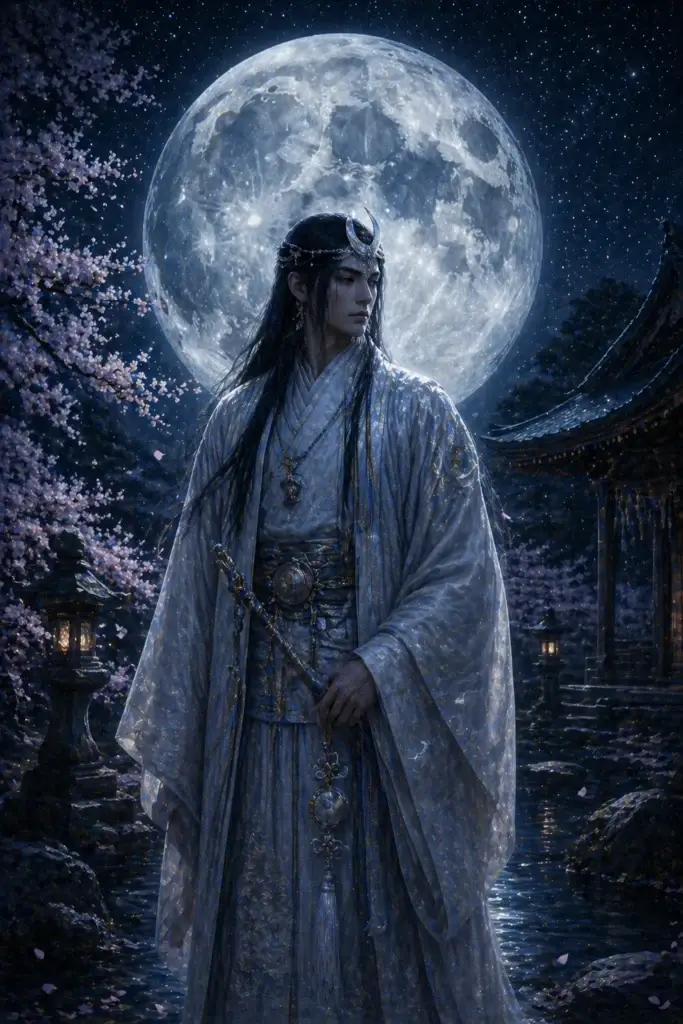
Tsukuyomi is rarely depicted in images, making him one of the most underrepresented deities of Japan. When depicted, he appears elegant, silver and luminous, yet at a distance. The moon itself is his body and his mirror. In iconographic systems he is shown beside Amaterasu, but spatially removed or separated by heaven and earth.
His symbol of passing is the cycle of lunar phases itself, the new moon, the full moon, the recurring darkness. Silver robes and moonlight are the iconographic signatures wherever he appears. His symbol is the lunar phase cycle itself.
Characteristics
Tsukuyomi is the moon, the administrator of the night, the regent of time (lunar and imperial). His main function is cosmic and mechanical: he governs the moon and thereby the night, the tides, and for earlier cultures the reckoning of time itself.
However, there are only a few Tsukuyomi shrines; his veneration is subsumed within general Shinto rituals or within private household altars.
The philosophical content runs deeper than the veneration: Tsukuyomi is Japan’s mythic symbol for that which exists in parallel yet separately, the night that is the opposite of the imperial light without being evil. A mournful distance is central to his identity.
Appearance and Symbolism
Tsukuyomi is depicted as a man with pale or silvery skin, often shrouded in moonlight. His image is less elaborated than that of Amaterasu or Susanoo. He is sometimes equated with the moon itself or shown enthroned upon the moon. His color is silver or blue.
Profile: Tsukuyomi
The most important aspects of Tsukuyomi at a glance. The following fields summarize origin, function, appearance, veneration, symbols and cultural parallels.
Tsukuyomi arises from Izanagi’s right eye when the latter purifies himself after returning from Yomi (the underworld), while Amaterasu arises from the left eye and Susano-o from the nose. He is the brother of Amaterasu (sun) and Susano-o (storm).
In the central myth he murders Ukemochi (goddess of food) because she brings forth the dishes from her body, which he perceives as impure. Afterwards Amaterasu turns away from him and never sees him again.
Moon god and patron of the moon’s course. In the Shinto calendar his phases determine the ritually important lunar days. He is patron of nocturnal activities and of the counting of time.
In some folk traditions he is patron of rice cultivation (through the moon phases). In personal cult he is rarely invoked directly, but rather serves as a background presence in the night sky.
Tsukuyomi has no fixed iconographic depiction; in the orthodox Shinto tradition the making of statues of the gods is avoided.
In later pictorial traditions he appears as a solemn male figure in a dark court robe with a crescent moon or lunar disc as his attribute. In contrast to Amaterasu’s warm golden hues, cold silver tones dominate with Tsukuyomi.
Area of influence: Tsukuyomi is venerated at Tsukiyomi-no-Miya (Ise) and at the few Tsukuyomi shrines. In agricultural tradition his moon phases play a role (rice sowing, sowing times). In personal cult he is rather peripheral. In modern anime and manga he is often received as a mysterious, cool character.
Lunar disc, crescent moon, black or dark blue court robe. Sacred animals: none specific. Sacred plants: plants associated with the moon (in modern esotericism: lotus, moonseed).
Selene (Greece, moon goddess, female), Luna (Rome, female), Sin/Nanna (Mesopotamia, moon god, male), Khons (Egypt, moon god, male), Chandra/Soma (Hinduism, moon god, male), Máni (Germanic, moon god, male), Chang’e (China, moon figure, female). Here the moon is predominantly male, with female exceptions (Selene, Luna, Chang’e); in Japan he is set against the female sun Amaterasu.
Protective Practice
Veneration Rituals
Tsukuyomi-no-Mikoto (Jap. 月読命, “Lunar Reading Highness”) is the moon god, brother of Amaterasu and Susanoo. He was born from Izanagi’s right eye (Kojiki I, ch. 11). Compared to Amaterasu and Susanoo, his cult is little developed; the main shrines are the Tsukuyomi-no-Miya (in the Ise inner shrine) and the Tsukuyomi shrine in Yamashiro.
Tsukimi (the moon-viewing festival, on the 15th day of the 8th lunar month) is dedicated to him, with rice-ball offerings (tsukimi dango) and pampas grass (cf. Picken).
Invocations
Norito prayers at the Tsukuyomi-no-Miya in Ise follow the Ise ceremonial. In the Manyoshu (8th century) Tsukuyomi appears frequently in poems of love and separation. The mythic episode of the murder of the food goddess Ukemochi (Nihon Shoki) explains the separation of sun and moon.
Amulets and Protective Symbols
Half-moon and full-moon amulets of silver serve as Tsukuyomi protection. At the Hagi moon festival, white rice balls (15 of them, symbolic of the 15th lunar day) and seven autumn grasses (aki no nanakusa) are placed on a veranda.
Stone statues of the moon god stand in Shinto shrines. The myth of the hare in the moon is interpreted as an attribute of Tsukuyomi.
Tsukuyomi, Parallels in Other Cultures
Tsukuyomi resembles the Greek Selene (moon goddess), the Roman Luna, and the Chinese Chang’e. In contrast to these, Tsukuyomi is male and structurally absent, more concept than person. With the Mexican Tezcatlipoca he shares the nocturnal wildness (but Tezcatlipoca is evil, Tsukuyomi is not).
The Zen philosophical principle of the empty or the still resembles Tsukuyomi’s nature. Unique is the cosmic tragedy: he and Amaterasu are not actually estranged but structurally so, for the moon and the sun cannot shine together in the sky.
Tsukuyomi in the Oldest Sources
Tsukuyomi, the moon god of Japanese myth, is recorded in the oldest surviving Japanese writings, in the Kojiki of the year 712 and in the Nihonshoki of the year 720. These two works are the principal sources for native Japanese mythology, and everything that can be said about Tsukuyomi with certainty derives at its core from them.
Tsukuyomi is one of the three children whom the creator god Izanagi brings forth when he undergoes a purification after his return from the underworld.
While washing his face, three significant deities arise: from the left eye the sun goddess Amaterasu, from the right eye the moon god Tsukuyomi, and from the nose the storm god Susanoo.
Izanagi assigns realms of rule to his children; Tsukuyomi is granted dominion over the night, or over the realm of the night.
It is striking how little the sources report about Tsukuyomi. While Amaterasu and Susanoo stand at the center of numerous detailed narratives, the moon god remains a shadowy figure. This scarcity of sources is a central feature of the Tsukuyomi tradition and should be kept in mind in any study of him.
Japanese mythological research has weighed various explanations for this, from an originally independent moon cult later suppressed to the assumption that the compilers of the 8th century simply had no richer tradition at their disposal.
The Murder of the Food Goddess
The only coherent narrative in which Tsukuyomi appears as an actor is found in the Nihonshoki and concerns his encounter with the food goddess Ukemochi. Amaterasu sends Tsukuyomi to earth to visit this goddess. Ukemochi entertains him by bringing forth rice, fish and game from her mouth and preparing a meal for him from them.
Tsukuyomi finds this manner of producing food impure and offensive. Out of indignation he kills the food goddess.
From her corpse the most important food plants and domestic animals then arise: from the head, cattle and horses; from the forehead, millet; from the eyes, panicle millet; from the belly, rice; from the genitals, wheat and beans.
This episode belongs to a mythic narrative type in which the cultivated plants arise from the slain body of a being, a type also known from other cultures.
The consequence of the deed for Tsukuyomi himself is significant. When Amaterasu learns of the murder, she is so enraged that she renounces her brother and declares that she no longer wishes to see him.
Since then, so the myth explains, the sun and the moon are separated and appear in the sky at different times, never meeting one another.
This narrative is thus at the same time an aetiological myth that explains the separation of day and night.
In the Kojiki, incidentally, a very similar story is attributed not to Tsukuyomi but to Susanoo, a difference between the two principal sources that has occupied scholarship and that counsels caution in all statements about the moon god.
Cult, Shrines and the Problem of the Source Situation
Compared to Amaterasu, whose veneration at the Grand Shrine of Ise stands at the center of the Japanese cult of the gods, Tsukuyomi has only a modest cultic presence. There are, however, shrines dedicated to him.
Within the precinct of the Ise sanctuary itself there are subsidiary shrines connected with Tsukuyomi, and in other places in Japan, too, Tsukuyomi shrines are found, for instance in the region around Kyoto.
The weak cultic standing of the moon god stands in striking relation to the significance that the moon otherwise holds in Japanese culture. Moon viewing, tsukimi, the contemplation of the autumn full moon, is a firmly rooted cultural custom, and the moon is a central motif of classical Japanese poetry.
This culturally highly valued moon, however, is precisely not closely linked to the figure of the god Tsukuyomi. The aesthetic and the mythological engagement with the moon proceed largely separately in Japan.
For the study of religion, Tsukuyomi is above all an instructive example of the limits of our knowledge. Unlike many deities about whom rich myths, cult texts and archaeological testimonies survive, here the source situation is thin.
Serious statements about Tsukuyomi must rely on the few passages in the Kojiki and Nihonshoki and must mark everything beyond them as conjecture.
Some accounts that endow Tsukuyomi with rich character traits or elaborated stories do not rest on the old sources but on modern popular culture, in which the moon god has indeed become a popular figure. This distinction between attested findings and modern elaboration is especially important here.
Sources and Literature
Further standard works in the literature index.