iWell Guard

Lu, Spirit of Naga Religious Practice

Lu is a spirit of Naga religious practice.

Water and earth spirits of the Tibetan tradition, guardians of springs, lakes and soils.

Table of Contents

Lu - spirits from the Tibet tradition, historical-illustrative

Lu (klu)

The Lu (Tib. klu) form one of the most important classes of spirit beings in the Tibetan worldview. They are water and earth spirits, guardians of springs, lakes, rivers, wetlands and certain soils.

In their ambivalence they stand between danger and blessing: those who respect the Lu gain prosperity, health and fertility; those who disturb their spaces, through pollution, improper digging or the felling of sacred trees, bring illness and misfortune upon themselves.

Iconographically and in terms of religious history, the Lu are closely related to the Indian nāga. In the Buddhist subjugation under Padmasambhava, many Lu became dharmapalas (protective spirits); others remained active as local, sometimes dangerous forces.

Adaptation from the Indian Naga Tradition

The Lu of Tibet are directly derived from the Indian Naga tradition, yet were localized in a specific context. While the Indian Naga is a king serpent with magical powers who lives in subterranean temples, the Lu of Tibet is more of a water deity or a water king with a more fluid nature.

The transformation shows how religious concepts are reshaped by climate and geography: the Indian Naga, at home in a tropical, rain-rich culture, becomes the Lu, who exists in the icy highland rivers of Tibet.

The retained features are water dwelling, control of wealth and a tendency toward anger when injured. The new features are associations with cold, the formation of mist and a stronger focus on the fertility of rock springs.

Brief Profile: Lu

Type: Water and earth spirits
Origin: Pre-Buddhist Bon; Indian Nāga tradition
Texts: Padmasambhava cycles, Kangyur/Tengyur, local ritual manuals
Effect: Skin diseases, leprosy, edema, water disorders when disturbed
Defense: Lu torma, offerings (milk, saffron, honey), avoiding the Lu places at the wrong time

Classification

Period of the Texts

The Lu belong to the oldest strata of Tibetan religiosity. Pre-Buddhist Bon texts describe them as one of the three main categories of beings (alongside lha and btsan).

With the introduction of Buddhism in the 7th century, the Tibetan conception of the Lu merges with the Indian Nāga tradition: the Nāga become part of the Buddhist pantheon (for example Muchilinda, who protects the meditating Buddha from rain), and Tibetan Lu take on naga iconographic traits.

The traditions attribute the subjugation of numerous Lu to Padmasambhava (8th century). Individual Lu were elevated to protective spirits of particular monasteries.

Area of Distribution

Lu are present throughout the Tibetan cultural sphere, especially at lakes, rivers and springs. Prominent are the Lu of Lake Manasarovar, Namtso, Yamdrok and numerous smaller mountain lakes. Every region, every village knows its own Lu sites.

Typical places: springs and wells, lakes, riverbanks, damp meadows, certain trees (often juniper), the roots of large rocks, holes in the earth.

Source Situation

Core sources: Padmasambhava cycles; Kangyur/Tengyur with Nāga sutras and related texts; local ritual manuals of individual monasteries; Bon compendia. Modern standard works: de Nebesky-Wojkowitz (1956); Samuel (1993); Karmay, Samten G. (1998) The Arrow and the Spindle.

Field research of the 20th and 21st centuries has documented numerous ritual details, among others in Ladakh, Bhutan, Sikkim and the Amdo region.

Name and Variants

Tibetan klu, pronounced Lu or Lü in the various dialects. Corresponds to the Indian Sanskrit term nāga.

  • Klu rgyal, “king of the Lu”.
  • Klu mo, female Lu.
  • Klu gnyan, especially powerful or dangerous Lu.
  • Sa bdag dang klu, the group of earth and water spirits together.

Description

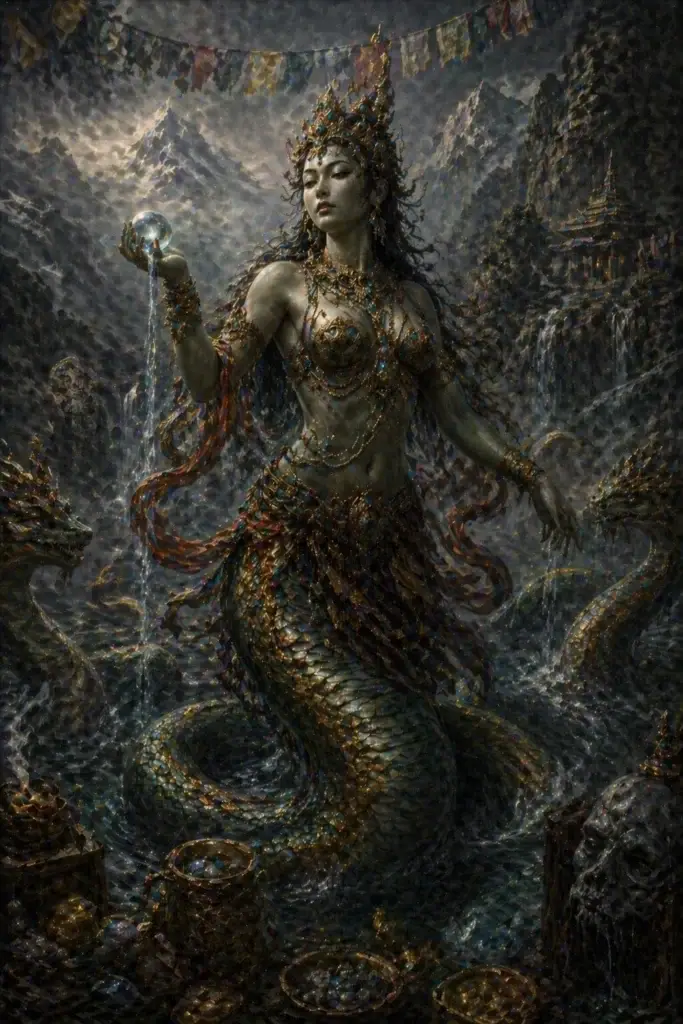
Appearance. Depicted in images like the Indian Nāga: human upper bodies with long, crowned serpent bodies; in white, blue, green or red coloring, depending on the class. The “Nine Lu Kings” (klu rgyal dgu) form an iconographic group.

Behavior. The Lu are sensitive to defilement: polluted waters, careless felling of trees, burning on Lu territory, construction work without prior rituals, even washing laundry in sacred lakes can trigger Lu punishments.

Diseases. Typical Lu diseases are skin ailments, leprosy, edema, kidney problems, chronic skin conditions in children, certain forms of mental clouding.

Lu Diseases and ritual Treatment

Contact with the Lu leads to a specific category of diseases that in modern terms are often associated with infections or disorders of the nervous system.

In the traditional understanding, a Lu disease is the consequence of injury to water: impure rituals in rivers, contamination of drinking water, river pollution or sexual acts at water sites.

The symptoms are often moisture-related: edema, diarrhea, expectoration of mucus, gout. Rituals to appease the Lu involve water offerings (chu-mchod), the casting of offerings into the water, blessing formulas and sometimes longer meditation retreats at springs or sacred lakes. A specialized lama or local shaman with Lu expertise is often necessary.

Profile: Lu

The most important aspects of the Lu at a glance.

Origin

Pre-Buddhist Bon stratum, closely related to the Indian Nāga; partially integrated into Buddhism through Padmasambhava.

Lu's Target Group

Farmers, well builders, fishermen, herders, all who work the soil or use bodies of water; children who play carelessly at springs.

Lu's Appearance

Human upper body with a serpent body, several colors depending on the class; in contact often invisible, they show themselves in serpent form or during rituals.

Sphere of Influence

Skin ailments, leprosy, edema, kidney ailments, loss of wells, crop failures, plagues among livestock; positive: rain at the right time, fertility, prosperity.

Protection

Lu torma offerings of flour, milk, honey and saffron; recitation of the Klu-‘bum; restitution through purification rituals and tree planting; avoidance of harmful actions at Lu sites.

Related Beings

Indian Nāga; Chinese dragons (lóng); Japanese ryū; Korean Mul-gwishin motifs concerning those who drowned.

Practical Defense

Lu torma. The central ritual for reconciliation with the Lu: small figures of roasted barley flour (tsampa), mixed with milk, honey and saffron, are placed in bowls at sacred waters or springs.

Klu-‘bum. The “Hundred Thousand Lu Invocations” are a Tibetan Buddhist collection of ritual texts recited to appease the water and earth spirits.

Purification rites during construction work. Before any house building, well, path digging or tree felling, the ground is blessed by a lama; offerings to Sa-Dag and Lu are meant to avoid disturbance.

Everyday avoidance. Do not urinate into sacred waters, do not wash laundry in certain lakes, avoid certain trees, basic rules of courtesy in dealing with the beings.

Lu, Parallels in Other Cultures

India/Hinduism. The Nāga are the direct root in religious history; they appear in the Mahabharata, the Puranas and in Buddhist literature.

Buddhism. Nāga as listeners of the Buddha and as guardians of sacred texts are present throughout the Buddhist sphere; the Tibetan Lu tradition takes over and modifies this heritage.

China. The Chinese dragon (lóng) overlaps functionally with the Lu: rule over water, the bringing of rain, imperial dignity.

Japan. The ryū dragon and the kappa share individual traits of water rule and water danger.

Local Tibetan Specializations and Water Blessing

Various regions of Tibet have developed their own Lu traditions. The Lu of the Brahmaputra region (southern Tibet) are characterized differently from the Lu of the Indus region (western Tibet). Some Lu are described as white and benevolent, others as black and dangerous.

In some local traditions, Lu are not primarily water deities but earth queens who dwell beneath mountains and control water reserves. Farmers and herders present Lu offerings to secure good rainfall and the flow of springs.

In modern Tibet, the veneration of the Lu is linked with ecological awareness: the protection of the Lu is read as equivalent to the protection of water resources.

The klu between the Indian nāga and Tibetan Heritage

The Tibetan klu (pronounced lu) are an example of how pre-Buddhist and Buddhist conceptions have overlapped in Tibet. With the adoption of Buddhism from India from the 7th century onward, the Indian nāga also came to Tibet, serpent-shaped water spirits of Indian mythology.

The Tibetan translators chose the native word klu for nāga. With this, two traditions merged: the Indian conception of the nāga as guardians of waters, treasures and teachings, and an evidently already existing Tibetan class of earth and water spirits.

Research, in particular René de Nebesky-Wojkowitz in Oracles and Demons of Tibet, places the klu within the tripartite Tibetan model of space: they inhabit the depths, that is springs, lakes, rivers, wells and the interior of the earth, while the gnyan occupy the surface and the btsan the heights.

The klu are regarded as wealthy, as guardians of minerals and mineral resources, and at the same time as sensitive to the pollution of their domains.

According to traditional belief, anyone who pollutes a spring, burdens a body of water with refuse, digs up earth at sensitive sites or fells trees at watering places risks the wrath of the klu.

The diseases attributed to them affect above all the skin: rashes, leprosy-like manifestations, swellings. Here too the pattern of the place-bound Tibetan spirits shows itself, whose relationship to humans is regulated through purity, consideration and the avoidance of transgressions.

Purity, Disease and the Ritual Reconciliation of the klu

The traditional way of dealing with the klu revolves around the concept of purity. Since they were regarded as sensitive to pollution, avoiding the defilement of their dwelling places was an everyday precaution.

Certain acts, such as washing impure things in a spring or burning dirty materials near a body of water, were regarded as dangerous, because they could offend the klu. Disease was then interpreted as their response.

If a person fell ill and the symptoms, above all skin diseases, were interpreted as a klu punishment, a distinct repertoire of reconciliation rituals was brought into play.

This included purifying ceremonies and the presentation of especially pure, often white or milky offerings, as well as the erection or renewal of small shrines, the lu khang or lu bum, in which the klu were venerated.

A klu bum, a vessel with pure substances, could serve as a permanent dwelling and place of offering. This practice combined, as was usual in Tibet, pre-Buddhist, Buddhist and Bon elements.

Remarkable is the dual nature of the klu. They are dangerous, but also a source of wealth, fertility and prosperity. A well-treated klu dwelling place could bring thriving to a family or a place.

In the Buddhist stratum of the tradition, the klu additionally appear as guardians of hidden teachings, a motif that derives directly from the Indian nāga tradition, in which the nāga preserve texts until the world is ready for them.

The klu are thus not a simple harmful being, but an ambivalent power with which a regulated relationship, determined by purity and respect, had to be maintained.

Further Links

Recommended internal links:

Research Literature

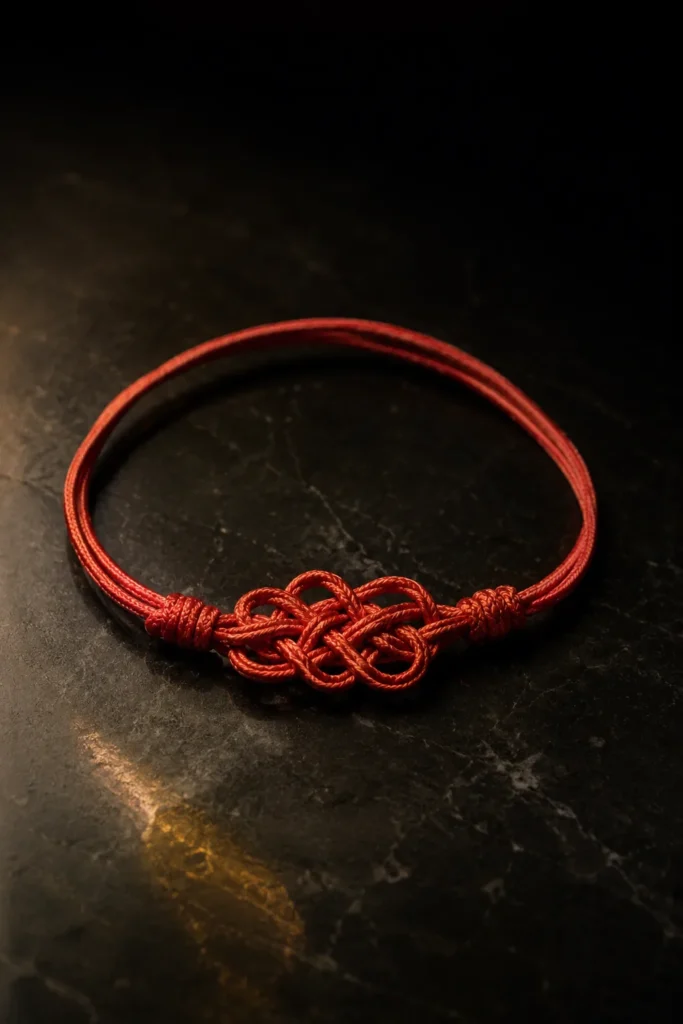
The protective practice described here is a religious-studies classification of historical traditions. iWell Guard ties in with this cultural-historical line of wearable protective objects and represents a contemporary form of it. More about the iWell Guard →

Classification & Protection

IIILEVEL
The Protection Compass assigns this being to influence level III, Burdensome influence.

Against its influence, cross-cultural tradition names these protective means:

Compare in the Protection Compass →

Recommended protective means

iWell Guard

The simplest protective means in this collection: 41 layers of fine gold 999, platinum, silver and silicon, manufactured in Ruhla, Thuringia. It requires no activation, is bound to no person, and is effective within a radius of around 50 meters, even without being worn.

All protective means at a glance →