Oni, Demon of Japanese Tradition
By Ralf Ittermann · last reviewed on
Oni is a demon of Japanese tradition.
Large, horned ogres of Japanese folk and hell tradition.
The Oni’s Setsubun ritual
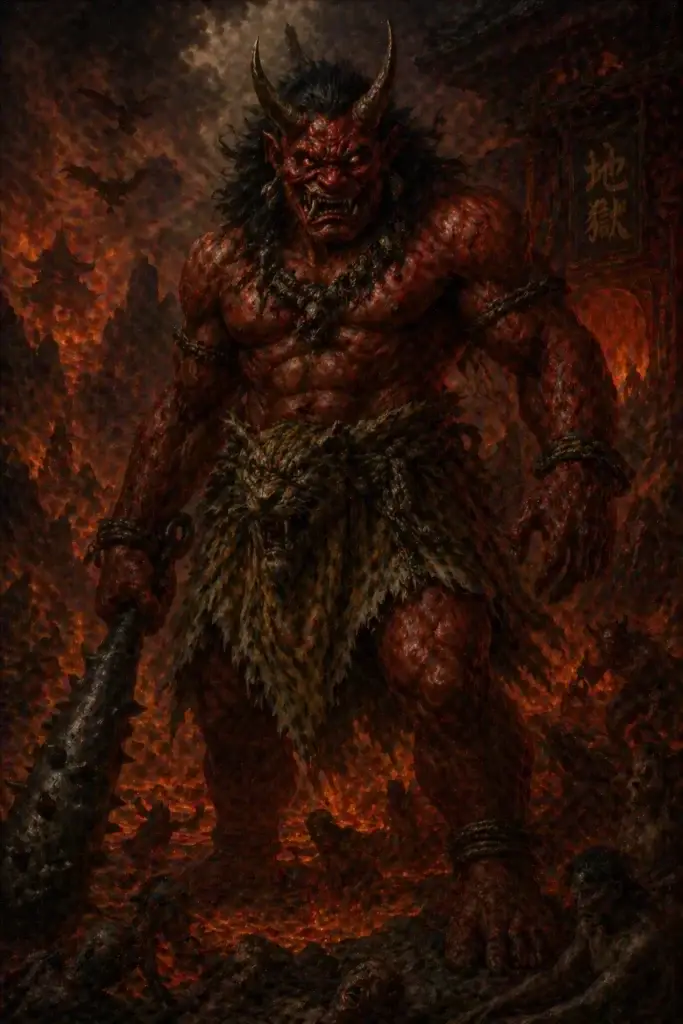
Oni are the large horned demons of Japanese Buddhist folk religion. Iconographically: red or blue skin, one or two bull horns, fangs, a loincloth of tiger fur, and an iron club (kanabō).
During the Setsubun festival (3 February, the start of spring according to the old lunar calendar), families throw roasted soybeans out of the windows and call out: Oni wa soto, fuku wa uchi (“Oni out, fortune in”).
The custom purifies the house for the new year. Their function in the Buddhist hell pantheon: as guardians of Naraka in Yama’s realm of hell, they punish the damned with club and sawmill.
As fixed figures, oni serve as gate guardians at the entrances of temples: Aka-oni (red, anger), Ao-oni (blue, cold and sorrow). Related folk traditions: Setsubun dances, oni pantomime, and the Namahage ritual on the Oga Peninsula (Akita) at New Year.
Oni (鬼) are among the best-known figures of Japanese demonology. In their typical depiction they are tall, muscular, with horns, fangs and red or blue skin. They often wear a tiger-fur loincloth and carry a club-like iron rod (kanabō).
The term unites two distinct strands of tradition: an older folk belief close to Shintō, in which oni appear as sinister mountain beings and guardians of the dead, and a Buddhist line in which oni are the wardens of the Naraka hells under the judge of the dead, Enma-ō.
Brief Profile: Oni
Type: ogre, hell warden, mountain spirit
Origin: folk belief and Buddhist cosmology
Texts: Konjaku Monogatarishū, Ōe no Masafusa’s “Honchō Shinsenden”, Noh dramas (e.g. “Rashōmon”)
Period: attested from the 8th century; full iconography established in the Muromachi and Edo periods
Protection: Setsubun bean-throwing, peachwood, the spinal-column mantra
Classification
The oldest written records of oni-like beings date from the 8th and 9th centuries. The character 鬼 comes from Chinese, where it first denotes the dead and their spirits (guǐ). In Japan this meaning merges with native conceptions of mountain and wilderness beings.
Between the 10th and 14th centuries, the classic narrative profile develops in setsuwa literature: oni as man-eating highwaymen at mountain passes, raiding travellers and abducting children. In the Muromachi period (14th to 16th century) they become iconographically fixed in illustrated handscrolls (emaki).
Oni stories are spread comprehensively across the Japanese archipelago. Regional variants exist especially in the mountain regions of Honshū, for example on Mount Ōe near Kyōto, the setting of the Shuten-dōji legend, and on Mount Suzuka in Mie Prefecture.
In the northeastern Tōhoku region, the Namahage ritual is well known, in which men in oni masks visit houses at the turn of the year.
Typical settings for oni encounters in the literature are mountain passes, ruins, abandoned temples and the borderlands between settlement and wilderness.
Important textual sources are the Konjaku Monogatarishū (12th century), which contains numerous oni stories, as well as the Muromachi-period otogizōshi tales (including “Shuten-dōji”). For the Buddhist line, the texts concerning Enma-ō and the ten judges of hell are relevant.
Oni become visually tangible in the Noh masks of the hannya and ja series, as well as in the yōkai picture books of the Edo period. Toriyama Sekien catalogues several oni variants in his works (from 1776).
Name
The term 鬼 (oni) combines several meanings: (1) a large, horned ogre, (2) a spirit of the dead, (3) a hell warden, (4) figuratively “something extraordinary” or “cruelly capable” (for example shigoto no oni, “workaholic”).
- Akaoni, the red oni, a symbol of anger.
- Aooni, the blue oni, a symbol of cold and grief.
- Kimon, the “demon corner”, the northeastern direction from which oni come.
- Yaksha / yasha, Buddhist parallel figures.
Description
Form. Oni are usually described as man-sized or gigantic, with a muscular build, one or two horns, red, blue or occasionally green skin, sharp fangs and three fingers on each hand. They wear tiger-fur loincloths, an allusion to the northeastern “tiger gate” direction.
Equipment. Their typical attribute is the iron rod (kanabō). The saying “oni ni kanabō”, “to give an oni an iron rod”, denotes the redoubling of an already overwhelming situation.
Behaviour. Oni rob people, devour children and abduct women. In the Buddhist hell scenes they beat, tear apart and boil sinners.
The most important aspects of Oni at a glance. These details deepen and complement the preceding chapters.
The Oni’s Origin
Folk belief and Buddhist hell cosmology; iconographically linked with the northeastern direction (kimon), which in Heian-period court architecture was regarded as the “demon gate” and was guarded by structural devices.
The oldest written traces go back to the 8th century, while the pictorial type with horns and tiger-fur loincloth only consolidates in the medieval period under the influence of the Tendai school.
Those Affected
Travellers in the mountains, inhabitants of remote farmsteads, and children after nightfall; in the Buddhist line, the dead at their judgement in the afterlife.
Folk tales warn especially of forks in the road, bridgeheads and the hour of the ox (around two o’clock in the morning), at which an oni is said to find easier access to the human world. In temple sermons, the oni were moreover held up as an admonishing figure for the living.
Appearance
Large, horned, with fangs and a tiger-fur loincloth; coloured red or blue, occasionally also black or green.
As an attribute the oni usually carries the iron club (kanabō), whose spiked head is proverbial in the saying “giving the oni a club” (“oni ni kanabō”) for a power that is already superior and is reinforced still further.
Female oni (kijo) appear in the Noh plays with long hair and a single hint of a horn on the forehead.
Activity
Abduction of people, child-snatching, acts of violence; in hell (jigoku) the oni act as torturers under the judge Enma, who examines the dead at the mirror of truth.
Metaphorically, an “oni” also appears in everyday-language attributions for illness, plague or sudden misfortune; a hard, unbending person is proverbially called an “oni father” or “oni teacher”, without an exclusively negative connotation.
Forms of Protection
The Setsubun bean-throwing (“oni wa soto, fuku wa uchi”) on the eve of the old start of spring; roasted soybeans, thrown within the family circle at a masked family member, are held to be effective when their number matches one’s age.
Further means are peachwood, holly twigs with a skewered sardine head (hiiragi-iwashi), Buddhist sutras and the recitation of mantra formulas, especially the Heart Sutra.
Counterparts
Chinese guǐ, Korean dokkaebi; Indian yaksha and rakshasa; Tibetan tsen warrior spirits. Structurally related are also the Mongolian chötgör and, in western antiquity, the lamiae; all share the motif of the man-hostile boundary figure that must be kept at a distance through rite, noise or wrought-iron implements.
Protective Practice
Setsubun. At the turn from winter to spring, roasted soybeans are thrown into the home and out the door with the call “oni wa soto, fuku wa uchi”. The ritual is widespread throughout Japan and lives on in shrines and households to this day.
Hiiragi-iwashi. A holly twig with a skewered, roasted sardine head is fastened at the entrance to the house to keep oni away; the sharp smell and the prickly leaves are held to be effective.
Peachwood. According to the Izanagi myth (Kojiki), the primordial god drove off the pursuing hell beings with peaches; peachwood has since been regarded as apotropaic.
Namahage. In the Oga area (Akita), the Namahage ritual at New Year sends men in oni masks from house to house, admonishing idle household members and children, an ambivalent combination of fright and blessing.
Oni, Parallels in Other Cultures
China. The character 鬼 and the basic meaning “spirit of the dead” come from Chinese; see Gui on the China page.
Korea. The Dokkaebi shares traits with the oni: horns, club, trickster nature; during the colonial period it was wrongly equated with the oni, but it is an independent figure.
India/Buddhism. Yaksha and Rakshasa are early models of oni iconography; with Buddhism the figure travels via China and Korea to Japan.
Europe. Ogres and trolls share the size and the bond to the wilderness; there is no direct historical connection.
Setsubun: The Festival of Demon Expulsion
The best-known ritual handling of the oni in present-day Japan is the festival of Setsubun, celebrated on the eve of the calendrical start of spring in early February.
Its centrepiece is the bean-throwing, mamemaki, in which roasted soybeans are thrown through house and door with the call Oni wa soto, fuku wa uchi (Oni out, fortune in).
In many households one family member, often the father, takes on the role of the oni and wears a mask while the others throw the beans.
In temples and shrines, public ceremonies take place, at which celebrities sometimes throw the beans into the crowd. In some places people eat as many beans as their years of age, plus one for the coming year.
The custom goes back to older rites of warding off evil that were connected with the turn of the year. A precursor ceremony, tsuina or oniyarai, is already attested for the court of the Heian period and itself derives from Chinese models of spirit expulsion.
Religious studies sees in Setsubun a typical threshold ritual that masters the dangerous transition between the old and the new season through symbolic purification and the expulsion of evil.
The bean as a throwing implement is interpreted in various ways, among others through a play on words with the term for the eye of the demon.
The Oni in the Buddhist Conception of Hell
An essential part of the oni conception draws on the Buddhist image of the hells, which came to Japan with the religion from China and Korea. In the hells, Japanese jigoku, the oni are the tormentors and guardians who torture the damned according to the instructions of the judge of the dead, Enma.
Two types of hellish oni are especially well known. The one, gozu, has the head of an ox; the other, mezu, the head of a horse.
They drive the sinners with iron clubs, boil them in cauldrons or force them onto mountains of blades. These depictions were popularized in Japan through the medieval hell handscrolls, the jigoku zoshi, as well as through sermons and temple paintings.
The iconographic features regarded today as typical of oni go back in part to these Buddhist models: the red or blue skin, the horns, the fangs, the iron club (kanabo), the loincloth of tiger fur.
Scholarship points out that the Japanese oni conception flowed together from several sources, alongside the Buddhist hell guardian also from native conceptions of mountain-spirit and plague-bringing beings as well as from Chinese terms for spirit and spirit of the dead.
The character for oni originally denotes a spirit of the dead in Chinese, which further complicates the shift in meaning within the Japanese context.
Momotaro and the Oni in Narrative and Theatre
The oni are deeply anchored in the Japanese narrative tradition.
The best-known story is the tale of Momotaro, the peach boy, who is born from a peach, sets out with a dog, a monkey and a pheasant as companions to the island of the oni, Onigashima, defeats the demons dwelling there and brings home their treasures.
The tale gained particularly wide circulation in the Edo period and was also politically instrumentalized in the 20th century.
In classical theatre the oni appear regularly. In Noh theatre there is a separate category of plays featuring demonic beings, and certain masks represent oni or humans transformed into demons.
The play Momijigari is famous, in which a beautiful woman reveals herself to be a mountain demon. The transformation of a jealous or wronged woman into an oni is a distinct and frequent motif, which also finds its iconic expression in the hannya mask.
Another well-known narrative tradition centres on Shuten-doji, a leader of oni who plagued the capital from Mount Oe and was slain by the hero Minamoto no Yorimitsu and his companions.
This story is handed down in medieval handscrolls and texts. Scholarship often sees in such narratives a working-through of historical conflicts, for instance the subjugation of marginal groups or rebels, who were depicted in literature as demons.
Further Links
Further reading:
- Culture page Japan (overview of Japanese demonology).
- Further individual profiles from Japan: Tengu, Kappa, Yūrei, Yuki-onna.
- Parallels: Gui (China), Dokkaebi (Korea), Guardians of Naraka (Buddhism).
Research Literature
The protective practice described here is a religious-studies classification of historical traditions. iWell Guard ties in with this cultural-historical line of wearable protective objects and represents a contemporary form of it. More about the iWell Guard →