Apophis, Demon of the Egyptian Tradition
By Ralf Ittermann · last reviewed on
Apophis is a demon of the Egyptian tradition.
Primordial serpent and embodiment of chaos, the daily enemy of the sun’s journey.
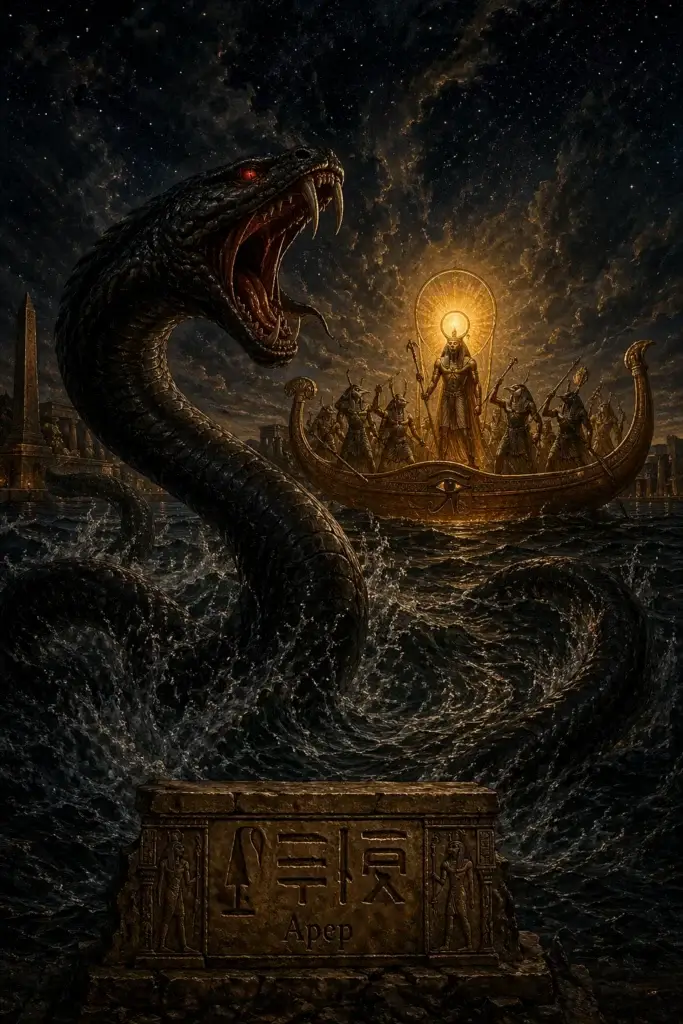
Apophis
Apophis, Egyptian ꜥꜣpp, Greek Apophis, is the most powerful threat in the ancient Egyptian worldview. As the primordial serpent, he opposes Maat, the cosmic order. Every night he threatens the solar journey of Ra through the underworld; every morning he is defeated, but never definitively destroyed.
This makes him an unusual figure: he is less an individual entity than a cosmic counter-principle. His cult is one of pure apotropaic practice; in texts and rites he is named only to be annihilated. The most famous of these rites, the Apophis dismemberment ritual, is documented in detail in Late Period papyri.
Short Profile: Apophis
Type: Primordial serpent, chaos being
Origin: Before creation; the unordered itself
Texts: Book of Apophis (Apophis Papyrus), Books of the Afterlife, Book of the Dead
Period: Middle Kingdom to Late Period
Distribution: Entire Egyptian cultural sphere
Warding off: Apophis dismemberment ritual, incantations, wax figurines
Context
Period of the Texts
The earliest attestations come from the Coffin Texts of the Middle Kingdom; the Apophis theology is fully developed in the Books of the Afterlife of the New Kingdom (Amduat, Book of Gates). The most extensive ritual tradition is found in the so-called Book of Apophis, preserved in Late Period and Ptolemaic papyri.
Area of Distribution
The concept of a chaos serpent is anchored throughout the entire Egyptian cultural sphere and is not regionally limited. In apotropaic rites, Apophis was cursed as a representative of every form of disorder: cosmic, political, and personal.
Sources
The central sources are the Book of Apophis (several papyri from the 22nd and 30th Dynasties), the Books of the Afterlife with their serpent beings, and the ritual texts for solar protection. These are supplemented by iconographic evidence in tombs and temples, in which Apophis is depicted almost exclusively at the moment of his defeat.
Name
Egyptian: ꜥꜣpp, pronounced roughly “apep”; the determinative is frequently the serpent hieroglyph.
Greek: Ἄποφις – Apophis.
Further forms: ꜥpp, occasionally in a feminine variant ꜥpp.t.
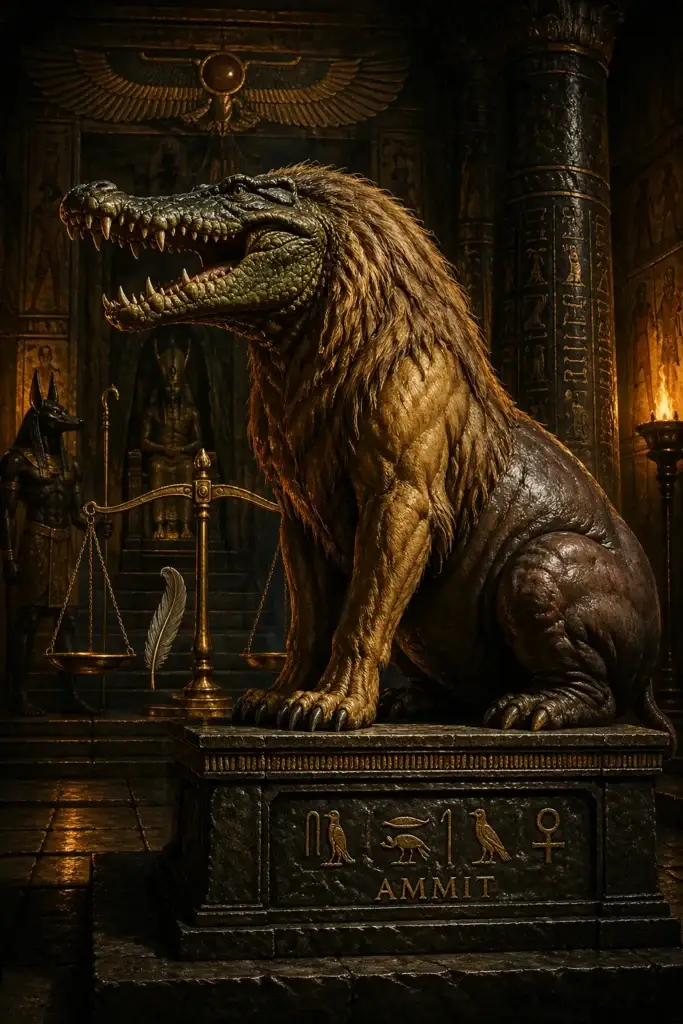
Unlike Ammit or Taweret, Apophis is never venerated as a deity. His name is expressly “struck down”, meaning it is ritually crossed out or overwritten in order to reinforce his annihilation. The Egyptians understood language and writing as actively effective: to speak the name of chaos meant to curse it.
Characteristics
Appearance
Apophis is an enormous serpent, often described as immeasurably long, with countless coils. He has no fixed dwelling place but lurks at the boundaries of the ordered world, particularly in the seventh hour of the night. In visual art he is shown almost exclusively at the moment of his defeat: pierced by spears, dismembered, burned.
Behavior
His action is always the same: he attacks the solar barque and attempts to halt the sun’s journey. He swallows, threatens to engulf, and disturbs the flow of the underworld’s waters. Night after night. Negotiation is not possible; the only response is annihilation by gods and humans acting together.
Sphere of Influence
In the mythic sense: the transition between worlds, the underworld, especially the seventh hour of the night. In the ritual sense: wherever disorder threatens, in the temple, at royal consecration, in illness, at the borders of the land.
Mythological Origin
Apophis exists before creation. He did not come into being but is part of the uncreated that accompanies creation. This primordial nature is decisive: the god Ra cannot definitively destroy him, because he is ontologically older than order itself.
Profile: Apophis
The key aspects of Apophis at a glance. Detailed treatment of his name, description, warding-off practices, and parallels can be found in the following sections.
A primordial serpent existing before creation, not of divine descent. Embodiment of the cosmic counter-principle: the unordered.
The solar barque of Ra, the cosmic order as a whole, every transition between night and day. In ritual terms: the temple, the kingship, the community.
An enormous serpent with countless coils. In imagery almost always shown at the moment of defeat: dismembered, pierced, burned.
Attack on the solar journey, disruption of the night, threat to cosmic order. Defeat is possible; total destruction is not.
Apophis dismemberment ritual: shaping a wax figurine, cutting it apart, spitting on it, burning it, burying the remains. Names are crossed out; writing is used as a weapon.
Tiamat (Mesopotamia), Leviathan (Jewish tradition), Vrtra (Vedic tradition), the dragon in Christian iconography (Revelation 12); the Midgard Serpent (Germanic tradition).
Practical Means of Protection
Rituals for Warding Off
The Apophis dismemberment ritual is the most prominent example. A wax figurine of the serpent is shaped, inscribed with Apophis’ name, and cursed. It is then cut apart, spat upon, burned, and the remains are buried or thrown into the river. The rite was repeated regularly in the temple cult.
Incantations
The spells of the Book of Apophis invoke Ra and his companions, name the enemies of the sun, and curse them. The formulae are highly condensed and cite the mythic defeat as a present event; the ritual makes the annihilation present again and again.
Amulets and Protective Symbols
Specific Apophis-warding amulets are rare, because the demon does not attack the individual person but the cosmic order. Indirect protective effect is provided by Ra and Udjat amulets, which keep the victorious sun present.
Apophis: Parallels in Other Cultures
Near East: Tiamat from the Babylonian Enuma Elish is the closest structural parallel: a primordial power that precedes order and must be defeated in the act of creation. Leviathan in the Hebrew Bible takes up this motif and carries it further into Jewish and Christian apocalyptic literature.
Indo-European sphere: Vrtra in the Rigveda, the dragon Python defeated by Apollo, the Midgard Serpent in Germanic mythology: all embody a primordial force that threatens the ordered world and is overcome by a divine hero.
Christian reception: The dragon of the Book of Revelation directly takes up the motif of the cosmic enemy of chaos and links it to eschatological dissolution. Later depictions of the dragon in saints’ legends and art also follow the Apophis schema structurally.
The Nocturnal Battle: Apophis and the Solar Barque
The central mythic function of Apophis lies in his nightly threat to the solar journey. According to Egyptian belief, the sun god Re traverses the underworld in his barque during the twelve hours of the night, in order to rise again in the east at dawn.
On this journey, Apophis, the enormous serpent of chaos, lies in wait and attempts to halt or engulf the barque.
This battle is described in detail in the Books of the Underworld of the New Kingdom, especially in the Amduat and the Book of Gates, which are inscribed on the walls of the royal tombs in the Valley of the Kings.
Apophis appears there most often in the seventh hour of the night as a colossal serpent.
Re himself does not intervene directly; his companions in the barque defend him. A particular role falls to the god Seth, who uses his strength to confront the serpent and pierce it. Other deities, including some in the form of cats, also appear as subduing powers.
It is important that Apophis is never definitively destroyed. Night after night he is dismembered, burned, and driven back, yet returns every night.
Scholarship interprets this as an expression of a fundamental principle of Egyptian religion: the world order, maat, is not a state achieved once and for all, but must be won anew in an ongoing cycle.
Apophis is thus less an enemy to be vanquished than the abiding counter-principle against which order must prove itself anew each day.
The Book of the Overthrow of Apophis
A particularly illuminating source is a collection of ritual texts referred to in Egyptological research as the Book of the Overthrow of Apophis.
It is preserved mainly in Late Period papyri, including the Papyrus Bremner-Rhind, though it goes back to older originals. The text contains instructions for a ritual that was performed regularly in the temple, primarily at Thebes, to ward off Apophis.
The ritual was an act of harmful magic directed against chaos. The priests fashioned images of Apophis, such as wax figurines, papyrus sheets bearing his painted or written name, or drawings of the serpent on a leaf.
These images were spat upon, trampled with the left foot, cut apart with knives, and finally burned in fire. The process was accompanied by spells that cursed Apophis and declared his annihilation.
The logic behind this is that of Egyptian image and name magic: what was done to the image and the name was intended to become reality for the being it represented.
By ritually annihilating Apophis each day, the priests contributed to maintaining the cosmic order and simultaneously offered symbolic support to the sun god on his nightly journey.
From a religious-studies perspective, the text is an important witness to how closely myth and ritual were intertwined in Egypt: the nocturnal battle in the underworld found its counterpart in the concrete, repeatable temple ritual of the visible world.
The Name as Weapon: Taboo and Erasure
The treatment of Apophis illustrates with particular clarity the Egyptian conception of the power of the name. A name was considered part of the being it designated; to speak or write it could make the designated being present. In the case of Apophis, this idea was exploited in two ways, working in opposite directions.
On one hand, the name was written in order to be subsequently destroyed ritually. In the apotropaic texts, the name Apophis is often furnished with additions intended to devalue it, for example with signs expressing weakness or death.
On the other hand, manuscripts attest the practice of deliberately damaging the name or the serpent sign used to write it, crossing it out or depicting it as cut through with a knife, so that the written sign itself could not exert any harmful effect.
Connected to this is the observation that Apophis, unlike most other figures of Egyptian religion, had no cult and no temple. He was not a recipient of offerings but exclusively the object of warding-off and annihilation. The aim was not reconciliation but erasure.
Scholarship sees in this consistent negativity a special case. While other dangerous powers of Egyptian religion, such as Seth or Sekhmet, were ambivalent and possessed useful aspects as well, Apophis remained the pure counter-image of order.
He embodied what existed before creation and what threatens it afterward: the undifferentiated, life-hostile chaos. Those seeking more on the Egyptian conception of order will find further references in the entry on Maat.
Further Links
Further reading:
- Egypt (parent culture page)
- Ammit (counterpart in the judgment of the dead)
- Mesopotamia (parallel: Tiamat)
- Leviathan and the dragon (Jewish and Christian reception)
- Chaos and Maat (mythological context)
Sources and Literature
Further standard works in the literature index.
The protective practices described here represent a religious-studies classification of historical traditions. iWell Guard connects with this cultural-historical lineage of wearable protective objects and offers a contemporary form of it. More about the iWell Guard →
Frequently Asked Questions about Apophis
Who was Apophis in Egyptian mythology?
Apophis (Egyptian Apep) was, in ancient Egyptian belief, the embodiment of chaos: an enormous serpent that attempted each day to devour the sun god Re on his nightly journey through the underworld.
Every sunrise was a victory of order (Maat) over chaos. Apophis texts (the Books of Apophis) were read aloud ritually in the Karnak temple to combat the serpent by magical means.
How was Apophis ritually combated?
The Book of Apophis (Papyrus Bremner-Rhind, c. 4th century BCE) preserves an elaborate anti-Apophis ritual: a wax figurine of the serpent was inscribed with the name of Apophis, pierced with a knife, spat upon, trampled underfoot, and finally burned.
Such destructive magic rites were unusual in Egypt; they show how seriously the cosmic threat posed by Apophis was taken.