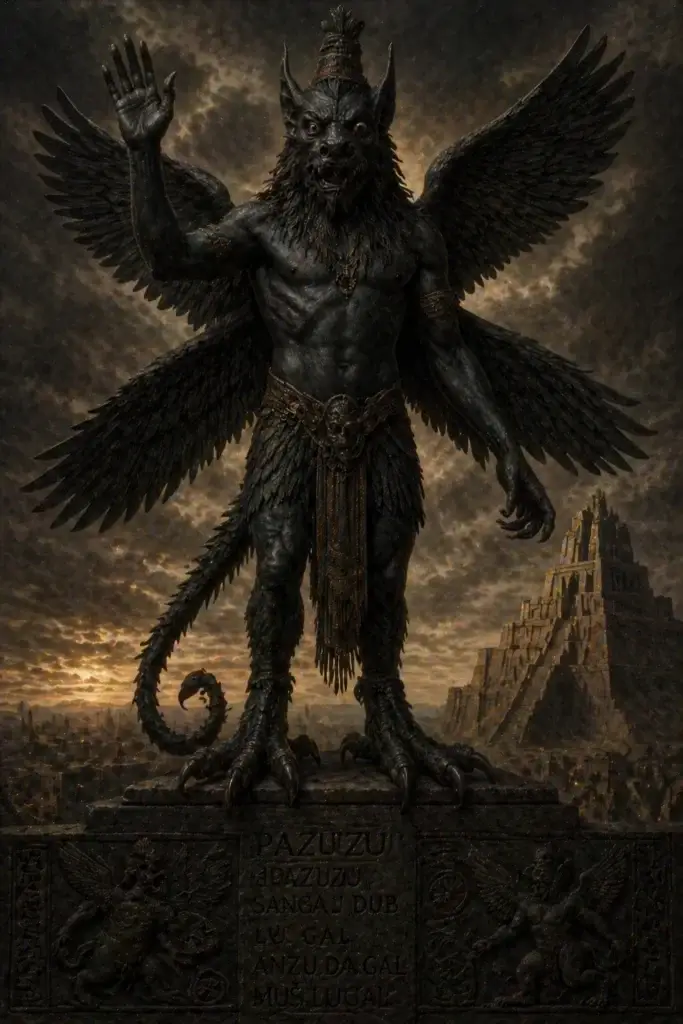
Lamashtu, demon of the Mesopotamian tradition
By Ralf Ittermann · last reviewed on
Lamashtu is a demon of the Mesopotamian tradition.
Demon of children and women in childbed of ancient Mesopotamia.
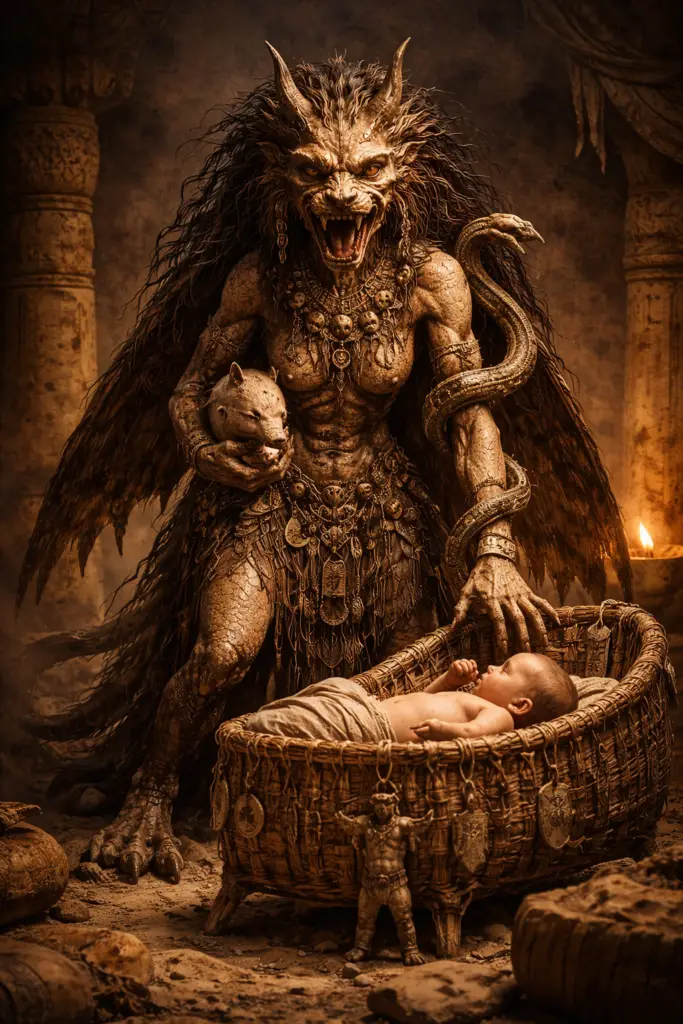
Lamashtu
Lamashtu is among the most fully documented demons of ancient Mesopotamia. Unlike many nameless disease or wind beings, she appears in the cuneiform texts as an individual figure with her own origin story, a fixed sphere of activity and a characteristic visual language.
She threatens pregnant women, women in childbed and newborns, brings fever and unrest, and is associated with infant death, miscarriages and so-called child-snatching motifs.
Against her attacks, Mesopotamia developed a dense network of conjurations, amulets and ritual acts, at the center of which, well into the late Assyrian-Babylonian period, stood the protective demon Pazuzu.
Short Profile: Lamashtu
Type: Demon of disease and birth
Origin: Daughter of the sky god Anu
Texts: Lamashtu series, conjurations, diagnostic tablets
Period: 2nd to 1st millennium BC
Distribution: Babylonia, Assyria, further areas of influence
Defense: Pazuzu amulets, conjurations, ritual expulsion
Context
The tradition concerning Lamashtu is attested in both Sumerian and Akkadian. The material is densest in the 2nd and 1st millennia BC, particularly in the so-called Lamashtu series, a compiled sequence of conjurations and ritual instructions preserved across several tablets.
Find sites range from Nippur, Uruk and Babylon to Assur and Nineveh. Lamashtu is thus present throughout the entire Mesopotamian cultural sphere. Parallels and successors of the motif can also be traced in the eastern Mediterranean region into late antiquity.
The Lamashtu series forms the textual core. Added to this are individual conjuration tablets, medical diagnostic tablets, amulet plaques of bronze or clay with incised conjurations, as well as iconographic testimonies on reliefs and seals. For a Mesopotamian demon, the state of the sources is unusually dense.
Name
Akkadian: Lamaštu (in modern transcription often written “Lamashtu”).
Sumerian: Dimme, also attested as dDÌM.ME.
Further written forms: Labartu (older European translations), Lamashtum.
Titles and epithets: among others “Daughter of An/Anu”, “Great Daughter of Heaven”.
In cuneiform her name is frequently provided with the divine determinative d, which linguistically places her close to a deity. Functionally she is nonetheless regarded as a demon: she is not venerated but warded off.
This dual classification, as the daughter of a sky god and at the same time a dangerous being, is an important characteristic. It underlines that in Mesopotamia “demonic” does not automatically mean “against the gods”. Lamashtu acts on her own authority and dangerously, but cosmologically she is not located outside the divine order.
Description
Appearance
Lamashtu is described in texts and images as a hybrid being.
Typical features are a lion’s head or lion-like face, the teeth of a donkey, a human or partly bird-like upper body, claws or bird talons on the feet, long and disheveled hair, as well as bared breasts at which she suckles animals, often a piglet and a dog. In her hands she often holds snakes.
Behavior
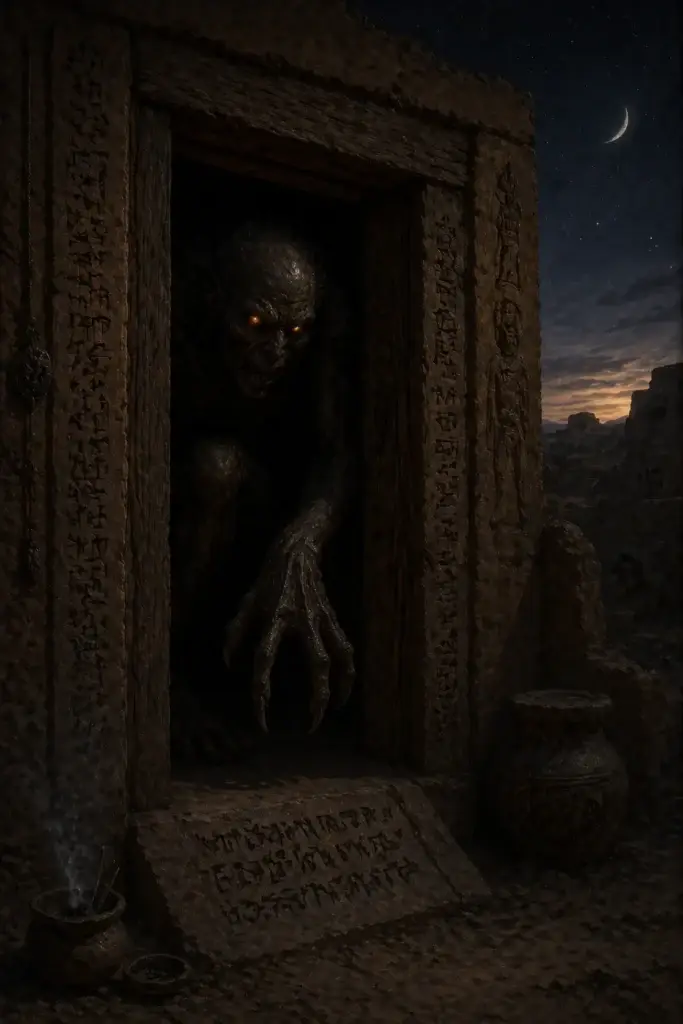
The texts describe her activity in recurring motifs. She creeps in “through the window like a snake”, slips into the house, reaches out her hand toward the belly of the pregnant woman or takes the newborn from the mother’s breast.
She acts covertly, preferring the night and moments of weakness: during birth, in childbed, in the sleep of children.
Sphere of Effect
Her grasp is directed especially at pregnant women and the unborn (miscarriage, stillbirth), women in childbed (childbed fever, mental exhaustion), infants and small children (sudden infant death, unexplained fever, convulsions), nursing mothers (lack of milk, infections), as well as travelers and the weak in the desert.
She is thus primarily a demon of the domestic space and of the most vulnerable phases of life.
Mythological Origin
In the texts Lamashtu is designated as the daughter of the sky god Anu. Because of her behavior, she is cast down from heaven into the world of humans.
The narrative follows a pattern that recurs frequently in Mesopotamia: a being is divine by its origin, yet dangerous by its actions. Evil is thus not a counter-principle but a derailed order.
Profile: Lamashtu
The most important aspects of Lamashtu at a glance. The detailed treatment of name, description, defense and parallels can be found in the following sections.
Daughter of the sky god Anu, cast down from heaven. Her name is frequently written with the divine determinative: a divine origin, yet not venerated.
Pregnant women, women in childbed, newborns, nursing mothers, small children. She acts above all in the domestic space and during birth.
Lion’s head, donkey’s teeth, bird talons, disheveled hair, snakes in her hands. At her breasts she suckles a piglet and a dog.
Fever, miscarriage, childbed fever, sudden infant death, lack of milk, unexplained convulsions. An explanatory figure for deaths that were previously incomprehensible.
Pazuzu amulets as the principal means. Multi-night ritual cycles of the āšipu, conjurations from the Lamashtu series, symbolic expulsion downstream.
Lilith and ardat-lilî (Jewish), Lamia, Gello, Mormo (Greco-Roman), Gellou and Abyzou (late antiquity), Pontianak (Southeast Asia).
Protective Practice
Rituals of defense
Against Lamashtu, multi-night ritual cycles of the āšipu (conjuration priest) were customary. They combined purification of the woman in childbed and the child, symbolic expulsion of the demon, for instance through a small clay image that was sent away “downstream”, and prescribed offering acts.
Conjurations
The Lamashtu series transmits numerous formulas that call the demon by name, recount her origin and command her to leave the house. They combined divine authorization with concrete instructions for the midwife, priest and relatives, and gave structure to an otherwise powerless situation.
Amulets and protective symbols
Especially well known are amulet plaques bearing the image of Lamashtu and a conjuration directed against her. Pregnant women wore them on the body, and households hung them over the child’s bed.
The male demon Pazuzu was regarded as one of the beings that could effectively drive Lamashtu away; Pazuzu heads and figurines protected doors, beds and pregnant women.
Lamashtu, Parallels in Other Cultures
Jewish tradition
Lilith and the figure of the ardat-lilî show clear functional overlaps with Lamashtu. Lilith as a threat to women in childbed and to children is well attested; protective amulets bearing her name remained in use into late antiquity and the Middle Ages.
Greco-Roman world: figures such as Lamia, Gello and Mormo take on the role of the child-killing demon. Here too, amulets and protective formulas against the death of newborns are found.
Late antiquity and beyond: Gellou and Abyzou texts connect with the fight against infant death and miscarriage and partly carry into medieval Christian material. In Southeast Asia, Pontianak takes on comparable functions. European folk-belief figures such as the “child-snatcher” or the “night mare” also take up similar fears, without direct dependence.
The Lamashtu Amulets: Image and Conjuration in a Single Object
Lamashtu is one of the few Mesopotamian powers of harm for which an extensive and well-datable pictorial tradition has survived.
From the second and first millennia before our era, numerous amulets are known, mostly of stone or metal, which show the demon in a fixed iconographic formula. Typical is a being with a lion’s or dog’s head, donkey-like teeth, hanging breasts and bird talons.
In her hands she often holds snakes, at her breasts a piglet and a young dog suckle, and she stands or kneels on a donkey. Alongside these, a ship, comb, spindle and other objects are often depicted, interpreted as gifts or provisions for the journey with which one sought to induce the demon to depart.
Many of these amulets bear conjuration texts in cuneiform on the back or on the narrow sides.
Image and word thus formed a unity: the object showed the enemy and at the same time contained the formula meant to banish it. Such amulets were worn above all by pregnant women and women in childbed, since Lamashtu was regarded as a threat to mother and infant.
A distinct group of objects are the multi-figure bronze tablets, often referred to in scholarship as Lamashtu plaques. They show in several registers the demon, her adversary and rows of protective hybrid beings.
Some of these tablets were provided with a ring at the top and could be hung up, presumably in the area of the childbed. The large number of surviving pieces from various find sites shows that protection against Lamashtu was among the most widespread concerns of Mesopotamian everyday religion.
Pazuzu as Counter-Power: A Demon Against the Demon
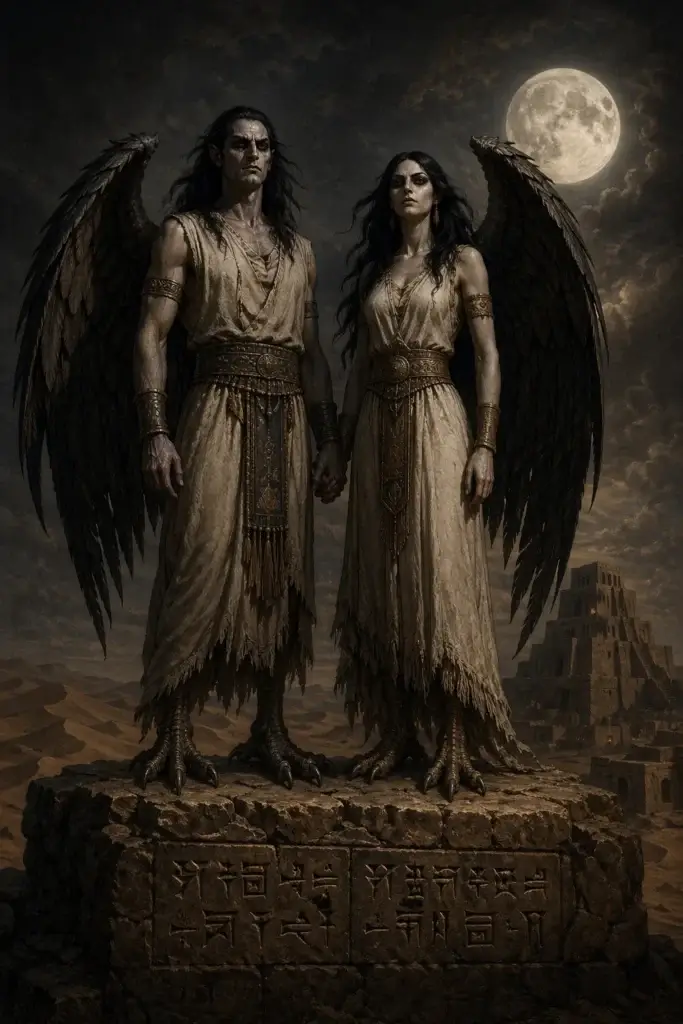
A peculiarity of the defense against Lamashtu is that her main opponent was himself a demon. Pazuzu, a winged hybrid being with a dog-like face, was regarded as the lord of the evil winds, but was for precisely that reason deployed against Lamashtu.
On many Lamashtu plaques, the head of Pazuzu appears at the upper edge, as if looking over the scene from behind, or the whole Pazuzu pushes the demon toward the edge of the tablet and in the direction of the water, across which she was meant to return to the underworld.
The principle behind this can be described as fighting the evil with kindred means. Pazuzu was not a benevolent guardian spirit but a fearsome figure, yet his aggressiveness could be directed against another power of harm.
Pazuzu heads were also worn as independent amulets and hung on houses. The frequent combination of both figures in a single object shows that Mesopotamian defensive practice did not think in simple categories of good and evil, but in terms of balances of power and areas of responsibility.
Alongside these stood other protective figures. In the conjurations, Lamashtu is often brought before gods such as the water god Ea and his son, who pronounce judgment over her and order her departure.
The ritual texts describe how a clay image of the demon was made, equipped with provisions for the journey and removed toward the west or into the water. The combination of fearsome helper, divine court and material sending-away yields a dense, internally coherent system of remedy and precaution.
The Conjuration Series and the Logic of the Accusation
The texts against Lamashtu are transmitted in a multi-tablet conjuration series that has been edited and studied in Assyriology. It contains conjurations, ritual instructions and descriptions of the demon. It is striking that the texts do not simply treat Lamashtu as a formless threat, but ascribe to her a biography and a character.
She is designated as the daughter of the sky god Anu, who was cast down from heaven because of her evil nature. She does not act on the orders of the gods, unlike the disease demons that are sent as messengers, but of her own accord.
This self-willed nature is the key to the ritual strategy. Because Lamashtu is not sent by the gods, one can bring her before the gods and raise an accusation against her.
The conjurations enumerate her misdeeds, she threatens pregnant women, snatches the infant, intrudes through windows and door hinges, and they demand her removal in the name of the great gods. The ritual act is thus modeled on a court proceeding: there is an accused, an accusation, a judging body and a verdict that pronounces banishment.
For scholarship, these texts are therefore also a source for Mesopotamian conceptions of law, responsibility and the interpretation of illness.
Illness in childbed, miscarriage and infant mortality were not understood as blind chance, but as the attack of a nameable power against which one could proceed with word, image and action. This gave those affected a framework for action in a situation that would otherwise have been marked by powerlessness.
Further Links
Further reading:
- Mesopotamia (parent culture page)
- Pazuzu (direct adversary and protective demon)
- Lilû and Lilītu (functionally related night beings)
- Lilith (later parallel figure in the Jewish tradition)
- Night beings and sleep paralysis (thematic proximity)
Literature (Selection)
Further standard works in the literature index.
The protective practice described here is a religious-studies classification of historical traditions. iWell Guard ties into this cultural-historical line of wearable protective objects and represents a contemporary form of it. More about the iWell Guard →
Frequently Asked Questions about Lamashtu
Who was Lamashtu?
Lamashtu was a Mesopotamian demon regarded as the daughter of the sky god Anu. She threatened pregnant women and infants in particular, bringing miscarriages, childbed fever and sudden infant death. Lamashtu is considered one of the oldest documented harmful-being figures in the history of world religions.
How did people protect themselves against Lamashtu?
The most important protection against Lamashtu was a Pazuzu amulet, paradoxically another demon, who was nonetheless deployed as an anti-Lamashtu protector. Alongside these there were special conjuration tablets (Lamashtu tablets), amulets with animal forms and ritual texts that held the demon’s own weakness up to her, in particular her return home to her father Anu.