Kartikeya, Hindu god of war
By Ralf Ittermann · last reviewed on
Kartikeya is a Hindu god of war who is regarded as the youthful commander of the gods and vanquisher of demonic powers. Kartikeya, also known as Skanda, Murugan, Subrahmanya or Kumara, is the god of war and commander of the divine forces in Hinduism.
He is the son of Shiva and Parvati and the brother of Ganesha. His mount is the peacock, his weapon the spear (Vel).
In southern India, especially in Tamil Nadu, Kartikeya is one of the most widely worshipped gods under the name Murugan.
In northern India his veneration is less prominent, though he is recognized everywhere within the classical pantheon. In terms of religious history, he is regarded as an important example of the fusion of Dravidian and Sanskritic traditions.
Profile: Kartikeya
Kartikeya: the most important aspects at a glance. The following fields summarise origin, function, appearance, veneration, symbols and parallels.
Kartikeya is the son of Shiva and Parvati. He was born in the reeds (Sharavana) after Shiva’s seed had fallen into the fire of Agni and into the Ganges, and was suckled by the Krittikas, the six stars of the Pleiades. In terms of the history of religion, Dravidian and Sanskritic traditions merge in him.
Kartikeya is the war god and commander of the divine army, appointed to this by Indra. He pierced the demon Taraka with his spear and is regarded as protector of the gods and guardian of the cosmic order. In Tamil Nadu, as Murugan, he is one of the most widely worshipped gods.
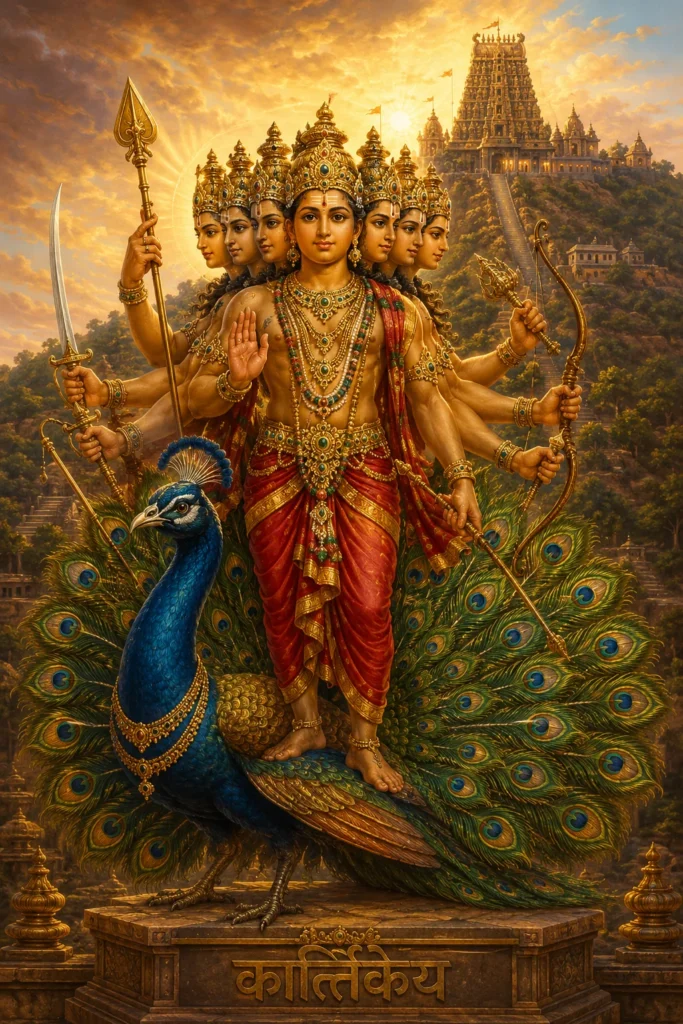
In the form Shanmukha he has six heads and twelve arms, in the South Indian form Subrahmanya one head and four arms. His garment is usually red, his jewellery of gold, and on his head he wears a crown. In South India he often appears with two consorts, Devasena and Valli.
The most important temples are the six abodes of Murugan (Arupadai Veedu) in Tamil Nadu, including Palani and Tiruchendur. The most important festival is Thaipusam in January or February with penitential processions in which believers carry kavadi. Skanda Sasthi in October or November commemorates the destruction of Taraka.
The main symbol is the spear Vel, which pierces ignorance. His mount, the peacock, embodies beauty, pride and the mastery of passions. The banner bears the cock, a sign of vigilance and the beginning of the day.
As war god Kartikeya resembles the Greek Ares, the Roman Mars and the Germanic Tyr, and because of the peacock and his solar nature also Apollo. The motif of the special birth recurs with Faridun in the Persian Shahnameh, with Moses on the Nile and with Romulus. The parallels are regarded as typological.
Myth and Origin
Kartikeya’s birth is closely connected with the need to defeat the demon Taraka. Through long ascetic practice, Taraka had obtained from Brahma the boon that only a son of Shiva could kill him. Since Shiva had withdrawn into asceticism after Sati’s death, such a son seemed unattainable.
The gods therefore awakened Kama, the god of love, to lead Shiva to Parvati. Shiva burned Kama with his third eye, but Parvati eventually won him through her own ascetic practice. Kartikeya was to issue from their marriage.
The birth itself is told in various versions. In the Mahabharata (Vana Parva 224-231) and in the Skanda Purana it is described that Shiva’s seed was so powerful that even Parvati could not receive it. The seed fell into the fire of Agni, then into the Ganges, then into the reeds (Sharavana).
From the reeds Kartikeya was born. He was suckled by the Krittikas, the six Pleiades stars. Hence the name Kartikeya (“son of the Krittikas”). Because he had six wet nurses, he developed six heads. Another name, Shanmukha (“the six-faced one”), refers to this.
In “Asceticism and Eroticism in the Mythology of Siva” (1973) Wendy Doniger interpreted this multiple birth genealogy as a reflection of two narrative layers: an older one in which Kartikeya appears as son of the Pleiades (presumably an ancient star cult), and a younger, Brahmanical one in which he is integrated into the Shiva-Parvati family.
This fusion was largely complete in the first millennium AD.
The mythical linkage of Taraka’s invulnerability and the need for a son of Shiva is, in terms of religious history, one of the most important cosmological narrative structures of Hinduism.
It connects the theological constellation of Shiva and Parvati with the eschatological necessity of destroying the demon. Without Shiva’s awakening from asceticism, without Parvati’s courtship, without the cosmic marriage, the world would have been subjugated by the demon Taraka.
The mythical birth from the reeds is a variant of the widespread motif of the unusual birth of great heroes.
In the Persian Shahnameh, Faridun is born under similar protection; in the Hebrew Moses myth there is the exposure in the reeds of the Nile; in the Roman Romulus myth there is the exposure of the twins.
This typological parallel was systematically described by Otto Rank in “Der Mythos von der Geburt des Helden” (1909). Kartikeya’s birth fits into this universal pattern, with the specifically Indian features of the reed birth and the Krittikas’ nursing.
Symbols and Attributes
Kartikeya’s most prominent attribute is the spear, Vel (Tamil) or Shakti (Sanskrit). This spear is not only a weapon but also a symbol of spiritual enlightenment, since it pierces ignorance. In Tamil Nadu the Vel is venerated as a central cult object in many Murugan temples.
He is typically depicted with six heads and twelve arms (Shanmukha form) or with one head and four arms (in the southern Indian Subrahmanya form). The six heads embody the six Krittika wet nurses. In southern India the single-headed form predominates, in northern India the six-headed form.
His mount is the peacock (Mayura). The peacock embodies beauty, pride and the control over the serpent (which the peacock holds in its claws, a symbol of mastery over the passions). In Tamil Nadu the connection between Kartikeya and the peacock is one of the central iconographic features.
His banner bears the rooster (Kukkuta). This connection is attested in the Mahabharata and in the Tamil sources. The rooster symbolizes vigilance and the beginning of the day. Kartikeya is therefore also associated with the dawn and with awakening to spiritual consciousness.
His garment is mostly red, his jewelry of gold. On his head he wears a crown. In the southern Indian tradition he is often depicted with two consorts: Devasena (daughter of Indra) and Valli (daughter of a mountain tribe), which embodies his dual anchoring in the Brahmanical-celestial and the popular-tribal spheres.
Cult and Veneration
The most important Murugan temples are the Arupadai Veedu (“Six Abodes of Murugan”) in Tamil Nadu: Palani (Palni), Tiruchendur, Thiruparankunram, Pazhamudircholai, Swamimalai and Thiruthani. These six temples are the most visited pilgrimage sites of Murugan and are celebrated in Tamil Bhakti literature, especially in the “Tirumurugatruppadai” of Nakkirar (presumably 6th century).
Outside India, Murugan is found in Sri Lanka, Malaysia, Singapore and among the Tamil diaspora worldwide. The Batu Caves temple in Malaysia (with a 42-metre-high Murugan statue) is one of the largest sanctuaries abroad.
The most important festival is Thaipusam (January to February), in which the faithful undertake penitential processions, often carrying a Kavadi (a yoke or a carrying frame fitted with lances) on their shoulders. In Malaysia and Sri Lanka the festival draws hundreds of thousands of pilgrims.
The self-mortification at Thaipusam (piercing the cheeks or tongue with small skewers) is a heavily debated phenomenon that has been described in detail in the academic study of religion.
Another festival is Skanda Sasthi (October to November), which commemorates the destruction of the demon Taraka. Kartikeya is venerated over six days, with particular intensity on the last day (Sasthi). In southern India this festival is among the most important family festivals.
In the daily domestic cult of Tamil Nadu, Murugan is omnipresent. Many Tamil boys bear his names (Murugan, Karthik, Skanda, Subramanian, Murugesh). Temples are present in almost every village. The Murugan cult is, sociologically, one of the strongest religious identities of the Tamils.
Important Myths
The principal myth is the destruction of the demon Taraka (Tarakasura). After Kartikeya had been born and grown up, he was appointed by Indra as commander of the divine forces.
In a tremendous battle he met Taraka and pierced him with the spear. This narrative is presented in many Puranas, most fully in the Skanda Purana; in Kalidasa’s Kumarasambhava (5th century) it appears only in later additional cantos.
The second myth is Kartikeya’s race with Ganesha. A central southern Indian narrative reports that Shiva and Parvati promised their two sons a fruit (sometimes described as a mango, sometimes as a sacred fruit) as a reward if one of them should circle the world three times. Kartikeya at once set out on his peacock.
Ganesha, however, circled his parents three times, saying “my parents are my world”, and won the fruit. When Kartikeya returned and heard the result, he was disappointed and withdrew to the mountain of Palani. This myth explains the southern Indian preference for Murugan, who after this dispute migrated to the south of India.
The third central myth is the love story with Valli. Valli, a tribal daughter of the Vedhar tribe, was found in the forest in a yam pit. Kartikeya fell in love with her.
To win her, he transformed himself into an old man, then into a hunter, then into an elephant (with the help of his brother Ganesha). Finally Valli accepted him. The narrative connects Kartikeya with the non-Brahmanical, Dravidian folk religion and is a central motif in Tamil Bhakti literature.
The narrative of the race between Kartikeya and Ganesha for the parents’ fruit holds a special place in the southern Indian tradition.
It explains mythically the distribution of the two brother-sons: Ganesha remains in northern India as the bringer of beginnings and of good fortune, while Kartikeya migrates to the south of India and there becomes Murugan.
This geographical distribution of the divine brothers is, in terms of the sociology of religion, an important phenomenon: it mirrors the historical division of classical Hinduism into northern and southern Indian traditions.
The love story with Valli is particularly significant in religious history because it connects a Sanskritic principal deity with a Dravidian tribal tradition. Valli is a daughter of the Vedhar tribe of the Kurinji landscape (the mountains), an indigenous Tamil tribe of the pre-Brahmanical period.
Her marriage to Kartikeya symbolizes the synthesis of Sanskritic Brahmanical culture with Dravidian folk tradition. This synthesis is a central motif in Tamil Bhakti literature, above all in the “Tirumurugatruppadai” and in the Tiruppukal hymns of Arunagirinathar.
In “The Many Faces of Murukan” (1978) Fred Clothey characterized this cultural connection as the key to understanding Murugan.
Relationships within the Pantheon
Kartikeya is the son of Shiva and Parvati, the brother of Ganesha. This family constellation is one of the most important divine families of India. In myth and in folk traditions, the four (Shiva, Parvati, Ganesha, Kartikeya) are often depicted together.
His consorts are Devasena (daughter of Indra, representative of the Brahmanical-celestial tradition) and Valli (a tribal daughter, representative of the Dravidian-popular tradition). This dual connection embodies the religious complexity of Kartikeya: he is at once a classical Hindu god and a principal figure of popular religion in southern India.
Toward the demons, Kartikeya acts as a destroyer. Taraka, Surapadma and others are defeated in the narratives. Kartikeya is not only a warrior but also a protector of the gods and a guardian of the cosmic order.
There is a close connection with his sister Sasthi (in some traditions) and his brother Ganesha. Ganesha is the auspicious first-born (in southern Indian traditions) or the later-born and wiser one (in northern Indian traditions), Kartikeya the martial second or the impetuous first. The genealogy varies regionally.
Reception and Influence
In Tamil Bhakti literature, Murugan is central. The Tirumurugatruppadai of Nakkirar (presumably 6th century) is one of the ten great Sangam works and describes the six abodes of Murugan.
The Tamil hymns of the Bhakti movement (6th to 9th century) as well as the works of Arunagirinathar (15th century) and his Tiruppukal hymns are among the greatest literary achievements of Tamil Nadu.
In the visual art of southern India, Murugan is one of the most frequent divine depictions. The Chola bronzes (10th to 13th century) produce classical Murugan statues. In modern calendar and bazaar art, images of Murugan are omnipresent.
In the music of the Carnatic tradition, Murugan is one of the most important Bhakti themes. Composers such as Muthuswami Dikshitar (1775-1835) and Papanasam Sivan (1890-1973) devoted numerous compositions to him. The Tiruppukal hymns are still recited today in temples and concerts.
In modern Tamil identity, Murugan is a central symbol. The Tamil movement of the 20th century, above all under the influence of Maraimalai Adigal and the Dravidian movement, has in part interpreted Murugan as the symbol of a genuinely Tamil, non-Aryan god.
This reading is to be assessed with historical nuance, but it has had a strong socio-cultural effect.
Religious-Studies Assessment
In “The Many Faces of Murukan” (1978) Fred Clothey analyzed Kartikeya’s functions comprehensively. He showed that Murugan is a syncretism of several layers: a Dravidian tribal tradition (Valli, the Kurinji landscape, peacock, rooster), a Vedic Skanda tradition (the Pleiades wet nurses, the six-headedness, the spear), and a Puranic integration into the Shiva family.
This synthesis was largely complete in the first millennium AD.
In terms of religious history, Kartikeya is one of the best examples of the convergence of Sanskritic and non-Sanskritic traditions in classical Hinduism. In “The Hindus: An Alternative History” (2009) Wendy Doniger highlighted Murugan as a key example of Dravidian religious history.
In comparative mythology, Kartikeya has parallels with the Greek Ares, the Roman Mars and the Germanic Tyr (war-god status), as well as with Apollo (peacock, solar character). These parallels are typological. In “A Survey of Hinduism” (3rd ed. 2007) Klaus Klostermaier provided a balanced account of the religious significance of Murugan.
In Southeast Asia, the Kartikeya cult spread across the entire Indian Ocean region through the historical movements of the Tamil diaspora. In Sri Lanka, Malaysia (especially at the Batu Caves), Singapore, Mauritius and Fiji there are significant Murugan communities.
The Thaipusam festival is observed in Malaysia as a national holiday and draws over a million pilgrims each year. These transnational forms are an important object of research in the sociology of religion. Vasudha Narayanan and Ron Geaves have described the global Murugan tradition in several studies.
The self-mortifying practices at Thaipusam (carrying the Kavadi, piercing the cheeks, piercing the tongue with small spears) are a phenomenologically interesting religious phenomenon. They combine ecstatic devotion with physical endurance.
The social significance of the Murugan cult in Tamil Nadu became politically charged in the 19th and 20th centuries through the Dravidian movement. Maraimalai Adigal (1876-1950) and later Tamil nationalists in part interpreted Murugan as a genuinely Tamil god who did not derive from the Aryan-Brahmanical Sanskrit heritage.
This reading is to be assessed with historical nuance, but it has had a strong socio-cultural effect and continues to shape identity politics in Tamil Nadu to this day.
Sources and Further Reading
Primary sources: Mahabharata Vana Parva 224-231 (the Skanda narrative), Skanda Purana, Brahmanda Purana, Kumarasambhava by Kalidasa (5th century), Tirumurugatruppadai by Nakkirar (6th century?), Tiruppukal by Arunagirinathar (15th century), Skanda Sasthi Kavasam by Devaraya Swamigal. English translations: Kumarasambhava by Hank Heifetz, “The Origin of the Young God” (1985), Tirumurugatruppadai in Kamil Zvelebil, “The Smile of Murugan” (1973).
Secondary literature: Fred Clothey, “The Many Faces of Murukan” (1978); Kamil Zvelebil, “The Smile of Murugan” (1973) and “Tamil Literature” (1974); Wendy Doniger, “Asceticism and Eroticism in the Mythology of Siva” (1973) and “The Hindus: An Alternative History” (2009); Klaus Klostermaier, “A Survey of Hinduism” (3rd ed. 2007); Axel Michaels, “Der Hinduismus” (2nd ed. 2006); Stella Kramrisch, “The Presence of Siva” (1981); George Hart, “The Poems of Ancient Tamil” (1975); David Shulman, “Tamil Temple Myths” (1980).