Parvati, Hindu goddess and consort of Shiva
By Ralf Ittermann · last reviewed on
Parvati is the divine mother and consort of Shiva, in whom the gentleness and creative power of the feminine are joined. In Hinduism, Parvati is the goddess of love, marital fidelity, fertility, and benevolent maternal power. She is the consort of Shiva and the mother of Ganesha and Kartikeya.
Her name means “she of the mountain,” as the daughter of the mountain god Himavat (the personification of the Himalaya).
Parvati is regarded as the gentle form of the Great Goddess (Mahadevi), whose wrathful manifestations are Durga and Kali. In religious studies, she is regarded as one of the most important embodiments of Hindu goddess theology.

Myth and Origin
According to Hindu tradition, Parvati is the rebirth of Sati, the first consort of Shiva. Sati had thrown herself into the sacrificial fire of her father Daksha after he failed to invite Shiva to his great sacrifice.
Shiva, overwhelmed by grief, withdrew into solitude. So that the cosmic balance could be restored, Sati was reborn as Parvati, as the daughter of Himavat and Mena.
This rebirth is recounted in detail in the Shiva Purana, the Skanda Purana, and Kalidasa’s mahakavya “Kumarasambhava” (around the 5th century).
Kalidasa’s work ranks among the major works of Sanskrit poetry and treats, in seven cantos, Parvati’s birth, her asceticism to win Shiva, her marriage, and the begetting of the war god Kartikeya for the deliverance of the gods from the demon Taraka.
In terms of religious history, Parvati is one of the goddesses whose profile takes shape only in post-Vedic Hinduism. She does not appear in the Rig Veda. The first traces are found in the Mahabharata and in the earliest Puranas.
The fully developed theology of Parvati as the Shakti of Shiva develops between the 5th and 10th centuries with the rise of Shaivism. In “Siva, the Erotic Ascetic” (1973), Wendy Doniger analyzed in detail the tension-laden connection of asceticism and eros between Shiva and Parvati.
Parvati’s rebirth as the daughter of Himavat is one of the theologically densest narratives of Hinduism. Sati, the first consort of Shiva, had thrown herself into the sacrificial fire of her father Daksha out of indignation at the insult to her husband.
Shiva, in deep grief, carried her corpse through the worlds and danced the Tandava dance of destruction. To save the world, Vishnu dismembered Sati’s body with his discus. The falling parts became the Shakti Pithas, the 51 places of power in India that remain places of pilgrimage to this day.
The rebirth of Sati as Parvati is therefore not a mere variant but theologically necessary: without Shakti, Shiva is not functional; without Parvati, Kartikeya cannot be born; without Kartikeya, the demon Taraka cannot be defeated; without this victory, the world is lost.
In “Siva, the Erotic Ascetic” (1973), Wendy Doniger analyzed this cosmological concatenation as a central narrative structure of Shiva mythology. Parvati is not choice but necessity.
Symbols and Attributes
Parvati is typically depicted with two or four arms. In her hands she holds lotus flowers, a mirror, a discus, or gestures of blessing. Her garment is usually red or gold; she wears rich jewelry and a crescent moon in her hair (together with Shiva).
Her mount is the lion or tiger, especially in her warlike form as Durga. In the gentler form she often sits beside Shiva on the bull Nandi. The connection of Parvati-lion and Durga-lion shows the fluid boundaries between the various manifestations.
She is often depicted together with Shiva as Ardhanarishvara (half male, half female, united in one person). This iconographic form is one of the strongest statements of Hindu theology about the inseparability of Shiva and his Shakti.
The right half is Shiva, the left half Parvati. This form is particularly well attested in the Pallava and Chola bronze art of South India.
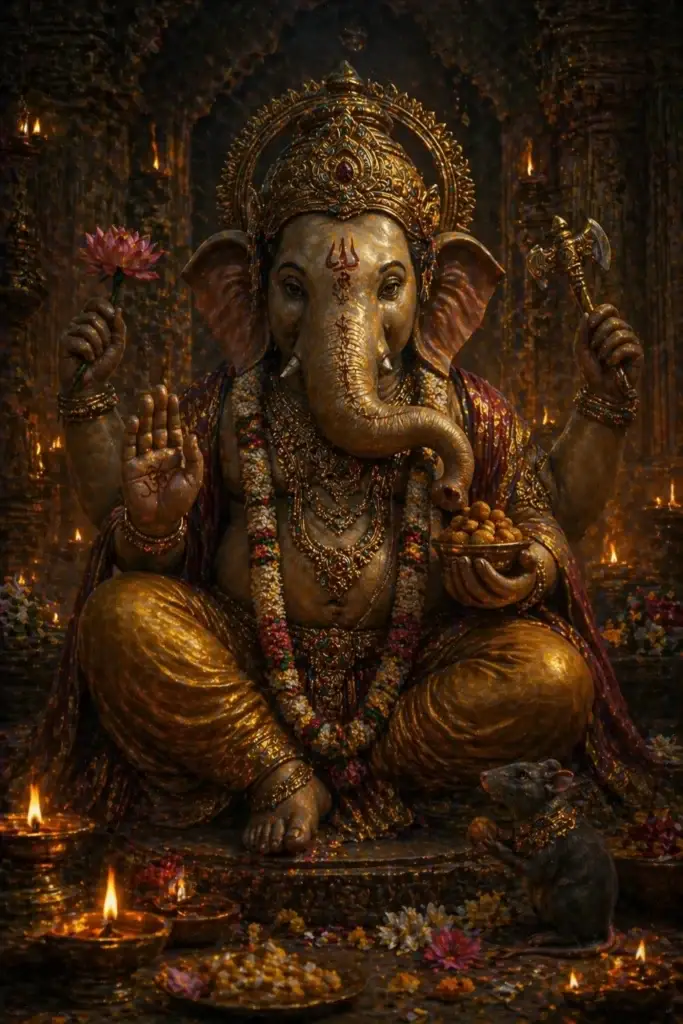
Her identifying symbols in the family context are her children: Ganesha with the elephant head and Kartikeya with the peacock. Family images with Shiva, Parvati, and both children have been highly popular in iconography since the Middle Ages and are regarded as an emblem of Hindu family life.
Cult and Worship
Parvati has no single principal temple, since she is worshipped in countless local forms and name variants. Important temples are the Meenakshi Temple in Madurai (Tamil Nadu), where Parvati is worshipped as Meenakshi with Shiva (Sundareshwara), and the Annapurna Temple in Varanasi, where she appears as the giver of food.
The most important Parvati festival is Teej, which is celebrated above all in northern India (Bihar, Rajasthan, Uttar Pradesh, Madhya Pradesh) and Nepal. Women fast, sing Parvati songs, and pray for marital happiness.
The festival days celebrate Parvati’s asceticism, her marriage to Shiva, and conjugal happiness. In South India the Karthikai Deepam festival (November to December) is celebrated in honor of Parvati and Kartikeya.
In Shaktism, one of the three main currents of Hinduism alongside Vaishnavism and Shaivism, the goddess stands at the center. The Shakta traditions worship Parvati in many forms: as Kali, as Durga, as Lalita, as Tripurasundari.
The Devi Bhagavata Purana and the Devi Mahatmya (part of the Markandeya Purana, 5th to 6th century) are the most important texts of this tradition. In “A Survey of Hinduism” (3rd ed. 2007), Klaus Klostermaier described Shaktism as a distinct main direction of Hinduism.
In the daily domestic worship of many Hindu families, Parvati is worshipped together with Shiva and Ganesha. Before business agreements, weddings, and important family events, Parvati mantras are recited. The Lalita Sahasranama (Thousand Names of Lalita-Parvati) is a liturgical work very widespread in South India.
Important Myths
The principal myth is Parvati’s asceticism and marriage to Shiva. After Sati’s death, Shiva had withdrawn into the Himalaya and broken off all contact with the world.
Parvati, born as the daughter of Himavat, wished to win Shiva as her husband. She went into the mountains and subjected herself to the most severe asceticism. She fasted, held postures, and endured heat and cold.
The love god Kama was sent by the gods to stir Shiva’s senses, but Shiva burned him with the fire of his third eye. Parvati continued her asceticism. Finally Shiva appeared to her in the form of a Brahmin who praised Shiva and sought to test Parvati’s choice.
Parvati remained steadfast. Shiva revealed himself, and the two were wed. The wedding on Mount Kailash is one of the most splendid narratives of Hindu mythology. Kalidasa’s “Kumarasambhava” unfolds this scene with great poetic effort.
The second central myth is the creation of Ganesha. According to the Skanda Purana and the Shiva Purana, Parvati formed a boy from the dirt and unguent of her body and gave him life.
She had him stand guard before the entrance of her bath. Shiva, who did not know of the newly created child, returned and was prevented from entering by Ganesha. In anger, Shiva struck off the boy’s head.
Parvati was beside herself with grief and rage and threatened the destruction of the world. To calm the situation, Shiva sent out his servants to bring the head of the first living being they would meet.
They brought the head of an elephant. Thus Ganesha was revived with the elephant head. This narrative explains the iconographic form of Ganesha and stands at the center of many folk festivals.
The third myth is the creation of the war god Kartikeya for the destruction of the demon Taraka. In the Kumarasambhava and in many Puranas it is told that Taraka could be killed only by a son of Shiva and Parvati.
Therefore the marriage of the two was a cosmic necessity. From the seed of Shiva, which fell into the Ganges, Kartikeya grew, who later defeats the demon. This mythic narrative connects eros and cosmos: the conjugal union of two gods is the precondition of the preservation of the world.
The wedding of Shiva and Parvati is elaborated with great attention in Hindu tradition. It is regarded as the mythic model of all Hindu weddings.
In the “Kumarasambhava,” Kalidasa describes the preparations with poetic precision: the adornment of the bride, the arrival of Shiva with his unusual retinue of Bhutas and Pretas (ghosts and demons), the wedding at the sacred fire, the wedding night.
This narrative was elaborated by Kalidasa in the 5th century and has since been the model for numerous literary and iconographic works.
The myth of the creation of Ganesha by Parvati is of particular interest in religious studies because it thematizes the tension between maternal love and conjugal loyalty. Parvati creates Ganesha without Shiva’s knowledge, Ganesha defends his mother against his own father, Shiva slays him and then gives him the elephant head.
This narrative is read in the anthropology of the family as a mythic illustration of Oedipal conflicts. Robert Goldberg, Stanley Kurtz, and Wendy Doniger analyzed this material in detail in the 1980s and 1990s. The Hindu family thereby becomes a theological stage on which conflicts and reconciliations are mythically enacted.
Relationships within the Pantheon
Parvati’s principal relationship is to Shiva. The two are conceived as one (Ardhanarishvara). In myth and in theology, Shiva and Parvati are inseparable.
Shiva without Shakti is sava (a corpse), Shakti without Shiva is movement without consciousness. This doctrine is elaborated philosophically in Tantrism, above all in the Kashmir Shaiva school (10th to 11th century, Abhinavagupta).
Her children are Ganesha and Kartikeya. Both belong to the most widely worshipped gods of Hinduism, above all Ganesha. The family Shiva-Parvati-Ganesha-Kartikeya is one of the most important divine families of India and is often depicted as an emblem of ideal family life.
Parvati is the sister of Ganga, the goddess of the river. Both are daughters of Himavat. In the myth of the descent of the Ganga there are tensions between the sisters, since Shiva receives the Ganga in his hair, which provokes Parvati’s jealousy.
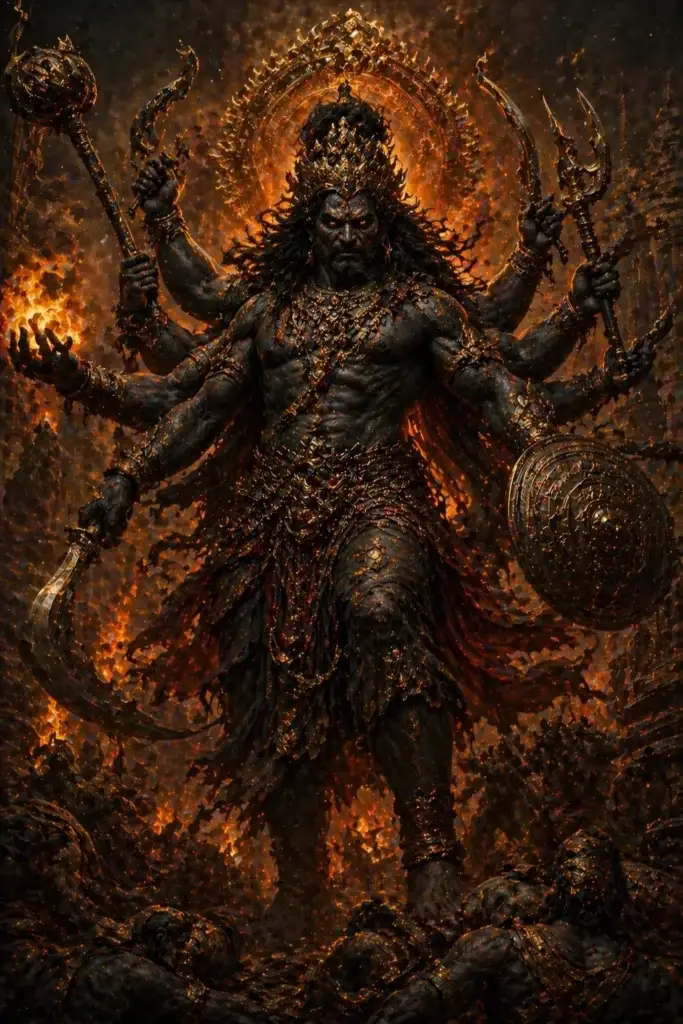
Parvati’s manifestations as Durga and Kali (in the Shakta traditions) show her other side. In the Devi Mahatmya, Durga fights against the buffalo demon Mahishasura.
In the Mahabhagavata Purana, Parvati releases Kali from her brow to destroy the demons Shumbha and Nishumbha. These warlike manifestations are an expression of the same divinity, in a darker form.
Reception and Influence
Parvati is one of the central goddesses in classical Sanskrit poetry. Kalidasa’s “Kumarasambhava” (5th century) is the outstanding work. Banabhatta too devotes verses to her in “Harshacharita” (7th century).
In the Tamil Bhakti literature of the Nayanars (6th to 9th century), Parvati is inseparably bound to Shiva and is often sung of as Uma or Ambika.
In the visual art of India, Parvati has been one of the most frequent divine depictions since the Gupta period (4th to 6th century).
The Chola bronzes of South India (10th to 13th century) produce classical Parvati figures, including the world-famous bronze type of Parvati as a gentle, standing goddess. These sculptures are exhibited in many Western museums, such as the British Museum in London and the Metropolitan Museum in New York.
In popular religion, Parvati is omnipresent. In every Shiva temple she is present as the consort. In many villages of India there are local Parvati temples with regional names (Bhagavati in Kerala, Amma in Andhra Pradesh, Chandi in Bengal).
These local forms are described in the anthropology of India, above all in the works of Lawrence Babb (“The Divine Hierarchy,” 1975) and Cynthia Talbot (“Precolonial India in Practice,” 2001).
In the West, Parvati became known through the Indology of the 19th century. Heinrich Zimmer, Stella Kramrisch, and Wendy Doniger brought her to an international audience in their works. In modern global yoga and spirituality culture, Parvati is often interpreted as a symbol of feminine creative power.
Classification in Religious Studies
In “Hindu Goddesses” (1986), David Kinsley classified Parvati as a central embodiment of the Hindu conception of the goddess as Shakti, that is, as the creative and sustaining power of the male deity. This classification is established in scholarship.
In Tantrism, above all in the Kashmir Shaiva school (Abhinavagupta, 10th to 11th century), Parvati is conceived as the Vimarsha (self-consciousness, pulsation) of Shiva. Shiva is Prakasha (pure light), Parvati is the self-experience of this light.
This highly abstract theology was scholarly worked out by Klaus Klostermaier and Andre Padoux (“Vac: The Concept of the Word in Selected Hindu Tantras,” 1990).
In terms of the anthropology of religion, Parvati is an example of the tension between gentle and warlike goddess aspects in Hinduism.
In “The Hindus: An Alternative History” (2009), Wendy Doniger read this dual nature as a reflex of a complex tension between the Brahmanical-orthodox and the non-Brahmanical-tantric tradition. Parvati embodies both: the orthodox household goddess and the tantric energy.
In Shaktism, the third great current of classical Hinduism alongside Vaishnavism and Shaivism, the goddess stands at the center of theology. Here Parvati is not the auxiliary figure of a male god but is herself the highest reality (Mahadevi).
The Devi Mahatmya (Markandeya Purana 81 to 93, around the 5th to 6th century) is the foundational text of this tradition. In the 700 verses, the Great Goddess is celebrated in her manifestations (Durga, Mahalakshmi, Saraswati) as she successively defeats the demons Madhu-Kaitabha, Mahishasura, and Shumbha-Nishumbha.
Shakta theology makes Parvati the first cause. Shiva is the basis of consciousness (chit), Parvati is the creative movement (kriya). Without movement, consciousness is lifeless.
This theology was elaborated philosophically in Kashmir Shaivism (Vasugupta, Abhinavagupta, 9th to 11th century) and belongs to the most demanding metaphysical systems of Indian philosophy. Andre Padoux, Mark Dyczkowski, and Paul Muller-Ortega established this tradition in Western scholarship.
In comparative mythology, Parvati has parallels with the Greek Hera (consort of the chief god), Aphrodite (goddess of conjugal love), Demeter (mother goddess), and Athena (warrior in the Durga form).
Yet none of these parallels captures the theological specificity of Parvati as at once gentle consort and cosmic energy. This dual nature is one of the most remarkable features of Hindu goddess theology.
Sources and Further Reading
Primary sources: Shiva Purana, Skanda Purana, Devi Mahatmya (Markandeya Purana 81 to 93, around the 5th to 6th century), Devi Bhagavata Purana, Mahabharata and Ramayana (with references), Kalidasa “Kumarasambhava” (5th century). Tantric texts: Lalita Sahasranama (in the Brahmanda Purana), Saundarya Lahari (attributed to Shankara, 8th century). English translations: Kumarasambhava by Hank Heifetz “The Origin of the Young God” (1985), Devi Mahatmya by Thomas Coburn “Encountering the Goddess” (1991).
Secondary literature: David Kinsley “Hindu Goddesses” (1986) and “Tantric Visions of the Divine Feminine” (1997), Wendy Doniger “Siva, the Erotic Ascetic” (1973) and “The Hindus: An Alternative History” (2009), Heinrich Zimmer “Myths and Symbols in Indian Art and Civilization” (1946), Klaus Klostermaier “A Survey of Hinduism” (3rd ed. 2007), Andre Padoux “Vac” (1990), Axel Michaels “Der Hinduismus” (2nd ed. 2006), Madeleine Biardeau “Hinduism: The Anthropology of a Civilization” (1989), Stella Kramrisch “The Presence of Siva” (1981).