Hathor, Goddess of the Egyptian Tradition
By Ralf Ittermann · last reviewed on
Hathor is a goddess of the Egyptian tradition.
Goddess of love, music, beauty and motherhood. Hathor is the universal mother and muse; she nourishes, comforts, delights. With cow horns and sun disk, in music and wine, in luxury and erotic power, she embodies the life-affirming moments that sparkle between the grave cosmic dramas. She is not weak, but vital, sensual and existentially necessary.
Quick Overview: Hathor
Type: Egyptian principal deity, goddess of love, music and motherhood
Pantheon: Egypt (all dynasties)
Function: Love, music, dance, motherhood, deity escorting the dead, daughter of the sun
Main attributes: Cow horns, sun disk, sistrum, menat necklace
Main cult sites: Dendera, Edfu, Memphis
Greek identification: Aphrodite-Hathor (Hellenistic, in Alexandria)
Historical Classification
Period of the Texts
Hathor is attested from the Early Dynastic period (ca. 2900 BC); on the Narmer Palette she appears as a cow goddess.
Her main flourishing was during the New Kingdom (1550 to 1070 BC); her temple at Dendera, one of the best-preserved Egyptian temples, dates to the Ptolemaic late period (1st century BC). In Hellenistic times she underwent syncretism with Aphrodite and Isis.
Area of Distribution
Main cult sites: Dendera (the famous Hathor temple complex), Edfu (annual festival journey to meet Horus), Memphis (Hathor, „Mistress of the Sycamore Tree“), Thebes (in the necropolis). On the Sinai, Hathor was the protective deity of the mining expeditions (Serabit el-Khadim).
Source Situation
Central sources: the Pyramid Texts (spell 466), the Book of the Dead (spells 18, 145), the inscriptions and reliefs of the Dendera temple (fully preserved theological texts), the Seven Hathors tradition (the myth of the dictum of fate at birth) and the story of the Eye of Ra. Secondary literature: Bleeker, Hathor and Thoth (standard work); Bonnet, Reallexikon; Pinch, Egyptian Mythology.
Designation and Spellings
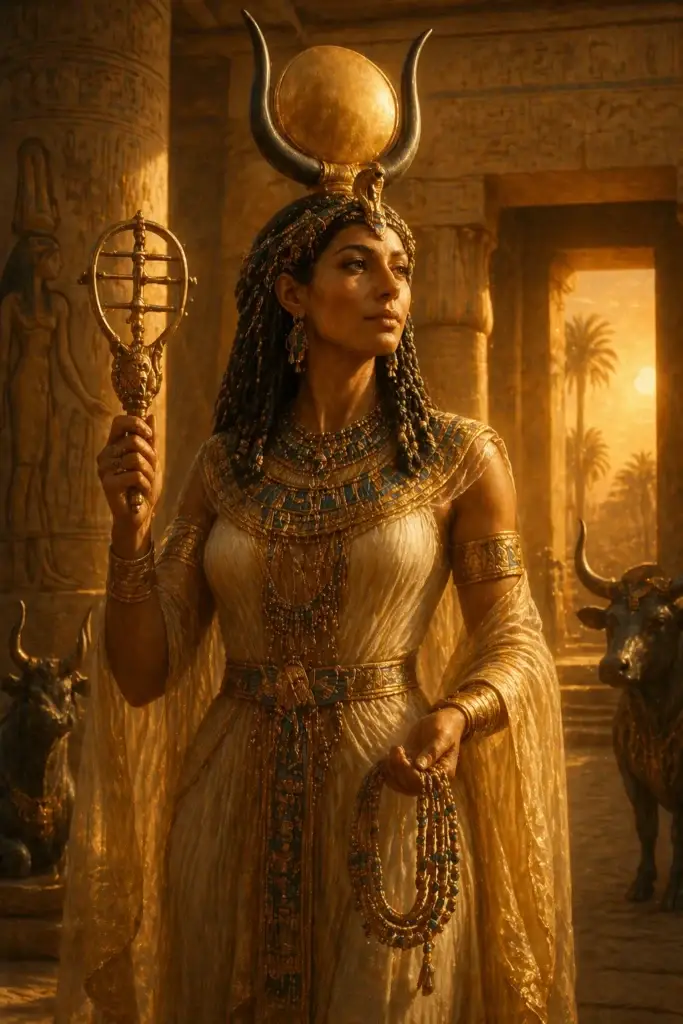
Hathor is depicted with a cow’s head, the cow being sacred in Egypt, or with a human face and cow horns between which the sun disk (Aten) sits. Sometimes she is a silver-colored cow.
She carries a sistrum (rattle instrument), a wine glass or a mirror (ankh mirror). Her body is often golden, full of jewelry and precious fabrics. The uraeus (serpent) adorns her brow. Her images were engraved in mirrors and cosmetic boxes; she was goddess of cosmetics and the toilette.
Characteristics
Hathor nourishes all living beings with her »celestial milk«; she is at once erotic and maternal. She is goddess of dance and music; female dancers and musicians were her priestesses. She protects women in pregnancy and during birth.
Hathor loves wine, fragrance and luxury; her temples were places of joy. Pharaohs gave Hathor precious offerings. The temple at Dendera was richly furnished and was magnificently expanded up to the Ptolemaic period. Women’s weddings and love magic were carried out in her name.
Appearance and Symbolism
Hathor is depicted as a woman with cow ears and the sun disk between them, or as a cow with the sun disk on her brow. The sistrum is her sacred instrument.
She wears a necklace of gold and lapis lazuli, the gemstones of the universe. Her body is often colored golden. In martial aspects she is shown with the Double Crown of Egypt. The cow as sacred animal symbolizes her maternal, life-giving nature.
Profile: Hathor
The most important aspects of Hathor at a glance. The following fields summarize origin, function, appearance, veneration, symbols and parallels.
Hathor is daughter of Ra, in one tradition equal to his Eye, the solar aspect of his power. Consort of Horus of Edfu, mother of Ihy.
In her wild form she is Sekhmet-Hathor, the destroyer of mankind (the myth of the Eye of the Sun). In some traditions identified with Isis, with whom she increasingly merges in the late period.
Patroness of love, of erotic desire, of music and dance. Protectress of women in labor and of newborns; the Seven Hathors appear at every birth and pronounce the destiny of life.
At the same time, she is an escorting goddess of the dead into the afterlife, which is why she is frequently depicted in tomb chapels. Also a goddess of mining and craft.
Three forms of appearance: (1) anthropomorphic woman with the Hathor crown, cow horns with sun disk; (2) as a cow (often with sun disk between the horns); (3) as a cow-headed woman.
Frequent attributes: sistrum (ritual rattle instrument), menat necklace (ceremonial neck ornament with counterweight), was scepter, lotus. The Hathor columns at Dendera show her stylized female face with cow ears.
Area of influence: Hathor was invoked by women of all ranks, in matters of love, before and during birth, in illness. Musicians, dancers and artists were regarded as her special charges.
The Beautiful Festival of the Reunion (meeting with Horus) drew thousands of pilgrims to Edfu each year. In the cult of the dead she was regarded as the Mistress of the Beautiful West, who escorted the deceased into the afterlife.
Sistrum, menat necklace, cow horns with sun disk, Hathor column, lotus, sycamore tree (as „Mistress of the Sycamore Tree“), mirror. In the temple reliefs, often two griffins or lions as accompanying beings.
Isis (Egypt, later overlay), Sekhmet (wild aspect in the Eye of the Sun myth), Bastet (gentle sister aspect), Aphrodite (Greece, Hellenistic syncretism), Inanna/Ishtar (Mesopotamia, love and music), Lakshmi (Hinduism, female principle of prosperity and love).
Practical Defense
Veneration in Everyday Life
Rituals and Invocations
Hathor’s festivals included the „Festival of Drunkenness“ and the „Beautiful Reunion“ between Dendera and Edfu. Music and dance shaped her cult, in which she was venerated as goddess of joy.
Incantations and Invocations
Textual Tradition and Formulas
Hathor appears in the Pyramid Texts and in detail in the temple texts of Dendera. The myth of the „Distant Goddess“ connects her closely with the dangerous lioness goddess Sekhmet.
Amulets and Protective Symbols
Material apotropaia and archaeological evidence
The Hathor sistrum and the menat necklace, Hathor-headed columns and amulets, as well as mirrors with a Hathor handle, served both in the temple cult and as personal protective signs.
Hathor, Parallels in Other Cultures
Hathor resembles Aphrodite (Greece), goddess of love and beauty. She shares with Freyja (Scandinavia) the aspect of love and sensuality. She recalls Demeter (Greece), a nourishing mother goddess. The motif of the universal mother is universal; Hathor is a particularly sensual and life-affirming expression of it.
Bringing Home the Distant Goddess
An important mythical cycle around Hathor is that of “bringing home the distant goddess.” It is well attested above all from the Greco-Roman period, for example through temple inscriptions and literary versions, but goes back to older ideas.
The narrative is based on the motif of the angry daughter of the sun god. The “Eye of Ra,” embodied as a lion-shaped goddess, has departed from the sun god and withdrawn into a distant region, frequently to Nubia.
As long as she is far away, the world lacks something essential. Ra sends out messengers, usually Thoth in the form of a baboon or a monkey, sometimes also Shu, to placate the enraged goddess and persuade her to return. Thoth relies on words, on stories and on flattery.
On the way back, a transformation takes place. The wild, dangerous lioness changes into the peaceful, friendly Hathor. This transformation is often associated with water, with bathing and with the transition from anger to joy. Her homecoming is celebrated with music, dance and festive joy.
In terms of religious studies, the myth is closely tied to the Egyptian calendar and to specific festivals. The return of the goddess was festively celebrated at several temples, for example in Dendera and Philae.
The myth moreover connects two aspects of the same power: the destructive lioness, who is close to Sekhmet, and the benevolent, joyful Hathor. It thereby explains how a dangerous force can become a protective one, and provides the mythical basis for rites of placation and celebration.
Dendera: Temple, Columns and the Image of the Goddess
The most important surviving cult site of Hathor is the great temple of Dendera, whose present buildings stem predominantly from the Ptolemaic and Roman periods, yet continue a much older cult place. Dendera is one of the best-preserved temple complexes in Egypt and thus a central source for knowledge of the Hathor cult.
Characteristic are the Hathor columns, whose capitals show the face of the goddess on all four sides, with the typical cow ears and the heavy wig. This type of column is regarded as an iconographic hallmark of Hathor and is also found on other buildings dedicated to her.
The walls and ceilings of the temple are densely covered with reliefs and inscriptions that record rites, festivals and theological statements about the goddess. Also well known is the ceiling relief with a depiction of the zodiac, which received much attention in the history of research.
Hathor is depicted in the visual arts in several forms: as a cow, as a woman with a cow’s head, but above all as a woman with the sun disk between two cow horns on her head.
Often she holds the menat necklace counterweight and the sistrum, a rattle instrument, both of which are closely connected with her cult.
Part of the cult was the festival of the “beautiful reunion,” in which the cult image of Hathor of Dendera was brought in a procession to the temple of Horus at Edfu.
These festivals, which combined music, procession and the meeting of two deities, shaped the religious annual cycle of the region and show Hathor as a deity of joy, of love and of festive community.
Mistress of the West: Hathor and the Dead
Besides her traits as goddess of love, music and joy, Hathor had a pronounced function in beliefs about the dead. She bore the epithet “Mistress of the West,” with the West in Egypt denoting the region of the sunset and thus the realm of the dead.
In this role, Hathor received the deceased at the transition into the afterlife. Especially widespread is the image of the “Hathor cow,” who emerges from the mountain or from the reeds of the Theban western range.
On numerous coffins, tomb walls and stelae she appears in order to protect, nourish and receive the dead into the world beyond the grave. She was regarded as the one who hands the deceased food and drink and prepares their way.
This connection to the realm of the dead does not contradict her life-affirming aspects but complements them. Hathor is the goddess who accompanies life throughout its entire span, from birth, at which she could appear as one of the fate-determining powers, through love and festival, to death and rebirth in the afterlife.
In the region of Thebes, Hathor’s function overlapped with that of other deities of the dead, and in the late period individual aspects of her merged with those of Isis.
In terms of religious studies, Hathor is a clear example of the multilayered nature of Egyptian deities: a single goddess could encompass domains that in other religions are distributed among several figures. Those seeking more on the related dangerous side will find further references in the entry on Sekhmet.
Further Links
Sources and Literature
Further standard works in the literature index.