Hamsa, Hand of Fatima, a protective symbol across many cultures
By Ralf Ittermann · last reviewed on
The Hamsa, also called the Hand of Fatima or Chamsa, is one of the oldest and most widespread protective symbols. With five fingers, often with an eye in the center, it is regarded in Jewish, Islamic and North African traditions as protection against the evil eye. Its pictorial history reaches back to Phoenician Carthage. Across many traditions the Hamsa is read as a symbol of protection, and its imagery recurs across Jewish, Islamic and North African communities alike.
What the Hamsa is
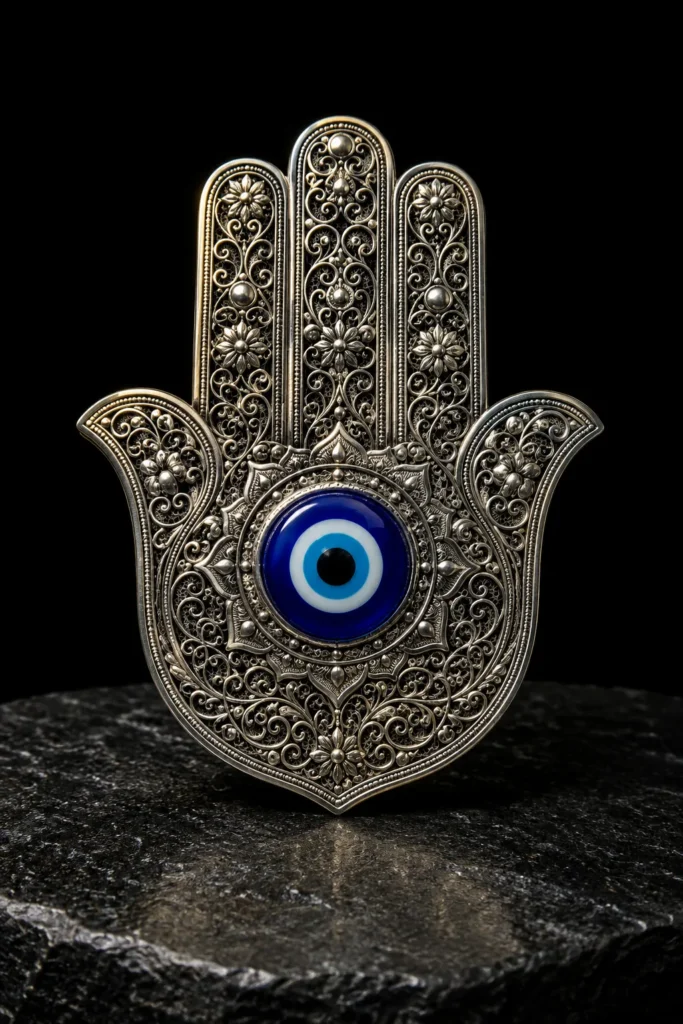
The Hamsa is a hand-shaped protective symbol with five outstretched fingers. It appears throughout the Mediterranean region, in North Africa, in the Near East and in parts of South Asia, worn as a pendant, painted on doors and walls, embroidered on fabrics or set into jewelry.
The name comes from the Semitic root chmsh, which denotes the number five, both in Hebrew (chamesh) and in Arabic (khams). The five refers to the five fingers of the hand and at the same time to a cultural numerical symbolism that plays a role in both religions.
Two main variants occur in its form. The symmetrical Hamsa shows a stylized hand with two thumbs, one on the right and one on the left, without anatomical accuracy but with graphic clarity.
The anatomical Hamsa follows the real shape of the hand with one thumb and four fingers. Both versions appear historically and are still produced side by side today.
Names in the cultures
In the Jewish sphere the symbol is usually called Chamsa, sometimes also Hand of Miriam, in reference to the sister of Moses and Aaron. In the Arabic sphere it is called Khamsa or Hand of Fatima, named after Fatima az-Zahra, the daughter of the Prophet Muhammad.
In Morocco, Algeria and Tunisia the symbol is simply called Khamsa and belongs to everyday jewelry. In the Turkish-speaking world it appears together with the nazar boncuğu, the blue eye pendant, and complements it.
This parallel naming is no coincidence. The Hamsa is an example of a symbolic form that cannot be assigned to a single religion but has been associated, in several religious spheres, with its own particular narrative.
Scholars of religion describe this as a shared symbolic heritage.
Early traces
The oldest possible precursors of the Hamsa come from the Phoenician sphere, roughly from the first centuries before our era. Researchers connect the symbol with the Hand of Tanit, a Punic goddess whose stelae were found in Carthage and on Sardinia.
On some of these stelae an open hand appears next to a moon and a solar symbol. Whether this is the direct precursor of the Hamsa or only a similar gesture is not fully settled in scholarship.
What is certainly documented: hand symbols as protection already appear in the ancient Egyptian and Mesopotamian visual world. An open hand can be read as a warding gesture, as a pose of blessing or as a sign of the presence of a protective power.
The Hamsa in its present form, however, only became established in the Middle Ages, above all in the Jewish-Arab symbiosis of the Andalusian and Maghrebi sphere.
Jewish tradition
In Jewish tradition the Hamsa is often connected with the sister of Moses. Miriam appears in the Book of Exodus as a prophetess who accompanies the people through the Sea of Reeds.
In this reading, the Hand of Miriam stands for female protective power and for preserving the community. Another reading connects the five fingers with the five books of the Torah.
In the folk belief of Sephardi and Mizrahi Judaism the Chamsa was regarded as effective against the ayin hara, the evil eye. It was attached to door frames, hung on babies’ cradles or worn as a pendant.
In the Ashkenazi tradition of Central Europe it plays a lesser role, but through migration and cultural exchange it also became visible there in the 20th century.
Islamic tradition
In Islamic tradition the Hamsa as the Hand of Fatima is closely connected with the daughter of the Prophet. Fatima az-Zahra is regarded as an ideal figure of female piety and as the mother of the Hasanids and Husaynids, that is, the descendants through Hasan and Husayn.
In the Shia context the five fingers are often associated with the five persons of the ahl al-bayt, namely Muhammad, Ali, Fatima, Hasan and Husayn.
In the Sunni context, above all in North Africa, the Khamsa is less theologically charged and more strongly rooted in folk belief. It is used against al-ayn, the evil eye, against envy and against unspecific everyday threats.
On houses it is painted on or placed beside the door, on babies it hangs as a small amulet, and on journeys it is carried along.
Iconography
Many Hamsa depictions bear an eye in the center, painted, engraved or set in blue glass or stone. The eye is a protective symbol in its own right, intended to work against the evil eye, and its combination with the Hamsa reinforces the symbolism.
Other Hamsas show a fish in the palm, a symbol of fertility, luck and growth, equally widespread in Islamic and Jewish contexts.
Inscriptions occur in both traditions. In Jewish Hamsas these are often Hebrew letters or words from the Tanakh, such as a Shaddai or a verse from the Psalms. In Islamic Hamsas Quranic verses appear, often the Sura Al-Falaq or the Sura An-Nas, both protective prayers.
Function and belief in its effect
The function of the Hamsa as a protective symbol is, in the scholarly sense of religious studies, an example of apotropaic magic, that is, of warding symbolic action.
Those who wear it associate the symbol with the idea that a certain protective effect emanates from the hand or is transmitted to the body through the hand.
Important for the classification: the effect is not measured objectively but experienced subjectively. Studies in the ethnology of religion, such as the work of Peter W. Schienerl on North African jewelry amulets, describe the Hamsa as part of a personal sphere of meaning in which material, form, tradition and individual belief interact.
Materials and modern forms of wearing
Classic Hamsas were made of silver, brass, copper and tin, and in Andalusia and North Africa also of filigree silver with enamel inlays. In the 20th and 21st centuries precious metal versions of gold and platinum were added, combined with gemstones and above all with blue glass or turquoise.
The wearable format is suited to necklaces, bracelets, earrings and key rings. In interior design the Hamsa is found as a wall object of ceramic, bronze or wood, and more recently also as a sticker, tattoo or embroidery.
Pop culture and fashion uptake
Since the 2010s the Hamsa has experienced a second wave in the Western fashion world. Madonna wore it publicly, Rihanna had a Hand of Fatima tattooed, and jewelry labels took up the motif in collections.
This has given the symbol reach, but also discussions about cultural appropriation. Scholars of religion emphasize that a respectful engagement with the history of the symbol is helpful when the Hamsa is worn outside its original cultural frame.
Classification in the iwell-guard lexicon
The Hamsa is one of those protective symbols that show that wearable protective objects are not an isolated phenomenon of a single culture but a human practice shared over millennia.
Other examples from the iwell-guard lexicon that occupy a similar functional sphere are the Mesopotamian Pazuzu pendants against Lamashtu, the Egyptian Bes statuettes as protection for children and pregnant women, the Jewish Mezuzah on the door frame and the Mediterranean evil eye pendant.
Those interested in the depth of religious studies will find further classification in the linked entries.
Literature and sources
- Esther Juhasz: Sephardi Jews in the Ottoman Empire, Aspects of Material Culture. Israel Museum, Jerusalem 1990. Chapter on Jewish-Oriental jewelry.
- Peter W. Schienerl: Eisen als Kampfmittel gegen Dämonen, Manifestationen des Glaubens an die Schutz- und Heilkraft des Eisens in der orientalischen Amulettkunst. In: Anthropos 75 (1980).
- Ahmed Achrati: Hand-symbol in the Maghreb. In: Anthropos 98 (2003).
- Encyclopedia Judaica, 2nd edition 2007, entry “Hamsa”.
- Encyclopaedia of Islam, Three. Entry “Khamsa”.
External links for the detail page:
- DOI / JSTOR: Anthropos articles by Schienerl and Achrati
- Wikipedia DE: entry Chamsa as a disambiguation point
- Encyclopedia Judaica online via the Jewish Virtual Library
- British Museum collection entry Khamsa pendant
- Museum für Islamische Kunst Berlin online collection
The Hamsa is worn in many Mediterranean and Near Eastern cultures, from Jewish, Christian and Muslim communities through to North Africa, and is regarded in each as a visible sign against the evil eye.