Apollo, god of the Greek tradition
By Ralf Ittermann · last reviewed on
God of light, music, healing and the oracle. Apollo is one of the twelve Olympians and the most multifaceted god of Greek religion.
Son of Zeus and Leto, twin brother of Artemis, he embodies order, beauty and prophecy. His sanctuary at Delphi is the navel of the ancient world; his oracle shapes the decisions of kings and mortals alike.
Apollo is a god of the Greek tradition, patron of the healing art, of music and of the oracle.
Apollo
Overview: Apollo
Type: Major Greek deity, god of the Muses, of healing, light and prophecy
Pantheon: Greece (one of the twelve Olympians); adopted unchanged in Roman religion
Function: music and poetry, healing and plague, archery, oracle, observance of due measure (mhdén ágan)
Main attributes: bow with silver arrows, kithara (lyre), laurel wreath, tripod
Main cult sites: Delphi (chief oracle of the ancient world), Delos (birthplace), Klaros, Didyma, Patara
Roman counterpart: Apollo (unchanged)
Context
Period of the texts
Apollo has held a central position in Greek mythology since Homer (8th century BC).
His main cult site, Delphi, probably emerged in the 8th century BC (above an older earth-oracle site of Gaia and Themis), became the panhellenic sanctuary and remained the most important oracle of the ancient world for almost a thousand years, until it was closed at the end of the 4th century AD under Theodosius.
The principal flourishing of Apollonian theology falls in the 5th and 4th centuries BC (Pindar, Aeschylus, Sophocles, Plato).
In the Roman Empire, Augustus turned the Apollo cult into a state programme: the Apollo Palatinus temple in Rome was a central imperial sanctuary. Decline set in during late antiquity; the last Pythian utterance at Delphi is dated to the end of the 4th century AD.
Area of distribution
Main cult sites: Delphi (the Pythian oracle, panhellenic, with the famous Pythia, who delivered her pronouncements in trance over earth vapours), Delos (the mythical birthplace, a panhellenic sacred island on which births were forbidden), Klaros (in Asia Minor, the second major oracle), Didyma (near Miletus, an Apollo temple with its own oracle), Patara (in Lycia, the winter seat of the oracle).
The Pythian Games at Delphi (every four years) were one of the four panhellenic games. Roman: temple of Apollo Palatinus in Rome (Augustan), the Sosianus temple.
Source situation
Central sources: Hesiod (Theogony), Homer’s Iliad and Odyssey (central; Apollo is the most important Greek god in the Iliad on the Trojan side), the Homeric Hymn to Apollo (the longest text on Apollo, which treats Delian as well as Delphic aspects), Pindar (Pythian Odes), Aeschylus’s Eumenides, Plutarch (De Defectu Oraculorum, a late reflection on the decline of the oracle), Pausanias’s Description of Greece, Book X (the topography of Delphi).
Secondary literature: Burkert, Greek Religion; Graf, Apollo; Bowden, Classical Athens and the Delphic Oracle; Fontenrose, The Delphic Oracle.
Name
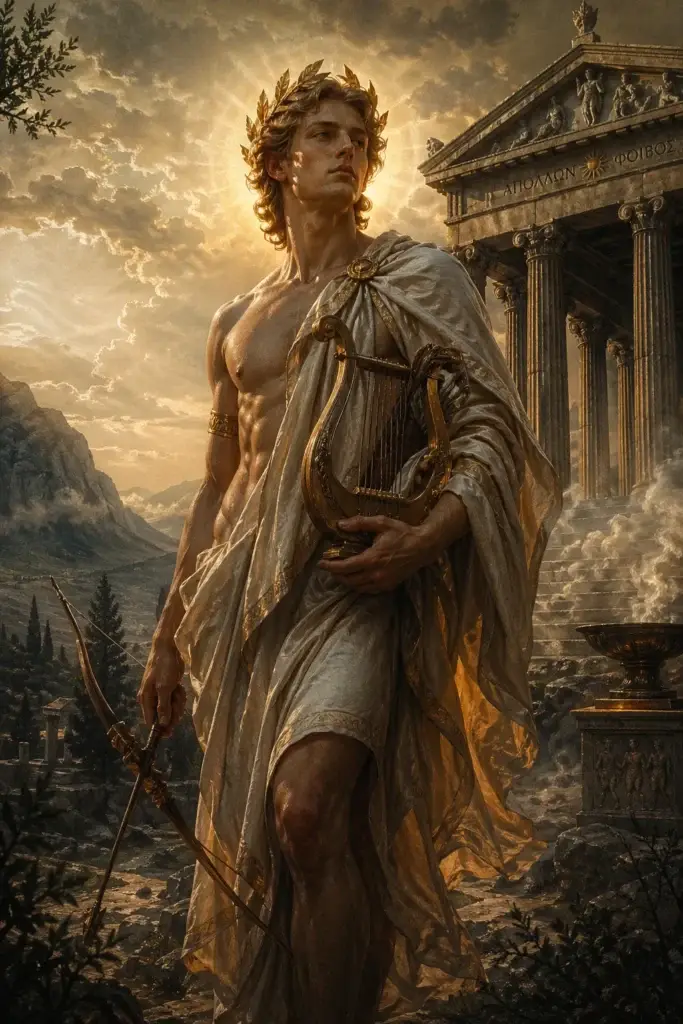
Apollo is depicted as a beautiful, beardless youth, often with a lyre in his hands or with bow and arrow. His symbol is the sun (although Helios is the direct personification of the sun god).
The laurel wreath, the tripod and the slaying of the serpent (the fight against the Python) belong to his iconography. His colours are gold and white; his animal is the raven, his tree the laurel.
Characteristics
Apollo is venerated in three principal aspects: as healer (the god who sends and heals plague), as seer (through the oracle of Delphi), and as musician (inventor and master of the lyre). His priesthood at Delphi was known for telling, ambiguous oracle responses that shaped destinies.
The Delphic maxim ‘Know thyself’ is attributed to Apollo. Pythagoreans and Platonists see in him the embodiment of harmony and reason. His annual festivals at Delphi and Delos gathered pilgrims from across Hellas.
Appearance and symbolism
Apollo embodies the ideal ephebic body: young, unbearded, muscular, often depicted nude with the lyre, his primary instrument.
His iconographic attributes are precise: the lyre (invented by Hermes and acquired by Apollo), the bow and quiver (weapons of his lethal power), the laurel wreath (a symbol of his victory over the Python and the prize of poets).
The wolf was his sacred animal, as was the raven, both symbols of prophecy. The laurel tree was consecrated to him; the Pythia at Delphi chewed laurel leaves before her prophecies. His colour was the gold of the sun; his light pervaded all artistic and spiritual insights.
Profile: Apollo
The most important aspects of Apollo at a glance. The following fields summarise his origin, function, appearance, veneration, symbols and cultural parallels.
Apollo is the son of Zeus and the Titaness Leto, twin brother of Artemis. He was born on the island of Delos, where Leto (pursued by Hera) had found refuge. Three days after his birth, Apollo slew the dragon Python at Delphi and took over the oracle from the pre-Hellenic earth deity Themis.
Among his literary affairs are Daphne (who was transformed into a laurel tree, hence his laurel wreath), Cassandra (to whom he gave the gift of prophecy but then withdrew belief in her words), Hyakinthos (the beloved who died from a discus throw, whose death Apollo commemorates in the Hyacinthia festival) and Cyrene (founder of the eponymous city).
He is the father of Asklepios (the god of healing) and of several prophetic heroines.
A double function typical of Apollo: bringer of plague (the opening of the Iliad, where the plague in the Greek camp is sent as Apollo’s punishment) and god of healing (father of Asklepios, patron of physicians).
Patron of music and poetry, leader of the nine Muses on Mount Helikon. Patron of archery with silver arrows.
Oracle god par excellence; his temple at Delphi was the religious centre of the Greek world. God of light (Apollo Phoebus, ‘the radiant one’), later assimilated to Helios as sun god in syncretism.
Patron of purity and of due measure (the Delphic ‘Know thyself’ and ‘Nothing in excess’ are sayings of Apollo). Patron of the initiations of young men (ephebia).
A young, beautiful, beardless man with long wavy hair, the ideal image of Greek male beauty, canonised in the Apollo Belvedere sculpture. Nude or with a light loincloth or cloak. A laurel wreath (the Daphne symbol) on his head. Bow and arrow quiver (silver arrows, not bronze as with Artemis).
The kithara (a lyre with a larger resonance body) in his hand, on which he plays at the table of the gods. The tripod (the symbol of the Delphic oracle). Accompanied by the Pythia in depictions of Delphi. In archaic art occasionally still shown with a long beard; in classical art consistently young and unbearded.
Sphere of influence: Apollo was among the most widely venerated Greek gods. In personal cult he was invoked for healing (especially in cases of plague), for inspiration before poetic or musical activity, and for purification after religiously laden killings (Apollo Katharsios).
The most important public point of contact with Apollo was the Delphic oracle: envoys (theoroi) and kings from across the Mediterranean travelled to Delphi to obtain the Pythia’s pronouncements on politics, colonisation, war and marriage.
The Pythia sat on a tripod over an earth fissure, chewed laurel leaves and spoke in trance; her utterances were rendered into hexameter verse by priests. Major festivals: the Pythia (every four years, panhellenic), the Karneia (Sparta), the Hyacinthia (Sparta) and the Daphnephoria (Thebes). In the Roman Augustan period the Apollo Ludi were held.
Bow with silver arrows, kithara (a larger lyre), plectrum, laurel wreath (the Daphne symbol), tripod (the oracle symbol), the omphalos stone (Delphi, the centre of the world), the sun disc (later through Helios syncretism), swan (his companion bird), dolphin (the epithet Apollo Delphinios).
Sacred plants: laurel, palm (the Delian birth symbol). Sacred animals: swan, dolphin, wolf, griffin and mouse (Apollo Smintheus, the mouse god).
Apollo (Rome, an almost identical adoption), Helios (Greece, the later Hellenistic syncretisation as sun god), Sol Invictus (Rome, the late Roman solar identification, possibly a precursor of Christ as Sol), Mithras (Persian, sun and truth), Surya (Hinduism), Re (Egypt, the principal sun god), Lugh (Celtic, god of light and of many crafts), Bragi (Germanic, poetry), Nergal (Mesopotamia, the plague-bringer aspect).
Functionally, all patrons of plague healing with a healer / sender double function (as with Sekhmet) share aspects of Apollo.
Protective practice
Veneration in daily life
Rituals and invocations
The Delphic oracle with the Pythia stood at the centre of the Apollo cult. Paeans were sung to ward off epidemics, and the festivals of the Thargelia and Karneia were observed. In cases of blood guilt, Apollo was the central instance for rites of purification (katharsis).
Invocations and adjurations
Textual transmission and formulas
The Homeric Hymn to Apollo celebrates the birth and the spheres of power of the god.
The oracular pronouncements of Delphi were collected and reworked in literary form, and the paean came to constitute a hymn genre of its own in the service of Apollo. Callimachus too dedicated a hymn to him.
Amulets and protective symbols
Material apotropaia and archaeological evidence
In front of house doors stood the Apollo Agyieus, a conical pillar or baitylos meant to secure the threshold. Apollo was invoked as Alexikakos, ‘the averter of evil’; laurel branches were considered purifying and protective and are widely attested in sanctuaries such as Delphi.
Apollo, parallels in other cultures
Sun gods and light deities are found everywhere: Helios (Greece, the pure sun god), Ra (Egypt), Surya (India), Shamash (Mesopotamia). Apollo’s link to healing and music is distinctive and connects him with Asklepios (his son) and with the Muses.
He shares his gift of prophecy with Athena and Zeus, but Delphi makes him unique. The Python myth (the struggle against chaos) connects him with other gods of order such as Marduk or Ra.
Delphi: the oracle and the dragon fight
Apollo’s most important sanctuary was Delphi on the slope of Mount Parnassus. There the Pythia, the priestess of the god, delivered oracular pronouncements that carried weight throughout the Greek cultural sphere.
For centuries private persons and entire cities consulted the oracle before founding colonies, before wars and before political decisions. Delphi was regarded as the centre of the world; a stone, the omphalos or navel, marked this spot.
The founding myth tells that the site had previously belonged to a chthonic power. At that place Apollo slew a serpent or dragon, in the sources called Python, and took possession of the sanctuary.
From this victory the tradition derives both the epithet Pythios and the name of the priestess, Pythia. The Homeric Hymn to Apollo describes the god’s search for a cult site and the dragon fight in detail.
How the oracular practice actually functioned is contested in scholarship. Ancient authors report vapours rising from an earth fissure that are said to have put the Pythia into an altered state.
For a long time this was held to be legendary, yet geological investigations of recent decades have shown that fault lines and gas-bearing strata are indeed present at the site, so that the ancient testimonies cannot simply be ruled out.
What is certain is that the pronouncements were brought into an interpretable form by priests. Delphi was therefore less a mysterious solitary voice than a religious institution that remained stable over centuries, the influence of which on Greek history can hardly be overstated.
The god of music and the contest with Marsyas
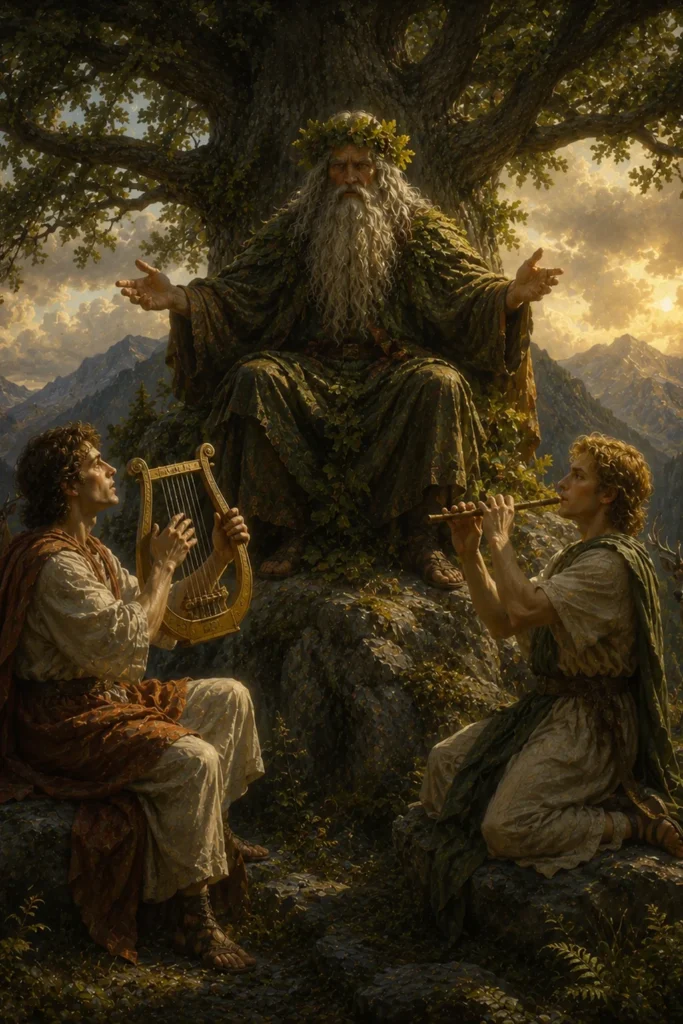
Apollo is the god of music, above all of stringed music. His instrument is the kithara, a form of lyre. He leads the chorus of the Muses and therefore bears the epithet Musagetes.
In Greek thought his music stands for what is ordered, measured and harmonious. This is bound up with a contrast that is played out in several myths: the contrast to the ecstatic, breath-driven music of the aulos, the double pipe.
This contrast is told in the myth of Marsyas. The satyr Marsyas finds the aulos that Athena has cast away and becomes such a virtuoso player that he challenges Apollo to a contest. The Muses or other gods decide in favour of Apollo.
As punishment for his presumption, the god has the satyr flayed alive. A second musical contest, that with the shepherd god Pan, ends more leniently: here King Midas judges against Apollo and receives ass’s ears for it.
Both narratives are illuminating from a religious-historical perspective. They classify musical instruments and styles and assign them to different divine spheres, the Apollonian measure and the Dionysian and Panic frenzy. At the same time they treat the theme of hybris: whoever measures himself against a god loses, and the punishment is harsh.
The cruel flaying of Marsyas was a widespread motif in ancient art. The myths show Apollo as a god who not only brings forth beauty but who also appears as an inexorable guardian of the order of rank between human, demigod and god.
Healer and bringer of plague: the ambivalence of Apollo
Apollo is the god of healing, yet at the same time the god who sends plagues. This double nature is not incidental but belongs to the core of his being.
The opening of the Iliad already shows it: because King Agamemnon has insulted Apollo’s priest Chryses, the god sends a plague into the Greek army. Apollo’s arrows, otherwise images of the sudden death of men, here strike whole camps. Only the god’s reconciliation through sacrifice and the return of the abducted daughter ends the epidemic.
On the other side, Apollo is the father of Asklepios, the god of healing. Apollo himself bears epithets related to healing, for instance Paian, originally the name of a healing god who was merged with him and which at the same time became the designation of a cultic healing song.
In this function he was venerated as Apollo Iatros, the physician, or as an averter of harm.
Scholarship has emphasised this ambivalence as typical of the Greek image of the gods. Apollo is the power that disposes of sudden, externally arriving threats, of plague and of sudden death as well as of their warding off and healing.
Whoever wished to avert a disease had to turn to the same power that could send it. The epithets Apotropaios, the averter, and Alexikakos, the warder-off of evil, belong in this context.
This conception must not be misunderstood as a promise of healing; it reflects the ancient attempt to interpret events not at human disposal, such as epidemics, in religious terms and to answer them ritually.
Apollonian and Dionysian: a modern history of interpretation
The name of Apollo has, beyond antiquity, become a term of cultural theory. Decisive here was Friedrich Nietzsche, who in his early work The Birth of Tragedy of 1872 set the Apollonian and the Dionysian over against one another as two opposed fundamental forces of Greek culture and of art as such.
For him, the Apollonian stands for measure, form, clarity, beautiful appearance and individuation; the Dionysian for frenzy, the dissolution of boundaries and the ecstatic merging into the whole.
This conceptual formation had an enormous effect on the intellectual history of the twentieth century, from literary studies to anthropology. It became the standard formula for grasping oppositions of reason and frenzy, of order and chaos.
From the perspective of the study of religion, however, caution is in order here. Nietzsche’s pair of concepts is a nineteenth-century philosophical construction, not a description of ancient religion. In lived Greek religion, Apollo and Dionysos were by no means simply opponents.
On the contrary, it is precisely Delphi that shows their interlocking. There Apollo ruled for the greater part of the year, but in the winter months, when the oracle rested, the sanctuary was considered a site of Dionysos. Both gods shared the same sacred place.
Scholarship, notably Walter Burkert, has stressed that the Greek pantheon did not fall apart into fixed camps but that the same cult landscape could take up different divine aspects.
The career of the term Apollonian therefore says more about modern cultural interpretation than about the ancient god himself, an instructive example of the difference between historical source and later appropriation.
Further links
Research literature
Frequently asked questions about Apollo
Who is Apollo in Greek mythology?
Apollo is one of the twelve Olympian gods, son of Zeus and the Titaness Leto, twin brother of Artemis. He is the god of light, of the arts (especially music and poetry), of healing and of divination.
His most important sanctuary was Delphi at the foot of Mount Parnassus, where the Pythia delivered her famous oracles.
Apollo slew the dragon Python (or serpent) at the site of the later sanctuary, a classic dragon-slayer myth. He is regarded as the ideal Greek god: beautiful, young, governed by reason, Apollonian (in Nietzsche’s sense, as opposed to the Dionysian).
What was the oracle of Delphi?
The oracle of Delphi was the most important oracular sanctuary of the Greek world, consulted for about a thousand years (from around 800 BC until the end of the 4th century AD, when it was closed by Theodosius).
The Pythia, a priestess on a tripod above an earth fissure with rising vapours (possibly ethylene-bearing gases, as modern geological studies indicate), gave Apollo’s answers in trance. Political, military and private questions were posed; the answers were often ambiguous (the legendary ‘wooden wall’ oracle given to Themistocles before Salamis).