Umibōzu, the black terror of the still sea
By Ralf Ittermann · last reviewed on
Umibozu is a demon of Japanese tradition.
A giant black head that shatters boats out of a still sea. The account portrays a black terror rising from the still sea to shatter passing boats.
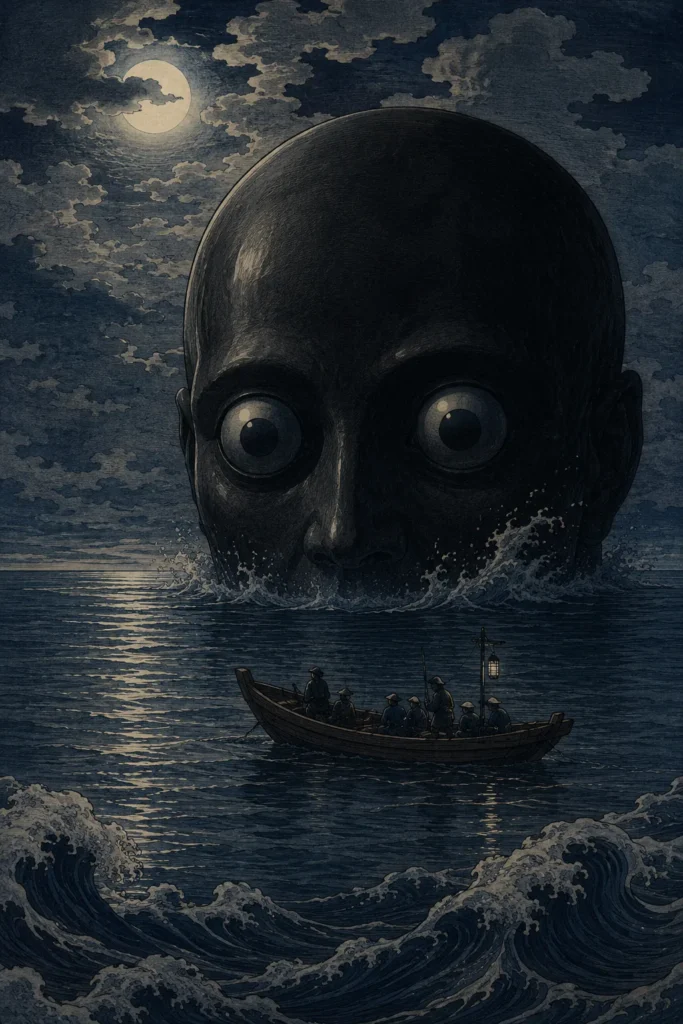
The Umibōzu is a feared yōkai among Japanese seafarers: a giant, pitch-black head rising out of a mirror-smooth sea, tipping stillness into storm. Documented in writing since the Edo period, presumably older in oral tradition.
Type: Yōkai, black sea monk
Origin: Japanese coastal belief
Texts: pictorial sources from the Edo period
Period: Edo period to the present
Appearance: bald giant head from a calm sea
Source Context
Period of the Texts
Documented in writing mainly from the Edo period, presumably older in oral tradition.
Area of Diffusion
The Japanese coasts nationwide, with regional name variants.
Sources
Good: Edo-period woodblock prints as well as the collections of Yanagita and Foster.
Name and variants
Japanese: umi means sea, bōzu alludes to the shaved head of Buddhist monks: Umibōzu is the sea monk.
Appearance and Behaviour
Appearance
A smooth, hairless giant head, black as the night sea, without a body.
Effect
When the weather turns, it shatters boats or drags them into the deep; if it demands a scoop, it uses it to sink the boat.
Profile: Umibōzu
The key characteristics of the sea monk at a glance.
Yōkai of Japanese coastal tradition, documented since the Edo period.
Fishermen and coastal sailors on the open sea at night.
A bald, pitch-black giant head without a body.
Tips a calm sea into storm, shatters boats.
A bottomless vessel, silence, not setting sail at year’s end.
The boatman Tokuzō and the trick with the vessel
Utagawa Kuniyoshi’s colour woodblock print from around 1845 depicts the legend of the boatman Tokuzō, who sets sail at year’s end against custom. The Umibōzu asks what is most terrible; Tokuzō’s answer, his own trade, makes it vanish along with the storm.
From woodblock print to manga yōkai
Kuniyoshi’s Tokuzō print became the iconic image of the yōkai, related to the legend of the European sea monk, a fish-like being caught off Denmark in 1546. From a religious-studies perspective, the Umibōzu marks the boundary between the coastal world and the sea and sanctions setting sail at year’s end.
The trick with the bottomless vessel
If the Umibōzu demands a ladle, one hands it a bottomless one, a motif it shares with the Funayūrei. Not setting sail at year’s end and not staring at the being: these are the rules of conduct. Recognised protective means include amulet, salt and holy water.
Sea spirits of Japan compared
Related is the giant red octopus Akkorokamui of Ainu tradition. Like the Umibōzu, the Greek whirlpool monster Charybdis rises from the sea, but remains bound to one place rather than appearing only sporadically.
Frequently asked questions about the Umibōzu
What does the Umibōzu demand?
A vessel; one hands it a bottomless one, so it scoops into empty air.
When does it appear?
At night on a calm sea that suddenly turns, the last day of the year being particularly risky.
Further links
Further reading:
Literature (selection)
Further standard works in the bibliography.
Searched for as umibozu yokai, the black monk’s head remains above all one thing: a Japanese sea monster of the still night over a mirror-smooth sea.