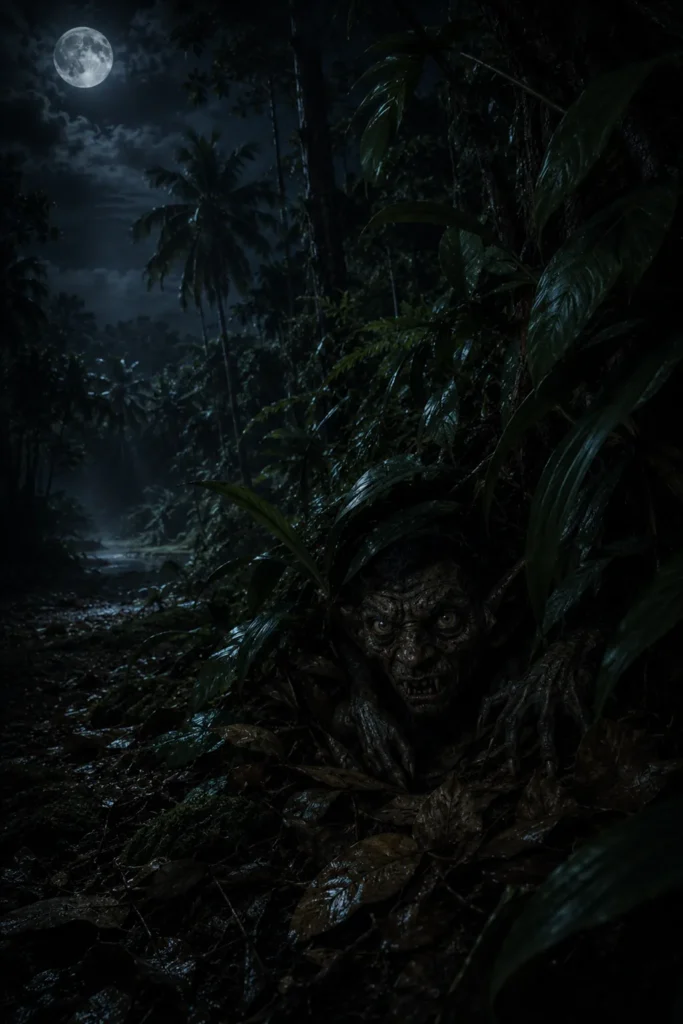
Manananggal, when the upper body detaches from the torso
By Ralf Ittermann · last reviewed on
Manananggal is a demon of Philippine tradition.
Her upper body separates at night and hunts pregnant women. The account centers on the moment when the upper body detaches from the torso.
Manananggal is the self-splitting woman of Philippine folklore. At night, her upper body separates at the waist from her torso, grows bat wings and flies off to suck the blood of pregnant women and unborn children with a long, thread-like tongue. A flying upper body with dangling entrails thus searches for prey, while the left-behind lower half remains her weakness.
The name derives from the Tagalog tanggal, to detach or loosen, and literally denotes the one who detaches herself. As a subtype of the Aswang complex, she belongs to the entrail-suckers in folklorist Maximo Ramos’ classification: by day an ordinary woman, by night the winged form.
Type: Flying entrail-sucker, self-splitting type of the Aswang complex
Origin: Philippine folklore of the Visayas and southern Luzon, pre-colonial with Spanish-Catholic overlay
Texts: Well documented through Maximo Ramos’ classification of the Aswang complex
Period: pre-colonial to the present
Appearance: woman who splits at the waist at night, upper body with bat wings

Area of origin and sources
Period of the Texts
The Manananggal, as a subtype of the Aswang complex, has pre-colonial roots, but was also shaped and demonised during the Spanish-Catholic colonial period.
Area of Diffusion
The belief is widespread mainly in the Visayas, and also in southern Luzon.
Sources
Good: fundamental is Maximo Ramos’ five-part classification of the Aswang complex, in which the Manananggal forms a distinct type.
Name and variants
Tagalog: The name comes from tanggal, to detach or loosen: Manananggal means the one who detaches herself. It thus directly names the core process of the figure, the separation of upper and lower body.
Form and effect
Appearance
Her upper body, from head to belly, detaches at night, grows bat wings and flies, while the lower half of her body remains behind. A long, thin, thread-like tongue is also part of her form. She symbolises threatened femininity and fertility and the fear surrounding pregnancy.
Effect
At night the Manananggal flies to the houses of pregnant women, lowers her long tongue through the roof or a window, and sucks the blood or the heart of the foetus. She also attacks sleeping people.
Profile: Manananggal
The key aspects of the self-splitting bloodsucker at a glance.
Subtype of the Aswang complex according to the classification of folklorist Maximo Ramos.
Pregnant women and unborn children, and also sleeping people in their homes.
By day an ordinary woman, by night a winged upper body with a thread-like tongue.
Bloodsucking of pregnant women and unborn children; the left-behind lower half is at the same time her weakness.
Salt, ash or garlic on the open wound at the waist of the abandoned half, together with ginger and the stingray tail Buntot Pagi as general protection against the Aswang.
The Malay Penanggalan separates at the neck instead of the waist, while the Thai Krasue is a flying head with entrails.
From Tagalog tanggal to the self-severing organ-eater type
The name Manananggal derives from the Tagalog tanggal, to detach or separate, and literally denotes the one who separates herself. She corresponds to the self-severing organ-eater type in the five-part classification of the Aswang complex proposed by the folklorist Maximo Ramos.
Like the Aswang as a whole, the Manananggal was shaped in a demonising manner during the Spanish-Catholic colonial period. Her roots, however, lie in pre-colonial Philippine belief, widespread especially in the Visayas and southern Luzon.
From the cinema screen to the Halloween mask
The best-known Manananggal segment is part of the Philippine film series Shake, Rattle and Roll from 1984, a cult classic. The figure is also firmly established in comics and Philippine Halloween iconography.
From a religious-studies perspective, the Manananggal is the organ-eater type of the Aswang complex. She embodies fears surrounding pregnancy and female sexuality: her beautiful daytime form and gruesome nighttime form reflect the ambivalence of a threat that seemingly comes from one’s own neighbourhood.
The vulnerable lower half
The Manananggal’s weakness is the lower half of the body left behind. If it is found, one scatters salt, ash or garlic onto the open waist wound; then the upper body can no longer reunite by daybreak, and the being dies. In addition, ginger and an amulet made from the dried tail of the stingray, Buntot Pagi, are considered general protection against the flying bloodsucker.
Related bloodsuckers of Southeast Asia
The Manananggal is closely related to the Malay Penanggalan, which however separates at the neck instead of the waist, and to the Thai Krasue, whose head flies with glowing entrails. Further regional relatives are the Ahp, Kasu and Leyak; a shared Austronesian root for these figures is discussed.
Frequently asked questions about the Manananggal
Why is it always women?
The figure embodies fears surrounding pregnancy and female sexuality; by day, the Manananggal appears as a beautiful young woman.
How is she killed?
By scattering salt, ash or garlic onto the lower half left behind, so that the upper body can no longer reunite.
Is she the same as the Penanggalan?
Related, but the point of separation differs: for the Manananggal it is the waist, for the Penanggalan the neck.
Further links
Further reading:
- Aswang – the umbrella term for the Philippine demon complex
- Penanggalan, Krasue – related organ-eaters of Southeast Asia
- Tiyanak – another Philippine demon
- Salt, garlic, amulet – traditional protective means
- Protection Compass – an overview of protective means
Literature (selection)
Further standard works in the bibliography.
As a self-severing woman, the Manananggal remains the most vivid figure of the Philippine Aswang complex: a flying upper body that must find its way back to the lower half left behind by daybreak in order to survive.