Kodama, tree soul and voice of the mountain echo
By Ralf Ittermann · last reviewed on
The Kodama is a spirit of Japanese tradition.
The soul of old trees, which answers as a mountain echo. The article treats the Kodama’s voice as the very mountain echo that answers back from ancient trees.
The Kodama is the spirit of an old tree in Japan, the soul of the tree. Felling a tree inhabited by a Kodama brings misfortune; at the same time, the Kodama explains the mountain echo, which was considered the tree spirit’s answer.
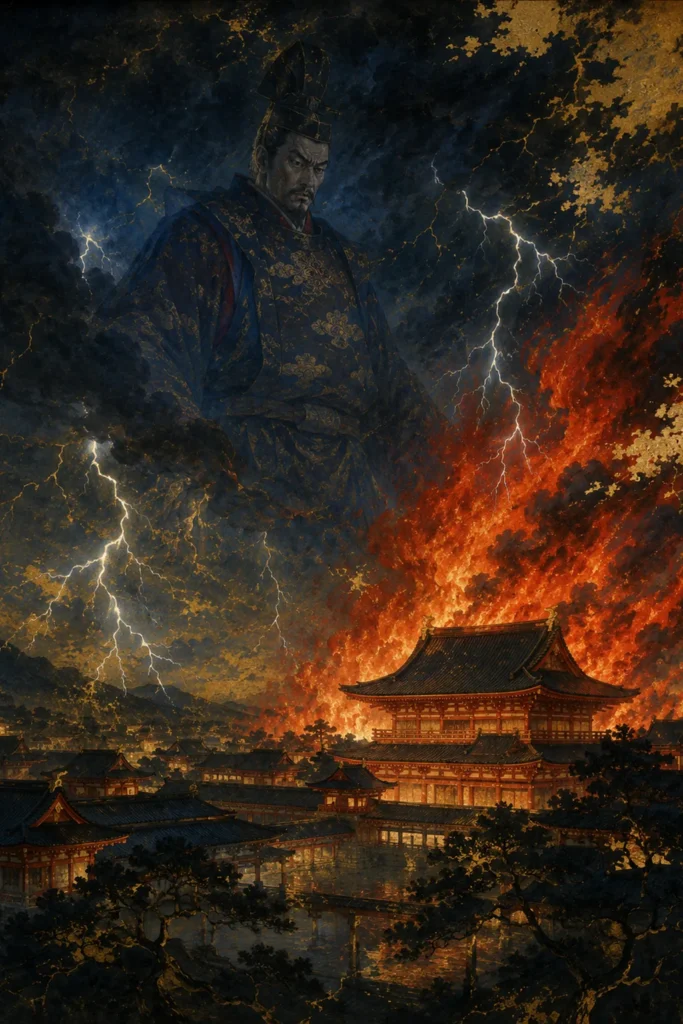
Trees considered to be inhabited by a Kodama are marked with the sacred rice-straw rope, the shimenawa, and are not felled. The Kodama was fixed iconographically in 1776, when Toriyama Sekien placed it at the beginning of his illustrated compendium Gazu Hyakki Yagyo.
Type: Tree spirit, soul of old trees, also an explanation for the mountain echo
Origin: Japan, attested in pre-modern times
Texts: Gazu Hyakki Yagyo (1776) and yokai research
Period: pre-modern to present
Appearance: usually invisible, as a ball of light, an animal or an old couple

Historical Classification
Period of the Texts
Attested in pre-modern times and fixed iconographically in 1776, when Toriyama Sekien placed the Kodama at the beginning of his illustrated compendium Gazu Hyakki Yagyo.
Area of Diffusion
Found throughout Japan, especially in mountain and forest regions, where old trees and the mountain echo are part of everyday life.
Sources
Good: Sekien’s illustrated compendium of 1776, its annotated editions and modern yokai research.
Name and variants
Japanese: Several spellings are attested, using the characters for tree and soul or spirit, modern usage mostly as Kodama, alongside a spelling for the echo. The basic meaning varies between tree soul and echo; both aspects are traditionally linked.
Nature and effect
Appearance
Kodama are usually invisible and bound to a tree; they appear as a ball of light, a strange sound or a forest animal; in Sekien’s depiction they appear as an old couple beside the trees. They embody the animateness of old trees and respect for the age of nature.
Effect
The Kodama is an explanatory model for the delayed mountain echo, which was considered the tree spirit’s answer, and has a protective function for forests and old trees. Felling a Kodama tree risks misfortune and a curse; there is a belief that blood may emerge when very old trees are felled.
Profile: Kodama
The key aspects of the tree spirit at a glance.
A classic tree spirit within an animist-Shinto framework, at the intersection of kami and yokai.
Forest visitors, woodcutters and villagers: anyone who uses old trees or enters the forest must reckon with the Kodama.
Usually invisible; visible as a ball of light, a forest animal or, in Sekien’s classic iconography, as an old couple beside the trees.
Protection of old trees through a felling taboo and belief in a curse; at the same time a traditional explanation for the delayed mountain echo.
Inhabited trees are marked with the shimenawa, the sacred rice-straw rope, and must not be felled.
Sekien's divine spirit of old trees
Toriyama Sekien placed the Kodama at the beginning of his picture-lexicon Gazu Hyakki Yagyo of 1776. His caption states, in essence, that a divine spirit takes up residence in old trees; often interpreted as: once a tree exceeds a hundred years, a divine spirit moves in and reveals its form.
The attested spellings link tree and soul or spirit, one further one links it to the echo; the underlying meaning wavers between tree-soul and echo, and precisely this connection shapes the being. The delayed mountain echo was regarded as the tree spirit’s answer, while the Kodama was at the same time thought of as the guardian of the old tree, whose felling brings misfortune.
From Sekien to Princess Mononoke
The Kodama became known worldwide through Studio Ghibli’s Princess Mononoke of 1997, where small, white, humanoid beings with oversized heads serve as a sign of a healthy forest. This depiction shapes today’s image, but departs from Sekien’s classical iconography of the old couple.
From the perspective of religious studies, the Kodama is a classic tree spirit within an animistic-Shinto framework, at the intersection of kami and yokai. It illustrates the Shinto notion of ensouled, awe-inspiring natural objects.
The Shimenawa and the felling taboo
Well attested is the practice of marking trees believed to be inhabited by a Kodama with the sacred rice-straw rope, the Shimenawa; they must not be felled. In Shinto, the Shimenawa marks sacred objects connected to a kami and protects the tree from being cut down. Anyone who breaks the taboo risks misfortune and curse; the rope around the trunk thus acts as a visible protective circle around both tree and spirit.
Tree souls and echoes: parallels and distinctions
The Kodama corresponds very closely to the Greek Dryad, whose life is bound to a tree and whose felling was regarded as murder, as well as to the Indian Yaksha and the West African Iroko Man; felling taboos and belief in curses occur across cultures. Within Japan, the Yamabiko must be distinguished: it is the independent echo-yokai of the mountains, whereas with the Kodama the echo is regarded as the tree soul’s answer, meaning the spirit is bound to the tree, not to the reverberation.
Frequently asked questions about the Kodama
In which work does Toriyama Sekien introduce the Kodama?
In the Gazu Hyakki Yagyo of 1776, where it stands at the very beginning.
Why does the Kodama explain the mountain echo?
The delayed echo was regarded as the tree spirit’s answer; one spelling links the Kodama directly to the echo.
How does one protect a Kodama tree?
By marking it with a Shimenawa rope and not felling it; breaking this brings misfortune.
Further links
Further reading:
- Japan – all beings of Japanese tradition
- Yamabiko – the echo-yokai of the mountains, for comparison
- Kijimuna, Dryad – related tree spirits
- Protective circle, Smoke cleansing, Amulet – traditional protective means
- Protection Compass – protective means at a glance
Literature (selection)
Further standard works in the bibliography.
As a Japanese tree spirit, the Kodama is the soul of the tree in the literal sense: a silent inhabitant of old trunks, answering in the mountain echo, whose rope around the trunk still commands respect today.