Tapio, the golden king of the forest
By Ralf Ittermann · last reviewed on
Tapio is a god of Finnish tradition.
King of the forest, who grants or withholds the hunter’s quarry.
Tapio is the king of the forest (metsän kuningas) and lord of the forest realm of Tapiola. Before every hunt, hunters asked him for quarry, for without his consent the forest was considered closed; his name still stands in Finnish today as a symbol for the forest itself.
Since Mikael Agricola’s list of gods from 1551, Tapio has been the forest god of written tradition, at that time as the giver of hunting quarry in the region of Häme. The Kalevala made him the head of an entire forest family: his wife is Mielikki, his children are Nyyrikki, Tellervo and Tuulikki.
Type: Forest god, king of the forest and lord of Tapiola
Origin: Finland and Karelia
Texts: Agricola 1551, Ganander 1789, rune songs (SKVR), Kalevala 1835/1849
Period: first attested 1551, main tradition 18th/19th century
Appearance: old man of the forest with a lichen beard, moss brows and a needle hat

Textual history
Period of the Texts
The first record dates from 1551, from Mikael Agricola’s preface to his Psalter; the actual body of sources lies in the rune songs of the 18th and 19th centuries and in the Kalevala of 1835/1849.
Area of Diffusion
Finland and Karelia. Depending on the region, the forest lord bears different names, including Kuippana, Hippa and Hilli.
Sources
Good sources: Agricola 1551, Ganander’s Mythologia Fennica of 1789, the rune song collection Suomen Kansan Vanhat Runot and the Kalevala.
Name and variants
Finnish: Tapio. Several interpretations exist regarding the origin of the name: Martti Haavio linked tapa with luck and fate and read Tapio as the giver of hunting luck, Eemil Aukusti Tunkelo thought of the trap’s catch mechanism, Kaarle Krohn and Uno Harva compared the Kola Sami hunting god Tavaj. In the rune songs, the word tapio can simply mean forest, and occasionally it even denotes the female forest lady.
Form and effect
Appearance
The 14th canto of the Kalevala captures the definitive image: Tapio is the old man of the forest with a grey beard, a hat of pine needles (havuhattu) and a coat of tree lichen (naavaturkki), at the same time the golden king of the forest. His courts lie deep in the forest, their windows shining gold through the moors. It is notable that many of his honorific names in the rune songs also refer to the bear; in the cattle blessing of the 32nd canto, the bear appears almost as Tapio’s dog or son.
Effect
Tapio grants and withholds game. In the 14th canto, Lemminkäinen pleads: ‘Grow mild, forest, soften, wasteland, yield, only Tapio.’ If favour is withheld, the hunter returns home without a gift. The dark side shows itself in the metsänpeitto, the forest cover: the forest conceals people or livestock, those affected no longer recognise familiar terrain, and searchers pass them by without seeing them.
Profile: Tapio
The key aspects of the forest king at a glance.
Supreme forest lord of Finnish-Karelian tradition; in the Kalevala, head of a family with a court in the forest realm of Tapiola, also called Metsola.
Hunting and forest pasture: hunters, trappers and herders asked him for game and for the safe return of livestock from his realm.
Old man of the forest with a beard of grey tree lichen, eyebrows of moss, a needle hat and a lichen coat; his body is barely distinguishable from a tree.
He opens or closes the forest’s storehouse; whoever offends the forest is denied game, and the forest folk can conceal him in the metsänpeitto.
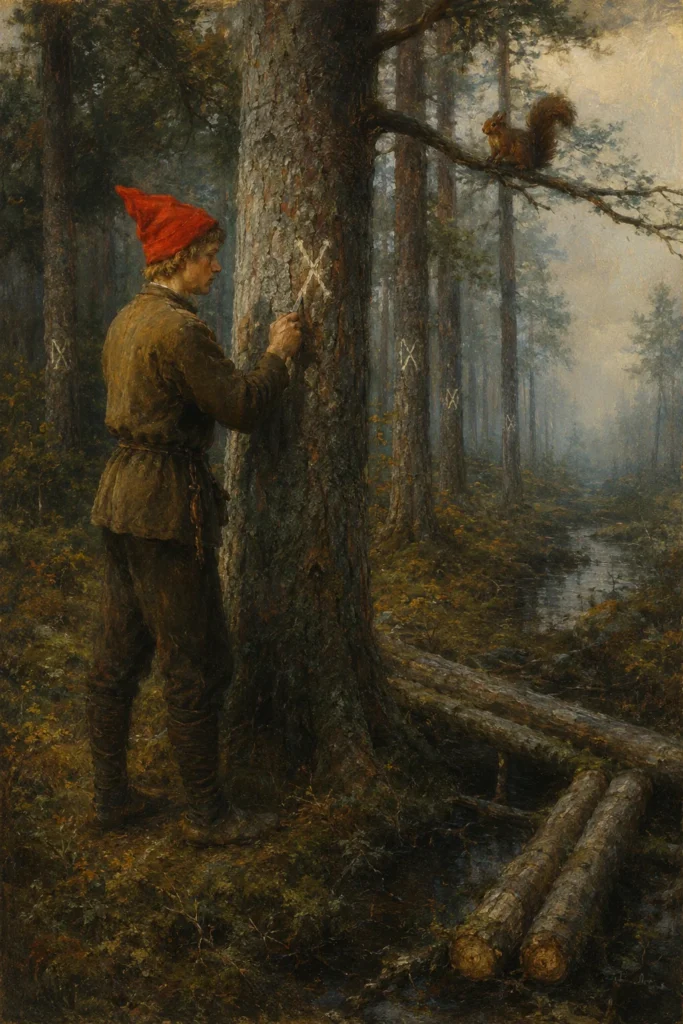
The cult site was the Tapionpöytä, a spruce grown without a crown, at which hunters left first-catch offerings; recorded practices include walking around it with the hat in hand and a sung prayer.
The Slavic Leshy as the closest equivalent, along with the animal-lord types around Cernunnos and Veles, as well as Diana as the giver of the hunt.
From Agricola's list of gods to the Kalevala king
The reformer Mikael Agricola names Tapio in 1551, in the preface to his Finnish Psalter, among the gods of the region of Häme: Tapio granted the hunting quarry from the forest; as the Karelian counterpart, Agricola lists Hiisi. Christfrid Ganander describes him in 1789 as a god of hunting and livestock, to whom a cockerel was sacrificed. The actual body of sources lies in the rune songs of the 18th and 19th centuries, in which the forest lord is called Kuippana, Hippa or Hilli depending on the region.
Elias Lönnrot combined this tradition in the Kalevala into a fixed figure with a court: Tapio resides in Tapiola or Metsola, his wife is Mielikki, his children are Nyyrikki, Tellervo and Tuulikki. Before the bear hunt of the 46th canto, Väinämöinen asks the forest to ‘take him among its men’: the forest is its own realm with a household order whose doors open only to those who knock politely.
Legacy and interpretation
Jean Sibelius erected a monument to the forest realm in 1926 with the tone poem Tapiola, op. 112. The district of Tapiola in Espoo and the settlement of Tapiola in Michigan bear the name, as do many Finnish men with the first name Tapio. Carl Eneas Sjöstrand created the sculpture ‘Tapio with his People’ in 1898; in the Finnish metal scene he appears, for instance, with Nightwish and Korpiklaani.
Scholars disagree over whether Tapio is an independent god or the personification of the forest: Carl Axel Gottlund and Kaarle Krohn saw a personification, Uno Harva emphasised the euphemistic use of tapio as a substitute word for forest and bear, Martti Haavio interpreted all the hunting figures of the family as distributors of fate, meaning hunting luck. What is certain is that the closed family of gods is Lönnrot’s literary ordering of a regionally highly varied Haltija tradition.
The table of Tapio: gifts rather than warding off
The traditional way of dealing with Tapio is one of honour, not warding off. The cult site was the Tapionpöytä, the table of Tapio: a spruce grown without a crown, at which hunters left first-catch offerings, including beer from the soup of the first catch, small rye flatbreads (Tapion kakkarat), silver and spirits. Also recorded is the practice of walking around the tree with the hat in hand and a sung prayer; those entering the forest greeted it, as shown in the 14th canto. Against the forest cover, folk tradition knew of turning one’s clothes inside out, pouring water into one’s own footprint and carrying steel; wise ones (tietäjät) negotiated with the forest folk for the release of what was hidden.
Forest lords of other cultures
The Slavic forest lord Leshy is the closest equivalent: lord over game and paths, who takes contracts from shepherds and misleads the discourteous. The Celtic Cernunnos, as lord of animals, is closely related, as is the Slavic Veles, responsible for livestock and wilderness. Tapio shares the role of giver of the hunt with the Roman Diana, though Finnish tradition tends to expect gifts more from the female side of the forest, from Mielikki.
Frequently asked questions about Tapio
Is Tapio a god or a nature spirit?
Both fit the sources. The oldest records treat him as a god of hunters, the rune songs often as the supreme forest haltija, meaning the protective lord of a place. Only Lönnrot’s Kalevala shaped him into a king with a family and court; for the practice of the singers, the distinction was of little consequence.
What is Tapiola?
Tapiola, also Metsola, is Tapio’s realm: the forest as its own household with courts, storehouses and servants. In the Kalevala, Lemminkäinen sees the golden windows of Tapio’s courts shimmering through the moors. The name later passed to the district of Espoo and to Sibelius’ tone poem.
How did people protect themselves from the forest cover (metsänpeitto)?
Folk tradition recommended turning one’s clothing inside out, pouring water into one’s own footprint or carrying steel. As a precaution, greeting the forest and offering it gifts were considered the best protection, since according to the tales the cover mainly affected the inconsiderate.
Further links
Further reading:
Literature (selection)
Further standard works in the bibliography.
With Tapio, Finnish mythology knows forest god and forest as one figure: the Lord of the Forest Tapiola receives the hunter’s greeting, grants the quarry and watches over the household order of his green realm.