Bieggolmai, lord over wind and storm in Sápmi
By Ralf Ittermann · last reviewed on
Bieggolmai is a god of Sami tradition.
The Wind Man who catches storms in caves and releases them again.
Bieggolmai, the wind man, is one of the most important gods of the pre-Christian Sami pantheon. He controls wind and storm, catching them in caves and releasing them again. Under the epithet wind elder, the same deity is recorded as Bieggagállis.
His practical significance was considerable: reindeer move against the wind to escape the mosquitoes, the wind determines hunting and weather, and along the coast safety at sea depends on him. Bieggolmai is documented in missionary and ethnographic reports from the 17th to 19th centuries and as a figure on the Sami magic drums.
Type: Wind god, lord over wind and storm
Origin: Pre-Christian Sami pantheon, Sápmi
Texts: Nærøy manuscript (Randulf, 1723), Læstadius, magic drums
Period: Missionary and ethnographic reports from the 17th to 19th centuries
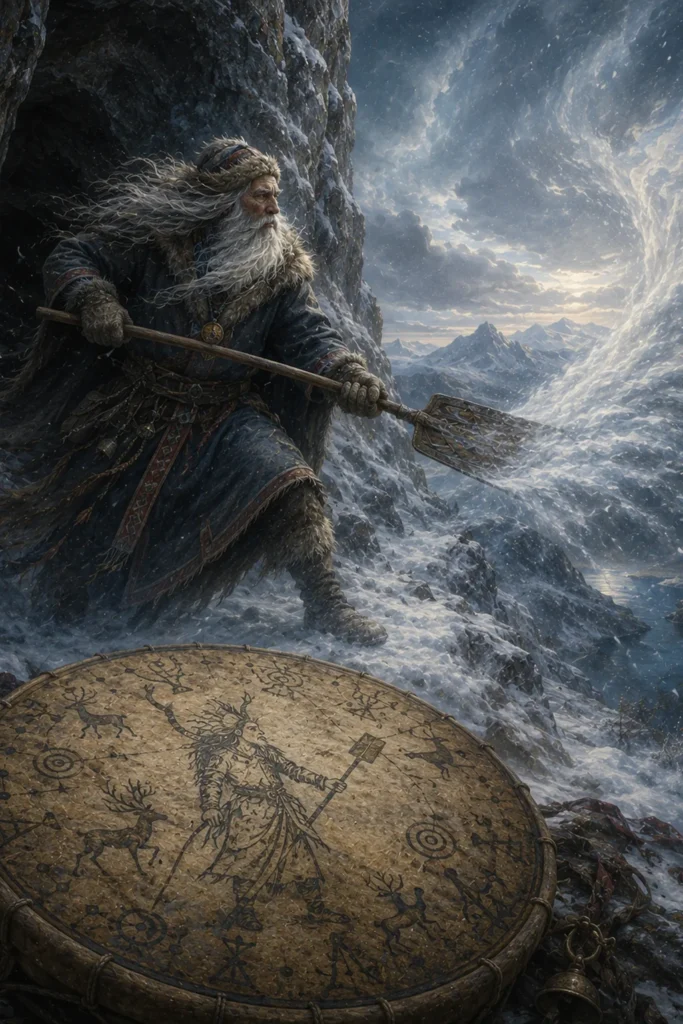
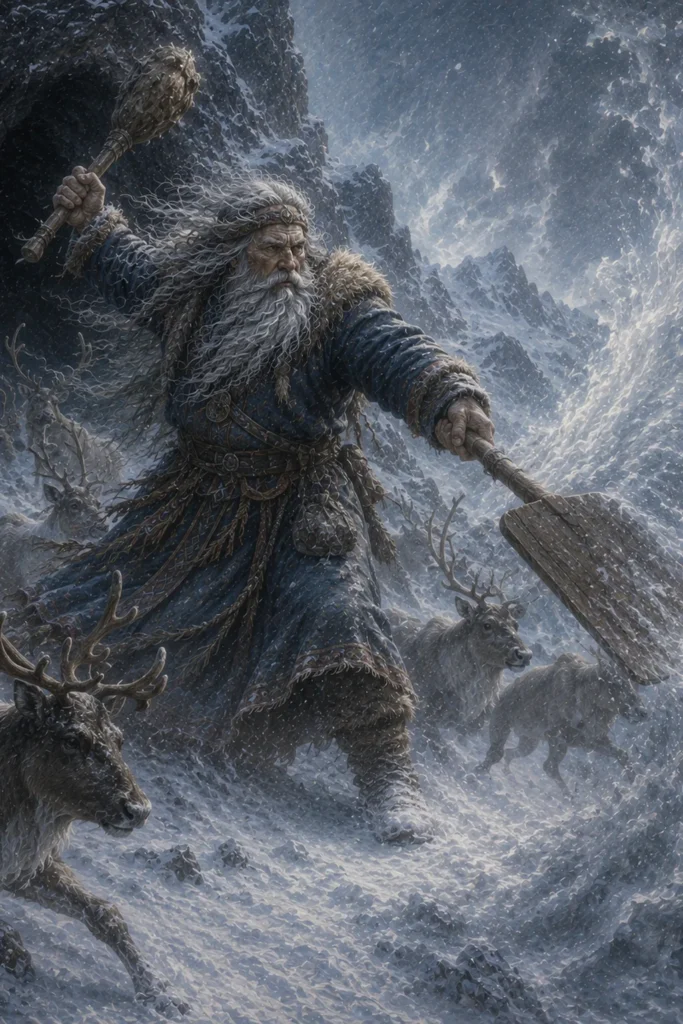
Appearance: Man with shovel and club
Origin and sources
Period of the Texts
The records stem from missionary and ethnographic reports of the 17th to 19th centuries, foremost Johan Randulf’s Nærøy manuscript of 1723 and Lars Levi Læstadius.
Area of Diffusion
Sápmi, the Sami region of Northern Scandinavia: from the fell of reindeer herders and hunters to the coasts, where the wind decided the fate of seafaring.
Sources
Good for Sami conditions: Randulf and Læstadius as the main sources, along with the depictions on the magic drums; even the cult is documented.
Name and variants
Sami: biegga means wind, olmmái man, hence wind man; variants include Bieggaolmmái and Biegkålmaj. Bieggolmai is the same being as Bieggagállis, the wind elder. The multitude of spellings arises from dialects and inconsistent transcription by non-Sami missionaries.
Form and effect
Appearance
Bieggolmai is a man with two tools: according to Randulf, he carries a shovel on the right, to shovel the wind back into its caves once it has blown enough, and a club on the left, to drive it out again to blow. He lives in caves and mountains, in which he confines the winds.
Effect
Bieggolmai controls wind and storm, releasing them and catching them again. For reindeer herders and hunters he is of practical importance, because the reindeer move against the wind to escape the mosquitoes; furthermore the wind determines hunting, weather and, on the coast, safety at sea.
Profile: Bieggolmai
The key aspects of the wind man at a glance.
One of the most important gods of the pre-Christian Sami pantheon; on the magic drums he appears in a trinity with Horagalles and Veralden Olmai.
Wind and storm over fell and coast: hunting, reindeer migration and safety at sea depend on his will.
Man with two tools: the shovel on the right, the club on the left. He dwells in caves and mountains, in which he keeps the winds.
He releases the winds and catches them again; the reindeer move against the wind to escape the mosquitoes, so his effect touches everyday life directly.
At Inari, antlers and horns are said to have been offered at the Piegg-oaivadz fells, along with animals, small boats and wooden shovels as symbolically fitting gifts.
Bieggegaellies, the wind elder, as a name variant of the same deity; typologically comparable to Aiolos with the same confinement motif.
Shovel, club and the caves of the winds
Sami biegga means wind, olmmái man; the wind man is thus already named in his name. The main sources are Johan Randulf’s Nærøy manuscript of 1723, Lars Levi Læstadius’ Fragmenter i lappska mythologien from 1840 to 1845 and the depictions on the Sami magic drums. According to Randulf, Bieggolmai carries the shovel on the right, with which he shovels the wind back into its caves, and the club on the left, with which he drives it out again.
Bieggolmai is the same being as Bieggagállis, the wind elder; the multitude of spellings arises from dialects and inconsistent transcription by non-Sami missionaries. On the drums, the wind deity appears as one of the central figures, in a trinity with Horagalles, the thunder, and Veralden Olmai, the man of world and fertility.
Reception and classification
Bieggolmai is prominent in modern Sami cultural and identity reception and in drum research, and gives his name to various cultural projects.
From a religious studies perspective, Bieggolmai is ambivalently powerful: as lord of the storm he governs hunting, reindeer and seafaring, potentially dangerous if disregarded, but appeasable through offerings and not an evil being. Three clarifications are important: Bieggolmai is identical to Bieggagállis and Bieggegaellies, thus a single deity. The often repeated claim of two shovels is a simplification; Randulf mentions a shovel and a club. And the sources are non-Sami missionary reports, to be read with caution.
Offerings at the wind fells
Unlike many wind beings, the cult is documented: at Inari, antlers and horns are said to have been offered to Bieggolmai at the Piegg-oaivadz fells, along with gifts of animals, small boats and wooden shovels, the latter a symbolically fitting attribute of the shovel-bearer. On the drums he stands in a trinity with Horagalles, the thunder, and Veralden Olmai, the man of world and fertility; those in Sápmi who depended on wind and weather turned to the wind man with gifts.
Wind lords of the North compared
There is a neighbouring tradition to the Finnish wind-lord complex with Tuuletar and Ilmatar. Typologically, Bieggolmai resembles the Greek Aiolos, who keeps the winds in a container, with the same cave and confinement motif. Within the Sami pantheon he stands alongside Horagalles and Veralden Olmai; under the epithet wind elder he is recorded as Bieggegaellies.
Frequently asked questions about Bieggolmai
Who is Bieggolmai?
The Sami wind man, one of the most important gods of the pre-Christian Sami pantheon. He controls wind and storm and catches them in caves.
What does he do with the shovel and club?
With the shovel he shovels the wind back into the caves, with the club he drives it out again to blow.
Is Bieggolmai the same as Bieggagállis?
Yes. It is the same deity; wind man and wind elder are two names for one being.
Further links
Further reading:
- Sami – all beings of the Sami tradition
- Bieggegaellies – the wind elder, a name variant of the same deity
- Tuuletar – the wind maiden of the neighbouring Finnish tradition
- Aiolos – the Greek keeper of the winds
- Amulet, protective candle, salt – traditional protective means
- Protection Compass – overview of protective means
Literature (selection)
Further standard works in the bibliography.
As the Sami wind god, Bieggolmai combines numinous power with tangible everyday life: the wind man with shovel and club decides over reindeer migration, hunting and the return of boats, and those who gave him gifts counted on his goodwill.