Erlik Khan, Altaic-Siberian lord of the underworld and counterpart of Ulgen
By Ralf Ittermann · last reviewed on
Erlik Khan is the ruler of the underworld in South Siberian Tengrism and the mythic counterpart of the light god Ulgen. He represents death and disease and, at the same time, a necessary, ordered shadow side of the world.
Erlik Khan is the Altaic-Siberian underworld god of Tengrism.
Erlik Khan, the Altai underworld god, rules over the dead and the subterranean world of Tengrist-shamanic mythology.

Profile: Erlik Khan
Erlik Khan: the most important aspects at a glance. The following fields summarise origin, effect, appearance, function, protection and parallels.
In Altaic and Tuvan belief, Erlik Khan belongs to the uppermost layer of gods of the South Siberian pantheon; his name is Old Turkic. In the Altaic creation myth he fetches, in the form of a bird at Ülgen’s request, mud from the primeval sea and secretly keeps a part of it in his mouth. From it arise swamps, mountains and finally Erlik himself as an independent power.
Erlik rules over the dead and over the spirits of plague and famine. According to one tale he makes the first humans ill by “picking” bones out of their bodies. In epidemics, sudden deaths and the loss of a child, the black shaman was called, who brought back the “led-away soul”.
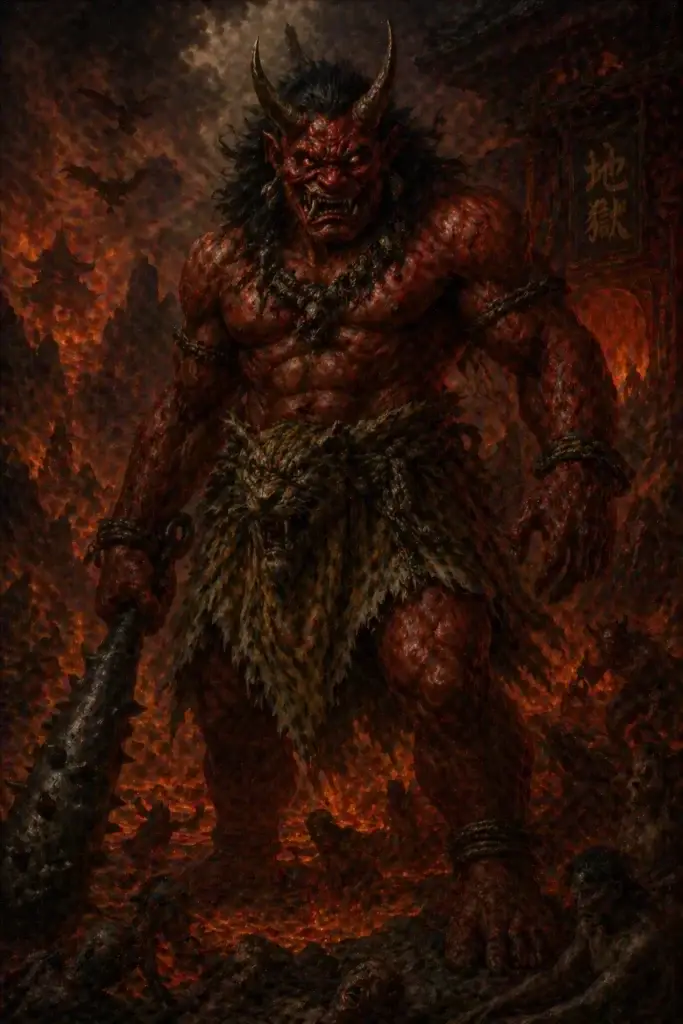
Erlik is described as an old, black-haired man with boar tusks, iron claws and a mace made of human vertebrae. He rides on a black bull or black horse and lives with nine sons and nine daughters in a palace on the bank of a river of hell. The Buddhist reworking adds buffalo horns, lasso and mirror of deeds.
Erlik is lord of the lower realm and stands for death and illness as well as for an ordered shadow side of the world. With Ülgen he forms a dual pair in the sense of a complementary order of above and below, summer and winter, birth and death. He is regarded as both cause and remover of illness.
Against Erlik, white woollen ribbons were hung on the door beam, small wooden figures were laid down as a symbolic substitute sacrifice and the house was fumigated with juniper. It was taboo to pronounce his name aloud after sunset. Sickrooms must not be entered wearing a hat, and door thresholds were smeared with charcoal.
Structurally comparable are Yama in Vedic and Buddhist India, Hades, Hel in Norse mythology, Mictlantecuhtli in the Aztec pantheon and Osiris as judge of the dead. In the Mongolian world Erlik merges as Erlig Khan with Yama; among the Yakuts Arsan Duolai is regarded as a parallel figure.
Classification and Brief Profile
Erlik Khan (also Erlik, Erklik, Erlig; Mongolian Erlig Khaan) belongs to the highest tier of the South Siberian pantheon. In Altaic and Tuvan belief he is the lord of the lower realm, not of evil as such, but of a distinct domain inhabited by the dead and the spirits of plague and famine.
In later layers he appears as a malevolent figure, a development attributable above all to Buddhist reinterpretation in the Mongolian world (Erlig Khan as Yama equivalent) and to Christian-missionary demonization in the 18th and 19th centuries.
Within the Siberian-Tengrist tradition, Erlik and Ulgen form a dual pair that is not to be understood in moral terms as a Manichaean dualism, but as a complementary order of above and below, summer and winter, birth and death.
A. V. Anokhin clarified this interpretation in his Materials on the Shamanism of the Altaians (1924).
The scholarly debate around Erlik is particularly rich because it illustrates, through this one figure, how missionary outside perspectives can distort an indigenous religion. What the Altaians knew as the “Lord of the Lower World” was rendered “devil” through Russian Orthodox and Buddhist translations, a classic case study in postcolonial religious studies.
Name and Etymology
The name Erlik is Old Turkic and is commonly derived in scholarship from er (“man, hero”); an alternative derivation connects it to a root meaning “brave, strong, imperious.” In Mongolian it becomes Erlig Khaan; in Buddhist overlay it merges with the Indo-Tibetan Yama / Shinje.
Walther Heissig described this merger in detail in Die Religionen der Mongolei (1970).
The title Khan marks him as a ruler; in the Altaic shaman-songs he is also called Yer-Tine Khan, “King of the Earth’s Depths.” Importantly, in its indigenous Siberian context Erlik is not a devil in the Christian sense; Christian missionaries of the 19th century (Verbickij and others) suggested this equation, and scholarship long accepted it uncritically.
Linguistically noteworthy is the possible connection to er-lig, “the manly one,” which characterizes Erlik as the “great man” beyond death. In this reading he is less a harmful being than the representative of a necessary anthropological function: death as part of what it means to be human.
Description and Iconography
Erlik is described as an old, black-haired man with boar tusks, iron claws, and a mace made of human vertebrae.
He rides a black bull or black horse; his palace stands on the bank of an infernal river, which he shares with nine sons and nine daughters. The Altaic shaman drum depicts him in its lower third, often with an inverted sun symbol.
This iconography is described in its classical form by Anokhin (1924) and N. Dyrenkova; it was later discussed by Mircea Eliade in Le chamanisme. Buddhist overlay adds to it the attributes of the Indo-Tibetan Yama: buffalo horns, a lasso, and a mirror of deeds.
Several Altaic Erlik representations are preserved in the collections of the Kunstkammer Museum (St. Petersburg); L. P. Potapov catalogued them in his standard work Altaiskij schamanizm (1991). They display a remarkable iconographic consistency across two hundred years of collection history.
Mythological Narratives
The Altaic creation mythology tells how Ulgen wishes to draw earth from the primordial sea and asks Erlik, in the form of a bird, for help.
Erlik dives down and brings up mud, but secretly keeps part of it in his mouth; from this remainder marshes and mountains arise, and eventually Erlik himself as an independent power. In his arrogance he later tries to seat himself beside Ulgen, is banished, and has ruled the lower world ever since.
A second narrative describes how Erlik causes the first humans to fall ill by “reading” bones out of their bodies. Shamans were born to bring these bones back, a mythology that provides the ritual foundation for the shaman’s journey to the underworld and occupies the prototypical place in Eliade’s shamanism model.
A third, less well-known narrative describes how Erlik negotiates with the messengers of Tengri over the souls of the deceased: those who led a good life may return to the upper world; those who acted badly remain with Erlik. This moralizing variant is probably of more recent, post-Buddhist origin.
Cult and Veneration
In the strict sense there was no “veneration” of Erlik, rather a ritualized demarcation. The Altaic shamans distinguished between aq kam (white shaman), who ascended to Ulgen, and kara kam (black shaman), who descended to Erlik.
Both vocations were considered legitimate and necessary; the ethnographic account in Anokhin makes clear that “black” here does not mean “evil” but “directed downward.”
When plague struck, when sudden deaths occurred, or when a child was lost, the black shaman was summoned. During the session he ritually entered Erlik’s realm, negotiated with him, and returned the “abducted soul.” Sacrifices consisted of black sheep or horses; the blood was poured not toward the sun but into the earth.
With the Soviet era this cult died out almost entirely; in the Altaic renaissance since 1991 it has experienced a cautious revival, though considerably less visible than the Ulgen cult, since Erlik continues to be associated in popular perception with “black magic.”
Protective Practice and Apotropaic Measures
Described from a religious-studies perspective (without any claim of efficacy): apotropaic practices against Erlik included hanging white woolen bands on the door lintel, placing small wooden figures (“Erlik’s servants”) as symbolic substitute offerings, the taboo against pronouncing Erlik’s name aloud after sunset, and fumigating the house with juniper.
Certain behavioral rules also had an apotropaic character: one was not to enter a sickroom wearing a hat, since Erlik “collects heads”; door thresholds were rubbed with charcoal because the restrained black supposedly restrains the threatening black, a classic example of sympathetic magic in the sense of James Frazer.
These practices are to be understood within the framework of the taboo and purity concepts of South Siberian religion, which in numerous detailed rules demarcates the ordered fabric of the world from the lower realm.
Roberte Hamayon, in La chasse a l’ame (1990), read them as part of a “kinship economy” in which illness and death are addressed as breaches of order.
Parallels in Other Cultures
Structurally comparable figures include: Yama in Vedic and Buddhist India; Hades in the Greek tradition; Hel in Norse mythology; Mictlantecuhtli in the Aztec pantheon; and Osiris in his function as judge of the dead rather than as dying god.
Within Siberia itself there are parallel figures such as Arsan Duolai, the counterpart of Aiy Tojon among the Yakuts.
The Buddhist-Tibetan transformation of Erlik into Erlig Khaan as Yama equivalent is the subject of a dedicated study by Walther Heissig (Die Religionen der Mongolei, 1970). This shows how an indigenous underworld figure was integrated into Tantrism and overlaid there with its own attributive layers.
From a phenomenology-of-religion perspective, it is noteworthy that virtually all three-tiered cosmological systems (upper, middle, lower) include an underworld deity who is simultaneously a figure of dread and a guarantor of order. Erlik is therefore not an anomaly but an instructive example.
Contemporary Reception and Research
In modern Tuvan and Altaic folklore, Erlik functions more as a figure of dread than as an object of cult; in popular reception (fantasy novels, online games) he appears partly as a “dark antagonist.” Academically reliable treatments are found in Andrei Znamenski, Roberte Hamayon, and in the Russian-language collection Mify narodov mira (vol. 2, 1992).
An important scholarly debate revolves around the question of how much of the current “dark” image of Erlik predates Islam and Buddhism and how much arose from Christian-missionary demonization in the 18th and 19th centuries. Verbickij and other missionaries simply translated “Erlik” as “devil” in their dictionaries, and later scholarship long accepted this uncritically.
Andrei Znamenski’s Shamanism and Western Imagination (Oxford 2007) has reconstructed this history of distortion comprehensively and argues for a restoration of the historical Erlik as an ambivalent figure of order beyond Christian-dualist schemas.
Research Debates and Open Questions
Three research questions remain open. First: what earlier form did Erlik have in proto-Turkic religion prior to contact with Buddhism and Christianity? Anokhin’s material suggests he was older and more autonomous than the Buddhist identification with Yama implies.
Second: to what extent is the Altaic Erlik tradition continuous with the Yakut abasy tradition and discontinuous with the Mongolian Erlig-Khaan tradition? L. P. Potapov argued for a split hypothesis here, which is being revisited in more recent research.
Third: what role does Erlik play in the contemporary Tuvan and Altaic neo-shamanism scene, which develops partly against, partly alongside the Russian mainstream? Marjorie Mandelstam Balzer has shown in several essays that modern shamans deliberately draw on Erlik to articulate an indigenous alternative to the dominant Russian Orthodox symbolism.
Relationship to the Yama Tradition
The identification of Erlik with Buddhist Yama is, from the perspective of religious history, one of the best-documented cases in Mongolian-Tibetan religion.
Walther Heissig showed in Die Religionen der Mongolei (1970) how, over several centuries, the Altaic Erlik merged with the Indo-Tibetan Yama / Shinje without a complete substitution taking place. Instead, a double-layered figure emerged in which either the Altaic or the Buddhist layer is activated depending on context.
This layering is an instructive example for the religious-studies field of “translation studies”: how precisely is a concept transferred from one tradition to another, which semantic shifts are unavoidable, and what hybrid forms arise from the translation process?
A concrete instance: in the Tibetan Bardo Thodrol (“Tibetan Book of the Dead”), Yama appears as the holder of a mirror that shows the dead person his or her deeds in life. This idea is absent from the autochthonous Altaic Erlik complex but present in the late-Mongolian Erlik conception, pointing to the Buddhist layer.
Sources and Reference to the Culture Hub
Those wishing to study the Erlik complex in its full breadth will find on the overview page Siberian-Tengrist Tradition the most important cross-references to related figures such as Ulgen and the lower abasy harmful beings. A. V. Anokhin’s Materials on the Shamanism of the Altaians (1924) remains the most important primary source.
For the Buddhist overlay, Walther Heissig’s Die Religionen der Mongolei (1970) and Klaus Sagaster’s studies are the standard references. For the critical examination of missionary distortions, Andrei Znamenski’s Shamanism and Western Imagination (Oxford 2007) is the best available work.
L. P. Potapov’s standard work Altaiskij schamanizm (Leningrad 1991) offers the most comprehensive Soviet-Russian synthesis and should not be overlooked in Erlik research.
Phenomenology of Religion: The Underworld
Erlik belongs to the phenomenology-of-religion spectrum of underworld deities, which Mircea Eliade treated extensively in Forgerons et alchimistes (1956) and in his shamanism volume. Characteristic is the ambivalence: underworld deities are not simply “evil” but represent the necessary shadow area of the cosmic order.
A particular feature of Erlik is his function as both cause and resolver of illness. The black shaman negotiates with Erlik for the return of lost souls, a classic model of “shamanic negotiation” that Roberte Hamayon developed in contrast to Eliade’s “ecstasy” model.
From a religious-anthropological perspective, the separation of “white” and “black” shamans with distinct divine addresses is noteworthy. This dual structure is found as clearly as among the Altaians and Tuvans in only a few Siberian traditions; it is probably of later religious-historical origin, perhaps arising under Buddhist influence.
Methodological Reflection
Working with Erlik sources raises several methodological problems. First: the oldest sources are the records of Christian missionaries (Verbickij, Chivalkov) from the 19th century, who systematically identified him with the Christian devil. Stripping away this missionary layer is methodologically demanding.
Second: the Buddhist identification with Yama has introduced additional layers of meaning that cannot easily be separated from the autochthonous Altaic Erlik layer. Walther Heissig’s layer model is helpful but remains open to discussion.
Third: contemporary shamanic practice around Erlik is fragmented after the Soviet era; what we observe today is not an unbroken continuity but a reconstitution based on ethnographic texts. Andrei Znamenski has reflected critically on this.
Erlik in Contemporary Popular Culture
In contemporary popular culture, Erlik is surprisingly present. He appears in several Russian fantasy novels, in online computer games (including Path of Exile and Smite), in heavy metal lyrics, and in the manga and anime world. This reception often distorts the historical image considerably, yet it keeps Erlik as a culturally active figure.
From a religious-studies standpoint this reception is ambivalent: it maintains Erlik in cultural memory while at the same time trivializing him. Andrei Znamenski pointed to the tension between scholarly reconstruction and popular appropriation in Shamanism and Western Imagination (2007).
In the Altaic and Tuvan republics themselves, Erlik is less prominent in folk culture than Ulgen or Tengri; he remains a rather peripheral figure who plays a role in shamanic practice but not in the public representation of the region.
Erlik Khan in the Altaic Creation Narrative: Co-Creator of an Imperfect World
In the creation narratives of the Turkic-speaking peoples of the Altai, Erlik, also known as Erlik Khan or simply Erlik, plays an ambiguous but indispensable role.
Several versions recorded by ethnographers of the 19th and early 20th centuries describe how in the beginning there was only water, and how the creator god, frequently identified with Ulgen, brings earth up from the primordial waters with Erlik’s participation.
In a widespread narrative form, the two dive in bird form, or send a creature to dive, in order to retrieve earth from the floor of the primordial sea. Erlik secretly keeps some earth in his mouth, intending to create his own world.
When the creator god causes the retrieved earth to expand, the hidden earth in Erlik’s mouth also begins to grow, forcing him to spit it out. From this spat-out earth arise the marshes, the impassable and barren regions. The motif explains mythologically why the world is not perfect.
This narrative belongs to a widely distributed type of earth-diver creation myths attested throughout northern Eurasia and North America. Noteworthy is Erlik’s morally ambivalent position: he is not simply a destroyer but a co-creator whose self-will and cunning simultaneously complete and damage the world.
When evaluating these narratives it should be borne in mind that the records date from a period when Altaic religion had already been touched by Christian and Buddhist ideas. Some researchers have therefore asked whether the emphasis on an adversarial co-creator was intensified by such influences. A definitive answer is not possible.
Lord of the Underworld: Erlik's Realm and the Shamanic Descent
Beyond the creation narratives, Erlik is known above all in Altaic and more broadly Siberian religion as the lord of the underworld and master over the dead. His realm is described in the sources as a gloomy region beneath the earth into which the deceased pass.
Erlik is also regarded as the originator of illness and death; according to Altaic belief, the life-force or soul of a person who fell seriously ill could have been abducted into the underworld by Erlik or his messengers.
A particular form of shamanic practice was connected to this idea. Whereas the celestial journey to Ulgen was an ascent, the journey to Erlik was a descent.
The shamanic specialist described in ritual songs how he traveled down into Erlik’s realm, overcame obstacles, and finally appeared before Erlik to negotiate, for example to reclaim the abducted soul of a sick person or to bring offerings. Wilhelm Radloff recorded such descent accounts, and they were later given much attention in comparative shamanism research.
Caution is called for in interpretation. The recorded texts are concrete performances, not timeless scripts, and their generalization into a pattern of shamanic underworld journey, as undertaken by Mircea Eliade among others, has been criticized by more recent research as overly schematic.
What can be stated is that in Altaic practice Erlik was not a merely feared being to be avoided, but a power with whom the specialist actively entered into negotiation in the ritual. Dealing with Erlik was not defense alone but a regulated, risky communication.
Erlik between Indigenous Tradition and Foreign Influence: A Research Debate
The figure of Erlik stands at the center of a long-running research debate about foreign influences on Inner Asian religion. Striking at the outset is the name itself: Erlik, or Erlik Khan, is linguistically and conceptually linked to the Yama of the Buddhist tradition, who entered Mongolian and Tibetan-Buddhist thought as Erlik Khan.
The question is whether the Altaic underworld figure was always constituted in this way or whether it was reshaped by Buddhism.
A second line of debate concerns dualism. The opposition of Ulgen above and Erlik below, of creation and harm, of heaven and underworld, reminds some scholars of dualistic religious systems, such as Zoroastrian ideas that may have spread via the Central Asian trade routes, or the Christian opposition of God and devil that arrived with the Russian mission.
Since the sources date only from a time when all these contacts had long existed, the original stratum can scarcely be isolated.
Methodologically cautious research draws the conclusion that Erlik probably goes back to an indigenous conception of an underworld power, but that this conception was reshaped and its contours sharpened by Buddhist and possibly further influences. Important here is the warning against a widespread misunderstanding: Erlik should not hastily be equated with the Christian devil.
In the Altaic narratives he is not an absolutely evil being but a necessary part of the world order with whom humans and their ritual specialists had to come to terms.
His classification as Ulgen’s counterpart describes a tension-filled complementarity, not a moral war. Related underworld rulers are known to other Inner Asian cultures as well.
Selected Bibliography
- A. V. Anokhin: Materials on the Shamanism of the Altaians (1924)
- Mircea Eliade: Le chamanisme (1951)
- Walther Heissig: Die Religionen der Mongolei (1970)
- Diószegi / Hoppál (eds.): Shamanism in Siberia (1978)
- Roberte Hamayon: La chasse a l’ame (1990)
- Andrei Znamenski: Shamanism and Western Imagination (2007)
- L. P. Potapov: Altaiskij schamanizm (1991)
In Altaic–Siberian belief, myth shapes Erlik Khan as ruler of the underworld and counterpart of Ulgen; shamanic songs of the Altai Turks and Buryats transmit his role in illness, death, and the guidance of souls.
Related key terms: Erlik Khan Erlig Khaan Altai underworld Yama Buddhist overlay.
iWell Guard and Protective Traditions
iWell Guard draws on the cultural-historical tradition of wearable protective objects, in the tradition of Siberia / Tengrism and many other cultures worldwide. 41 layers, genuine gold, platinum, silver, crafted in Germany. 30-day return policy.
Individual experiences may vary. Not a medical device. No promise of healing.