Wandjina, cloud figures of the Worora, Ngarinyin and Wunambal in the Kimberley region
By Ralf Ittermann · last reviewed on
Wandjina are the most important creation figures of the Worora, Ngarinyin and Wunambal Aboriginal peoples in the Kimberley region of north-west Australia. They are cloud and rain beings who both shaped the landscape and gave the present-day tribal laws.
Profile: Wandjina
Wandjina: the most important aspects at a glance. The following fields summarise origin, function, appearance, veneration, symbols and parallels.
The Wandjina are collective creation figures of the Worora, Ngarinyin and Wunambal in the Kimberley region of north-western Australia. They are cloud and rain beings who in the Lalai time, the variant of the Dreaming in the Kimberley, travelled through the land and shaped it.
In the Lalai time the Wandjina came with the Great Flood (Galagari), ordered the chaotic world through their torrential floods, established today’s topography and gave people the tribal laws. Afterwards they “painted themselves onto the rocks”, that is, they transformed themselves into today’s rock paintings.
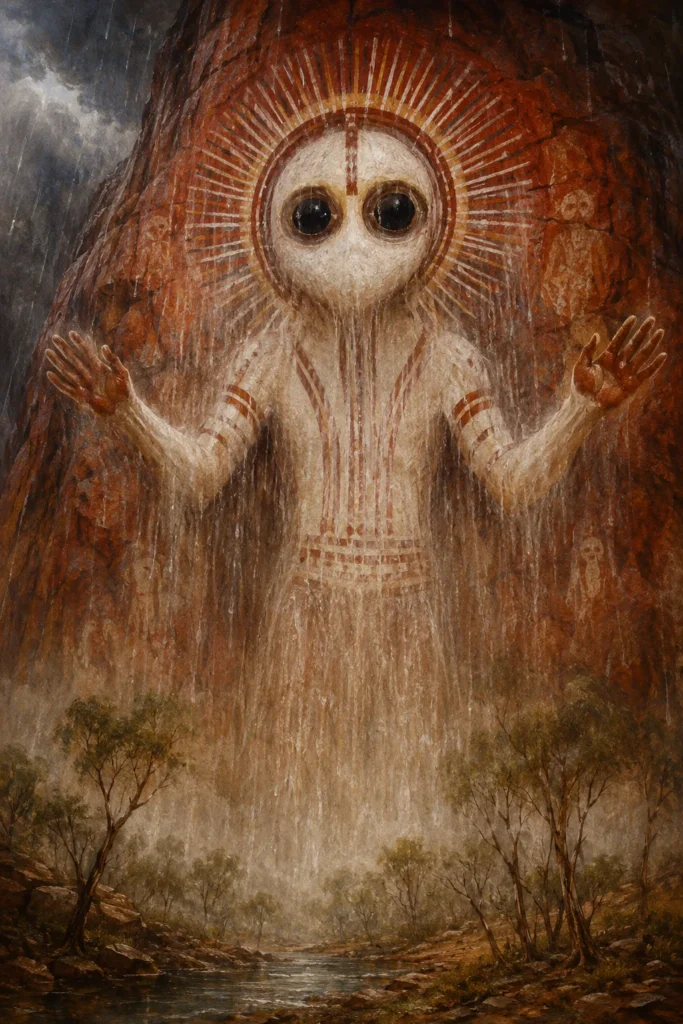
Wandjina appear with large, dark eyes without pupils and a broad nose, but without a mouth, because a mouth would flood the world. A headdress similar to a halo represents rain clouds and lightning; the body is often painted red, yellow and white. The rock paintings are attested for at least 4000 years.
Central is the annual renewal of the rock paintings (repainting): before the rainy season, elders of the Worora, Ngarinyin and Wunambal repaint the Wandjina with new colours, whereby they stay “awake”. The elders speak with the Wandjina and ask for orderly rain. Responsibility for an image is hereditary.
The Wandjina stand for clouds, rain and weather and at the same time for the land itself. The headdress depicts rain clouds and lightning, the missing mouth the torrential flood that a Wandjina with a mouth would unleash. The rock paintings are regarded as visible testimony to the groups’ continuous connection to the land.
Structurally comparable are Tlaloc and Chac in Mesoamerica, Indra in his rain function in India, Baal in Old Syrian religion, Tāwhirimātea in Polynesia and several Apus with weather power in the Andes. Unlike the single Rainbow Serpent, the Wandjina are a multitude of beings with individual names.
Classification and short profile
Wandjina (also Wanjina, Wondjina) are collective creation figures of the Aboriginal religions of the Kimberley region in north-west Australia. Three language groups, the Worora, Ngarinyin and Wunambal, share the Wandjina complex; together they hold the rock paintings preserved in the Kimberley gorges in their thousands.
Wandjina are cloud and rain beings who moved through the land in the mythical Lalai time (the Kimberley variant of the Dreaming) and shaped it. Unlike the Rainbow Serpent, which appears as a single figure, the Wandjina are a multitude of beings with individual names and tribal affiliations.
Within the Aboriginal tradition, the Wandjina are particularly well known for their iconographic distinctiveness: they are depicted with large eyes, an absent mouth and a halo-like headdress, a pictorial form unique in Aboriginal art.
Name and etymology
The name Wandjina is preserved in the three Kimberley languages, with small phonetic variations. A single etymological derivation is disputed; in 1968 Ian Crawford proposed a link with a verb meaning “to appear, to show oneself,” which fits the mythology of the Wandjina as beings who materialise.
Other researchers (Andreas Lommel, Helmut Petri) have associated the name with the notion of “the one who watches over us.” Both etymologies are defensible in terms of language history and may have operated together historically.
In the earliest European sources (George Grey 1838, the first European to document Wandjina rock paintings), the name is rendered incorrectly as “Wonjina.” This spelling persisted in some Victorian texts but has since been superseded.
Description and iconography
Wandjina iconography is one of the most distinctive in Aboriginal art.
Its characteristic features are: large, dark eyes without pupils; a broad nose; the absence of a mouth (explained by the idea that a Wandjina mouth would flood the world); a halo-like headdress representing rain clouds and lightning; and often an extensive painting of the body in red, yellow and white.
This iconography has been attested on the rock paintings of the Kimberley for at least 4,000 years; it emerged later than the older, thin figures known as “Gwion-Gwion.” In The Art of the Wandjina (Melbourne 1968), Ian Crawford set out the iconographic chronology systematically.
In present-day Aboriginal art, Wandjina continue to be painted by the three named tribal groups in acrylic, on bark and on paper. The Mowanjum artists’ association in Derby (community since 1956) is one of the most important centres of this tradition.
Mythological narratives
The most important Wandjina narrative tells of a “Great Flood” (Galagari) in the Lalai time: the Wandjina came, the world was chaotic, they ordered it through their torrents, established the present-day topography and gave people the tribal laws.
Once their work was done, they “painted themselves onto the rocks,” that is, they transformed into the present-day rock paintings.
A second narrative describes a conflict between different Wandjina groups that ends with the onset of the dry season. This aetiological myth explains the climate of the Kimberley: the rainy “Wet Season” and the dry “Dry Season” as a cosmic alternation.
In Places that Move (2005), Anthony Redmond presented a particularly precise record of several Wandjina narratives from the Ngarinyin tradition. These records are a methodological model for the collaborative ethnography of contemporary Aboriginal research.
Cult and veneration
The central ritual practice is the annual renewal of the Wandjina rock paintings (repainting). Before the rainy season, tribal elders of the Worora, Ngarinyin and Wunambal visit the rock-painting sites and repaint the Wandjina with fresh colours.
This ritual is not merely conservation but active religious renewal; the Wandjina remain “awake” through the repainting.
Ritual responsibility for a particular Wandjina image is hereditary and follows complex kinship rules. Whoever bears the responsibility is also responsible for the region in which that Wandjina image lies, a direct link between ritual right and land right.
In the 1990s a conflict arose when the non-Indigenous artist Vesna Tenodi publicly exhibited figures resembling Wandjina; the Mowanjum artists protested and the conflict ended in the Australian courts, an instructive example of the legal dispute over Indigenous image rights.
Protective practice and the apotropaic
Described in religious-studies terms: protective practice within the Wandjina complex aims at preserving the rock-painting sites and observing the corresponding rules of conduct. Unauthorised persons may not enter the sites, photograph them or touch them. Breaking these taboos is regarded, within the tradition, as a trigger for storms, illnesses and social conflicts.
A particular apotropaic practice is the invocation of a Wandjina before the start of the rainy season: the elders visit the sites, speak with the Wandjina and “ask” them for orderly rain. This rite can be described in religious-studies terms as a practice, without any promises of efficacy being made.
From the external ethnographic perspective, these practices are everyday-structuring rules that embody collective responsibility for Country (in the sense of Deborah Bird Rose).
Parallels in other cultures
Cloud and rain creation beings are widely attested from the perspective of the phenomenology of religion. Structurally comparable are: Tlaloc and Chac in Mesoamerica; Indra in his rain function in India; Baal in ancient Syrian religion; Tāwhirimātea in Polynesia; and several Apus with weather power in the Andes.
Despite these parallels, the Wandjina are unique in the history of religion through their collective multitude, their iconographic distinctiveness (mouthlessness) and their complete integration into a specific topographical practice. They are not a “rain god” but cloud beings who are land and weather at the same time.
From the standpoint of the phenomenology of religion, it is interesting to observe that the mouthlessness of the Wandjina follows an explicit mythological rationale: a Wandjina with a mouth would cause a torrent. Such self-referential pictorial theology is rare in the history of religion.
Present-day reception and research
The most important early works are George Grey’s travel account (1841), Andreas Lommel’s Die Unambal (1952), Helmut Petri’s Sterbende Welt in Nordwest-Australien (1954) and Ian Crawford’s The Art of the Wandjina (Melbourne 1968). Anthony Redmond’s contemporary work complements this older tradition.
The Wandjina are internationally known today through the Mowanjum artists’ association and through the annual Mowanjum Festival in Derby, which brings the three tribal groups together. In religious-studies terms this association is of interest because it combines traditional practice and modern marketing without abandoning religious substance.
An important contemporary line of research links the Wandjina tradition with the land-rights processes since the Mabo judgment of 1992. Here the religious significance of the Wandjina rock paintings has become a legal argumentative figure.
Research debates and open questions
Several research debates surround the Wandjina. First: what is the relationship of the Wandjina to the older Gwion-Gwion rock paintings? An older thesis (Lommel) saw in the Gwion-Gwion a predecessor tradition; more recent research (Crawford) is more cautious on this point.
Second: what relationships exist between the Wandjina and the pan-Aboriginal Rainbow Serpent tradition? Anthony Redmond proposes a partial integration; Tony Swain warns against sweeping pan-Aboriginal hypotheses.
Third: how is the Wandjina tradition changing through the global art market? Howard Morphy’s concept of “Becoming Art” is a central theoretical reference point here.
Repainting and religious renewal
The repainting ritual as a religious practice deserves particular attention. The ritual renewal of the rock paintings has a twofold function: physically it keeps the images visible over millennia, religiously it keeps the Wandjina “awake” and in relationship with the living community.
Research long understood the repainting as mere conservation; only since the 1990s, in particular through Anthony Redmond’s work, has it been recognised as an integral religious practice. This recognition has consequences for the handling of the rock paintings by Western conservators: if repainting is prevented, the Wandjina are “killed” in the traditional sense.
From the standpoint of the phenomenology of religion, repainting is an example of “living religious materiality”: religious objects are not merely bearers of meaning but active agents kept alive through ritual action.
Wandjina and Aboriginal land rights
A current research perspective links the Wandjina with the Australian land-rights processes. Since the Mabo judgment of 1992 and the subsequent Native Title Act 1993, Aboriginal groups have been able to assert land claims on the basis of traditional connections. The Wandjina rock paintings have become a legal argumentative figure in this context.
Several Wandjina-related land-rights cases have been concluded successfully; the Worora, Ngarinyin and Wunambal groups today hold substantial land rights in the Kimberley region. Anthony Redmond has described the religious and legal significance of these processes in several essays.
From the standpoint of the sociology of religion, this connection is an instructive example: religion becomes a legally effective category without giving up its religious character. This interweaving is central to contemporary Aboriginal research.
Methodological reflection and sources
Several methodological problems arise in Wandjina research. First: the most important early sources (George Grey, Andreas Lommel) are shaped by colonial prejudices; their statements must be read critically. Ian Crawford’s The Art of the Wandjina (1968) is a methodological turning point here.
Second: much Wandjina knowledge is “restricted” and may not be made publicly accessible. Contemporary research practises an ethic of “informed consent”: what is published is done in consultation with the traditional owners. This practice has been standard since the 1990s.
Third: the Wandjina self-representation by Indigenous researchers, artists and activists is a source level of its own. Donny Woolagoodja and other contemporary voices from the Mowanjum association complement the external academic perspective.
A broader religious-studies classification of the Wandjina within the framework of north-west Australian Aboriginal religion is offered by the hub Aboriginal tradition. There you will find cross-references to closely related groups of figures: the ophidian Rainbow Serpent, the lightning personification Namarrkon, and the thin-lined shadow beings of the Mimi spirits.
Wandjina and the Mowanjum complex
The Mowanjum artists’ community in Derby, Western Australia, deserves particular attention. Mowanjum (community since 1956) is an association of the Worora, Ngarinyin and Wunambal communities. It maintains the Wandjina tradition through art, education and festival culture.
The annual Mowanjum Festival, held since 1997, is one of the most important Aboriginal festival-culture events in Australia. It brings the three tribal groups together in shared dances, songs and Wandjina invocations.
From the standpoint of the sociology of religion, Mowanjum is an instructive example of contemporary Aboriginal self-organisation. Religious tradition, economic sustainability and political representation are combined here in an integrated structure.
Wandjina and the global art market
A research direction of its own examines the position of Wandjina art in the global art market. Since the 1980s, Wandjina-related works have been exhibited and traded internationally; some achieve high prices.
This commercial exploitation is ambivalent from the standpoint of the sociology of religion. On the one hand it secures the economic survival of the Aboriginal communities; on the other it transforms secret religious content into marketable objects.
The Mowanjum association has developed mechanisms for dealing with this tension, for example through certified “Land of the Wandjina” labels.
Anthony Redmond has discussed the ethical implications of this art marketing in several essays. His work is methodologically pioneering for contemporary Aboriginal art ethnology.
Wandjina rock paintings in native-title proceedings
Since the Mabo judgment of the Australian High Court in 1992, Aboriginal groups have been able to assert land claims on the basis of traditional connections. The Wandjina rock paintings have become a legal argumentative figure in this context; they are the visual testimony of a continuous connection to the land.
A number of land-rights proceedings with a Wandjina connection have now been concluded successfully; extensive land rights in the Kimberley region have been granted to the Worora, Ngarinyin and Wunambal. Anthony Redmond has described the religious and legal dimensions of these processes in detail.
From the standpoint of the sociology of religion, this case shows in exemplary fashion how religion can become a legally robust category without losing its religious content. For contemporary Australian legal practice this is an innovation whose implications reach far beyond the Wandjina region.
Methodological reflection and research ethics
Contemporary Wandjina research follows a strict research ethic. Since the 1990s, the “informed consent” practice has been standard: scholarly work is agreed with the traditional owners, sensitive content is not published, and Indigenous authorship is acknowledged.
Anthony Redmond is particularly pioneering here in methodological terms. His work is a model for collaborative ethnography that combines scholarly standards and cultural sensitivity. Howard Morphy also follows similar standards.
This ethic protects not only the religious substance but also the quality of the scholarly research. It avoids the distortions that were frequent in older colonial ethnography and enables a more differentiated grasp of the Wandjina tradition.
Wandjina repainting and conservation debates
A particular debate surrounds the repainting of the Wandjina rock paintings. Western conservators long understood the repainting of traditional images as “damage”; from the Indigenous perspective, by contrast, repainting is part of the religious practice.
In the 1990s this tension became visible in exemplary fashion in a dispute over the Wandjina site “Munja”: a Western restoration initiative was rejected by the traditional owners; instead they carried out a traditional repainting. This decision was later recognised as methodologically pioneering.
Today the conservation of the Wandjina sites follows the traditional rules. Western scholars cooperate with the traditional owners; the repainting is respected as a religious practice. This cooperation is a model for similar situations worldwide.
The rock paintings of the Kimberley and the right to repaint
The Wandjina are not only figures of narrative but above all a concrete pictorial complex on the rock walls of the Kimberley region in north-west Australia.
The paintings typically show large faces with wide-open eyes and a nose, but without a depicted mouth, surrounded by a radiating headdress that research usually associates with clouds and lightning.
These images are found in rock shelters and caves in the tribal areas of the Worrorra, Ngarinyin and Wunambal, who today sometimes group themselves as Wandjina-Wunggurr communities.
A custom central to understanding is the ritual renewal of the paintings. Unlike European notions of an unchangeable work of art, the tradition of the Kimberley knows the repainting and refreshing of the Wandjina images as a religious duty.
Authorised persons who stand in the correct relationship to a particular place and its Wandjina renew the colours so that the image, and with it the effect of the Wandjina, remains alive.
A fading, untended image was regarded as a sign of disturbed order. The question of who may repaint is strictly regulated and bound to kinship, place attachment and the transmission of knowledge.
It is precisely this custom that led to serious conflicts in the second half of the 20th century.
In the 1980s, rock paintings were renewed under employment programmes by persons who, in the view of the traditional owners, were not authorised to do so. The ensuing debate, which became known in Australia under the heading of Wandjina repainting, made clear that conservation, tourism and Indigenous religious practice can easily come into conflict.
It also showed that the images are not archaeological material that can be freely disposed of, but part of a living religious practice with clear responsibilities.
It follows from this, for a serious account, that the Wandjina rock paintings must not be treated as mere prehistoric art.
Their dating is disputed; many visible layers are young as a result of repeated renewal, without this calling into question the great age of the tradition itself. Anyone writing about the Wandjina should explicitly name the continuing right of the traditional owners to image, place and story.
Literature (selection)
- Ian Crawford: The Art of the Wandjina (Melbourne 1968)
- Andreas Lommel: Die Unambal (1952)
- Helmut Petri: Sterbende Welt in Nordwest-Australien (1954)
- Tony Swain: A Place for Strangers (Cambridge 1993)
- Anthony Redmond: Places that Move (2005)
- Kim Akerman: Aboriginal artifacts (2015)
The Wandjina are the cloud figures of the Worora, Ngarinyin and Wunambal in the Kimberley region of Western Australia; their mouthless rock images are connected with rain, the monsoon and the renewal of the foundations of life.
Related key terms: Wandjina Kimberley Worora Ngarinyin Wunambal rock paintings Mowanjum.
iWell Guard and protective traditions
iWell Guard draws on the cultural-historical tradition of portable protective objects, in the tradition of Aboriginal and many other cultures worldwide. 41 layers, solid gold, platinum, silver, made in Germany. 30-day right of return.
Personal experiences may vary. Not a medical device. No promise of healing.