Sun Wukong: Monkey King, Trickster and Buddhist Disciple
By Ralf Ittermann · last reviewed on
Sun Wukong, the Monkey King, is arguably the most famous trickster figure in Chinese literature and religion. Emerging from the novel Journey to the West, he combines rebellious unruliness with Buddhist purification. This article provides a religious-studies classification of the figure and addresses name, myth, cult and scholarship.
Classification
Sun Wukong, known in English primarily as the Monkey King, is the central figure of the Chinese novel Journey to the West, which took its familiar form in the sixteenth century during the Ming dynasty and is traditionally attributed to the author Wu Cheng’en. Over the centuries, a literary figure became a being venerated in Chinese popular religion.
Sun Wukong thus stands at the intersection of literature, mythology and lived belief.
From a religious-studies perspective, Sun Wukong can be classified on two levels. On one level he is a trickster, that is, a figure characterised by cunning, rule-breaking and boundary-crossing who simultaneously acts in creative and disruptive ways.
On the other level he is a Buddhist disciple and pilgrim who undergoes a path of purification in the course of the narrative. This combination of rebellious trickster and religious seeker accounts for the figure’s particular depth.
The novel in which Sun Wukong appears draws on a historical core. It connects to the actual journey to India undertaken by the Buddhist monk Xuanzang in the seventh century, who brought Buddhist scriptures from India to China.
Around this historical material, folk narratives, theatrical plays and legends accumulated over centuries, in which the Monkey King as the monk’s supernatural companion took on an ever greater role.
In the history of religion, Sun Wukong is a remarkable example of how a fictional character can become an object of religious veneration.
In southern China, Taiwan, Hong Kong and in the Southeast Asian diaspora there are temples dedicated to him, where he is invoked as a powerful deity. His figure thereby unites the three major currents of Chinese religion, Buddhism, Daoism and popular religion, in a single figure.
Name and Etymology
The name Sun Wukong is explained and charged with meaning within the novel itself. The family name Sun is bestowed upon him by a Daoist master and is associated with a Chinese character linked to monkeys.
The personal name Wukong means “he who perceives the void” or “awakened to emptiness.” This contains the central Buddhist concept of emptiness, that is, the insight into the insubstantial nature of all phenomena. The spiritual goal of the figure is thus already encoded in the name.
In the course of the narrative Sun Wukong bears a series of further titles and epithets that mark his changing stations in life. As king of the monkeys on his home island he is called the Monkey King.
After he rebels against Heaven he adopts a presumptuous title meant to place him on a par with Heaven, a title that expresses his hubris.
After his submission and his entry into the service of the pilgrim monk he is simply called the monk Sun. At the end of the journey he receives a Buddhist honorary title that identifies him as an enlightened being.
This sequence of names is more than a narrative detail. It maps the spiritual journey of the figure, from untamed natural force through rebellion and punishment to purification and redemption. The naming is thus simultaneously a literary and a religious device.
In popular usage and outside China, the figure is known under various translations of his name, such as the Monkey King or simply the Monkey.
In Japan, where the material arrived early, he is known under the Japanese reading of his name. The variety of names and translations reflects the wide dissemination of the figure beyond the Chinese cultural sphere.
Description and Iconography
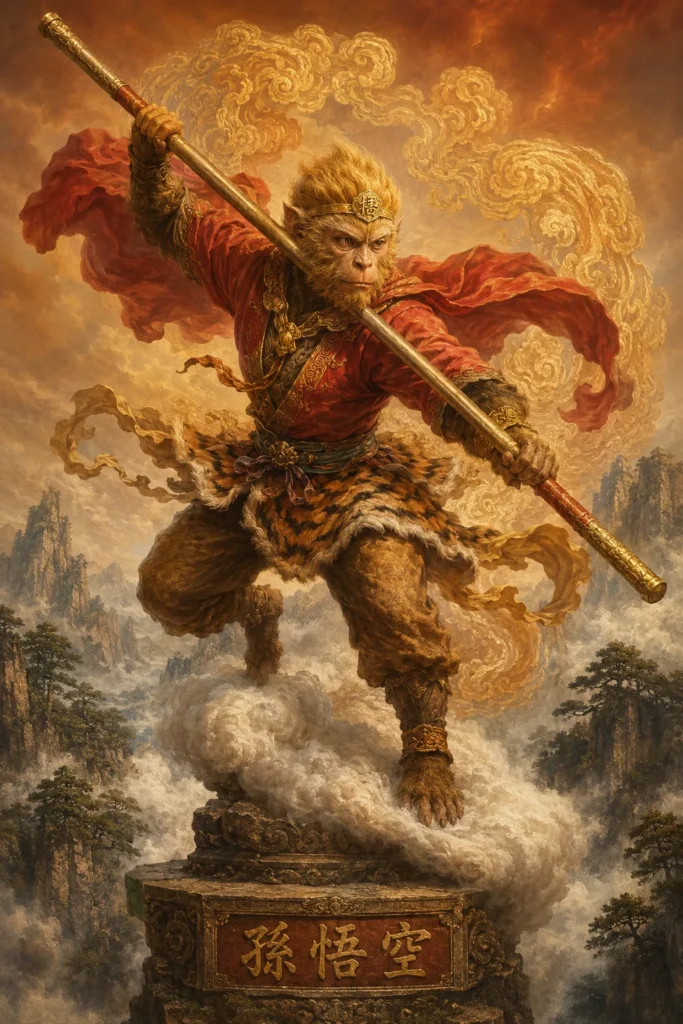
Sun Wukong is depicted as an anthropomorphic monkey, that is, a being with a simian face and body who nonetheless walks upright, speaks and dresses like a human.
Characteristic features are his hairy face, his alert and penetrating eyes, which according to the narrative were sharpened in a furnace and can perceive what is hidden, and a posture that is often combative and ready to spring.
His most important attribute is the magic staff, a weapon which, according to tradition, he wrested from the Dragon King of the Sea.
The staff can change its size at will, from the size of a needle so that Sun Wukong can conceal it behind his ear, to enormous dimensions. In pictorial representations the Monkey King nearly always holds the staff in his hand or slung over his shoulder.
A further iconographic feature is the headband that the pilgrim monk places on his head after his submission. Whenever the monk recites a certain formula, the band contracts painfully. This attribute symbolises the taming of untamed force through spiritual discipline. In many depictions the headband is clearly visible on the Monkey King’s forehead.
Sun Wukong is frequently depicted in the garb of a pilgrim or a warrior, with armour elements or a monk’s robe.
In opera and theatre his mask or face-painting is unmistakable, typically featuring a characteristic heart-shaped design around the eyes and nose. His movements in stage performance are acrobatic and swift, expressing his agility and supernatural abilities.
These abilities include transformation into countless forms, covering vast distances in a single leap and the creation of doubles from his hairs. The iconography thus makes visible that Sun Wukong is a being who transcends the ordinary boundaries of space, form and order.
Mythological Narratives
The narrative of Sun Wukong is structured in several major sections. At the beginning stands his miraculous birth. He emerges from a stone on a mountain that over countless ages has absorbed the forces of Heaven and Earth.
An egg breaks from the stone, and from it the stone monkey is born. From the outset, then, Sun Wukong is no ordinary being but a creature of the cosmos itself.
The young monkey becomes king of his troop of monkeys through courage and cunning. Fearing death, he sets out in search of immortality and becomes the disciple of a Daoist master who teaches him the arts of transformation and cloud-riding.
Armed with these abilities, Sun Wukong becomes arrogant. He steals the magic staff from the Dragon King, strikes his own name from the register of mortals in the underworld and ultimately challenges Heaven itself.
Next follows the episode of the Great Disruption in Heaven. Sun Wukong is initially appeased with a minor post in Heaven, but he sees through the contempt shown him and rebels. He ravages a celestial banquet, consumes the peaches of immortality and the elixirs, and defies the heavenly armies.
Only the Buddha himself can subdue him. In a famous episode Sun Wukong wagers that he can leap out of the Buddha’s palm, but fails and is punished by being imprisoned beneath a mountain, where he must remain for five hundred years.
The second major part of the narrative begins with his liberation. The goddess Guanyin appoints him to accompany and protect the pilgrim monk Xuanzang on his journey to India. To make the unruly monkey submit to the monk, the restraining headband is placed on him.
Together with the monk and two further companions, the pig demon and the sand monk, Sun Wukong endures a long series of trials and battles against demons and obstacles.
In the course of this journey he is transformed from a rebellious trickster into a loyal, if still wilful, disciple. At the end, after the successful return with the sacred scriptures, he is elevated to an enlightened being in recognition of his merits.
Cult and Veneration
Although Sun Wukong originated as a literary figure, he has received independent cultic veneration in Chinese popular religion. Particularly in Fujian, in southern China, in Taiwan, in Hong Kong and in Chinese communities throughout Southeast Asia, there are temples dedicated to the Monkey King or in which he is listed among the venerated deities.
In these temples Sun Wukong is invoked under honorary titles that emphasise his rank as a heavenly and enlightened being.
Worshippers bring him incense and offerings and address petitions to him, for example seeking protection, assistance in difficult circumstances or support in illness. His qualities as an invincible fighter against demons make him a protective power against evil influences in popular belief.
Sun Wukong plays a particular role in connection with mediums and spirit invocation. In certain traditions of southern China and Taiwan, the Monkey King is regarded as one of the deities who can be embodied by a ritual medium.
During the ritual the medium takes on the gestures, speech and behaviour of the Monkey King. Such practices are well documented ethnographically and show how deeply the figure has penetrated into lived religion.
Beyond this, Sun Wukong is closely associated with theatre. In Chinese opera the Monkey King role is among the most demanding and popular parts of all, and theatrical performances of his story have had, and continue to have, a ritual or festive character.
Temple festivals, opera performances and veneration merge into one another here. The cult of the Monkey King is thus a striking example of how literature, stage and religion are closely intertwined in the Chinese cultural sphere.
Protective Practice and Apotropaic Function
Sun Wukong is regarded in popular belief as a powerful protective figure against demons and evil influences. This function derives directly from the novel, in which the Monkey King defeats countless demons on the pilgrimage and shields the monk from danger.
The protective ideas associated with him can be described from a history-of-religions perspective without any claim being made about their actual efficacy.
Among the widespread practices is the placing of images or small figurines of the Monkey King in the home or at a place of business to seek protection.
Amulets and talismans bearing his image or name were worn, especially for the protection of children, since the Monkey King was regarded in popular belief as a powerful yet also childlike and playful guardian.
His alert eyes, which according to the narrative can see through disguise and perceive what is hidden, made him a suitable power against disguised and concealed evil spirits.
In ritual terms, embodiment by a medium plays an apotropaic role. When the Monkey King is believed to be present through a medium, he can, according to the understanding of those involved, drive out demons, purify houses and temples or assist the sick.
Such rituals form part of the religious repertoire in parts of southern China and Taiwan.
Theatre also had a protective dimension. Performances of the Monkey King’s story at festivals were widely regarded as purifying and auspicious for the community. The Monkey King on stage, defeating the demons, symbolically restores order.
Overall it becomes clear that Sun Wukong’s protective function is closely bound to his character as conqueror of chaos. Noteworthy is that it is precisely a trickster, a figure who himself challenges order, who is simultaneously invoked as guarantor of order against the demonic. This tension belongs to the nature of the trickster figure.
Parallels in Other Cultures
From a religious-studies perspective Sun Wukong can be classified as a trickster, a character type that appears in the mythologies of numerous cultures. Tricksters are figures characterised by cunning, transformation, rule-breaking and boundary-crossing, carrying both creative and destructive traits.
In the northern European tradition, Loki embodies similar qualities; in West African traditions the spider Anansi; in North American indigenous mythologies figures such as the Coyote or the Raven.
With these figures Sun Wukong shares unruliness, wit, the art of transformation and the ability to challenge even the most powerful authorities.
A distinctive feature of the Chinese figure, however, is that the trickster does not remain in his status but undergoes a religious purification and is ultimately integrated into the Buddhist order of salvation. The Monkey King is thus a trickster who is redeemed, which distinguishes him from many other representatives of the type.
Sun Wukong is frequently compared with the Indian monkey deity Hanuman from the epic Ramayana. Like Sun Wukong, Hanuman is a simian being of superhuman strength who can transform himself and leap great distances, and who faithfully serves a revered hero.
Whether a direct historical influence of Hanuman on the shaping of Sun Wukong exists, or whether it is an independent Chinese development with only typological similarity, remains contested in scholarship and has not been conclusively resolved.
Finally, the story of the Monkey King’s rise, fall and reintegration recalls the widespread motif of the presumptuous figure who is punished for hubris but redeemed through a trial. The comparison shows that Sun Wukong participates in universal mythic patterns while expressing them in a distinctly Chinese combination of folk narrative, Buddhism and Daoism.
Modern Reception and Scholarship
Sun Wukong is one of the best-known figures in the whole of East Asian culture and has spread worldwide beyond the Chinese sphere.
The novel Journey to the West is counted among the four classical novels of Chinese literature and exists in countless editions, translations, children’s and young-adult adaptations. The Monkey King has emerged from it as the most popular individual figure.
In modern popular culture Sun Wukong is omnipresent. He appears in films, television series, animated productions, comics, video games and in the fine arts.
Numerous figures in international entertainment culture are demonstrably or plausibly inspired by him. In China itself he is a national cultural asset and a symbol of resourcefulness, courage and resistance to unjust authority.
Scholarship engages with Sun Wukong from several directions. In literary studies the focus is on the genesis of the novel, its precursors in oral narratives, theatrical plays and earlier narrative cycles, and the question of authorship.
In religious studies the central concern is the connection between Buddhism, Daoism and popular religion, as well as the question of how a fictional character could become an object of cultic veneration.
A field of inquiry in its own right is the interpretation of the figure. It has been read as a religious allegory of the path to enlightenment, as a satirical engagement with both heavenly and earthly bureaucracy, and as a psychological emblem of the untamed mind brought to heel through discipline.
This plurality of interpretations is itself an indication of the figure’s richness. Scholarship thus regards Sun Wukong as an outstanding example of how literary creation, religious imagination and popular culture interpenetrate one another within the Chinese cultural sphere and remain vital across centuries.
Selected Bibliography
- Lihui Yang, Deming An: Handbook of Chinese Mythology (2005)
- Edward T. C. Werner: Myths and Legends of China (1922)
- Anthony C. Yu (trans.): The Journey to the West (1977 to 1983)
- Henri Maspero: Le taoisme et les religions chinoises (1971)
- Glen Dudbridge: The Hsi-yu chi. A Study of Antecedents to the Sixteenth-Century Chinese Novel (1970)
Related key terms: Sun Wukong Monkey King Journey to the West Trickster Buddhism Xuanzang Wu Cheng’en Hanuman.
iWell Guard and Protective Traditions
iWell Guard draws on the cultural-historical tradition of wearable protective objects, in the tradition of China and many other cultures worldwide. 41 levels, real gold, platinum, silver, crafted in Germany. 30-day right of return.
Individual experiences may vary. Not a medical device. No healing claims.