Hwanin, supreme sky god of Korea
By Ralf Ittermann · last reviewed on
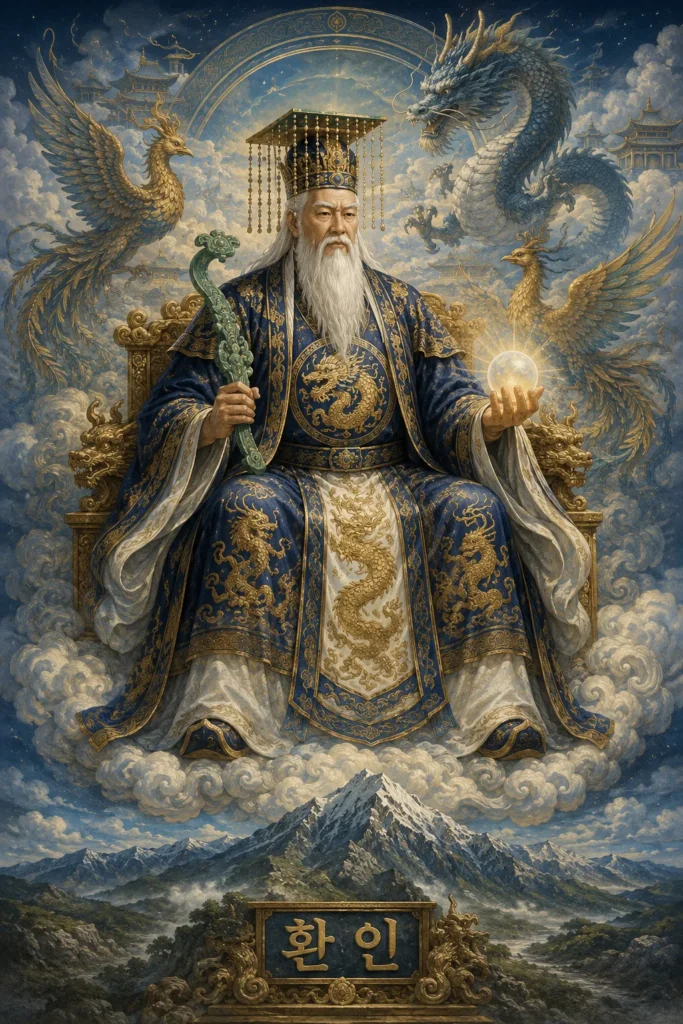
As the supreme sky god of Korea, Hwanin is the grandfather of the legendary founder of the realm, Dangun, in the foundation myth. Hwanin (Korean 환인, 桓因) is the supreme lord of heaven in the Korean foundation myth and the grandfather of the mythical progenitor Dangun.
His figure is bound up with the Korean identity as a “people from heaven” and stands at the beginning of the oldest surviving genealogy of Korean kingship. The most important written source is the “Samguk Yusa” (“Memorabilia of the Three Kingdoms”), which the Buddhist monk Iryeon (1206 to 1289) compiled in the year 1281.
Profile: Hwanin
Hwanin: the most important aspects at a glance.
Supreme Lord of Heaven of the Korean founding myth and grandfather of the mythical ancestor Dangun. The most important source is the “Samguk Yusa,” which the monk Iryeon compiled in 1281. The tradition was only committed to writing in the late Goryeo period, but it builds on older oral traditions.
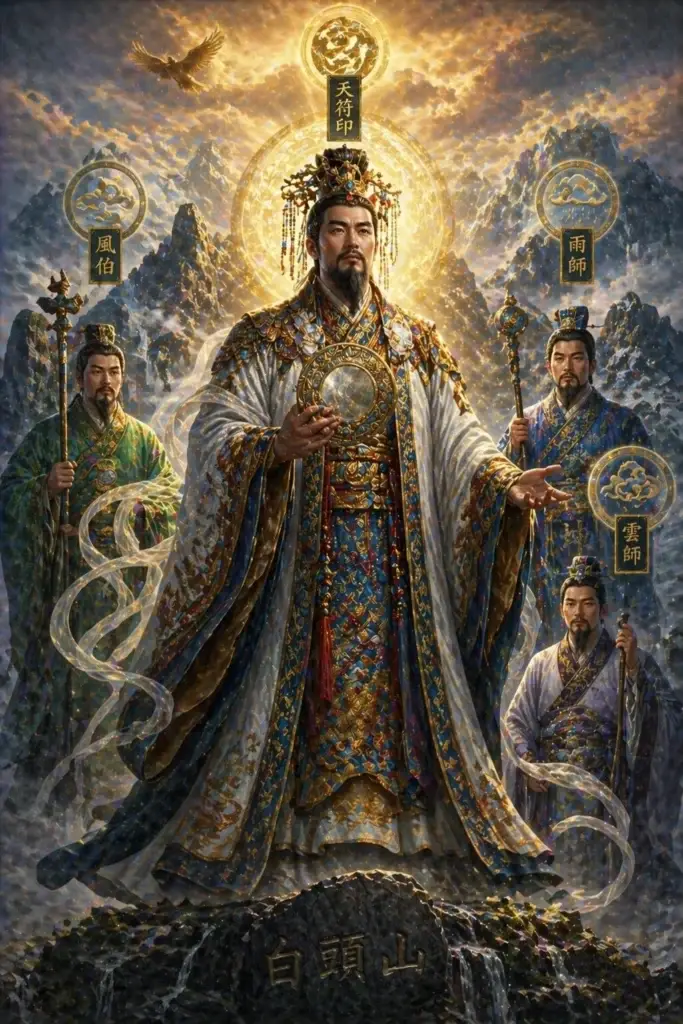
Hwanin is a transcendent background god. He dispatches, commissions and authenticates, but does not intervene himself: to his son Hwanung he gives three heavenly seals and 3000 attendants for the descent to Mount Taebaek. Religious studies knows this type as “deus otiosus.”
In shamanic practice Hwanin plays hardly any role, while his son Hwanung and his grandson Dangun are venerated at least in the mountain cults. The religion Daejonggyo, founded in 1909 by Na Cheol, venerates him as creator in a holy trinity with Hwanung and Dangun, but today has only few followers.
The three heavenly seals (cheonbu inseo) authenticate the authority of his son as Son of Heaven. Mount Taebaek, today usually identified with Mount Baekdu, is the setting of Hwanung’s descent.
Iryeon equates Hwanin with the Indian god Indra. Typologically he stands beside the Mongolian Tenger, the Turkic Tengri, the Manchu Abka enduri and the Korean Hananim. A parallel is offered by the myth of Ninigi no Mikoto in the “Kojiki” (712), in which the highest deity sends a divine grandson down to earth.
Source situation and textual-historical background
The “Samguk Yusa” is the central source for the Hwanin tradition. In it, Iryeon drew on older writings now lost, such as the “Gogi” (“Old Records”), which presumably dated from the late Goryeo period.
A second important source is the “Samguk Sagi” (“History of the Three Kingdoms”) by Kim Busik (1145), which, however, is Confucian-rationalist in orientation and largely omits mythical elements. Hwanin does not appear there. The “Jewang Ungi” of Yi Seunghyu from 1287, by contrast, names him in a verse history that arose parallel to Iryeon.
James Grayson reconstructed the source history in “Korea: A Religious History” (1989) and showed that the written fixing of the Dangun-Hwanin tradition took place only in the late Goryeo period, possibly as a reaction to Mongol overlordship.
Hong-Key Yoon has pointed out that the mythical genealogy played an important role in the construction of a Korean collective identity against Mongol dominance. Maurizio Riotto has examined the Buddhist mediation in Iryeon in detail.
Position in the Dangun myth
In the myth, Hwanin is the supreme lord of heaven (cheonje) and father of Hwanung, who in turn is the father of Dangun. Hwanung wishes to descend to earth in order to instruct humankind.
For this his father Hwanin gives him three heavenly seals (“cheonbu inseo”), which authenticate his authority as the Son of Heaven, and sends him together with 3000 companions to Mount Taebaek (today mostly identified with Mount Baekdu). There Hwanung founds the “City of God” (“Sin-si”) and instructs humankind in the 360 arts of life.
On the mountain live a bear and a tiger who wish to attain human form. Hwanung gives them mugwort and garlic and orders them to fast for 100 days in a cave.
The tiger gives up, but the bear endures and becomes the beautiful woman Ungnyeo, who with Hwanung conceives the progenitor Dangun. Dangun later founds the mythical realm of Joseon, which the medieval texts date to the year 2333 BC. Hwanin himself remains throughout in heaven and does not intervene directly in earthly events.
Name and etymology
The name Hwanin is written in Chinese as 桓因 in the oldest texts. Iryeon himself notes that it is a phonetic rendering and that Hwanin is another name for the Indian god Indra (Shakra Devanam Indra, in Mahayana Buddhism Sakra).
This identification is at first surprising, but follows from Iryeon’s Buddhist background. In Buddhist cosmology, Indra is the ruler of the Trayastrimsa gods and corresponds functionally to the supreme lord of heaven.
Don Baker analyzed the significance of this Buddhist identification in “Korean Spirituality” (2008) and showed that Iryeon thereby combined two functions: the anchoring of the Korean foundation myth in a pan-Buddhist cosmology and the elevation of the national origin through the connection with one of the central deities of the Buddhist world.
Antonetta Bruno has proposed in her work on Korean religious history that Hwanin in his pre-Buddhist form was a native sky god whose designation was only subsequently harmonized with the Buddhist Indra.
Function in the religious system
Unlike his son Hwanung and his grandson Dangun, Hwanin does not act within the myth. He dispatches, commissions, and authenticates, but does not intervene himself. His role is that of a transcendent background god who makes the world possible from above, without intervening in its destinies.
Religious studies knows this type as the “Deus otiosus”, the “idle god”, who, according to Mircea Eliade, in many indigenous religions ends up at the margin of the pantheon at the end of a development.
Boudewijn Walraven has pointed out in his work on Korean shamanism that Hwanin plays hardly any role in shamanic practice, while his son Hwanung and his grandson Dangun are venerated at least in the mountain cults.
This distribution corresponds to the classical pattern in which the supreme god remains in the background, while the acting deities or heroes receive direct veneration.
Hwanin and the Daejonggyo
In the late 19th and early 20th century, the religion Daejonggyo arose in Korea, a reform movement that transferred the Dangun-Hwanin myth into a modern religious teaching.
Daejonggyo, founded in 1909 by Na Cheol, venerates a “holy trinity” consisting of Hwanin (the Creator), Hwanung (the World-Shaper), and Dangun (the progenitor), who are understood as three aspects of a single divine reality. This theological formulation had no precursors in pre-Christian Korean religion and is a creative synthesis of Christian, Buddhist, and folk-religious elements.
Don Baker and James Grayson have analyzed the significance of Daejonggyo for Korean identity formation in the colonial period. The Japanese colonial administration pursued the movement intensively because it was regarded as a bearer of a national Korean consciousness.
Today Daejonggyo has only few adherents, but it played an important cultural role as a preserver of the mythical tradition.
Political and national significance
The Hwanin tradition has a strong national significance beyond the religious sphere. The mythical starting point of 2333 BC is regarded in Korean historiography as the beginning of the “Fourth Millennium” (Dangi calendar). During the colonial period, in which the Japanese administration attempted to dissolve Korean identity, the Dangun-Hwanin myth became a symbol of resistance.
In the modern Republic of Korea and in North Korea too, the tradition is taken up by the state, although in different ways: in the South more as cultural heritage, in the North as a historical fact with a political function.
Hong-Key Yoon has shown in his work on the cultural geography of Korea that the mythical localization of Hwanung at Mount Baekdu has a political significance still virulent today, because the mountain lies on the border between Korea and China and its identification as a sacred mountain is contested in both state traditions.
Research and discussion
Hwanin research faces the difficulty of interpreting a tradition fixed in writing only late, whose older layers are not directly accessible. Antonetta Bruno, Boudewijn Walraven, James Grayson, Don Baker, and Maurizio Riotto have presented the most important methodological clarifications in recent decades.
They largely agree that the myth in its written form is a product of the late Goryeo period, but that it builds on older oral traditions whose exact form can no longer be reconstructed.
The connection to the Siberian and Mongolian tradition of the lord of heaven (Tengri belief) is discussed cautiously in research. Some parallels, such as the motif of heavenly descent and of the three-part genealogy, suggest a common North Asian background, without this being capable of being developed into a clear line of religious history.
Maurizio Riotto has pointed out that the structural similarity does not necessarily mean genetic kinship, but can express a typological kinship between sky deities in Altaic-Uralic and neighboring cultures.
Hwanin in the modern Korean religious sphere
In present-day South Korea, Hwanin is not a directly venerated deity outside the relatively small Daejonggyo community. He remains present, however, as educational material and as a reference point of national memory.
In school textbooks the Dangun-Hwanin myth is presented as cultural heritage, without elevating it to the rank of a historical fact. In North Korea the Pyongyang school of historiography has partly treated the myth as a historical fact, which is viewed critically in international research.
In the Christian churches of Korea too, which today comprise a considerable part of the population, the tradition is occasionally received.
Individual Korean Protestant theologians use Hwanin as a cultural point of connection for proclaiming the biblical God, which Don Baker has described as a typical process of theological acculturation. This use is not undisputed, because it claims the mythical distinctiveness of Hwanin for a foreign tradition.
Archaeological discussion and prehistoric background
The archaeological investigation of the Korean Bronze Age has raised the question of whether the Dangun-Hwanin myth refers to real early state formations. The Liaoning Bronze Age (about 1500 to 300 BC) with its characteristic mandolin-shaped daggers and multi-knobbed mirrors is regarded as the material basis of the early Korean cultural sphere.
Sarah Nelson showed in “The Archaeology of Korea” (1993) that the mythical dating of 2333 BC is not covered archaeologically, but that the Bronze Age of the Liaodong Peninsula and North Korea represents a real cultural unit in which the later Dangun tradition could be rooted.
Mark Byington has pointed out in his work on early Gojoseon that the historical existence of a Bronze Age state of Gojoseon is archaeologically probable, but that the mythical genealogy with Hwanin as a heavenly origin was added secondarily.
North Korean research has since the 1990s presented an alleged “Dangun burial site” near Pyongyang and dated it to about 5000 years, which is, however, regarded in international scholarship as a politically motivated construction. Pankaj Mohan and other researchers have documented the methodological problems of this dating.
Comparative mythology
The figure of Hwanin stands typologically in a series of North Asian sky deities. The Mongolian Tenger (“heaven”), the Turkic Tengri, and the Manchu Abka enduri are supreme lords of heaven with a similar standing.
The Korean Hananim, the Mongolian Tenger, and the Chinese Tian (“heaven”) each denote a transcendent lord of heaven who stands above earthly events and acts upon the earth through a mediating being or a son.
A specific parallel emerges with the Japanese Ninigi-no-Mikoto myth in the “Kojiki” (712) and “Nihon Shoki” (720). There too the supreme deity (Amaterasu, or in the further background Ame-no-Minakanushi) sends a divine grandson down to earth, who becomes the progenitor of the ruling dynasty.
Maurizio Riotto has analyzed this parallel as a typological pattern of East Asian royal ideology: the supreme god remains in heaven, a mediating being conveys the divine authority to earth. The question of whether it is a matter of genetic kinship or independent parallel developments has not been conclusively settled.
Sources and literature
Primary sources: Iryeon, “Samguk Yusa” (1281); Yi Seunghyu, “Jewang Ungi” (1287); Kim Busik, “Samguk Sagi” (1145). Secondary literature: James H. Grayson, “Korea: A Religious History” (Oxford 1989, 2nd edition 2002) and “Myths and Legends from Korea” (Richmond 2001); Don Baker, “Korean Spirituality” (Honolulu 2008); Maurizio Riotto, “La leggenda di Tan’gun” (Cassino 1994); Antonetta Bruno, “The Gate of Words: Language in the Rituals of Korean Shamans” (Leiden 2002); Boudewijn Walraven, “Songs of the Shaman” (London 1994); Hong-Key Yoon, “The Culture of Fengshui in Korea” (Lanham 2006); Sarah Nelson, “The Archaeology of Korea” (Cambridge 1993); Mark Byington, “The History and Archaeology of the Koguryo Kingdom” and essays in “The Han Commanderies in Early Korean History” (Cambridge MA 2013). On the North Korean Dangun construction: Pankaj Mohan, “Rescuing a Stone from Nationalism”, in “Journal of Inner and East Asian Studies” (2004).