Hina: Polynesian Moon Goddess, Primal Mother and Many-Faced Atua
By Ralf Ittermann · last reviewed on
Hina is one of the central female Atua of Polynesian religion. Under various epithets she appears as a moon goddess, primal mother, water goddess or goddess of the underworld. In the Maori tradition she is closely connected with Hine-nui-te-po, the great woman of the night. This account describes her many-shaped position in religious studies.

Profile: Hina
Hina: the most important aspects at a glance. The following fields summarise origin, function, appearance, veneration, symbols and parallels.
Hina is a pan-Polynesian figure. She appears in Hawai’i, Tahiti, Tonga and Aotearoa under similar names, among the Maori in the form Hine. Her functions differ from region to region, and in Maori the name means “woman” or “girlish being”.
Depending on the region Hina appears as moon goddess, primal mother, water goddess or goddess of the underworld. In Hawai’i she is often regarded as moon goddess and mother of Maui; in Aotearoa, as Hine-nui-te-po, she is goddess of the underworld and of mortality.
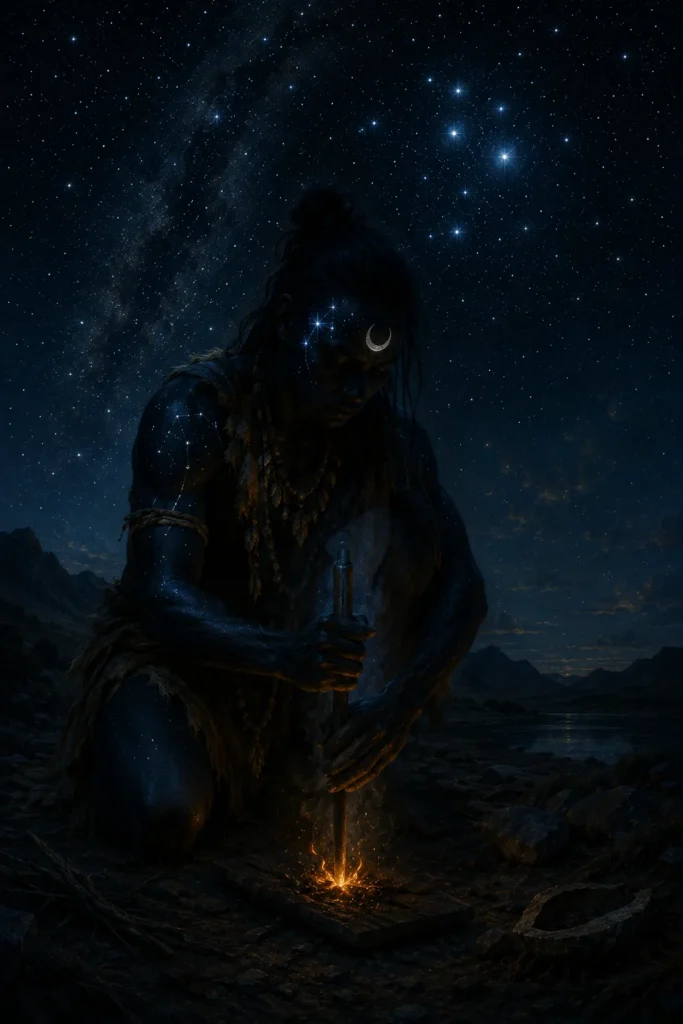
Hina is depicted as a beautiful woman, often appearing in moonlight, who beats tapa (bark cloth) on the moon. In Hawai’i she is often portrayed with the beater for tapa (i’e kuku). As Hine-nui-te-po she is a terrifying figure with obsidian-like eyes and sharp teeth.
Hina is honoured through the beating of tapa, through moon observation and certain women’s rituals. In Hawai’i there were lunar calendars linked with her phases. In the Maori calendar (maramataka), certain nights are assigned to Hina, on which some iwi speak karakia.
Belonging to Hina are the moon, the crescent moon, the calabash and the beater for beating tapa. In some Polynesian traditions the spots on the moon are regarded as Hina’s tapa beater.
As moon goddesses, Selene and Artemis (Greek), Luna (Roman), Chang’e (Chinese) and Mawu (West Africa) are compared. The combination of moon and death goddess in one figure is regarded as a Polynesian development; it recalls Kali in the Hindu tradition, but arose independently.
Classification within the Polynesian Pantheon
Hina is a pan-Polynesian figure. In Hawai’i (Hina), Tahiti (Hina), Tonga (Hina) and Aotearoa (Hina, in the form Hine) she appears under similar names.
The exact functions vary regionally: in Hawai’i she is often a moon goddess and the mother of Maui; in Tahiti a moon goddess and mother; in Aotearoa, as Hine-nui-te-po, a goddess of the underworld and of mortality.
Margaret Orbell, Martha Beckwith and Mary Kawena Pukui document the regional variations. In religious studies, Hina is one of the best examples of how Polynesian theology composes regionally distinct pantheons from a shared stock of figures.
Maori theology, in which Hina leaves her traces as Hine, gets by without a closed system of doctrine. There is no fixed doctrine; whatever reality the Atua possess, they prove in the enactment: in the karakia, in the gatherings on the marae, in the whakapapa recitations.
The study of religions values this practice-based form of theology as a contribution of its own to the field.
Anyone who researches Hina encounters a fundamental difficulty of Polynesian religious research: a large part of the sources stems from the colonial nineteenth century and is coloured by the perceptions of missionaries and ethnologists.
More recent research therefore works continuously on a decolonisation of these holdings by placing Polynesian voices at the centre and critically questioning Western ordering concepts.
If one compares Polynesian religion with other indigenous religions of Oceania, Australia and Southeast Asia, a twofold peculiarity emerges: in its basic motifs it remains remarkably constant, yet at the same time it adapts locally.
Hina, who appears in Hawai’i, Tahiti, Tonga and Aotearoa under similar names yet with different functions, is a vivid example of this. This tension between universality and locality forms an important object of inquiry for Pacific religious ethnology.
Name and Etymology
The name Hina, Hine or Sina (with a phonetic shift depending on the language branch) means in Maori ‘woman’ or ‘girlish being’. In compounds such as Hinetitama (‘Hina of the dawn’), Hine-nui-te-po (‘Hina of the great night’), Hina-i-ka-malama (‘Hina in the moon’), functions are made precise.
The etymology points to proto-Polynesian *Sina with the meaning ‘grey’ (like moonlight) or ‘woman’. Both meanings are present in the transmitted narratives. Bruce Biggs and other linguists have discussed the etymology.
That Hina appears under forms such as Hine or Sina and additionally with numerous epithets is linguistically revealing: such an abundance of names points to an oral transmission that has differentiated itself richly on a regional level.
The linguistic depth of the Maori and Hawaiian theonyms is documented in the lexicon works of Bruce Biggs and Ross Clark, a body of research that is at the same time fundamental for grasping the kinship of the Polynesian languages.
Hina’s epithets are frequently more than mere ornament. They encode particular ritual functions and are fixed in the karakia formulas. The tohunga, the ritual specialists, knew precisely which epithet was to be invoked in which situation. Charles Royal and Pou Temara study this closely regulated liturgical practice.
What original meaning underlies the epithets is often disputed: the name Hina itself can be traced back to proto-Polynesian *Sina with both ‘grey’ and ‘woman’. In many cases competing etymological proposals stand side by side without secured sources allowing a decision. Modern religious studies regards this diversity as a richness and not as a deficiency.
Description and Iconography
Hina is depicted as a beautiful woman who often appears in the moonlight. In some narratives she beats tapa cloth (bark paper) on the moon: the spots on the moon are interpreted in some Polynesian traditions as Hina’s tapa beater. In Hawai’i she is often portrayed with the beating stick for tapa (i’e kuku).
As Hine-nui-te-po in the Maori tradition, Hina is a terrifying figure with obsidian-like eyes and sharp teeth, a figure who mediates between death and birth. This iconographic dual nature is central in religious studies.
Over the last five decades the carving art of the Maori and Hawaiians has experienced an impressive renaissance. Cliff Whiting, Robyn Kahukiwa, Wright Bowman and Sam Ka’ai are among the artists who have developed both transmitted forms and modern reworkings.
In their works the Atua, among them Hina, take on manifold shape; their iconographic presence thus reaches into contemporary art.
Polynesian art cannot be separated from its cosmological meaning. Every spiral (koru), every ornament and every line carries a religious-phenomenological sense, including in depictions of Hina with the beating stick for tapa. Roger Neich, Damian Skinner and further art historians have systematically opened up these layers of meaning.
Hina's Paths to the Moon
In Hawai’i and Tahiti there exists the narrative of how Hina goes to the moon. She is a mortal or half-divine woman whose brother or husband treats her badly; she flees to the moon.
Beckwith reports the Hawaiian version: Hina takes a calabash and her tools and ascends to the moon by way of a rainbow or a moonbeam, where she has dwelt ever since.
In religious studies this is a classic aetiological myth of the moon spots. Moon spots are interpreted mythologically in many cultures (the ‘moon rabbit’ in East Asia, the ‘man in the moon’ in Europe). The Polynesian variant is specifically female.
In religious studies the narratives of Hina’s paths to the moon are likewise not to be read as a closed narrative, but as a web of narratives that explain one another and are accented differently in the individual tribal traditions.
This rhizomatic, net-like structure makes the research methodologically demanding, yet at the same time it opens up hermeneutic depth. Versions of a story that diverge from one another do not count as ‘false’ or ‘distorted’, but as equally valid regional expressions.
The narratives of Hina are not merely preserved in memory but actively passed on: in karakia, in the speeches on the marae and in teaching. They are thus living practice and not a static archive. The language programmes for Te Reo Maori and Olelo Hawai’i have considerably strengthened this vitality over the last thirty years.
Hina as Hinetitama and Hine-nui-te-po
In the Maori tradition Hina is connected with the central myth of Tane and the first woman. Tane forms Hineahuone from red clay, with whom he fathers Hinetitama. Hinetitama becomes Tane’s wife, but when she discovers that her husband is also her father, she flees into the Po (underworld), where she becomes Hine-nui-te-po.
As Hine-nui-te-po she is the goddess of mortality. Maui’s attempt to pass through her and to win immortality for humankind fails. Hine-nui-te-po kills Maui, and human beings remain mortal. This narrative is profound in religious studies. Anne Salmond and Margaret Orbell interpret it as a key myth of Maori anthropology.
That Hina, as Hinetitama and as Hine-nui-te-po, mediates between dawn and great night, between birth and death, points to a basic feature of the religion of the Maori and Hawaiians: rite and everyday activity interlock.
While other religious systems sharply separate the sacred from the profane, here the references to the Atua run through the whole of life. This religiosity, anchored in the lifeworld itself, is the subject of religious-phenomenological studies by Mason Durie, Charles Royal, Lilikala Kame’eleihiwa and further Polynesian scholars of the present generation.
How closely ritual practice and everyday life are intertwined can also be read from language: terms such as mana, tapu, aroha or hauora today belong to the general English of Aotearoa and are used outside religious contexts as well. That Maori theology has thus inscribed itself into linguistic usage documents its cultural depth of effect.
Cult and Rituals
Hina is honoured in the Polynesian tradition through tapa beating, moon observation and certain women’s rituals. In Hawai’i there were moon calendars linked to Hina’s phases. Women-specific rites as well, such as menstruation and birth, could carry Hina references.
In the lunar-month calendar (maramataka) of the Maori, certain nights are Hina nights. In some iwi there are karakia that are spoken on these nights. This practice is today partly revived within the framework of the maramataka renaissance.
Polynesian religion remains alive above all at marae and heiau, those places that are at once meeting place and cult site.
Every marae and every heiau has its own whakapapa, its own traditions and its own Atua references, which in the case of a pan-Polynesian figure like Hina are shaped very differently from region to region.
A marae visit begins with the powhiri, the ritual in which the tangata whenua solemnly receive their guests. It is not ceremonial folklore, but lived religious practice that, in religious studies, ranks among the best-documented Polynesian welcome rituals.
The veneration of figures such as Hina, too, is part of a cult practice that changed markedly in the twentieth and twenty-first centuries.
The central ritual role that formerly belonged to the tohunga today often lies with the kaumatua, the elders, and with the marae committees. Manuka Henare and Mason Durie treat this religious-sociologically revealing shift in their research.
Traditions of Protection
In the Maori tradition Hina, as Hine-nui-te-po, is not primarily ‘invoked’ in a protective context: she is rather a power to be respected. The dying are received into her realm; mourning rituals (tangihanga) honour her reception of the dead.
In Hawai’i and Tahiti, Hina is more strongly present as a beneficial moon goddess. Women who are pregnant can request Hina’s blessing; tapa makers ask for help with their craft. This practice is today partly revived in the Hawaiian renaissance.
On the subject of protection, religious studies makes a distinction: Western thinking proceeds from the effective amulet, the Polynesian from the cultivated relationship. Here protection does not rest on a magical-causal effect but is constituted relationally and ritually.
Whoever stands in relationship to an Atua such as Hina and maintains that relationship is regarded as ‘protected’, not because an object unfolds power, but because an existing relation is cosmologically binding. In religious anthropology this is discussed under the heading of ‘relational ontology’.
It is precisely in protective practice, which also knows invocations of figures such as Hina, that tradition and modernity meet.
Smartphone apps with karakia, online tutorials on protective rituals and virtual marae visits show that Polynesian religion opens up new media for its practice. This modernisation is not to be understood as a flattening but as an adaptive further development.
Parallels in Other Cultures
Hina can be compared with numerous moon goddesses: Selene and Artemis (Greek), Luna (Roman), Chang’e (Chinese), Mawu (West Africa). The connection of moonlight, femininity and water is globally widespread.
The specifically Polynesian expression is the connection of moon and death goddess in one figure. Hine-nui-te-po as at once a creative and a death-bringing power is remarkable in religious studies. This dual nature recalls Kali in the Hindu tradition, but arose independently.
Universal structures of religious experience, such as a figure between birth and death like Hina touches upon, have been systematically investigated by Joseph Campbell and Mircea Eliade.
As fundamental as their works are, they must nonetheless be rethought for the concrete Polynesian contexts, without lapsing into a pan-globalising simplification. More recent Polynesian research places great value on this context-sensitive interpretation.
The moon goddess Hina cannot be viewed in isolation, for global indigenous-studies research systematically works out the parallels between Polynesian and other indigenous religions. With Decolonizing Methodologies (1999), Linda Tuhiwai Smith set methodological standards whose effect reaches internationally.
Reception Today
Hina is today a significant reference figure of the Polynesian feminist movement. Anne Salmond and other researchers have reappraised Hina’s standing. The Hine-nui-te-po figure in particular is read as a powerful symbol of female autonomy and self-assertion.
In Hawaiian hula and in the Maori haka, Hina appears in numerous works. In modern Pacific literature too (for instance with Sia Figiel or Patricia Grace), Hina is a recurring point of reference. A deeper classification within the Polynesian religious family shows her central position as a pan-Polynesian figure.
The moon goddess Hina is part of a religious transmission that is increasingly recognised in international discourse as a system in its own right and no longer devalued as ‘mythology‘ or ‘folklore‘. That terms such as ‘mana’, ‘tapu’, ‘mauri’ and ‘whakapapa’ have entered the technical language of religious studies attests to this recognition.
Whoever uses them, however, needs a contextual sensitivity that does not arise of its own accord.
The reception of Polynesian religions into popular culture, through Disney productions, tourism and esoteric literature, is the subject of critical debates. Where does an appropriate mediation take place, where is it flattened or distorted? These questions are discussed in Aotearoa and Hawai’i with emphasis and in public.
Research and Sources
Important contributions on Hina come from Margaret Orbell, Martha Beckwith, Mary Kawena Pukui, Anne Salmond, Marie Alohalani Brown and Patrick Kirch. Their works document the regional variations and the religious-historical depth of the figure.
Hina remains a central figure for the understanding of Polynesian concepts of femininity and their cosmological embedding. Her dual nature as moon and death, birth and mortality, is of particular depth in religious studies.
The dialogue between the Polynesian-internal traditions of knowledge and academic research today finds an institutional foothold in the Royal Society of New Zealand, Te Aparangi, in the Maori Studies Department of Auckland University, at the University of Hawai’i at Manoa and in the foundation Te Punga Tipu.
These institutions ensure that Polynesian research is not only carried out about Polynesia but likewise by Polynesia itself.
The connection to global religious studies is established by studies that use Polynesian theology as an exemplary case of a non-Western religiosity. This comparative work is methodologically demanding, but it opens up new perspectives for understanding religion as a cultural phenomenon.
Hina in the Moon and the Beating of the Bark-Cloth Lengths
One of the most widely spread Hina narratives of Polynesia connects the goddess with the moon. In numerous island groups, from Hawaii by way of the Society Islands to Aotearoa, there are versions in which Hina leaves the earthly sphere of life and moves to the moon.
In the Hawaiian tradition that Martha Beckwith compiled in Hawaiian Mythology, she is there called Hina-i-ka-malama, Hina in the moon.
The occasion of her ascent is frequently her activity as a maker of kapa or tapa, the cloth beaten from tree bark that was used throughout Polynesia for clothing, blankets and ritual purposes. Hina is regarded as the mythical originator of this women’s work.
Weary of the burden of life on earth, of a strict husband or of endless labour, she ascends on a rainbow or a path of light to the moon.
The dark spots on the lunar disc are interpreted by some traditions as Hina herself, her kapa-beating support or the banyan tree whose bark she works.
The regular sound of bark-cloth beating, which belonged to everyday life in the Polynesian villages, connected the women who performed this work with the goddess. Hina is thus not a distant cosmic figure but bound to a concrete, gender-specific technique. In religious studies it is remarkable that the myth translates an everyday toil into a cosmological image: the goddess who escapes the earthly burden of work remains at the same time visible in the sky with the tools of precisely this work. The reference to Tāne and other nature deities shows that Hina is embedded in a widely spanned web of Polynesian narratives.
Māui and Hina: Mother, Sister or Wife?
In the Māui cycles, which are among the best-known narrative complexes of Polynesia, Hina is a recurring but, depending on the island group, differently determined figure. In some traditions she is the mother of the culture hero Māui, in others his sister, elsewhere again his wife.
This variability is not an error of transmission but an expression of the fact that the name Hina stands pan-Polynesianly for a whole group of female figures, often with an explanatory epithet.
In an episode attested in several island groups, Māui tries to win immortality for his mother or wife Hina by attempting to enter the body of the death goddess Hine-nui-te-pō, whose name itself contains a Hina form.
The attempt fails, Māui is killed, and death remains in place for human beings. In the New Zealand tradition that George Grey recorded in the nineteenth century in Polynesian Mythology, this connection is especially clearly developed.
A further well-known episode is Hina and the eel: an eel-being harasses Hina, Māui kills it, and from its head or body grows the first coconut palm. This narrative explains at the same time the origin of one of the most important useful plants of Polynesia. Research, for instance in Katharine Luomala’s study Maui-of-a-Thousand-Tricks (1949), has mapped the branching of these cycles and shown how closely Hina and Māui are connected in the whole Polynesian narrative tradition. The indeterminacy of their kinship relationship reflects the openness of an oral tradition that recombined the same names anew across centuries and across thousands of nautical miles.
Colonial Collectors and the Distortion of the Hina Image
Today’s knowledge of Hina stems almost exclusively from records made in the nineteenth and early twentieth centuries by European and American collectors, and this source situation shapes the image of the goddess in a way that is to be critically reflected upon.
Missionaries such as William Wyatt Gill, who was active for decades on Mangaia in the Cook Islands and published narratives in Myths and Songs from the South Pacific (1876), collected extensively but ordered the material into European genre categories and filtered it through their theological perspective.
A frequent problem is the tendency to merge the many Hina figures into a single goddess. The Polynesian traditions know Hina-i-ka-malama, Hina-of-the-tapa, Hine-nui-te-pō and many others, each with its own epithet and its own function.
Early collectors often smoothed this diversity into a tidy figure because that suited their notions of order. This created the misleading impression of a closed Hina theology.
In addition, male collectors predominantly drew on male informants, and the women’s traditions connected with Hina, for instance the songs during the kapa beating, are more poorly documented. Later researchers such as Katharine Luomala and Martha Beckwith have partly corrected this imbalance. In religious studies it therefore holds: every statement about Hina hangs on a particular collection, a particular informant and a particular island. The notion of a uniform Polynesian moon goddess that circulates today is to a good part a product of colonial collecting activity and not the faithful image of a single indigenous tradition.
Literature (Selection)
- Margaret Orbell: The Illustrated Encyclopedia of Maori Myth and Legend (1995)
- Martha Beckwith: Hawaiian Mythology (1940)
- Mary Kawena Pukui: Nana I Ke Kumu (1972)
- Anne Salmond: Tears of Rangi (2017)
- Patrick Kirch: On the Road of the Winds (2000)
The cult of Hina is attested across large parts of Polynesia, from Hawai’i by way of Tahiti to Aotearoa, where she is invoked under related names as moon goddess and primal mother.
Local expressions of the cult connect Hina with tapa production, birth and the transition into the night side of existence, and show how closely moon, female agency and life cycle are linked in Polynesian religion.
Hina appears in Polynesian traditions as a many-faced Atua who, depending on the island group, is portrayed as moon goddess, primal mother, patroness of tapa production or companion of Maui.
Related key terms: Hina Polynesia moon goddess Hine-nui-te-po maramataka Tapa Hinetitama.
iWell Guard and Traditions of Protection
iWell Guard ties in with the cultural-historical tradition of portable protective objects, in the tradition of Polynesia / Maori and many other cultures worldwide. 41 layers, solid gold, platinum, silver, made in Germany. 30-day right of return.
Personal experiences may vary. Not a medical device. No healing promise.