Shezmu, demon of the Egyptian tradition
By Ralf Ittermann · last reviewed on
Shezmu is a demon of the Egyptian tradition.
Demon of slaughter, of anointing and of wine, ambivalent and dangerous. Shezmu is the blood-stained force of transition: butcher, oil presser, wine maker. With a broad, wild laugh and a butcher’s tools, he is creative as much as destructive.
Wine from crushed grapes, oil from pressed seeds: his crafts require violence. In the afterlife Shezmu can become an enemy if one does not know his names.
Shezmu is an Egyptian demon of slaughter and of the winepress.
Quick overview: Shezmu
Type: Egyptian deity, slaughterhouse god and presser of the dead
Pantheon: Egypt (all dynasties)
Function: preparation of wine and anointing oil; in funerary contexts „presser of the damned“
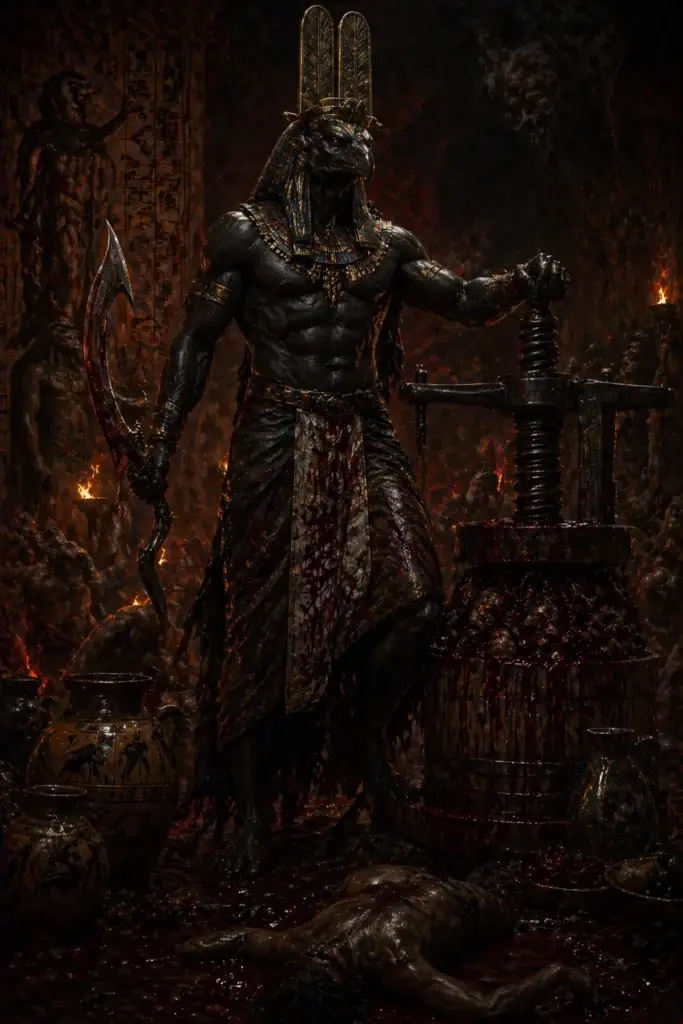
Main attributes: lion or falcon head, press (Sefshet), knife, blood-red skin colour
Main cult sites: Edfu, Dendera, Thebes
Dual function: peaceful preparer of anointing oil / wrathful presser of the dead
Classification
Period of the texts
Shezmu is attested from the Pyramid Texts (utterances 246, 273 to 274, ca. 24th century BC) onward, one of the oldest funerary deities among the beings of the Egyptian pantheon.
In the Cannibal Hymn of the Pyramid Texts (Pyramid of Unas) he is a central figure: he presses the damned for the Egyptian royal meal. In later traditions he was softened toward a more peaceful function (preparer of wine and anointing oil), while the dual nature was retained at Edfu and Dendera.
Area of distribution
Worshipped throughout the Egyptian land. Main cult sites: Edfu (reliefs depicting him as presser in the Ptolemaic tradition), Dendera, Thebes. Anointing-oil workshops stood under his patronage. In the funerary burial rites of the Ptolemaic Late Period he appears as a wrathful guardian figure on sarcophagi.
Source situation
Central sources: Pyramid Texts (utterances 246, 273 to 274, Cannibal Hymn), Coffin Texts, Book of the Dead (spells 17, 64), reliefs of the Edfu temple. Secondary literature: Bonnet, Reallexikon; Wilkinson, The Complete Gods and Goddesses; Eyre, The Cannibal Hymn.
Name
Shezmu is depicted with a broad, wild face, sometimes with animal features. His colour is red (blood) or black (decay). He often carries a large knife, an axe or pliers, the tools of craft and of violence.
Sometimes his arms are stained with blood. In papyri he is shown as a muscular and aggressive figure. The uraeus (serpent) sometimes adorns his brow. Wine amphorae or oil vessels may stand beside him.
Description
Shezmu sacrifices animals, presses oil and wine, and judges over the dead in the afterlife. In the Book of the Dead he is treated as a danger; his name must be known and appeased. If a deceased person does not know his name, Shezmu can become a tormentor.
Wine and oil were precious goods; Shezmu oversaw their production and their ritual use. Slave workers in oil and wine presses prayed to him in order to remain safe. Priests invoked him so that sacrificial animals would be ritually slaughtered. His worship was less formal than that of the greater gods, but culturally pervasive.
Appearance and symbolism
Shezmu is depicted as a muscular man, often with the features of a lion or of a raw, animalistic being. He carries or holds a winepress or a pressing tool. His body is often coloured with blood or wine, which symbolises his duality.
He may be depicted with a red or dark-red body. Shezmu has intensely staring eyes that appear at once cruel and transformative. His hair may be wild or curly. The grape-press chamber or the pressing tool are his attributes.
Profile: Shezmu
The most important aspects of Shezmu at a glance. The following fields summarise origin, function, appearance, worship, symbols and parallels.
Shezmu’s genealogical position is not consistently fixed. In some traditions he is the son of Sekhmet (the lion-headed mother, which suits his dual nature). In others he is the son of Ra (in his function as protector of the solar barque).
His dual aspect, peaceful preparer of anointing oil and wrathful presser of the dead, reflects the male counterpart to the function of the Sekhmet-Bastet double goddess.
Dual function: peaceful patron of the preparation of wine and anointing oil (red grapes were pressed out in presses, a parallel to the pressing of the dead) and wrathful „presser of the damned“.
In the Cannibal Hymn he hands the king the heads of the deceased after he has himself slaughtered and cooked the gods. In later traditions he appears more as a protective guardian than as an active punisher.
Two main forms:
Lion-headed: with blood-red skin colour, press (Sefshet) in hand, knife.
Falcon-headed: depicted as protector of the solar barque, with the was sceptre and the ankh.
At Edfu present in both forms, according to context. On some reliefs there is also a pure pressing scene without anthropomorphic form, only the press with grapes (or heads).
Area of effect: Shezmu was invoked before the production of anointing oil and the preparation of wine; his patronage ensured quality drink and ointment.
In funerary burials he was invoked as a guardian who protects the deceased from being devoured by disordered powers. In the Ptolemaic temple tradition he has, like Sekhmet, a component of appeasement.
Lion head, falcon head, press (Sefshet), knife, blood-red skin colour, was sceptre, red grapes, anointing-oil jugs. Plants: grapes (especially red ones), olive (for oil), lotus. Sacred animals: lion, falcon. Sacred colours: red, gold.
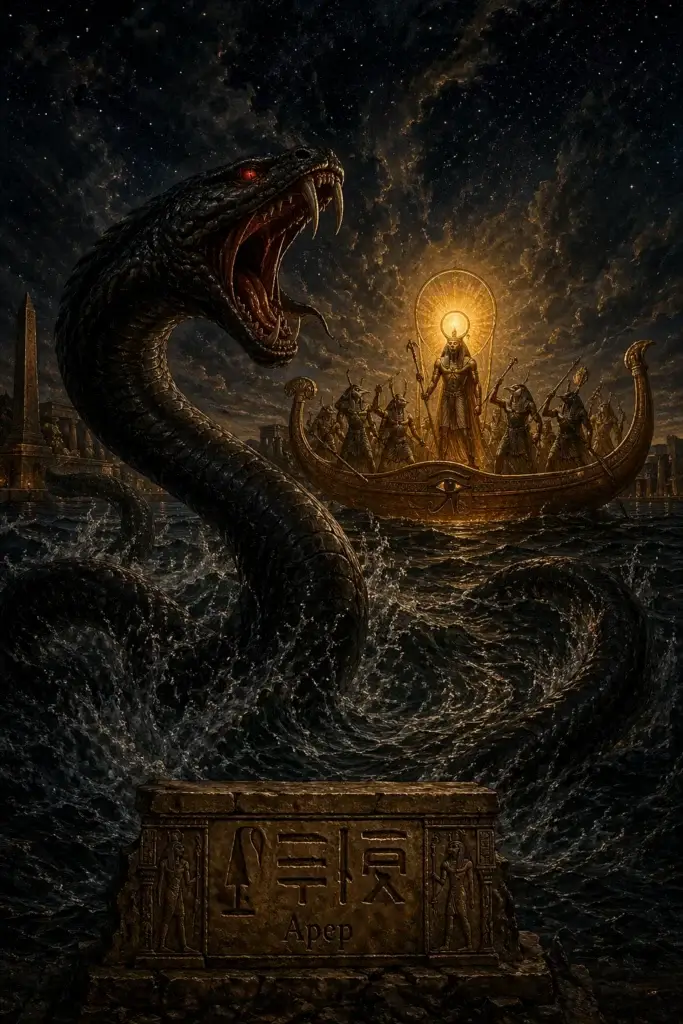
Sekhmet (Egypt, mother, the same wrathful aspect), Anubis (Egypt, escort of the dead), Apophis (antagonist as the chaos serpent), Bhairava (Hinduism, wrathful protector with a bloody connotation), Yama-Dharmaraja (Tibet, judge of the dead with a buffalo dual nature), Mahakala (Buddhism). Functionally: any guardian of the dead with a bloody connotation shares Shezmu’s functions.
Protective practice
Apotropaic rituals
Shezmu (Egyptian Šzm.w) is an executioner and torture god and at the same time the god of the wine, oil and ointment presses; the double-facedness of killing and anointing shapes his role.
The Pyramid Texts (utterances 273 to 274, „Cannibal Hymn“) name him as the master presser who prepares the gods as food for the pharaoh.
In the Late Period his role shifts from executioner to protective god of the dead. Apotropaic rituals against Shezmu’s destructive side are found in the liturgy of the Edfu temple, above all in the drama of the Horus myth (cf. Wilkinson, Complete Gods and Goddesses; Morenz, Egyptian Religion).
Conjurations
In the Book of the Dead (chapters 17 and 64) Shezmu appears as a companion of the deceased who dismembers the enemies of the dead in the underworld, an apotropaic function. Ritual texts from Edfu (Ptolemaic) name him in connection with the anointing of the pharaoh at coronation and renewal rituals.
Amulets and protective symbols
The Shezmu symbol is the wine-press screw (shesp), depicted in hieroglyphs as the image of a man with a press beam. Apotropaic Edfu tablets bearing his name protected storerooms holding wine and oil. Clay seals on wine amphorae of the Late Period bear Shezmu inscriptions, against theft and spoilage.
Shezmu, parallels in other cultures
Shezmu resembles Ares (Greece), god of blood and violence, but more pragmatic.
He recalls Loki (Scandinavia), a trickster demon who both helps and harms. The concept of a demon of craft and of the threshold is universal; Shezmu is an archetypal Egyptian expression of it.
The god of the press: wine, oil and blood
Shezmu (also Shesemu) is one of the most ambivalent figures of the Egyptian pantheon, and his dual nature can be fixed on a single image: the press. Shezmu is the god of the winepress and of the oil press. In this function he is a thoroughly friendly deity associated with provision and festive joy.
Texts and depictions show him as lord of the red grapes, as the one who prepares the wine for the gods and for the festive table, and as the preparer of the fragrant anointing oils that were indispensable in the temple cult and in the funerary realm.
The very same activity, however, has a gruesome reverse side. The pressing and crushing of the grapes, in which the red juice wells forth, became an image for the pressing of heads and the collecting of blood.
In the Coffin Texts and especially in a famous passage of the Pyramid Texts, Shezmu appears as the one who slaughters the gods for the king, throws their limbs into the press and presses them out like grapes, so that the deceased ruler may draw on their power.
From the presser of wine becomes the presser of blood.
This connection is not contradictory but follows an inner logic. The same act, the crushing to obtain a red liquid, carries both meanings.
Shezmu thus shows exemplarily how Egyptian thought did not divide deities into good and evil but granted them mutually opposed aspects that arise from a common root. The god of the festive wine and the slaughterer of the wicked are one person.
Shezmu in the Book of the Dead and in the judgement of the afterlife
In the funerary literature Shezmu has a fixed, though not central, place. In the Book of the Dead, the collection of spells for the afterlife, and in the older Coffin Texts, he appears as one of the powers that serve among the dead.
His role there has remained ambivalent: he can be well disposed toward the justified deceased and prepare for him the good oils and the wine of the afterlife, but he can also belong to the executors of punishment who fall upon the damned.
Especially in the depictions of the judgement of the afterlife and of the places of punishment, beings appear who behead the condemned, dismember them and throw them into cauldrons or presses. Shezmu is connected with such acts of punishment in several sources.
The precise delimitation of his role against other punishing beings of the afterlife has not been fully clarified in research, because the texts often name him only briefly and his function varies according to spell and epoch.
It is important that Shezmu in the funerary context is never the supreme judge. The judgement itself lies with Osiris and the assessor gods; the weighing of the heart takes place before Maat. Shezmu is an executing being, one of those who carry out the verdict.
This position suits his character: he is the one who lays his hand to the work, who presses and slaughters, not the one who decides.
In the later tradition, especially in the Greco-Roman temple texts of Edfu and Dendera, his friendly aspect as a preparer of ointments emerges more strongly again, which shows that the two sides of the god existed alongside each other throughout the whole history of Egyptian religion.
Iconography and places of worship
The depictions of Shezmu are not numerous, but characteristic. He appears mostly in human form, occasionally with a lion’s head, which underlines his dangerous, predatory aspect.
In some depictions he carries attributes that refer to the press and the oil press. The lion-headed form connects him iconographically with other dangerous, but also protective, deities of the Egyptian pantheon.
Shezmu was not one of the great state deities with their own monumental temples. His cult is graspable rather as local and functional.
He was worshipped especially where his areas of responsibility were practically relevant: in the regions of viticulture, for instance in the western Delta and in the oases, and in connection with the production of anointing oils.
The sources connect him, among other places, with the Faiyum region. Inscriptions and mentions are scattered across the history of Egyptian religion, from the Pyramid Texts of the Old Kingdom to the temple texts of the Ptolemaic period.
This source situation explains why Shezmu is less present in modern perception than the great gods. He was a specialist, a deity for particular activities and places.
Yet precisely this makes him interesting for religious studies: in him one can study how the Egyptians also charged craftsman-like and everyday processes, the pressing, the squeezing, the production of ointments, with divine meaning.
The wine on the festive table and the anointing oil in the temple had a divine preparer, and the same god guaranteed at the same time that the enemies of order would be crushed in the afterlife like ripe grapes.
Further links
Research literature
Further standard works in the literature index.
The protective practice described here is a religious-studies classification of historical traditions. iWell Guard ties in with this cultural-historical line of wearable protective objects and represents a contemporary form of it. More about the iWell Guard →