Gui, Spirit of the Chinese Tradition
By Ralf Ittermann · last reviewed on
Gui is a spirit of the Chinese tradition.
The diverse Chinese spirit world, from ancestors to avengers.
Gui in Chinese ancestor veneration
Gui (鬼) designates, in classical Chinese folk belief, primarily the ancestor spirit, the immortal soul of a deceased person who continues to exist after death.
In the Confucian system there are two soul components: hun (the heavenly, lighter soul that ascends) and po (the earthly, heavier soul that remains in the grave). When the po soul is unbalanced, through dying without burial, absence of offerings, or breach of filial duty, it becomes a restless Gui.
The most important rites for appeasement: Qingming Festival (Tomb-Sweeping, 4th/5th April), Zhongyuan Festival (Hungry Ghost Festival, seventh lunar month), and maintenance of ancestor tablets in the family shrine.
The Daoist interpretation extends the schema to include spirit ranks: Tu-di Gui (local spirits), Shan-Gui (mountain spirits), Shui-Gui (water spirits). Related figures: Jiangshi (hopping corpse), Diao-si Gui (hanged spirit).
Gui
Gui (鬼) is the foundational term of Chinese demonology. The character originally depicts a head with flowing hair, the soul of a deceased person.
The term is broad: it encompasses ancestor spirits (which are benevolent when the proper rite is observed), restless dead (which haunt), vengeful souls, and many subcategories. According to yin-yang cosmology, Gui belongs to the yin, cold, dark, feminine, dead, and requires ritual balance with the yang of the living.
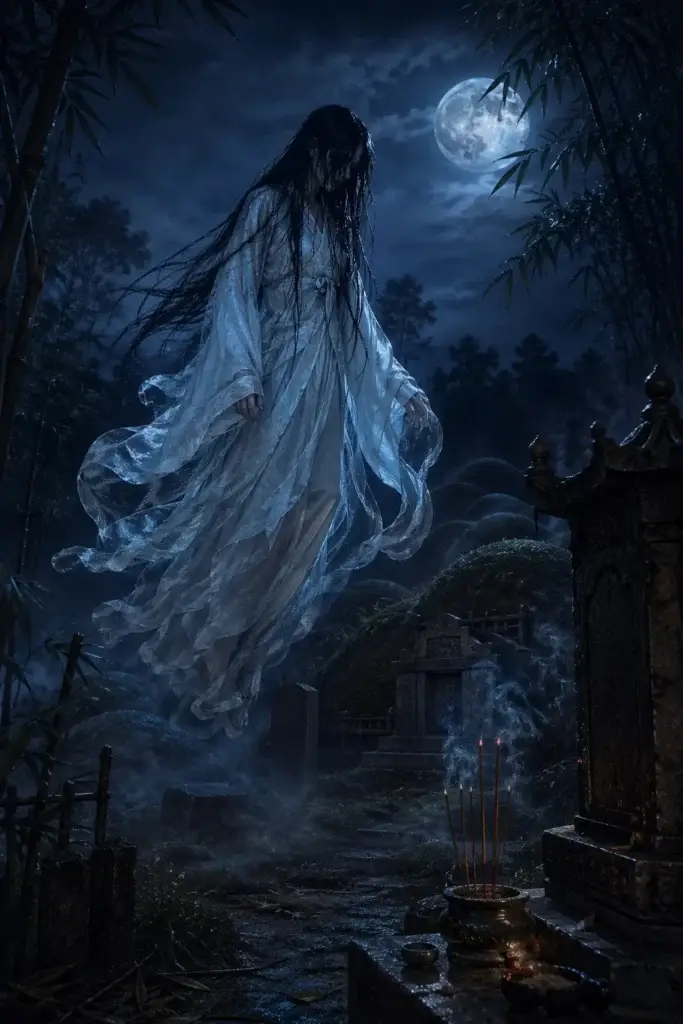
Classical literature recognizes many types. Nügui (女鬼) as a female spirit is especially prominent in folk tales and operas, the beautiful young woman who returns out of grief or revenge. Shui Gui (水鬼) is the drowned, Diao Si Gui (吊死鬼) the hanged.
Pu Songling’s masterwork Liaozhai Zhiyi (17th century) contains hundreds of Gui narratives and has shaped the modern image, in particular the motif of “Gui as tragic lover,” in which the living and the dead exist in complex relationships.
Short Profile: Gui
Type: General term for spirit/demon
Origin: Souls of the deceased, especially the unredeemed
Subtypes: Nügui (female), Shui Gui (drowned), Diao Si Gui (hanged), many others
Texts: Shang oracle bones, Zuozhuan, Sou Shen Ji, Liaozhai Zhiyi
Period: pre-imperial to the present
Context
Shang oracle bones (ca. 1250 BCE) with early Gui invocations. Han-period texts (Shujing, Liji) systematize the material. Jin-period marvel literature (Sou Shen Ji, 4th century) with dense Gui narratives. Qing-period Liaozhai Zhiyi (17th century) as the literary high point. Modern film industry and literature continuing the tradition.
Han Chinese heartland. Worldwide through the diaspora (Taiwan, Hong Kong, Southeast Asia, North America, Europe). Regional diversity: southern Chinese traditions (Hong Kong, Singapore) are particularly dense with Gui belief; ethnic minorities (Hui, Miao) have their own variants.
Shang oracle bones, classical Confucian texts (Liji, Zuozhuan), Daoist exorcism texts (Daozang), Ganbao’s Sou Shen Ji, Pu Songling’s Liaozhai Zhiyi, Yuan Mei’s Zi Bu Yu, modern folklore studies, and film.
Name and Variants
Chinese: 鬼 (guǐ).
Subtypes: nügui 女鬼 (female), nangui 男鬼 (male), shui gui 水鬼 (drowned), diao si gui 吊死鬼 (hanged), yuan gui 冤鬼 (unjustly deceased), e gui 餓鬼 (hungry ghost, see dedicated page).
Etymology: Pictogram; already present in the Shang oracle bones as a flowing-hair head form.
Japanese: Oni (partially adopted), Yūrei as the counterpart to Gui.
Regional differentiation is enormous. Hong Kong folk belief recognizes, for example, the jiandie gui (spy spirit), zanpu gui (massacre spirit), and many others. Taiwanese traditions have their own classes. Unity lies in the basic term; diversity lies in the concrete forms.
Characteristics
Appearance
Mostly shadowy or translucent. Nügui as a beautiful young woman in white garments with long black hair. Shui Gui as a bloated, wet body. Diao Si Gui with a bluish face and protruding tongue. Modern horror aesthetics continue to shape the pictorial tradition (Ring films).
Behavior
Dependent on type: ancestor spirits come at festivals and expect offerings; vengeful Yuan Gui pursue their murderers or immoral witnesses; Shui Gui attempt to drown others (in order to obtain a replacement and be reborn themselves).
Sphere of Activity
The place of death, the family of the deceased, and impure locations. At night and during the ghost hour. Intensified annually during the Hungry Ghost Month (seventh lunar month). Always present at cemeteries and cremation sites.
Mythological Classification
Gui belongs to the yin aspect of cosmology. In Buddhist-Daoist syncretism, Gui are beings in one of the six states of existence; within the Confucian framework they are ancestors requiring proper ritual maintenance (li).
Profile: Gui
The most important aspects of Gui at a glance.
Souls of the deceased, ancestors or the unredeemed. The yin side of the world. Ranging far beyond the demonic spectrum, from benevolent to threatening.
Families of the deceased (ancestors), victims of murder (Yuan Gui), bathers at Shui Gui sites, people during the seventh lunar month.
Shadowy or translucent. Nügui with long black hair in white; Shui Gui bloated and wet; Diao Si Gui with a bluish face and protruding tongue.
Depending on type: haunting, vengeance, drowning, illness, psychological distress. Ancestor spirits are benevolent when properly tended, threatening when neglected.
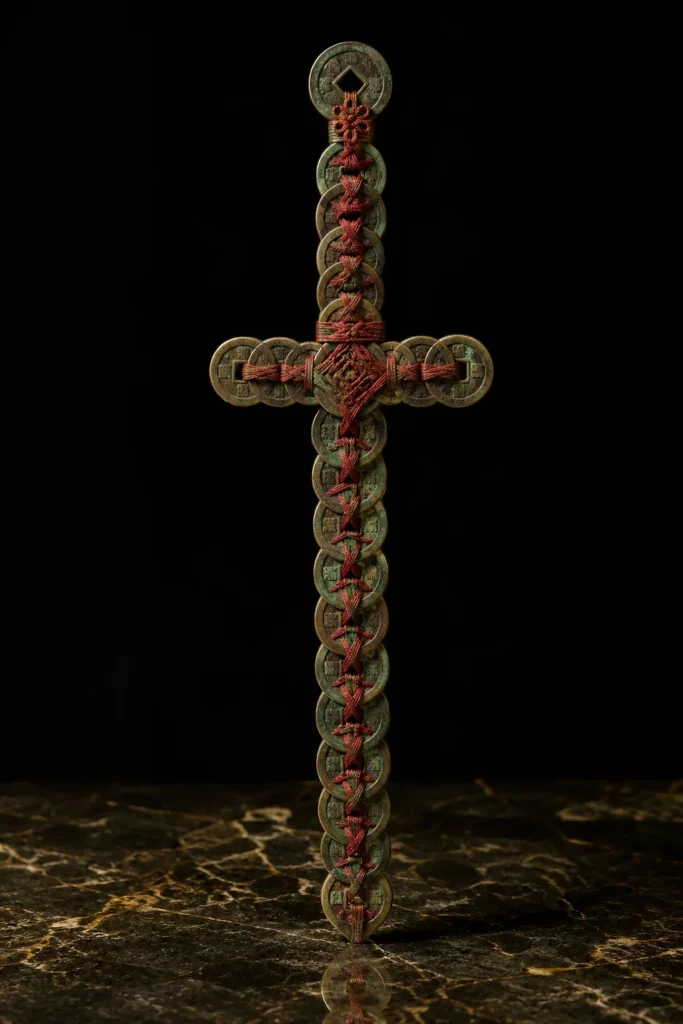
Ancestor offerings and family rituals (Qingming, Hungry Ghost Festival), Daoist fu talismans, bagua mirrors, peach-wood swords, rooster blood, recitation of sutras or Daoist texts.
Everyday Practice
Ancestor Rituals
Qingming Festival (April): grave visits, burning of paper food and paper money. Hungry Ghost Festival (seventh lunar month): offering gifts at the front door, public rituals. Lunar New Year with ancestor invitation. Without these rituals, ancestors become Yuan Gui.
Exorcism and Warding off
Daoist priests (Daoshi) with fu talismans made from yellow paper with red ink. Rituals using peach-wood swords and bells. Yin-yang compass (luopan) for identifying dangerous locations. Feng shui correction as a preventive measure.
Amulets and Household Ritual
Bagua mirror above the front door, paired door deities (Menshen, Qin Shubao and Yuchi Jingde), red threads for newborns, jade amulets. House thresholds, roof edges, and entrances receive particular protection.
Reception and Modernity
Literary Tradition
Pu Songling’s Liaozhai Zhiyi (17th century) as the high point, nearly 500 narratives featuring Gui, Yaoguai, and Huli Jing. Adapted repeatedly to the present day. Yuan Mei’s Zi Bu Yu (18th century) supplements the tradition. Modern authors (translators of Pu Songling, contemporary Chinese literature) continue the line.
Film and Popular Culture
Hong Kong ghost films (A Chinese Ghost Story, 1987) and Taiwanese horror productions shape the modern image. Japanese J-Horror (Ring, Ju-on) draws heavily on Chinese Gui motifs.
Diaspora Today: Gui belief is cultivated in Chinese communities worldwide. Hungry Ghost Festival practices in Singapore, Malaysia, and North America. Contemporary Chinese in the People’s Republic maintain the rituals despite official secularization.
The term gui and the Chinese understanding of the soul
The Chinese gui, usually translated as ghost or spirit of a deceased person, can only be understood against the background of the traditional Chinese conception of the soul.
According to a widespread view that developed from the Han period onward, a human being possesses two kinds of soul force: the hun, the more spiritual and lighter component, which ascends after death, and the po, the body-bound and heavier component, which remains with the corpse in the earth.
In the case of a normal, orderly death and correctly performed funerary rituals, both components find their proper place: the ascending one becomes the venerated ancestor, the earthly one rests in the grave.
The gui in the narrower, problematic sense arises where this orderly transition fails. A deceased person whose rites are omitted, who has no descendants, who died violently, far from home, or as a victim of injustice, may become a restless, wandering gui.
Thus, in the Chinese conception, the gui is not an independent being from a foreign sphere but a human in the wrong condition. The boundary between the venerated ancestor and the feared ghost runs not through the nature of the being, but through the question of whether it is ritually provided for and socially integrated.
This understanding has far-reaching consequences. It makes the living responsible for the fate of the dead; it establishes the central importance of ancestor veneration; and it explains why concern for proper burial and regular offerings shaped Chinese family life over centuries. The gui is the constant reminder of what happens when these duties are neglected.
Hungry Spirits, Vengeful Spirits, and the Diversity of the Dead
The collective term gui encompasses a range of distinctly different manifestations whose common feature is that they are dead persons in an unresolved state. The Chinese tradition, from the early collections of the strange to the later narrative works, has given rich expression to this diversity.
One important group consists of the hungry spirits, egui: the dead without descendants or without proper offerings, who wander without provision and suffer from hunger.
Through the influence of Buddhism they were connected with the Indian conception of the hungry ghost realm, and they stand at the center of the Ghost Festival of the seventh month, at which the living offer food to the neglected, unknown dead as well, so that these cause no harm.
Another group consists of the vengeful spirits, the yuangui: dead persons who suffered injustice, who were murdered, unjustly executed, or driven to suicide. They return to demand retribution or to bring their wrong to light, often pursuing the guilty party directly.
In countless narratives and later in theater, the vengeful spirit who forces justice through a court proceeding or supernatural intervention forms a central motif.
Beyond these, the tradition recognizes spirits that arise from particular circumstances of death: the drowned, for example, who seek a replacement in order to be released themselves, or spirits that remain bound to a specific place.
This differentiation shows that the gui was not conceived as a uniform figure of terror. It is, rather, an entire field of dead persons whose individual histories, their manner of death, their injustice, their neglect, determine in what form they return and what they demand of the living.
The Just Spirit and the Moral Order of the Narratives
In Chinese narrative literature, the gui is frequently not a mere figure of terror but a bearer of moral order.
Especially in the collections from the early medieval period and in the classical works of the Qing period, notably in the Liaozhai zhiyi of Pu Songling, the spirit takes on a function that supplements or corrects human justice.
A common pattern is the spirit that reveals a concealed crime. A murder victim appears to an official in a dream, points to the body or to the perpetrator, and thereby enables the punishment of the guilty.
Here the gui acts as an instrument of a cosmic order that does not permit injustice to go unatoned. The bureaucracy of the beyond, the underworld courts with their registers and judges, forms the framework within which such spirits act.
Equally common is the grateful spirit. A dead person to whom a living person has done a kindness, for example by burying their bones, settling their debts, or making offerings, returns in order to reciprocate, through counsel, through protection, or through assistance in time of need.
These narratives affirm the norm that care for the dead is worthwhile and that a relationship of giving and receiving continues even beyond death.
This moral dimension distinguishes the Chinese gui from a purely terrifying ghost. It is embedded in a worldview in which the boundary between the living and the dead is permeable and in which both sides bear obligations toward each other.
The ghost story thereby becomes an instrument of ethics: it demonstrates that injustice is pursued and good deeds are repaid, even across the boundary of death.
Further Links
Further reading:
Bibliography (Selection)
Further standard works in the literature index.
The protective practice described here represents a religious-studies classification of historical traditions. iWell Guard connects to this cultural-historical line of wearable protective objects and represents a contemporary form of it. Learn more about the iWell Guard →
Frequently Asked Questions about Gui
What are Gui in Chinese folk religion?
Gui (鬼) are, in Chinese folk religion and in Daoism, the spirits of deceased persons, typically those who suffered a violent, unatoned, or improperly handled death.
They hover between worlds because they lack the proper funerary rites or their need for vengeance remains unresolved. In Buddhism this becomes the class of hungry ghosts (E Gui); in folk religion, Gui are the most common cause of illness, misfortune, and haunting phenomena.
What is the Ghost Festival in the Chinese tradition?
The Hungry Ghost Festival (Yu Lan Pen Jie, in the seventh lunar month) is the most important ritual for dealing with Gui. During the “ghost month” (seventh month), the separation between worlds is considered permeable.
Families set out food and offerings, burn paper money, and thereby provide for the returning deceased. Those who no longer have a family are provided for by the community, which prevents the Gui from causing harm out of hunger.