Indra, God of the Hindu Tradition
By Ralf Ittermann · last reviewed on
The Vedic thunder king, ruler of the sky and victor over demons. Indra is one of the oldest Hindu gods, the most important in the *Rigveda*, set aside in later periods. With his thunderbolt *Vajra*, riding on a white elephant, Indra once led the council of the Devas.
He defeated the dragon *Vritra*, who had stolen the rain, and returned it to the world. Yet, unlike Shiva, Indra is hardly worshipped anymore, a god whose time has passed, whose splendour has faded before bhakti.
As thunder king and guardian of the sky, Indra is the leader of the Devas.
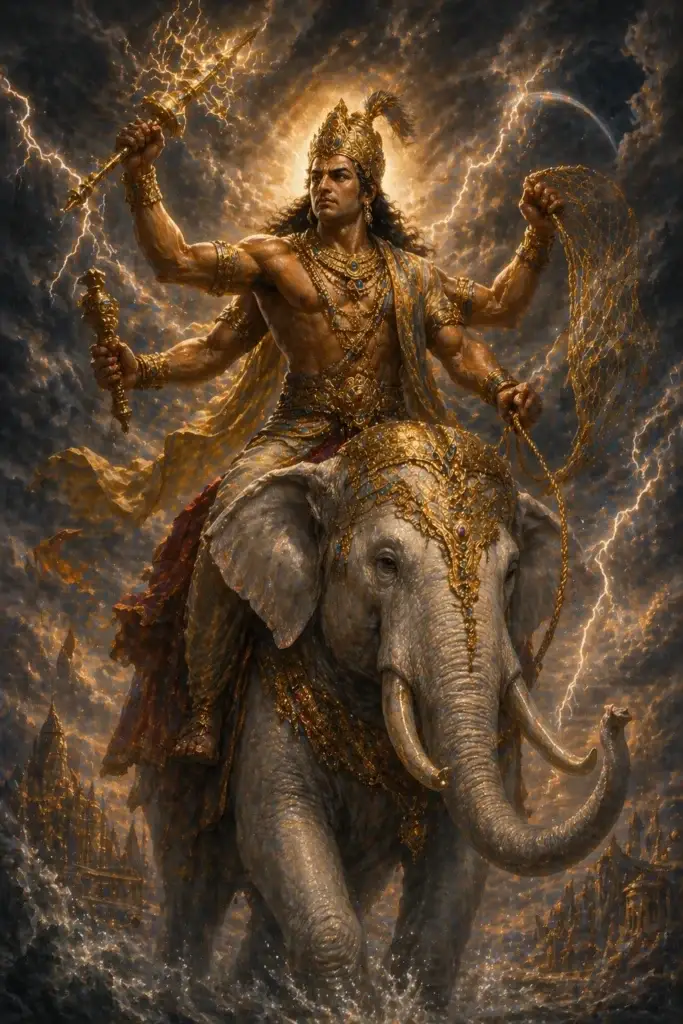
Indra
At a Glance: Indra
Type: Vedic chief god, god of thunder and kingship, moved into the background in the Purâṇas
Pantheon: Hinduism (central in the Vedic period, secondary post-Vedic), Buddhism (as &Saacute;akra/Taishakuten)
Function: thunder and lightning, war, kingship, victor over Vritra (dragon demon of drought)
Main attributes: Vajra (thunderbolt), bow, white elephant Airavata as mount
Main cult sites: central everywhere in the Vedic period, post-Vedic in Trayastriṃša (Buddhist)
Buddhist identification: &Saacute;akra (Sanskrit), Taishakuten (Japan), Indra (Tibet)
Classification
Period of the Texts
Indra is the central deity of the Rigveda (1200–900 BCE); roughly a quarter of all Rigveda hymns are dedicated to him.
His main myth is the battle with Vritra: Vritra, the dragon demon of drought, holds back the cosmic waters; Indra drinks Soma (an entheogenic drink), kills Vritra with the Vajra (thunderbolt) and releases the waters.
With the post-Vedic tradition (Brâhmaṇas, Purâṇas from the 3rd or 4th century CE onward), Indra loses significance; he becomes a subordinate deity below Vishnu and Shiva. In Buddhism he is adopted as &Saacute;akra, ruler of the Trayastriṃša heavenly realm and protector of the Dharma. In Japan he is integrated as Taishakuten.
Area of Distribution
In the Vedic tradition there were no special Indra temples; Vedic religion was purely sacrificial practice (yajña) at the household altar or at an open-air sacrificial site. With the Purâṇa tradition, isolated Indra temples were built, but they remained peripheral.
In Buddhism, by contrast, he is present in every temple: &Saacute;akra/Taishakuten is lord of the Thirty-Three Gods and ranks above the four Heavenly Kings (Shitennō), worshipped in Japan at the Taisanji (Ehime Prefecture) and many other places as Taishakuten.
In Tibet he appears as a figure within the Buddhist pantheon. In Nepal the Indra Jatra festival is held in Kathmandu (annually in September) as a large popular festival.
Source Situation
Central sources: the Rigveda (especially the numerous Indra hymns, e.g. RV 1.32 on the Vritra myth), the Yajurveda, the Atharvaveda, the &Saacute;atapatha-Brâhmaṇa, the Mahabharata (Indra episodes, especially the Karna story), and the Purâṇas. Buddhist: the Sakkapañha Sutta (Pali, dialogue between the Buddha and Sakka).
Secondary literature: O’Flaherty, The Origins of Evil in Hindu Mythology; Macdonell, Vedic Mythology; Doniger, Hindu Myths; West, Indo-European Poetry and Myth.
Name and Variants
Indra is depicted as a powerful, reddish or golden warrior, often with one or four arms. He carries the Vajra, a thunderbolt with curved ends, a symbol of absolute power.
His animal is the huge white elephant Airavata with four tusks, which he rides. Sometimes Indra also wears a golden breastplate. His court is Amaravati, a heaven full of splendour and pleasure.
Characteristics
Indra is the ruler of the upper world (Swarga) and of the gods. He brings rain and storms, vital for the harvest in ancient India.
The battle against Vritra, the hundred-headed dragon, is an eternal myth: Vritra holds the waters captive, Indra strikes him with the Vajra. This is not merely nature mythology, but a cosmic metaphor for overcoming inertia and ignorance. In Vedic Yajna sacrifices Indra was the principal recipient.
Appearance and Symbolism
Indra is depicted as a well-built, blue-green or golden god, often with a thousand eyes across his whole body. He carries a thunderbolt (Vajra) and rides the white elephant Airavata. Thunder is his primary attribute, associated with rain and martial charisma.
Profile: Indra
The most important aspects of Indra at a glance. The following fields summarise origin, function, appearance, worship, symbols and cultural parallels.
Indra is the son of the sky father god Dyaus (a Vedic Indo-European inheritance from *Dye&#u014d;s ph&#u2202;t&#u113;r) and the earth mother Pṛthivî. He is the brother of the twin pair of gods Mitra and Varuna.
Consort: &Saacute;acî (also Indrâṇî). Father of the demigod Arjuna (hero of the Mahabharata). In Buddhism, where he appears as &Saacute;akra, the genealogical identity is set aside in favour of the cosmic function.
King of the Vedic gods and martial hero. Patron of the warrior class (kṣatriya-varna). Bringer of rain and fertility (through the victory over Vritra).
In Buddhism, as &Saacute;akra: protector of the Dharma, lord of the Trayastriṃša heavenly realm (33 gods), often depicted as a courteous, petitioning interlocutor of the Buddha, a characteristic reduction in status from Indra-as-king to Buddhist cosmic official.
Anthropomorphic, a strong bearded male body in a golden-yellow garment. Several eyes on the body (in some Purâṇas transformed as a punishment from several vulvae). The Vajra (thunderbolt) in the hand, the most important Indra symbol, which later became the principal symbol of Vajrayana Buddhism.
Mount: the white elephant Airavata with three or more heads. Bow and arrows (as swift as lightning). In Buddhist depictions (Taishakuten) he appears as an enthroned, courteous figure with sceptre and crown, frequently in the lotus posture.
Sphere of influence: In Vedic India, Indra was invoked in every yajña sacrifice and fed with Soma offerings. Warriors and kings called upon him before battles. The complete Soma rites (agniṣṭoma, vâjapeya) were dedicated to him and Agni together.
In present-day Hindu practice he is only peripheral. In Buddhism, by contrast, he remains present: he is invoked for protection in every temple rite. In Nepal the great Indra Jatra festival is held in Kathmandu with masked dances and chariot processions.
Vajra (thunderbolt, main attribute, later a Buddhist symbol), bow with arrows, Airavata (white elephant), Soma (sacred drink), the Indra banner (in the Purâṇa tradition), rainbow (his bow). Sacred plant: Soma (not yet clearly identified botanically). Sacred animals: elephant (Airavata), eagle. Sacred number: 1,000 (his 1,000 eyes).
&Saacute;akra / Taishakuten (Buddhism, a nearly identical adoption), Zeus (Greece, thunderbolt-bearing king of the gods, sharing the common Indo-European root *dyeus), Iuppiter (Rome), Thor (Germanic, hammer-wielding thunder god), Perun (Slavic), Tarchunna/Tesub (Hittite), Marduk (Mesopotamia, storm hero), Adad/Hadad (Mesopotamia), Baal (Levant), Raijin (Japan, thunder god in Shinto).
The Vritra-Indra battle corresponds structurally to the dragon-combat myths of many Indo-European religions (Thor-Jormungand, Apollo-Python, Marduk-Tiamat).
Practical Defence
Amulets and protective symbols
The most important protective symbol associated with Indra is the Vajra, the thunderbolt with which he slew the dragon Vritra.
The Vajra stands for indestructible power and the warding off of chaos; as a ritual implement and as a pendant it became, far beyond the Vedic context and into Hinduism and Buddhism, a sign of firmness and protection.
In the Vedic tradition, Indra is moreover regarded as a helper in battle and in need; numerous hymns of the Rigveda call upon him for aid against enemies and drought. Pictorial depictions of Indra on his white elephant Airavata adorned temple gates as guardian figures of the eastern direction.
Cult and Worship
Indra had intensive cults in Vedic times with sacrificial rituals, especially Soma libations. The Indra festival marks victories over demons and is still partly observed in South India. The focus of his veneration lay in the Vedic sacrificial cult.
Indra, Parallels in Other Cultures
Indra resembles the Greek Zeus; both are kings of the gods, thunder gods, rulers of the sky. The battle against Vritra recalls Thor’s fight against the serpent Jormungandr in Norse mythology or Apollo’s victory over Python.
Indra’s style is more martial and less moral than that of the later Hindu gods; he enjoys ambrosia and flirting nymphs, in a manner typical of Vedic polytheism.
The Dragon Battle Against Vritra: Indra's Central Myth in the Rigveda
The most important and most frequently celebrated myth concerning Indra is the battle against Vritra. The Rigveda, the oldest layer of the Indian tradition, probably composed in the second millennium BCE, returns to this deed again and again; it is regarded as Indra’s great deed above all others.
Vritra, whose name means roughly “obstacle” or “encloser”, is a serpent- or dragon-like being that holds back the waters. In some verses he lies on the mountains and dams up the rivers, so that the world withers.
Indra, strengthened by the intoxicating drink Soma, attacks with his thunder-club, the Vajra, slays Vritra and releases the waters, which now flow down to the sea.
The myth has several levels of meaning. On one level it explains the monsoon and the release of life-giving water after the dry season.
On another it is a cosmogonic act: by removing the obstacle, Indra first makes possible the ordered course of the world. He supports the sky, lets the sun rise and creates space.
In terms of religious studies, the Vritra battle belongs to the wide circle of chaos-combat narratives, which also includes the Babylonian battle against Tiamat. Within the Rigveda it is the foundation of Indra’s rank: he is the king of the gods because he has accomplished this deed.
Later texts elaborate the story further and add that the killing of Vritra, who is in part regarded as a Brahmin, burdens Indra with guilt, a motif that accompanies his later loss of significance.
From Highest God to Guardian of a Direction: Indra's Decline
Few deities show such a clear shift in significance as Indra. In the Rigveda he is by far the most frequently invoked deity; a large part of the hymns is dedicated to him. He is the kingly god, the warrior, the vanquisher of enemies, the helper of the Vedic tribes.
In the post-Vedic period, in the epics Mahabharata and Ramayana and in the Puranas, Indra loses this leading rank. Religious worship shifts to Vishnu and Shiva, and later also to the goddess in her various forms. Indra becomes a subordinate figure.
In the later texts he often appears as the king of a heavenly world, the Svarga, a paradisiacal but transient place, and as a Lokapala, a guardian of one of the directions, namely the east.
Stories now frequently portray him as weak, jealous or fallible: he fears for his throne when an ascetic accumulates too much power through penance, and he sends heavenly temptresses to disturb the ascetic’s concentration. The story of his transgression with Ahalya and the curse that follows is among the best known of these episodes.
Scholarship interprets this decline as a reflection of far-reaching religious shifts: from the Vedic sacrificial cult, at whose centre gods such as Indra stood, towards the devotional piety (bhakti) of the later Hindu movements.
Indra remained present, but his role changed from worshipped chief god to literary secondary figure, used to illustrate the limits even of heavenly power.
Indra in Buddhism and Jainism: Sakra and the Patron of the Teaching
Indra did not disappear from Indian religious history but was adopted and reclassified by the non-Brahmanical traditions. In Buddhism he usually appears under the name Sakra or Shakra, an epithet already attested in the Rigveda that means “the mighty one”, often expanded to Sakra Devanam Indra, “Sakra, the lord of the gods”.
In the Buddhist texts, Sakra is the ruler of the heaven of the Thirty-Three Gods, which lies on the summit of the world mountain Meru.
Unlike in the Hindu material, here he is a consistently benevolent figure: he appears as protector of the Buddha and of the Buddhist teaching, puts questions to the Buddha, listens to his sermons and supports devout people. In Buddhist art, for example in the early reliefs of Sanchi and Bharhut, he is frequently depicted.
Important here is the hierarchical placement: Sakra is indeed king of the gods, but is himself subordinate to the teachings of the Buddha and, like all gods in the Buddhist worldview, subject to the cycle of birth and death. His existence as a god is a fortunate but transient form of being.
Jainism, too, knows Indra, there as Shakra or under similar names, as a heavenly ruler who appears at the key events in the life of a Tirthankara, a ford-maker, and honours them.
In both traditions the same pattern appears: the once highest Vedic god remains a respected, powerful figure but is placed within and subordinated to the higher doctrine of salvation in each case.