Shiva, god of the Hindu tradition
By Ralf Ittermann · last reviewed on
Shiva is a god of the Hindu tradition.
The destroyer and renewer, the dancing god of meditation.
Shiva
Shiva is one of the three gods of the Trimurti, the cosmic triad that creates, preserves and destroys the universe. With his third eye that turns worlds to ash, a trident in his hand and serpents around his neck, Shiva dances the *Nataraja*, the cosmic dance that unsettles time, space and matter.
A god of extremes: the wild ascetic in a Himalayan cave, and at the same time the loving husband of Parvati and father of Ganesha.
Type: Principal Hindu deity, destroyer and transformer (Trimurti), patron of ascetics
Pantheon: Hinduism (especially Shaivism, one of the two largest Hindu confessions)
Function: destruction and renewal of the universe, cosmic dance, yoga, Tantra
Main attributes: Trishula (trident), Damaru (drum), third eye, serpents, crescent moon, tiger-skin loincloth
Main cult sites: Varanasi (Kashi-Vishwanath), Mt. Kailash (Tibet), Kedarnath, Rameswaram, the twelve Jyotirlingas
Main manifestations: Nataraja (cosmic dancer), Bhairava (wrathful), Ardhanarishvara (androgynous), Lingam (formless symbol)
Classification
Shiva develops out of the Vedic storm and healing god Rudra (Rigveda, 1200 to 900 BCE); in the Vedic hymns Rudra is still a peripheral, feared deity. His rise to a principal deity occurs in the Purâṇas (especially the &Saacute;iva Purâṇa and the Linga Purâṇa, 4th to 10th century CE).
The main flourishing of the Tantric Shaiva traditions begins in the 8th century (Kâpâlika, Kâlâmukha, Shaiva Siddhânta, the Trikasambândha school of Kashmir Shaivism with Abhinavagupta).
In the Tamil country, the important Nâyanârs Bhakti corpus emerges (6th to 9th century). Today Shiva is one of the three principal Hindu deities alongside Vishnu and Devi; the Shaiva tradition comprises roughly a third of all Hindus.
Main cult sites: Varanasi (Kashi, with the Kashi-Vishwanath temple, one of the holiest places of Hinduism, where dying is said to grant direct entry into mokṣa), Mt. Kailash (in western Tibet, his mythical abode), Kedarnath (Uttarakhand, Himalaya), Rameswaram (Tamil Nadu, one of the four Char Dham pilgrimage sites).
The twelve Jyotirlingas form a main pilgrimage chain spanning India geographically: Somnath, Mallikarjuna, Mahakaleshwar (Ujjain), Omkareshwar, Kedarnath, Bhimashankar, Kashi-Vishwanath, Trimbakeshwar, Vaidyanath, Nageshwar, Rameshwar, Ghushmeshwar.
In the Tamil country, Chidambaram, as the Nataraja cult centre, is the theological focal point of the Tamil Shaiva tradition. Internationally, Shiva is present in every Hindu temple with Lingam veneration.
Central sources: the Rigveda (Rudra hymns, especially RV 2.33), the &Saacute;iva Purâṇa, Linga Purâṇa, Skanda Purâṇa, Kûrma Purâṇa. Tantric texts: Vijñâna Bhairava Tântra, Mâlinivijayottara Tântra, Svacchanda Tântra, Netra Tântra.
Tamil Bhakti: the Tevâram of the three Nâyanârs (Sambandar, Appar, Sundarar) and the Tiruvâcakam of Manikkavâcakar. Kashmir Shaivism: Abhinavagupta’s Tantrâloka. Secondary literature: Doniger, Asceticism and Eroticism in the Mythology of &Saacute;iva (classic study); Sanderson, The &Saacute;aiva Age; Kramrisch, The Presence of &Saacute;iva; Michaels, Hinduism: Past and Present.
Name and variants
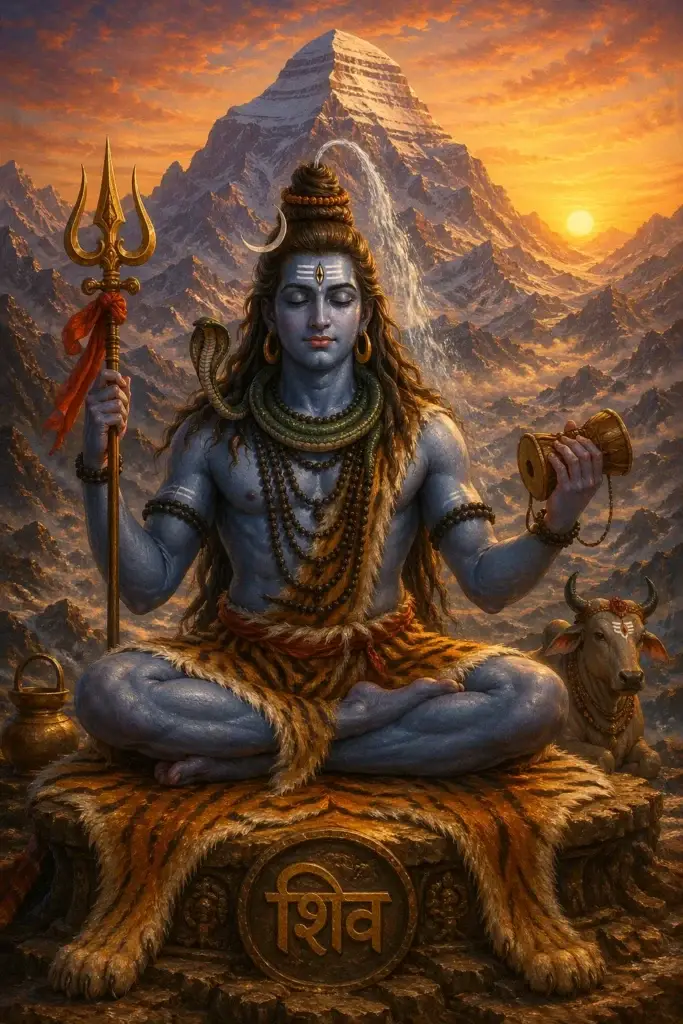
Shiva is depicted as a blue-throated god, often nude or clad in a tiger skin, his hair piled into a knot from which a crescent moon and the river Ganga flow down. His third eye, vertical on his forehead, becomes a weapon in anger.
The moon and the Ganga itself dwell in his hair. He carries a trident (Trishula), a small drum (Damaru) and serpents as ornament. The Lingam, an abstract, phallic form, is his primary object of veneration. The ash (Vibhuti) on his skin points to renunciation and cosmic destruction.
Character traits
Shiva represents the cosmic consciousness that destroys creatively in order to renew. His Nataraja dance is not cruel but necessary: without destruction, no rebirth. In meditation, yogis and ascetics identify themselves with Shiva; Om Namah Shivaya is the central mantra of Shaivism.
Shivaratri, the Night of Shiva, is celebrated each year with night-long vigils, festivities and the ritual handling of the Lingam. The lingas in temples such as Varanasi are centres of intense veneration and pilgrimage.
Profile: Shiva
The most important aspects of &Saacute;iva at a glance. The following fields summarise origin, function, appearance, veneration, symbols and cultural parallels.
In one tradition Shiva emerges from the uncreated Brahman itself, in another he is a son of Brahma’s creation.
He is the consort of Parvati, also in the aspects of Sati (his first wife), Durga (warrior) and Kali (raging destroyer). He is the father of the elephant-headed Ganesha and of the war god Skanda / Murugan / Kartikeya.
His abode is Mt. Kailash in the Himalaya. His mix of characters is unique in world mythology: at once ascetic (Mahâyogî, meditating across aeons) and ecstatic dancer (Nataraja); at once the wrathful destroying god (Bhairava aspect) and the gentle, compassionate family man (with Parvati and the sons).
Within the Trimurti concept Shiva is the destroyer, but destruction is understood as a necessary re-creation: at the end of every Mahâ-Yuga, Shiva destroys the universe through his cosmic dance (Tâṇḍava); from the ashes the next world arises. He is the patron of ascetics (Sannyasi, Sâdhus, Aghoris), of yogis and Tantrikas.
In the Bhakti tradition he is the addressee of personal love of God (with the Tamil Nâyanârs as the most famous Shaiva Bhakti poets).
In the Lingam cult he is worshipped as the formless energy aspect; the Lingam (together with the Yoni as its base) symbolises the uncreated creative energy. In Kashmir Shaivism he is the highest reality of consciousness (Paramâšiva).
Anthropomorphic as an ascetic male figure with blue-grey skin (in Tantric tradition: covered in ash, “white as the snow of Kailash”). A third eye sits on his forehead (the eye of higher perception, with which he burns Kama, the god of love).
A crescent moon rests in his matted hair (jata), which catches the stream of the Ganga (the Ganga-Avataraṇa myth). Serpents wind around his neck and serve as sacred ornament.
He carries the Trishula (trident) and the Damaru (hourglass-shaped drum whose sound creates the universe). He wears a tiger-skin loincloth. In his Nataraja form he appears as a cosmically dancing figure within a ring of fire (prabhâmaṇḍala): his left leg lifts, his right tramples the dwarf demon Apasmâra (ignorance).
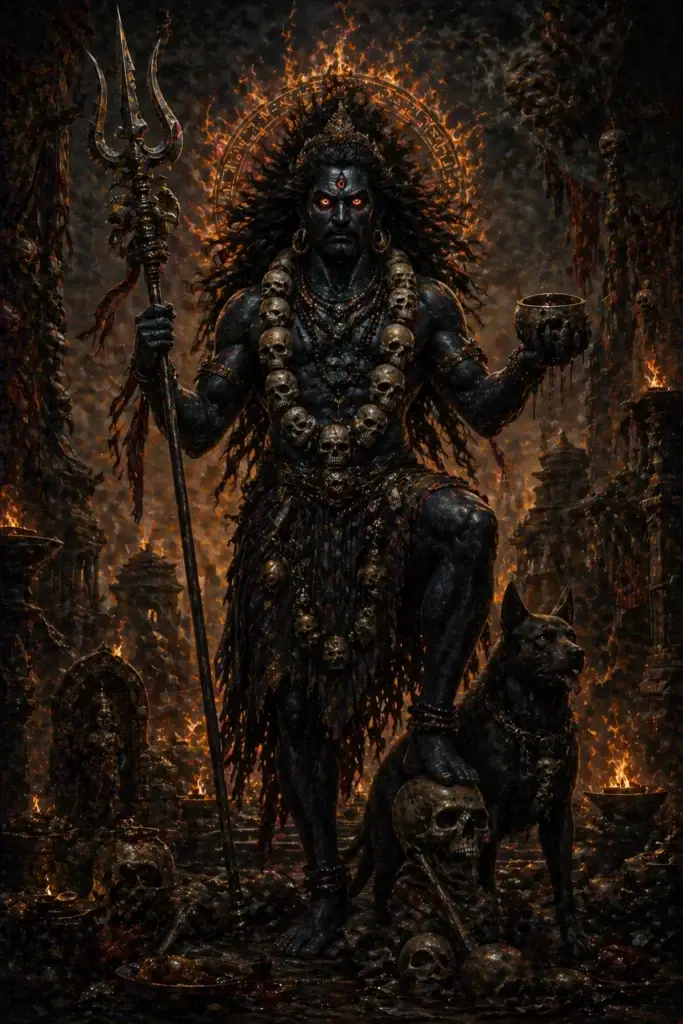
In Ardhanarishvara form he is androgynous, one half Shiva, the other Parvati. In Bhairava form he is wrathful with an ornament of skulls.
Sphere of action: Shiva is invoked daily by hundreds of millions of Hindus. Principal festivals: Maha-Shivaratri (the great night of Shiva in February or March, one of the largest Hindu festivals, observed with night-long vigils in temples and Lingam Abhiṣeka rituals), Kârttika Purṇimâ, Pradosha Vrata (a fortnightly fast on the thirteenth lunar day).
In Varanasi, dying is held to grant direct entry into mokṣa through the daily Shiva invocation whispered into the ear of the dying.
Tantric practices belong to the Aghori and Kâpâlika traditions (extreme asceticism, cremation-ground rites). Lingam veneration is central in every Shiva temple; the Lingam is bathed with water, milk, honey, coconut milk and ghee (Pañcâmṛta Abhiṣeka). In Chidambaram, the Dikṣitar Brahmins have been performing the same Nataraja ritual for more than a thousand years.
Trishula (trident), Damaru (hourglass drum), third eye, crescent moon in the matted hair, serpent necklace (especially Vasuki), tiger-skin loincloth, the Lingam (a formless energy symbol, the most important Shiva symbol of all), the Nandi bull (his mount, always present at the entrance of Shiva temples), vibhûti (sacred ash, applied in three stripes on the forehead) and the Rudrâkṣa prayer mala (seeds of the sacred tree).
Sacred plants: the Bilva tree (Aegle marmelos, whose leaves are considered especially dear to Shiva), Datura, the banyan tree. Sacred ash from cremation grounds.
Rudra (Vedic predecessor), Bhairava (wrathful aspect, with its own page), Mahakala (in Buddhism, a Vajrayana adaptation as a wrathful protective deity), Pashupati (“Lord of Animals”, a possible Indus Valley predecessor on prehistoric seals from Mohenjo-Daro), Dionysos (Greece, ecstatic and destructive aspect, with dance and a wine tradition), Hades-Plouton (Greece, the chthonic fertility-double aspect), Wotan-Odin (Germanic, the one-eyed yogi-king) and Cernunnos (Celtic, horned forest ascetic god).
Functionally, all destroying and renewing high deities, all ascetic-Tantric teacher gods, share aspects of Shiva.
Protective practice
Rituals of veneration
Alongside Vishnu, Shiva is a principal god of Hinduism (Trimurti). Daily veneration includes abhisheka (anointing the linga with milk, honey, yogurt, ghee and water, the panchamrita) and offerings of Bilva leaves at the linga.
Mahashivaratri (in the month of Phalguna, February or March) is his principal festival, observed with night vigil and fasting (see Doniger, Hindu Myths). His most important pilgrimage destination is Varanasi (Kashi Vishvanath); the twelve Jyotirlinga sanctuaries (Somnath, Mahakaleshwar, Kedarnath and others) shape regional devotional practice.
Mantras and invocations
The Mahamrityunjaya mantra (Rigveda 7.59.12), “Om Tryambakam Yajamahe”, is India’s most famous mantra of healing and protection. The Panchakshara mantra “Om Namah Shivaya” (Yajurveda) is recited in japa repetition 108 times with a Rudraksha mala. The Shiva Stuti from the Lingapurana is a liturgical standard.
Amulets and protective symbols
Rudraksha beads (seeds of the Eleocarpus fruit, “tears of Shiva”) strung on malas of 27, 54 or 108 beads. Vibhuti (sacred ash) is applied to the forehead as three horizontal stripes (tripundra). The Trishula (trident), the Damaru (hourglass drum) and the linga itself function as iconic apotropaia.
Shiva, parallels in other cultures
Further standard works in the literature index.
Shiva as Nataraja: the dance of the world
One of the best-known and theologically densest manifestations of Shiva is Nataraja (“Lord of Dance”), the king of the dance.
This form was developed in particular in South India and found its classical pictorial expression in the bronze art of the Chola dynasty between the 9th and 13th centuries. The Nataraja bronzes count among the most important works of Indian art history.
The depiction is a thoroughly composed theological image. Shiva dances inside a ring of flames that signifies the universe. Beneath his right foot he tramples a dwarf who embodies ignorance.
One of his hands holds a small drum whose beat marks the rhythm of creation. Another hand holds a flame, the sign of dissolution and destruction. A further hand displays the gesture of fearlessness, a fourth points to the raised foot, which promises liberation.
This single image gathers the five activities that Hindu theology ascribes to Shiva: creation, preservation, dissolution, concealment and liberation. The dance is therefore not mere movement but the expression of the ongoing cosmic process in which becoming and passing away are inseparably bound.
The art historian Ananda Coomaraswamy elaborated this reading at length in a much-noted essay of the early 20th century. The most important cult site of this manifestation is the great temple of Chidambaram in Tamil Nadu, regarded as the place where Shiva performed this dance.
The Lingam: Shiva's most important cult symbol
Unlike many other Hindu deities, Shiva is venerated in the temple cult predominantly not in human form but in the form of the Lingam, a mostly cylindrical, rounded stone.
The Lingam usually stands on a base called yoni. Tradition interprets this combination as the joint working of the masculine and feminine principles, of Shiva and the Goddess.
The interpretation of the Lingam has been the subject of much debate. Older Western scholarship understood it primarily as a phallic symbol. The Hindu tradition itself and part of more recent scholarship emphasise a further layer of meaning: in Sanskrit the word linga also means sign or mark.
The Lingam is, accordingly, the sign of Shiva, a deliberately non-figurative form that precisely through this non-figurality expresses what is boundless and beyond every shape in the deity.
A narrative of the Lingapurana reports that Shiva once appeared as an endless pillar of light whose beginning and end even Brahma and Vishnu could not find. The Lingam recalls this pillar without limits.
Lingams exist in numerous forms, from artfully crafted temple Lingams, through the natural, not human-made stones regarded as especially sacred, to the twelve Jyotirlinga, the light-Lingams distributed across India and counted as the most important Shiva sanctuaries.
In daily temple worship the Lingam is venerated with water, milk, leaves of the Bilva tree and other offerings. It is thus not an abstract symbol but the concrete centre of a living, everyday ritual practice.
The ascetic on Mount Kailash: Shiva's character traits
Shiva unites in his figure traits that at first sight seem irreconcilable. He is the great ascetic, Mahayogi, who rests motionless in meditation on Mount Kailash in the Himalaya, his body smeared with ash, his hair piled into matted locks.
At the same time he is a family father, married to the goddess Parvati and father of the sons Ganesha and Skanda. He is the lord of the wild animals and of the wilderness, wears a serpent as ornament and a tiger skin, yet also lives within his family.
This tension is not a contradiction in the tradition but belongs to the theological core of the figure. Shiva stands for the overcoming of ordinary opposites.
He is the one who drinks poison and yet does not die: in the story of the churning of the milk ocean, Shiva swallows the world-poison that threatens to destroy creation and holds it back in his throat, which turns blue from it. From this he receives the epithet Nilakantha, the Blue-Throated.
His firm attributes include the trident, the crescent-moon sign in his hair, the third eye on his forehead whose gaze can consume, and the sacred river Ganges, which according to tradition descends to the earth over his head, slowed by his hair so that the force of the water does not destroy the earth.
His mount is the bull Nandi. In this wealth of features Shiva appears as a deity that gathers the dangerous and the protective, the wild and the controlled, death and liberation into a single figure.
Shaivism: Shiva as ultimate reality
Within Hinduism there is a comprehensive religious current that venerates Shiva not as one deity among others but as the ultimate reality: Shaivism. This current is not a uniform entity but comprises numerous regionally and philosophically distinct schools that have developed over centuries.
One important school is Kashmir Shaivism, a philosophical tradition elaborated in northern India between the 9th and 11th centuries, whose most important thinker was Abhinavagupta. It understands all reality as the unfolding of the one consciousness, which is identified with Shiva.
Another important strand is Shaiva Siddhanta, especially widespread in South India, which developed its own doctrine concerning the relation of God, soul and world. Alongside these existed ascetic and at times socially separate groups, the earliest of which are already attested in the first centuries of our era.
An important movement within South Indian Shaivism were the Nayanars, a group of poet-saints of the early medieval period whose hymns in Tamil sing of Shiva in a tone of personal devotion. Their songs were collected and to this day belong to the liturgical repertoire of South Indian Shiva temples.
Shaivism shows that Shiva is not only a mythological figure but the subject of fully developed theology and philosophy. For his followers he is the ground and goal of everything, and the diversity of schools shows how differently this one conviction has been interpreted over the course of history.
The sources: from Vedic Rudra to the Puranic age
The figure of Shiva has a long prehistory that can be traced through the sources. In the oldest body of scripture, the Vedas, the name Shiva does not yet appear as a divine name in its later sense. The word shiva initially means favourable or gracious and appears as an adjective.
One Vedic deity, however, clearly bears traits that later become characteristic of Shiva: the god Rudra, a fearsome figure linked with storm, illness and the wilderness, whom one sought to render gracious through invocation. It is precisely in such propitiating invocations that Rudra was given the epithet shiva.
Out of this Vedic root, and presumably out of further, non-Vedic traditions as well, the classical Shiva figure developed over several centuries. An important intermediate stage is the Shvetashvatara Upanishad, in which Rudra-Shiva already appears as the ultimate deity.
The most detailed mythological narratives are then found in the epics, above all in the Mahabharata, and in the Puranas, an extensive body of literature that arose between the early and high medieval periods. Texts such as the Shivapurana and the Lingapurana bundle this mythological material.
Some scholars have further suggested that roots reaching back to the Indus culture lie behind the figure and have pointed to certain seal finds that show a seated figure surrounded by animals. This interpretation is, however, highly contested and cannot be proven.
What is certain is that the Shiva figure is the result of a long process in which older deities, regional traditions and theological reflection flowed together.
Anyone who wishes to understand Shiva historically must observe this stratification and should not without further ado project the fully developed figure of the Puranas back into the early period.
Further reading and links
Research literature
Frequently asked questions about Shiva
Who is the god Shiva in Hinduism?
Shiva is one of the three principal gods of Hinduism, alongside Brahma (the creator) and Vishnu (the preserver). Shiva is the destroyer, but in Hindu understanding destruction is necessary for renewal: he dissolves the universe at the end of a world age so that it can be created anew.
Shiva’s main attributes are the trident (Trishul), the drum (Damaru), the third eye (the eye of knowledge), the serpent around his neck (Vasuki) and the crescent moon in his hair. He meditates on Mount Kailash.
What is the dance of Shiva (Nataraja)?
Shiva Nataraja (“Lord of Dance”) is one of the most important forms of Shiva: the cosmic dancer who in his Tandava dance creates, preserves and destroys the universe at the same time.
The famous bronze sculptures from the Chola period (10th to 12th century) show him four-armed within a ring of flames, dancing upon the dwarf Apasmara (ignorance). Every gesture has meaning: the raised foot is liberation, the dwarf pressed down is ignorance overcome. The dance is an emblem of the cosmic rhythm.