Isis, goddess of the Egyptian tradition
By Ralf Ittermann · last reviewed on
Isis is a goddess of the Egyptian tradition.
Goddess of magic, motherhood, healing and resurrection. Isis is the sorceress who reassembles her dismembered husband Osiris and raises his child Horus in secret.
With crown or forehead emblem, with wings and feminine power, she is nurturing as much as magically active, not only a mother but an agent. Her cult outlasted Egyptian civilisation and spread as far as Rome, where she was still venerated in Late Antiquity.
At a glance: Isis
Type: Major Egyptian deity, goddess of motherhood, magic and the protection of the dead
Pantheon: Egypt, later Mediterranean-wide (Hellenistic and Roman)
Function: motherhood, magical healing, protection of the dead, resurrection
Principal attributes: throne hieroglyph on the head, sun disc with cow horns, knot amulet (Tit)
Principal cult sites: Philae (island in the Nile), Behbeit el-Hagar, Pompeii, Rome
Greek identification: Isis (taken over unchanged)
Context
Period of the texts
Isis is attested from the 5th Dynasty onward (ca. 2400 BCE), appearing in the Pyramid Texts as the sister and wife of Osiris. Her importance grows steadily; in the Middle and New Kingdoms she becomes the most important goddess of Egypt.
In the Hellenistic period (from the 3rd century BCE) the cult of Isis spreads across the entire Mediterranean; in Roman times Isis is one of the most popular deities of the empire, with temples from Britain to Mesopotamia. The last temple of Isis at Philae was closed only in 537 CE under Justinian.
Geographic range
Principal Egyptian cult sites: Philae (island at the First Cataract, her most famous temple), Behbeit el-Hagar (Delta, large Ptolemaic temple), Abydos (connection to the cult of Osiris). Outside Egypt: Pompeii, Rome (Iseum Campense), Delos (Hellenistic diaspora). With Christian Late Antiquity the cult gradually faded.
Source situation
Central sources: the Pyramid Texts (spells 532, 670), the Tale of Isis and Re (myth of magic), Plutarch’s treatise De Iside et Osiride (the most extensive Greco-Roman source), the novel Metamorphoses by Apuleius (Book XI: initiation into the Mysteries of Isis), and the inscriptions of the temple of Philae.
Secondary literature: Witt, Isis in the Greco-Roman World; Münster, Untersuchungen zur Göttin Isis; Bonnet, Reallexikon.
Name and variants
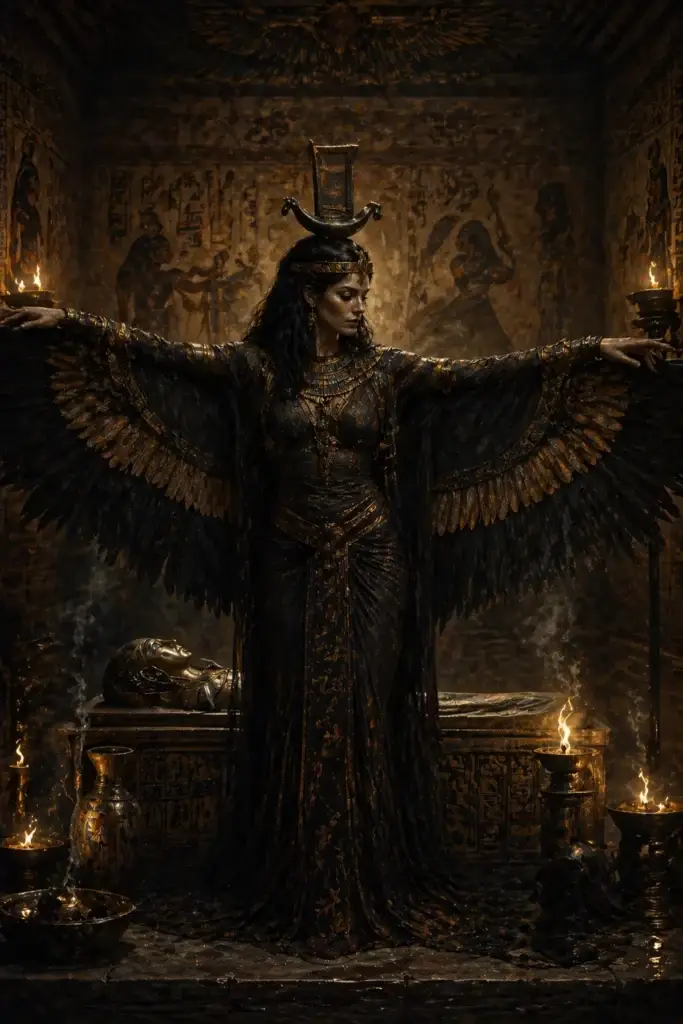
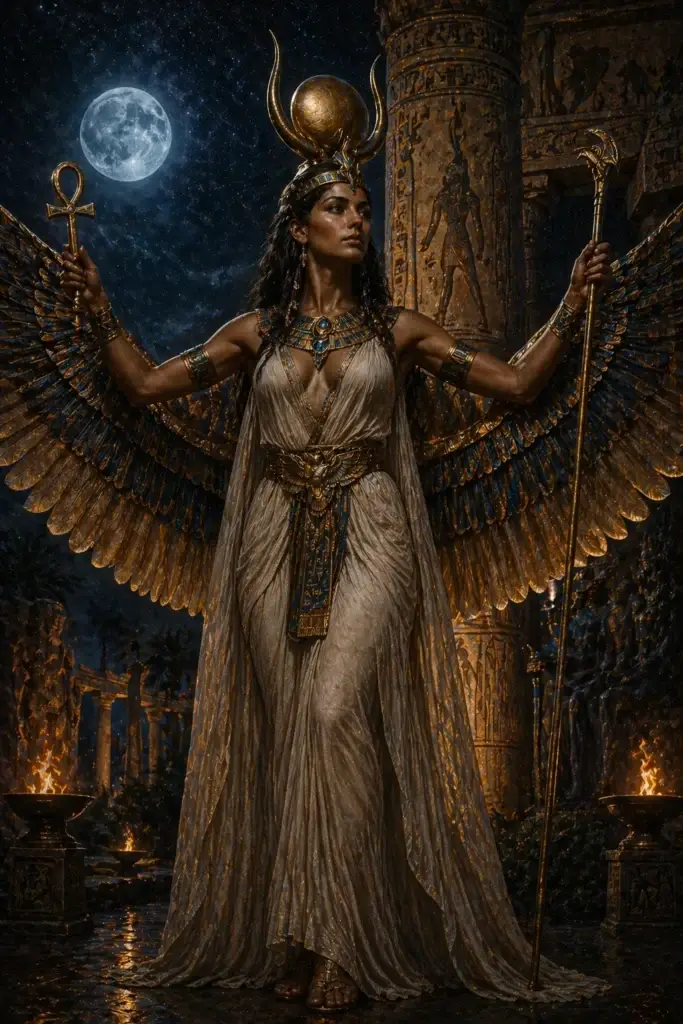
Isis is depicted with a throne crown on her brow (the hieroglyphic sign for throne) or as a seated female figure with horns and sun disc. She often bears large falcon wings, not as a bird but as a protective force.
The Ankh (cross with a loop), the symbol of vital force, rests in her hand. The uraeus (serpent) adorns her brow. In papyri she is shown with curled hair and Egyptian dress, sometimes with Osiris or with Horus at her breast.
Characteristics
Isis is the sorceress of restoration. After Seth murders Osiris, Isis gathers her husband’s limbs, conjures him back into life and conceives from him the child Horus. Her magic (Heka) is not malign but life-sustaining.
In the temple of Philae she was invoked daily in rites; priestesses sang hymns to her, and the faithful brought offerings. She was the patroness of women, mothers and midwives. In the Ptolemaic and Roman periods, mystery rites in honour of Isis were celebrated, comparable to the Eleusinian Mysteries.
Appearance and symbolism
Isis is most often depicted as a woman crowned with the diadem of the throne hieroglyph (her name literally means “throne”). In her hand she holds the Ankh cross, the symbol of eternal life. At her side, falcon wings are often shown, which she spreads, trembling, around the dying Osiris.
The sistrum is her sacred instrument. Her colour is deep blue or gold. She is also depicted as a black cow or as a falcon with a woman’s face, in her psychopompic role as a guide of souls.
Profile: Isis
The most important aspects of Isis at a glance. The following fields summarise origin, function, appearance, veneration, symbols and parallels.
Isis is the daughter of Geb (earth god) and Nut (sky goddess), sister and wife of Osiris, sister of Seth and Nephthys, mother of Horus.
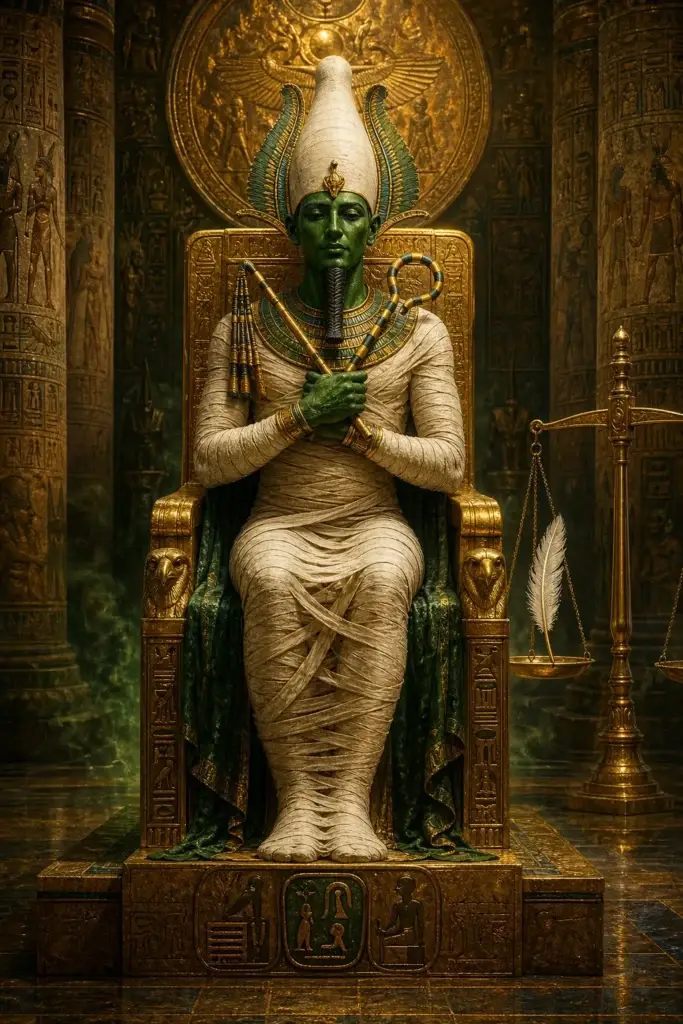
In the myth of Osiris she reconstructs the body of her husband, dismembered by Seth; through her magic, Osiris becomes the first deceased to enter the afterworld and rule there.
Mother, widow, sorceress, patroness of the dead and healer. Mysteries of resurrection around her and Osiris formed a central element of the Hellenistic-Roman cult of Isis; initiates experienced death and rebirth symbolically.
For women she was patroness in every phase of life. As goddess of healing, healing texts have been attributed to her since the Late Period (Isis magic on the so-called healing stelae).
Anthropomorphic, as a woman with the throne hieroglyph (her name Aset means “throne”) on her head, or with cow horns and sun disc (the Hathor crown, which she adopted in later times).
Frequently seated with the Horus child on her lap, an iconography that is compared with the early Christian image of Mary with the child, without a direct connection being provable. In the Hellenistic world she is often shown in Greek dress, with sistrum and situla (ritual bucket).
Sphere of influence: Isis was the goddess to whom people of every social rank and gender turned, in Roman times especially women, slaves and freedmen. The Mysteries of Isis (initiatory cult) promised protection in this life and a happy lot in the next.
Temples were typically governed by morning, noon and closing rites; priests shaved their bodies and wore white linen. Apuleius describes the Isis experience as the central spiritual turning point of his life.
Throne hieroglyph (on the head), Tit knot (Isis knot, protective amulet), sistrum, situla (ritual water vessel), sun disc with cow horns, outspread winged arms (protectress of the dead), lotus. In the Late Period: the star Sothis (Sirius). Plant: the persea tree.
Hathor (Egypt, late fusion), Demeter (Greece, mother and mediator of mysteries), Aphrodite (love and motherhood), Inanna/Ishtar (Mesopotamia, goddess of power), Astarte (Phoenicia), Mary (Christian tradition, iconographically compared with the Isis lactans type, without a provable direct connection). In a wider comparison: Lakshmi (Hinduism), Kuan-Yin (Buddhism, goddess of compassion).
Practical means of protection
Veneration in everyday life
Rituals and invocations
The festival of Navigium Isidis opened the sailing season. Apuleius describes the initiation into the Mysteries of Isis in the eleventh book of his Metamorphoses; rites of incubation (healing sleep) are also attested in her sanctuaries.
Conjurations and invocations
Textual transmission and formulas
The Pyramid Texts, the Isis-Osiris myth in Plutarch’s treatise De Iside et Osiride, the tale of Isis and the secret name of Re, and the Greco-Roman Isis aretalogies all transmit her figure.
Amulets and protective symbols
Material apotropaia and archaeological evidence
The Tit knot, the so-called “blood of Isis” amulet of red stone, figurines of the nursing Isis (Isis lactans) and Isis amulets were widespread throughout the Roman Mediterranean.
Isis, parallels in other cultures
Isis resembles Demeter (mother, mourning, resurrection), Hera (queen and consort) and Aphrodite (sexual power). Her motif of resurrection appears in numerous cultures: Persephone (Greece), Inanna (Mesopotamia).
The figure of the sorceress mother is universal; Isis embodies it with particular ritual and literary elaboration. Her iconography is compared with Coptic and Christian Marian iconography, without a direct connection being provable.
Isis in the myth of Osiris
The central narrative around Isis is the myth of Osiris. Her brother and husband Osiris is murdered by his brother Seth; in some versions he is enclosed in a coffin and cast into the Nile, in others cut into pieces and scattered across the land.
Isis wanders the land, gathers the parts of the body and reassembles the body of Osiris. With the help of her magical abilities she revives him just far enough to conceive from him their son Horus.
A continuous, self-contained narrative of this myth has not come down to us from Egyptian sources themselves. We know it above all from numerous allusions in Pyramid Texts, Coffin Texts, hymns and ritual texts, as well as from a detailed but Greek-language, interpretively reworked version by Plutarch in his treatise On Isis and Osiris.
Egyptology therefore has to reconstruct the myth from many fragments, taking into account that the individual sources come from very different periods.
In the myth Isis embodies several interconnected roles: the loyal wife mourning the dead, the powerful sorceress who restores life, and the mother who raises and protects the heir. This combination of mourning, magical efficacy and motherhood constitutes her distinctive position.
The myth also served royal ideology, for the deceased king was identified with Osiris and the living king with Horus, so that Isis was at once the mother of the reigning pharaoh.
The powerful sorceress
The Egyptians regarded Isis as the most effective deity in matters of magic. Her Egyptian name Aset is connected with the word for throne, but her significance is not exhausted by this connection.
In numerous texts she appears as the goddess who knows healing and protective spells, who banishes diseases and wards off dangerous animals.
A well-known text recounts how Isis, by means of a ruse, gains power over the sun god Re. She fashions a venomous serpent from his spittle and from earth; the serpent bites Re. Since only Isis can banish the venom, she compels the suffering sun god to reveal his secret, true name to her, for knowledge of the name confers power over its bearer.
This narrative illustrates the Egyptian conception of the power of knowledge and of the word, and presents Isis as the superior mistress of this art.
In everyday life this had practical consequences. Numerous protective spells for mother and child invoked Isis, because in the myth she had preserved the Horus child in the marshes of the Nile delta from serpents, scorpions and the pursuit of Seth.
On the so-called Horus stelae, or Horus cippi, small stone plaques bearing images and spells, water was poured over the depiction and then drunk for its healing power. Religious studies see in Isis an example of how closely myth, medicine and protective practice were intertwined in Egypt.
The spread of the Isis cult across the Mediterranean
In Hellenistic and Roman times Isis became a deity of significance far beyond Egypt. Starting from Egypt, and especially from Alexandria, her cult spread across the entire Mediterranean.
Merchants, soldiers and travellers carried it further; sanctuaries of Isis are attested on the island of Delos, in Pompeii, in Rome itself and as far as Britain and the Rhine.
This Isis cult was not a simple export of ancient Egyptian religion but a reshaping. Isis took on features of Greek goddesses and became a deity who appeared responsible for many spheres of life: for seafaring, for fate, for fertility, and for the hope of a good lot after death.
Mystery initiations developed: rites of initiation that promised the initiate a special closeness to the goddess and a prospect of salvation. The Roman author Apuleius gave an impressive, though literarily shaped, account of such an initiation into the Mysteries of Isis in the eleventh book of his novel The Golden Ass.
The Roman authorities at times regarded the cult with suspicion and several times in the late Republic moved against the sanctuaries of Isis in Rome. Under the empire, however, the cult established itself and at times enjoyed imperial patronage. Only with the rise of Christianity did it lose ground, dying out in Late Antiquity.
Scholarship has long debated the degree to which the veneration of Isis, in particular the image of the enthroned goddess with the child, influenced the Christian depiction of Mary. Caution is in order here: there are points of contact in the visual language, but a direct, straightforward line of derivation cannot be demonstrated.
Iconography and temples
In Egyptian art, Isis is recognisable by certain features. She frequently wears on her head the hieroglyphic sign for throne, which writes her name. In later times, especially when she merges closely with the goddess Hathor, she appears with the cow horns and the sun disc.
A widespread image type shows her seated, nursing the Horus child on her lap; this type, often called Isis lactans in scholarship, was especially widespread in Greco-Roman times.
A symbol of her own is the so-called Isis knot, Egyptian tit, a loop-like sign worn as a protective amulet and often appearing together with the Djed pillar of Osiris. Mourning depictions of Isis, frequently with outspread winged arms, also protect the deceased in tombs and on coffins.
The most important surviving temple of Isis stands on the island of Philae in southern Egypt.
It was extended over several centuries, especially in Ptolemaic and Roman times, and remained one of the last active sanctuaries of ancient Egyptian religion; the cult there was officially terminated only in the 6th century CE. Because of the construction of the Aswan dams, the entire temple complex was dismantled in the 20th century in a major international effort and reassembled on a neighbouring, higher-lying island.
Philae illustrates vividly how far the veneration of Isis reached, from the early Pyramid Texts to almost a thousand years after the end of pharaonic Egypt.
Further links
Scholarly literature
Further standard works in the literature index.
Frequently asked questions about Isis
Who was the goddess Isis in Egypt?
Isis (Egyptian Aset, “she of the throne”) is the central goddess of the Egyptian pantheon, wife and sister of Osiris, mother of Horus, embodiment of magical power (Heka). In the myth of Osiris she gathers the dismembered limbs of her husband and revives him through magical knowledge.
She protects her son Horus by transforming into a vulture and raises him in hiding in the reed thickets of Chemmis. Isis is regarded as the goddess of maternal love, of magic, of seafaring and of reversals of fate.
How did the cult of Isis spread into the Roman Empire?
The cult of Isis was one of the most important oriental cults in the Hellenistic-Roman world. Its Hellenisation began in Alexandria as early as the 4th century BCE.
In the 1st century BCE it reached Rome, despite repeated bans by the Senate (it was felt to be too foreign and too popular among women and slaves).
Under the emperor Caligula, Isis was officially recognised. The cult spread from Britain to Mesopotamia. Apuleius (Metamorphoses, Book 11, 2nd century) describes an Isis initiation in striking detail. Only the Christian turn from 391 CE onward brought the cult of Isis to an end.