Bonbibi, protective mistress in the land of eighteen tides
By Ralf Ittermann · last reviewed on
Bonbibi is a goddess of Bengali folk tradition.
Protective mistress of the honey collectors against the tiger demon Dokkhin Rai.
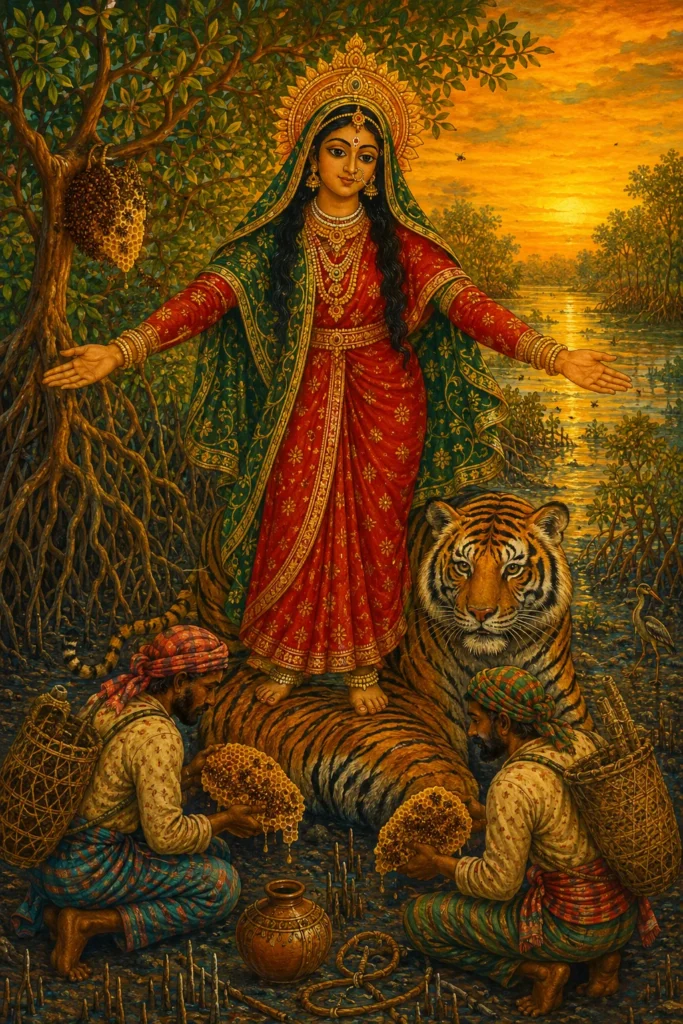
Bonbibi is the protective goddess of the forest in the Sundarbans, worshipped jointly by Hindus and Muslims alike. She protects honey collectors and woodcutters from the demon king Dokkhin Rai, who appears as a tiger, and is one of the most vibrant forest-protection deities of South Asia.
Her cult combines folk Islam and Hindu piety: according to the myth, Bonbibi is the daughter of a fakir from Mecca, sent by Allah to the land of the eighteen tides, and is depicted at once with crown, garland and her mount, the tiger. The core text is the Bonbibir Johuranama.
Type: Forest and protective goddess, worshipped jointly by Hindus and Muslims
Origin: Sundarbans in West Bengal and Bangladesh
Texts: Bonbibir Johuranama
Period: folk-Islamic and Hindu cult, alive to this day
Appearance: forest-born goddess raised by a doe, never depicted alone
Area of origin and sources
Period of the Texts
The cult is shaped by folk Islam and Hinduism and remains alive to this day; its core text is the Bonbibir Johuranama, the Bengali primary text of the tradition.
Area of Diffusion
The Sundarbans, the tidal and mangrove forest in West Bengal and Bangladesh, the land of the eighteen tides of the myth.
Sources
The source material is good: alongside the Johuranama, studies such as those by Sufia Uddin and Annu Jalais document the living cult.
Name and variants
Bengali: The name combines ban, forest, and the Persian bibi, lady or mistress: the mistress of the forest. Unlike the classical Hindu forest goddess Bandevi, Bonbibi is shaped by folk Islam and is never worshipped alone.
Being and effect
Appearance
The early veneration was aniconic at earthen mounds. Later images mix Hindu and Islamic elements: Hindu-influenced with crown, garland, mace and trident and her mount the tiger, Muslim-influenced with braided hair, cap and trousers. She is always depicted in a group, among others with her brother Shah Jangali and the tiger demon Dokkhin Rai.
Effect
Bonbibi saves forest users from tiger attacks; her renown grows after disasters. The central narrative core is the Dukhe episode, in which the poor shepherd boy Dukhe is saved by invoking Bonbibi from Dokkhin Rai, disguised as a tiger.
Profile: Bonbibi
The key aspects of the protective goddess at a glance.
Protective goddess of the Sundarbans, venerated jointly by Hindus and Muslims; a model case of syncretism and shared sacred space.
Honey collectors and woodcutters before entering the forest: those who enter the mangroves first invoke Bonbibi.
Never alone: always in a group with her brother Shah Jangali and Dokkhin Rai, in mixed Hindu-Islamic attire, often riding the tiger.
Protection from tiger attacks, embodied by the demon king Dokkhin Rai, from whom she extracted the promise to spare her devotees.
Bonbibi puja before entering the forest, public rites on the first day of the month of Magh with molasses sweets and recitation of the Johuranama.
Within India, the Vedic Aranyani, the Vanadevata and the Vanadurga; functionally a forest and tiger protection goddess without an exact equivalent.
The fakir's daughter and the tiger demon
According to myth, Bonbibi is the daughter of a fakir from Mecca, sent with her brother Shah Jangali by Allah to the land of the eighteen tides. There she defeats the mother of the tiger demon Dokkhin Rai, but spares him and extracts from him the promise not to harm anyone who venerates her. The core text of this tradition is the Bonbibir Johuranama.
The name itself tells of her dual origin: ban, forest, combines with the Persian bibi, lady or mistress. Unlike the classical Hindu forest goddess Bandevi, Bonbibi is shaped by folk Islam and is never venerated alone; her cult belongs to Hindus and Muslims together.
A living cult and its interpretation
The Bonbibi cult is alive today and a model case of Hindu-Muslim syncretism and shared sacred space. It has been taken up in literature by Amitav Ghosh, among others in The Hungry Tide and Jungle Nama.
From a religious-studies perspective, Bonbibi combines folk Islam, tree and forest cult, and the ambivalence of nature spirits, in which the tiger marks the boundary between inhabited and wild space. She is an outstanding example of joint veneration by Hindus and Muslims; the danger does not come from her but from her adversary Dokkhin Rai.
Puja, mantras and red flags
Well documented is the Bonbibi puja before honey collectors and woodcutters enter the forest. Public rites outside the forest, especially on the first day of the month of Magh, with offerings such as molasses sweets and the recitation of the Johuranama, belong to it, as do private rites in the forest performed by specialists with protective mantras, amulets and red flags at the forest boundaries.
Forest goddesses compared
As a protective forest goddess, Bonbibi is related to the Vedic Aranyani, the tree deities called Vanadevata, and the Vanadurga; the ambivalent Yakshas also belong in this neighbourhood of Indian forest and tree beings. Functionally she remains a syncretistic forest and tiger protection goddess without an exact equivalent.
Frequently asked questions about Bonbibi
Who venerates Bonbibi?
Hindus and Muslims of the Sundarbans together, particularly honey collectors and woodcutters before entering the forest.
What does she protect from?
From tiger attacks, embodied by the demon king Dokkhin Rai, from whom she extracted the promise to spare her devotees.
Is she depicted alone?
No, always in a group, among others with her brother Shah Jangali and Dokkhin Rai.
Further links
Further reading:
- Aranyani, Vanadevata, Yaksha – related forest and tree beings of India
- Aleya – the will-o’-the-wisp of the Bengal marshes
- Amulet, Smoke cleansing, Mugwort – traditional protective means
- Protection Compass – protective means at a glance
Literature (selection)
Further standard works in the bibliography.
As a forest goddess, Bonbibi is venerated across the Sundarbans jointly by Hindus and Muslims and stands as a protective goddess by honey collectors and woodcutters alike: a living mistress of the tidal forest, whose cult bridges the boundary of religions.