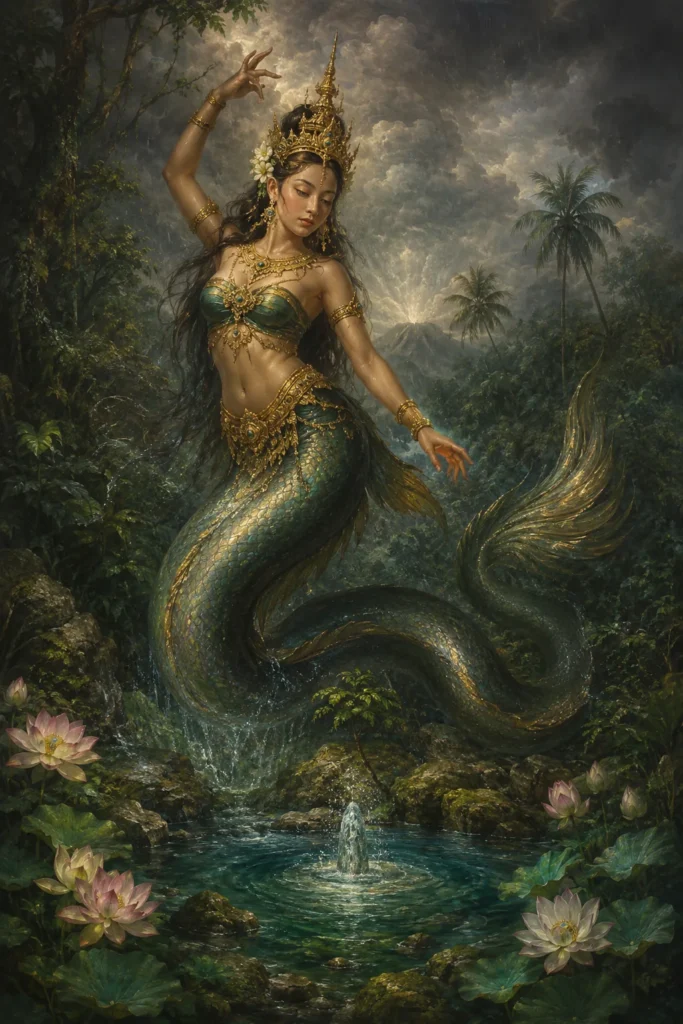
Diwata, the luminous guardians of forest and mountain
By Ralf Ittermann · last reviewed on
The Diwata are deities of Philippine tradition.
Guardians of nature in the Balete tree, blessing and punishing alike. The profile presents the Diwata as luminous guardians who bless or punish those who disturb the sacred Balete tree.
Diwata are the benevolent nature and forest deities of the Philippines who watch over forest, mountains and nature. They live in large trees such as the Balete, granting a good harvest and health when honoured, and sending illness and misfortune when disregarded.
The name goes back to the Sanskrit word devata, meaning deity, and reached the Malay archipelago via Indian trade routes. The idea is most widespread in the central and southern Philippines, on the Visayas and on Mindanao; in the north, on Luzon, the term anito tends to be used instead.
Type: nature and forest deities, fairy- and nymph-like nature spirits
Origin: pre-Spanish animistic tradition of the Philippines
Texts: colonial and modern ethnographic sources, documented by Ramos
Period: pre-Spanish to the present
Appearance: beautiful and radiant, often as a glowing female figure

Origin and sources
Period of the Texts
The Diwata belong to the pre-Spanish animistic tradition; belief in them is attested in colonial and modern ethnographic sources.
Area of Diffusion
The central and southern Philippines, above all the Visayas and Mindanao. In the north, on Luzon, the term anito tends to be used in their place.
Sources
Well documented, above all through the standard works of Maximo D. Ramos; the dating varies between editions, with the material going back to a dissertation from the 1960s.
Name and variants
Sanskrit: diwata derives from devata, meaning deity, and reached the Malay archipelago via Indian trade routes; the word is related to the Hindu-Buddhist devata beings. On Luzon in the north, the term anito tends to be used instead.
Nature and effect
Appearance
The Diwata appear as fairy- and nymph-like nature spirits or lesser deities, often beautiful and radiant. They are closely linked to the Balete tree, the strangler fig, regarded as a threshold to the spirit world; light, beauty and the fertility of nature form their symbolism.
Effect
The Diwata watch over forest, mountains and fields and can be invoked ritually for harvest, healing and prosperity. Whoever neglects or harms forest and mountain brings punishment such as illness or misfortune upon themselves; the Diwata are ambivalent, between blessing and curse. In effect, they form an ecologically effective code of respect.
Profile: Diwata
The key aspects of the nature deities at a glance.
Deities of the animistic Philippine worldview, in which places in nature are ensouled, with a layer of Indian religious terminology.
Forest, mountains and fields; those addressed are farmers, travellers and all people who make use of nature and land.
Fairy- and nymph-like, beautiful and radiant; modern popular culture likes to depict the Diwata as a beautiful nature goddess.
Protective and guardian spirits of nature: they grant a good harvest and health when honoured, and send illness and misfortune when disregarded.
The formula tabi tabi po at the Balete tree, offerings and ritual invocation, in some traditions linked to the ritual Pagdiwata.
The Hindu-Buddhist devata as a direct predecessor, alongside the European fairies and nymphs such as the Dryad.
From Sanskrit devata to ensouled forest
The name Diwata derives from the Sanskrit devata, meaning deity, and travelled via Indian trade routes to the Malay archipelago; it is related to the Hindu-Buddhist devata beings. In substance, however, the Diwata belong to the animistic Philippine worldview, in which places in nature are ensouled: they are protective and guardian spirits of nature over which a layer of Indian religious terminology has settled.
Their preferred dwelling is large trees such as the Balete, the strangler fig, regarded as a threshold to the spirit world. Whoever honours the Diwata may hope for a good harvest and health; whoever damages their trees and mountains can expect illness and misfortune. In the north of the archipelago, on Luzon, the same layer of beings tends to be captured by the term anito instead.
From folk tradition to fantasy
The Diwata are a fixed feature of the modern reception of Philippine folklore, of fantasy and of popular culture, where they are often portrayed as a beautiful nature goddess.
From a religious-studies perspective, the Diwata are forest deities and nature-guardian deities with an Indian origin of name upon an animistic substrate. Two clarifications belong here: only the layer of the name is Indian, the worldview behind it is local animism; and the Diwata are not merely lovely, but ambivalent, fundamentally benevolent or neutral, yet punishing when disregarded.
Tabi tabi po: respect at the Balete tree
Well attested in sources is the formula tabi tabi po, meaning roughly with your permission, which is said before disturbing the ground or the plants around a Balete tree. Added to this are offerings and ritual invocation, in some traditions linked to a ritual called Pagdiwata. Trees and places of the Diwata remain untouched; the cult is thus less a means of defence than a regulated respect for ensouled nature.
Devata, fairies and dryads compared
The Diwata correspond to the European fairies and nymphs; among the Greek tree nymphs, the Dryad is the closest counterpart. A direct predecessor are the Hindu-Buddhist devata, from whom the name derives. The best-known Diwata of the Philippines is considered to be the mountain lady Maria Makiling; from the same forest tradition come the tree giant Kapre and the horse-headed Tikbalang, and conceptually related are also the place spirits Neak Ta of Cambodia.
Frequently asked questions about the Diwata
Is a Diwata good or evil?
Fundamentally benevolent or neutral. When forest, mountain or their trees are disregarded, however, they become punishing and send illness or misfortune.
Where does the name come from?
From the Sanskrit devata, meaning deity; it reached the Malay archipelago through Indian trade influences.
Where do the Diwata live?
In large trees such as the Balete, in mountains and forests; the Balete is regarded as a threshold to the spirit world.
Further links
Further reading:
- Maria Makiling – the best-known Diwata of the Philippines
- Kapre, Tikbalang – forest beings from the same tradition
- Neak Ta – related place spirits of Cambodia
- Smoke cleansing, Amulet, Mugwort – traditional protective and cult items
- Protection Compass – an overview of protective means
Literature (selection)
Further standard works in the bibliography.
Whether in the singular or the collective: the Diwata remains the Philippine nature goddess par excellence. As a forest deity bound to Balete trees, mountains and fields, she rewards respect with blessing and makes the protection of nature a religious duty.