Ong Dia, the smiling guardian of house and ground
By Ralf Ittermann · last reviewed on
Ong Dia is a god of Vietnamese tradition.
The smiling earth god who watches over house and plot. Villagers saw Ong Dia as a smiling guardian watching over house and ground alike.
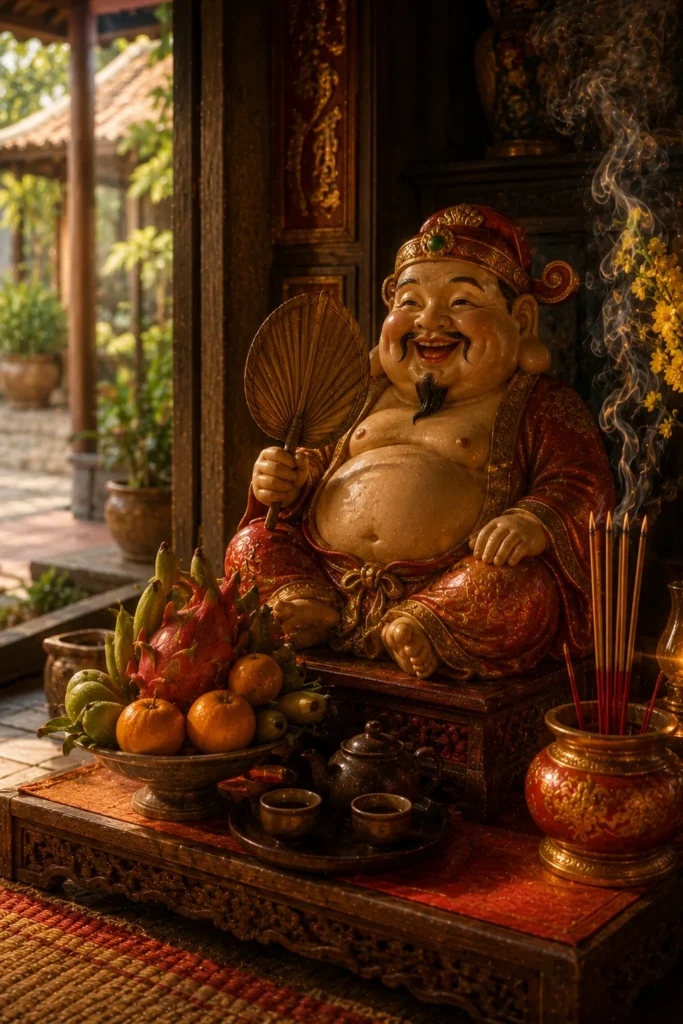
Ong Dia is the Vietnamese earth and house god, the protective lord of plot and house. As a stout, broadly smiling man with a palm-leaf fan, he preserves peace and protection and, together with the god of wealth Than Tai, brings prosperity and business fortune.
His cult is shaped by the Chinese Tudigong earth god cult and interwoven with Taoism, Confucianism and ancestor worship. He is venerated at a floor-level altar near the entrance door, in Vietnam as well as in the diaspora.
Type: earth and house god, protective lord of plot and house
Origin: Vietnamese folk religion with Sino-Vietnamese roots
Texts: Cadière, Toan Ánh, research on the kitchen god complex
Period: lived folk religion into the present
Appearance: stout, smiling man with a palm-leaf fan
Context of tradition
Period of the Texts
The cult belongs to Vietnamese folk religion; it is shaped by the Chinese Tudigong earth god cult and interwoven with Taoism, Confucianism and ancestor worship.
Area of Diffusion
Vietnam and the Vietnamese diaspora: floor altars for Ong Dia are found in shops, restaurants and households.
Sources
Well documented: the classic studies by Léopold Cadière and Toan Ánh, as well as more recent research on the Vietnamese kitchen god complex.
Name and variants
Vietnamese: The name combines ong, lord or grandfather, with Dia, Sino-Vietnamese for earth. Related terms are Tho Dia, earth god, and Tho Cong, earth lord, which largely refer to the same local deity.
Appearance
Appearance
Ong Dia is typically depicted as a fat, bare-bellied man with a broad smile, often holding a palm-leaf fan. He is clearly distinct from the wealth god Than Tai, who appears clothed, white-bearded, and carrying gold bars.
Effect
Ong Dia is an earth god and protective lord of land and house: he preserves peace and protection, and together with Than Tai brings prosperity and business fortune.
Profile: Ong Dia
The key aspects of the earth god at a glance.
Sino-Vietnamese syncretism: emerged from the Chinese Tudigong cult and interwoven with Taoism, Confucianism and ancestor worship.
Land and house: Ong Dia preserves peace and protection and brings prosperity and business fortune, especially in shops and restaurants.
A fat, bare-bellied man with a broad smile and a palm-leaf fan; not to be confused with the clothed, white-bearded Than Tai carrying gold bars.
Protective lord of the land and bringer of prosperity, very often venerated together with the wealth god Than Tai at a double altar.
A low altar near the entrance door; daily offerings are incense, water, fruit, tea and occasionally cigarettes.
The Chinese Tudigong as origin, the Thai Phra Phum with his spirit house, the Roman genius loci, and the kitchen god complex Tao Quan.
Sino-Vietnamese roots of a household god
The cult is shaped by the Chinese Tudigong earth-god cult and interwoven with Taoism, Confucianism and ancestor worship; its roots are Sino-Vietnamese, not purely Vietnamese. This entanglement also explains the conceptual blurriness: Tho Cong, Tho Dia and the kitchen god complex overlap and are defined differently depending on the region.
Ground altar, lion dance and diaspora
Ground altars for Ong Dia are found in Vietnamese shops, restaurants and households, both in Vietnam and in the diaspora. The masked fat, smiling man with a fan who leads the lion in the lion dance is the same Ong Dia, his most popular manifestation.
In religious studies terms, Ong Dia is a benevolent earth and household god. Three clarifications: the cult is a syncretism of indigenous animism and Chinese folk religion, not purely Vietnamese. The terms Tho Cong, Tho Dia and the kitchen god complex overlap and are defined differently depending on the region. And the exact placement of Tho Cong within the kitchen god trio is not resolved uniformly in the literature.
The altar on the ground and its offerings
Ong Dia is venerated at a low altar near the entrance door, not high up like the ancestor altar, very often together with Than Tai, especially in shops and restaurants. Daily offerings are incense, water, fruit, tea and occasionally cigarettes. The 10th day of the first lunar month, Via Than Tai, is the great day of the double altar, when many people buy gold.
Earth gods from China to Rome
Related figures are the Chinese Tudigong, from whom the cult originated, the Thai Phra Phum with his spirit house San Phra Phum, and the Roman genius loci. Within Vietnam, Ong Dia stands alongside the kitchen god complex Tao Quan, with which his name Tho Cong partly overlaps; the kitchen god motif is covered on the page about the Chinese Zao Jun.
Frequently asked questions about Ong Dia
What is Ong Dia?
The Vietnamese earth and household god, protective lord of land and house. Together with the wealth god Than Tai, he brings prosperity and business fortune.
Where does his altar stand?
At a low altar near the entrance door, not high up like the ancestor altar, often together with Than Tai.
Why does he lead the lion dance?
The masked, smiling man with a fan in the lion dance is Ong Dia, his most popular manifestation in living culture.
Further links
Further reading:
- San Phra Phum – the Thai spirit house
- Nang Kwak – Thailand’s beckoning bringer of fortune
- Zao Jun – the kitchen god of the Chinese cultural sphere
- Incense burning, amulet, salt – traditional protective means
- Protection Compass – protective means at a glance
Literature (selection)
Further standard works in the bibliography.
As both Vietnamese earth god and household god, Ong Dia shows how closely protection and prosperity sit together in Vietnamese daily life: down on the ground, near the door, with a broad smile.