Kel Essuf, the people of the void
By Ralf Ittermann · last reviewed on
The Kel Essuf are spirits of Tuareg tradition.
The spirits of the wilderness that attack as illness. The profile locates the Kel Essuf in the wasteland of Tuareg tradition as a cause of illness.
Kel Essuf are the spirits of wilderness and solitude in Tuareg folk belief, literally the people of the void. They attack humans as illness; someone who is possessed is idiomatically said to be found in the void.
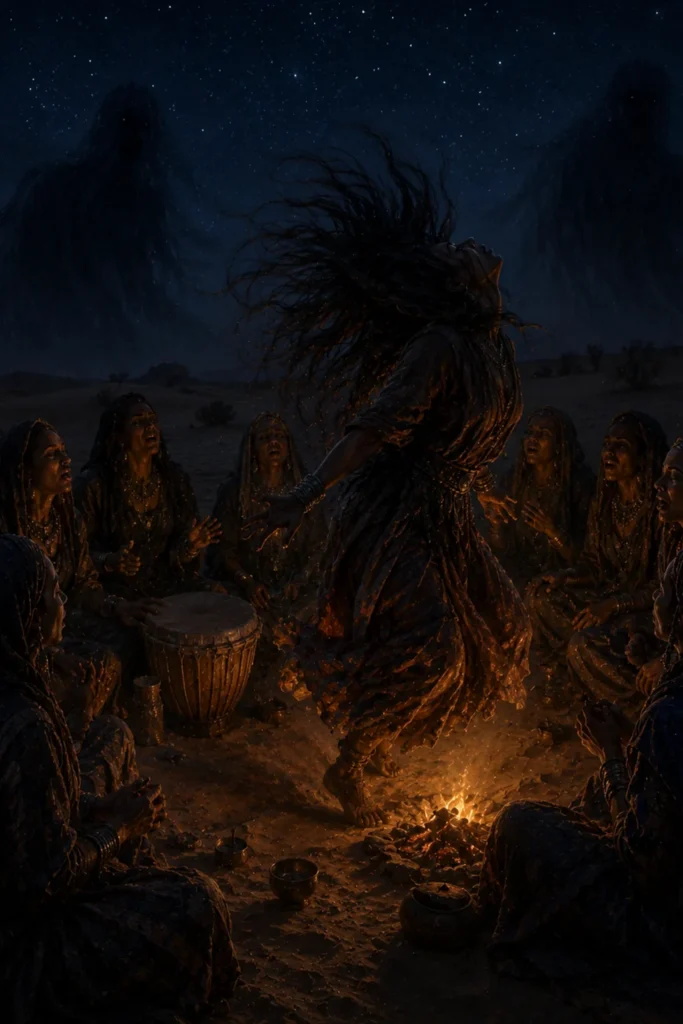
The public healing ritual against their possession is the drum festival tende n goumaten, whose verses are learned exclusively by women. The scholarly literature treats the Kel Essuf as non-Quranic spirits that persist under Islamisation.
Type: Spirits of wilderness and solitude, possession spirits
Origin: Tuareg folk belief, non-Quranic
Texts: 20th-century ethnographies, Rasmussen and Nicolaisen
Period: ethnographically documented in the 20th century
Appearance: invisible and formless
Context of Tradition
Period of the Texts
Tuareg folk belief, ethnographically documented in the 20th century, chiefly by Nicolaisen and Rasmussen.
Area of Diffusion
Central and southern Sahara: the main sites of documentation are the Aïr in Niger and the Ahaggar in Algeria.
Sources
Well documented: the ethnographies of Rasmussen and Nicolaisen record belief, illness and healing ritual in detail.
Name and variants
Tamashek: Kel Essuf is a compound of Kel, people of, and essuf, which means wilderness, solitude and longing all at once: the people of the wilderness or void. Someone who is possessed is idiomatically said to be found in the void.
Nature and effect
Appearance
The Kel Essuf are largely invisible and formless. They are bound to desolate places, darkness and being alone in open expanses, they multiply, have a language of their own and are associated with night, solitude and madness.
Effect
They attack humans as illness and grow jealous of happy people and of people in transitional phases. The typical possession illness is called tamazai, is depression-like and does not respond to Quranic healings, which is why it requires the public healing ritual. The Kel Essuf usually attack adults; the focus on women lies chiefly with the female ritual specialists.
Profile: Kel Essuf
The key aspects of the spirits of the void at a glance.
Non-Quranic spirits of Tuareg folk belief that persist under Islamisation; documented in the Aïr and the Ahaggar.
Adults, especially happy people and those in transitional phases, of whom the spirits grow jealous; the illness tamazai is their attack.
Invisible and formless, bound to desolate places, darkness and being alone in open expanses; with a language and reproduction of their own.
Personification of wilderness and solitude: they attack as illness and mark the void beyond camp and community.
The drum healing ritual tende n goumaten with a women’s chorus and head dance; alongside this, amulets, a small mirror and a copper ring, and in parallel Quranic verses recited by the marabouts.
The Eljinen of Tuareg cosmology, from the Arabic djinn; typologically related to the musical possession-healing cults Zar, Bori and Stambali.
Essuf: wilderness, solitude and longing
The name is a Tamashek compound of Kel, people of, and essuf, which means wilderness, solitude and longing all at once: the people of the wilderness or void. This field of meaning also shapes the language of possession, for someone who is possessed is idiomatically said to be found in the void.
The main sites of documentation are the Aïr in Niger and the Ahaggar in Algeria. The scholarly literature treats the Kel Essuf as non-Quranic spirits that persist under Islamisation: they belong to an older layer of Tuareg cosmology and stand there alongside the Eljinen, whose name derives from the Arabic djinn.
From spirit belief to desert blues
The word assouf, essuf, has become a key term in Tuareg guitar music, desert blues, in the work of Tinariwen and the band Kel Assouf. This music deals primarily with exile and longing, not with spirit demonology in the narrower sense.
From the perspective of religious studies, the Kel Essuf are non-Quranic spirits of the wilderness. Three clarifications: well documented are the field of meaning of essuf, the illness tamazai and the tende n goumaten with its women’s chorus. To be stated with caution are the focus on women and the blanket iron apotropaism. And the ritual is, depending on context, exorcism or mediumship, not merely negotiation.
The healing ritual tende n goumaten
The smith caste of the inaden provide the ritual drummers for the possession ceremonies. The central healing ritual is tende n goumaten, a public drumming and possession healing ritual with a mortar drum and verses that only women learn; at its centre is the head-dance performance of the possessed. In addition, amulets, a small mirror and a copper ring serve as protection, while marabouts heal in parallel with Quranic verses.
Eljinen, Zar and Hamadsha: related cults
In Tuareg cosmology, the Kel Essuf stand alongside the Eljinen, whose name derives from the Arabic jinn. The tende complex belongs typologically to the family of musical possession healing cults such as Zar, Bori and Stambali. Related is the Moroccan Aïsha Qandisha of the Hamadsha cult, who is likewise appeased through trance rituals.
Frequently asked questions about the Kel Essuf
What are the Kel Essuf?
The Tuareg spirits of the wilderness and solitude, literally the people of the void. They attack humans as illness.
How is possession by them healed?
Through the public drumming healing ritual tende n goumaten with a women’s chorus and head-dance, since the illness tamazai does not respond to Quranic healings.
Are they Islamic?
No, they are non-Quranic spirits that persist under Islamisation and belong to an older layer of Tuareg cosmology.
Further links
Further reading:
- Aïsha Qandisha – the Moroccan spirit patroness of the Hamadsha cult
- Jinn – the Arabic beings of fire behind the Eljinen
- Jann, Hatif – further spirits of desert tradition
- Amulet, Iron, Smudging – traditional protective means
- Protection Compass – protective means at a glance
Literature (selection)
Further standard works in the bibliography.
As Tuareg spirits of the wilderness and spirits of the void, the Kel Essuf embody the experience of the Sahara itself: the solitude of the vastness that enters a person as illness and is healed in the drumming feast of the community.