Nazar Battu: the Indian apotropaic grimace against the evil eye
By Ralf Ittermann · last reviewed on
In the Indian context, Nazar Battu refers to various means against the evil eye. Particularly well known is a deterring grimace, often black, that is fixed to houses and vehicles in order to keep harmful glances away.
Classification
Nazar Battu is a term from the Indian context that is connected with Hinduism and with the wider folk culture of the subcontinent. It refers to means against the evil eye.
The word nazar means glance and, in Indian usage, often stands for the evil, harmful glance. Battu points to turning aside and rendering ineffective. Nazar Battu thus refers to that which wards off the evil eye.
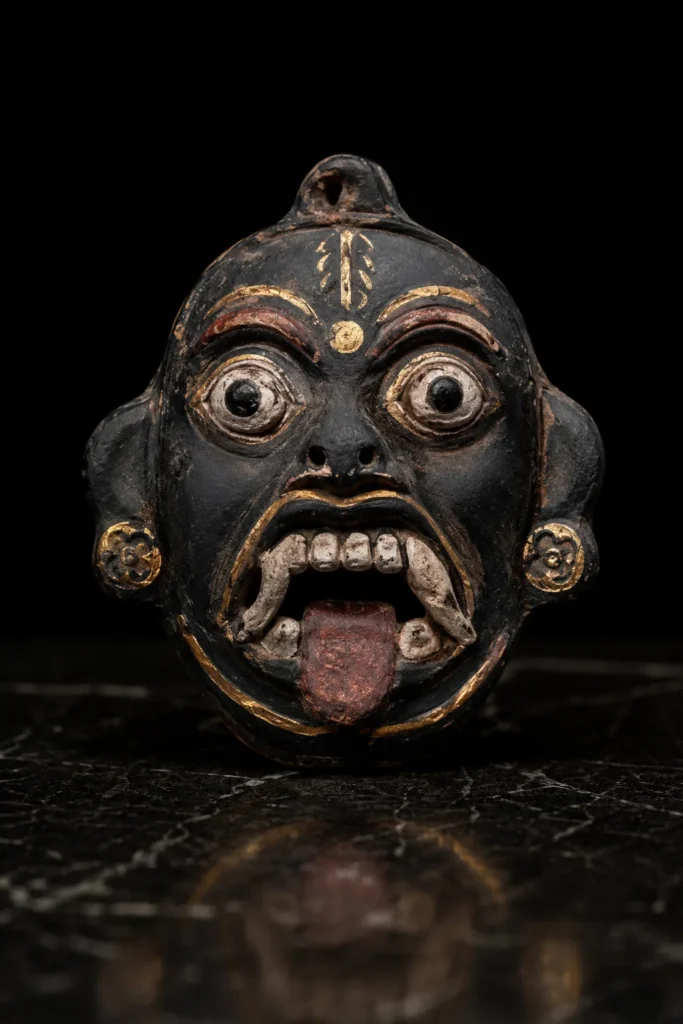
A number of protective customs are gathered under this term. Particularly well known is a deterring grimace, a distorted face that is frequently rendered in black and placed in a visible spot.
Such apotropaic grimaces are found on house walls, on new buildings, on vehicles and in other places that were regarded as at risk. They are meant to draw the onlooker’s glance to themselves and away from what is being protected.
In religious studies and in folklore studies, Nazar Battu is a good example of a deterring means of protection that works according to the basic idea of distraction and frightening.
This page presents Nazar Battu from the perspective of protection. It describes the apotropaic grimace, its use, its principle of action and its place within the Indian belief in the evil eye.
The evil eye in the Indian context
To understand Nazar Battu, one has to be familiar with the Indian belief in the evil eye. This belief is widespread across the subcontinent and runs through many sections of the population.
In the Indian context, the evil eye is often simply called nazar. According to this idea, a person’s glance can cause harm, without this always having to be intended.
The evil eye is frequently connected with envy. Whoever regards another person or their possessions with ill will can harm them. Yet even pure admiration was regarded as dangerous.
Children, newborns, pregnant women, brides, newly built houses and flourishing businesses were considered especially at risk. Wherever something was beautiful, new or successful, the nazar threatened.
The belief in the evil eye is not confined to the Indian context. It is found throughout the Mediterranean region and across large parts of Asia, and it is presented on the page about the evil eye.
Nazar Battu is the Indian answer to this widespread fear. It is the collective term for the means by which people sought to ward off the harmful glance.
The apotropaic grimace
The best-known form of Nazar Battu is the apotropaic grimace. It is a deliberately ugly, distorted face that is placed in a visible spot.
The grimace is frequently black. It shows coarse features, wide-open eyes, a distorted mouth and a deterring expression. It is deliberately made unsightly.
Such grimaces are produced in various ways. They can be painted onto a pot or a mask, formed from material or bought as a finished protective object.
They are placed in clearly visible spots. On new buildings a black-painted pot bearing a grimace is often hung. The distorted face is found on houses, on scaffolding and on vehicles.
The grimace is designed to catch the eye. It is meant to be the first point that an onlooker’s glance encounters. In this way it fulfils its task of drawing the glance to itself.
The apotropaic grimace is thus a deterring means of protection. It belongs to a type of sign that is encountered in many cultures, the deliberately ugly or frightening depiction used to ward off misfortune.
The principle of action: distraction
The apotropaic grimace of Nazar Battu follows a clear principle of action. It protects through distraction and frightening.
The first idea is distraction. According to the belief, the evil eye is directed at whatever first captures attention. A striking grimace draws this glance to itself.
This relieves what is actually being protected. The beautiful child, the new house or the flourishing business is spared the glance, because it remains caught on the grimace.
The second idea is frightening. The grimace is designed to deter. It is meant to scare back and drive away the harmful glance and the power standing behind it.
A third idea concerns the ugliness itself. A deliberately ugly depiction arouses no envy. It thereby distracts precisely that resentful glance that was considered especially dangerous.
Nazar Battu thus works differently from an eye amulet, which catches the glance, or from a sacred sign that protects through blessing. It works through distraction, frightening and the deliberate avoidance of beauty.
Other forms of Nazar Battu
Nazar Battu is a collective term. Besides the well-known apotropaic grimace, further protective customs and means of protection belong to it.
The use of the lemon and chilli peppers is widespread. Several chilli peppers and a lemon are threaded onto a string and hung at doors, at shops and on vehicles in order to ward off the evil eye.
Another means is a black dot, a spot of dark colour or soot. It is placed especially on children, on the cheek or behind the ear, so that the glance falls on the small blemish.
Protective elements are also found in clothing and jewellery. Black threads, beads and small amulets are put on children to protect them from the nazar.
These various means share a basic idea. They all set a small blemish, something dark or something inconspicuous against the beautiful, so that the glance does not fall on the beautiful thing itself.
Nazar Battu thus encompasses a whole range of customs. The apotropaic grimace is the most striking, but the black dot, the lemon with the chilli peppers and the protective threads belong to it just as much.
Nazar Battu and the blue eye
It is important to distinguish Nazar Battu from another, similarly named means of protection, the blue eye amulet of the Mediterranean region.
The blue glass amulet is known as the Nazar Boncuğu and is presented on the page about the Nazar Boncuğu. It comes from the Turkish and eastern Mediterranean region.
Both means carry the word nazar in their name, since both concern the evil eye. In their form and their principle of action, however, they differ markedly.
The Nazar Boncuğu is a blue, eye-shaped glass amulet. It works by reflecting and catching the evil eye. It sets a protective eye against the harmful eye.
Nazar Battu, by contrast, in the form of the apotropaic grimace, is deliberately ugly. It works not through a reflecting eye, but through distraction and frightening.
Nazar Battu and Nazar Boncuğu are thus two different answers to the same fear. The one catches the glance with a beautiful blue eye, the other distracts it with an ugly grimace.
Protection of house, child and business
Nazar Battu is used above all where people felt especially at risk. Three areas stand to the fore, the house, the child and the business.
For the house, protection applies above all to the new building. A newly erected house was a source of pride and was conspicuous, and could arouse envy. The black grimace on the new building was meant to distract this envy.
For the child, protection applies to the newborn and the small child. A healthy, beautiful child was considered especially at risk. The black dot and the protective threads were meant to preserve it.
For the business, protection applies to success. A thriving business could draw resentment to itself. The lemon with the chilli peppers at the entrance was meant to ward off the evil eye of customers and passers-by.
In all three areas the same idea underlies the practice. What is beautiful, new or successful is at risk. Nazar Battu places beside this beautiful thing a distracting, ugly or dark sign.
Nazar Battu is thus firmly embedded in Indian everyday life. It accompanies the turning points of life and of livelihood, birth, house building and commercial success.
Nazar Battu in Indian folk culture
Nazar Battu is deeply rooted in the folk culture of the Indian subcontinent. It is not the custom of a single group, but runs through many communities and religions.
The belief in the evil eye and its warding off is found among Hindus as well as among members of other religions of the subcontinent. Nazar Battu is thus a unifying folk-cultural custom.
The means of Nazar Battu are ever-present in everyday life. The lemon with the chilli peppers at shops, the black grimace on new buildings and the black dot on children’s faces are part of the familiar picture.
This broad rootedness shows how seriously the fear of the evil eye was taken. It was not a matter for a few, but a widespread part of the lived world.
At the same time the customs are simple and inexpensive. A lemon, a few chilli peppers and a string are easy to obtain. This made protection attainable for everyone.
Nazar Battu is thus a living example of folk-cultural protection. It shows how a widespread fear was answered with simple means accessible to everyone.
Reception today
Nazar Battu is to this day extraordinarily present in the Indian context. The customs for warding off the evil eye are part of everyday life.
The lemon with the chilli peppers can be seen on countless shops and vehicles. The black apotropaic grimace is found on new buildings. The black dot on children’s faces is widespread.
These customs are maintained equally in cities and in the countryside. Even people who regard themselves as modern and enlightened often keep them, whether out of conviction or out of respect for tradition.
The word nazar has become known beyond the subcontinent. In Indian communities worldwide the customs of Nazar Battu are carried on.
For folklore studies and religious studies, Nazar Battu remains an instructive subject. It shows how the apotropaic principle of the ugly depiction has remained alive in a major culture.
Nazar Battu is thus a striking example of a deterring means of protection. In it the widespread belief in the evil eye, the principle of action of distraction and simple, universally accessible everyday customs come together.
Literature (selection)
Related key terms: Nazar Battu evil eye nazar apotropaic grimace India Hinduism lemon chilli peppers black dot apotropaion.
iWell Guard and protective traditions
iWell Guard stands in the cultural-historical line of portable protective objects, to which the Nazar Battu also belongs. A modern companion for people who live with protective symbols: made in Germany, 41 layers of solid gold, platinum and silver, with a 30-day right of return.
Personal experiences may vary. Not a medical device. No promise of healing.