Ryujin, Japanese dragon god of the sea
By Ralf Ittermann · last reviewed on
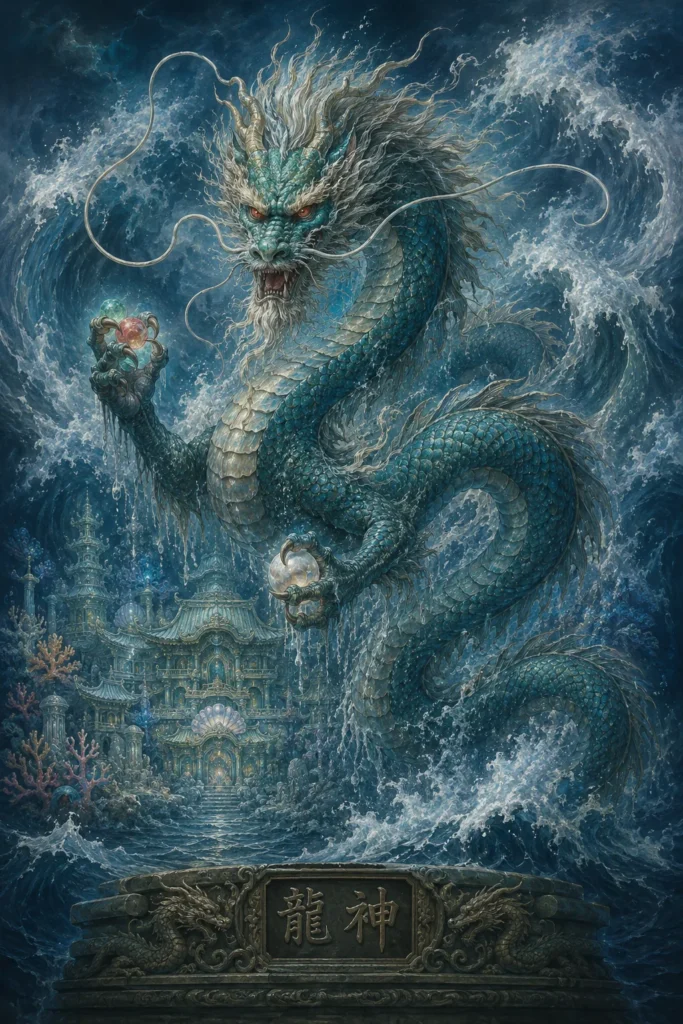
Ryujin is a Japanese dragon god of the sea who, from his palace on the ocean floor, commands the tides and storms. Ryūjin, also called Ōwatatsumi-no-Kami, is in Japanese Shintō the dragon king of the sea and thus the principal god of the deep sea, the tides, and the water beings.
According to mythical conception, his palace “Ryūgū-jō” lies deep beneath the Pacific, built of coral and mother-of-pearl. Ryūjin unites two strands of religious history: the archaic Japanese veneration of the sea god Watatsumi and the Buddhist-Chinese tradition of the nāga dragon, which entered East Asian Buddhism.
Name, Etymology, and Identification
The name Ryūjin is composed of “ryū” (dragon, character 龍) and “jin” (deity, character 神). In the “Kojiki” and “Nihon Shoki” the principal figure appears under the name Watatsumi-no-Kami (also Owatatsumi, “Great Water Master”).
Only in the medieval period, with the arrival of Buddhist dragon conceptions from China and India, did the Watatsumi figure merge with the nāga kings into a single figure, the dragon king Ryūjin.
The tale of Hoori in the “Kojiki” still describes Watatsumi’s palace without dragons; the designation “Ryūgū-jō” is only medieval.
In some texts Ryūjin is thought of as a subordinate representative of Watatsumi; the sources are not consistent here.
Nelly Naumann (“Die einheimische Religion Japans,” 1988 and 1994) reconstructed the layers of the Watatsumi tradition and distinguished between a coastal fisherfolk religiosity and a courtly, mythological reworking of the Heian period.
The Myth of Hoori and Toyotama-hime
The central Ryūjin narrative is found in the “Kojiki” (Book I, closing section) and in the “Nihon Shoki” and is part of the Yamato dynastic myth. It is regarded as the link between the divine and the human rulers.
The brother Hoori (also Yamasachi-hiko, “Mountain-Luck Prince”) loses his fishhook in the sea when he exchanges tools with his brother Hoderi. In search of this hook he descends into the palace of the sea king, where he lives for three years as a guest and marries his daughter Toyotama-hime.
Toyotama-hime becomes pregnant and follows Hoori to the surface to give birth. As her labor approaches she forbids him to look at her, because she gives birth in her true dragon form.
Hoori breaks the taboo, sees her as a huge wani (crocodile or dragon), and she flees back into the sea in shame, leaving the child with Hoori.
From this child, Ugayafukiaezu, later comes Jimmu-tennō, the mythical first emperor of Japan. The taboo-breaking motif shows close parallels to the Izanagi narrative and is the subject of comparative-myth research (Joseph Kitagawa, Klaus Antoni).
Symbols, Attributes, and Beings of the Court
Ryūjin is depicted in the visual arts as an old, wise man with a beard, often with a crown and dragon insignia, sometimes directly in dragon form with a long serpent-like body, three claws, and antlers similar to the Chinese long.
His chief attributes are the two tide jewels, Shio-mitsu-tama (flood jewel) and Shio-hiru-tama (ebb jewel), which he gives to Hoori as a wedding gift and with which the latter later defeats his brother Hoderi.
Various sea dwellers belong to Ryūjin’s court: jellyfish, octopuses, fish, turtles. The turtle plays an important role as messenger and mount; in the Urashima Tarō legend it is the one that leads the fisherman to the dragon palace.
In the myths Ryūjin has numerous children, among them Toyotama-hime and her younger sister Tamayori-hime, who later marry Hoori and his son and connect the imperial line with dragon blood.
Veneration, Shrines, and Rituals
Ryūjin is venerated above all in coastal regions, by fishermen, divers (Ama), and seafarers. Important shrines are Ryūgū-jinja in Mie Prefecture on the Shima Peninsula, the Shika-no-Umi-jinja in Fukuoka (one of the oldest shrines in Japan, already named in the Engishiki), Watatsumi-jinja on Tsushima, and the Enoshima-jinja off Kamakura.
The latter is connected with the legend of Benzaiten and the dragon king, who are frequently venerated together.
At ritual ceremonies on the coast, rice, sake, and salt are offered to Ryūjin, often also fish, which is returned to the sea. Before long sea voyages it was customary to pray at dragon shrines; during storms fishermen cast ritual offerings into the sea.
On Tsushima and Iki there are dragon festivals with boat processions to this day. The Bukatsuchi-no-mikoto rite at the bay of Mikuriya refers to the reconciliation with the water beings.
Ryūjin in Buddhism: Syncretism with Nāgaraja
With the arrival of Buddhism in Japan in the 6th century, the native sea god was increasingly identified with the nāga kings of the Indian tradition.
The eight great nāga kings (Mahānāgarāja) appear in the Lotus Sutra in chapter 1 as listeners of the Buddha and are venerated in Japan as “Hachidai-Ryūō.” Their leader Sāgara (“Ocean”) is often equated with Ryūjin.
The daughter of Sāgara attains Buddhahood in the Lotus Sutra (Devadatta chapter) despite her animal form and her sex; this account had considerable influence on the Buddhist question of women in Japan.
In the Shingon tradition the dragon kings are invoked during the rain rite; the rainmaker rite attributed to Kūkai at the Shinsen-en pond in Kyoto (documented in the year 824) is regarded as the classic Japanese application of this practice.
In Zen the dragon becomes the symbol of enlightenment; the dragon image on the ceiling of many Zen temple main halls goes back to this tradition.
Folk Tales: Urashima Tarō and Other Fairy Tales
The best-known folk tale about Ryūjin is the legend of Urashima Tarō, already attested in an early form in the “Man’yōshū” (8th century, poem 1740) as well as in the “Tango-fudoki.” A young fisherman rescues a turtle, is led into the dragon palace, lives there for three years, and returns with a box whose opening ages him: on earth, hundreds of years have passed in his absence.
The motif of distorted time in the Other World is found in Celtic, Hawaiian, and Chinese comparative material. Klaus Vollmer and Bernhard Scheid have traced the adaptation history of this narrative in several works.
Religious-Historical Classification and Cross-References
Ryūjin belongs to a pan-Asian dragon complex that extends from the Indian nāga through the Chinese long to the Korean yong. Unlike the West Eurasian dragon (lindworm, Tiamat, Leviathan), the East Asian dragon is not understood as a hostile chaos being but as an ambivalent, often beneficent power.
Christine Guth and Nelly Naumann have worked out the Japanese specificity of the dragon conception in several essays, in which the water-being-dragon continuum remained alive into the folk religion of the Edo period.
In modern popular culture, Ryūjin is present in works such as “Spirited Away” (Hayao Miyazaki, 2001) as Haku, in “Dragon Ball” as Shenlong, and in numerous anime and game adaptations. The dragon iconography has shifted from the religious into an aesthetic, narrative sphere without losing its roots.
Sources
“Kojiki” (712), Book I, Hoori episode. “Nihon Shoki” (720), Book II. “Man’yōshū” (8th century), poem 1740 (Urashima Tarō). “Tango-fudoki” (8th century, fragments). “Engishiki” (927). “Lotus Sutra,” Devadatta chapter and opening chapter.
Nelly Naumann, “Die einheimische Religion Japans,” 2 volumes, Leiden 1988 and 1994. Klaus Antoni, “Shintô und die Konzeption des japanischen Nationalwesens,” Leiden 1998. Joseph Kitagawa, “Religion in Japanese History,” New York 1966. Helen Hardacre, “Shinto.
A History,” Oxford 2017. Klaus Vollmer, “Shintô und Buddhismus,” Munich 2002. Bernhard Scheid, “Religion-in-Japan: Ein digitales Handbuch,” Vienna, ongoing. Inken Prohl, “Religiöse Innovationen,” Berlin 2006.
Watatsumi and the Mythical Geography of the Seas
The ancient Japanese conception of the sea distinguishes between several mythical water spheres, which over the course of the medieval tradition merged into the central Ryūjin figure.
In the Kojiki the “Watatsumi-no-Kami” appear as a trio: Soko-tsu-Watatsumi (“Bottom Water God”), Naka-tsu-Watatsumi (“Middle Water God”), and Uwa-tsu-Watatsumi (“Upper Water God”), who arise from the Misogi water during the purification of Izanagi.
This triad is regarded as the oldest Watatsumi complex and is frequently combined into a single Ryūjin figure in the medieval tradition, without the triad having disappeared liturgically.
The regional Watatsumi traditions are very diverse. On Tsushima and Iki, the islands off northern Kyūshū, an older layer of worship dominates, which shows close connections to the Korean sea-king tradition.
In Shimane and on the west coast of Honshu, by contrast, Watatsumi conceptions mix with the regional Susanoo cult, which leads to complicated local mixed traditions. Nelly Naumann has worked out these regional layers in several detailed studies and pointed to their significance for the religious history of the Japanese sea god.
The Ryūgū-jō and Its Literary Tradition
The dragon palace Ryūgū-jō (“Castle of the Dragon Palace”) is one of the central motifs of Japanese narrative literature. In Konjaku Monogatari, in numerous Setsuwa collections, and in the Nō plays (“Ama” and others) it appears as a radiant, palace-like place beneath the sea.
The typical description includes coral columns, mother-of-pearl floors, gemstone walls, sunlight despite the depth of the sea, vast banquet halls, and a temporally differently structured reality in which hours can become centuries.
In the “Heike Monogatari” and in the later medieval narrative literature, the Ryūgū-jō becomes the place to which the heroes of the Heike War who drowned in the sea are carried away.
This conception connects the dragon palace with the realm of the beyond and makes it a Japanese variant of the “Isles of the Blessed” topos.
Christine Guth and Bernhard Scheid have shown that the medieval literary treatment of the Ryūgū-jō is essentially a courtly construction that takes up older fisherfolk conceptions and condenses them in an elegant narrative form.
The Daughter of the Dragon King and Buddhahood
One of the most influential passages about a dragon king in East Asian Buddhism is found in the “Devadatta” chapter of the Lotus Sutra. There the eight-year-old daughter of the nāga king Sāgara appears, presents the Buddha with a gemstone, and instantly attains full Buddhahood.
This narrative is significant in religious history for two reasons: it shows that animals (dragons) and women too can attain Buddhahood, which was revolutionary in patriarchal and anthropocentric early Buddhism.
In the Japanese tradition this narrative was taken up intensively and connected with the native dragon complex. In the Tendai and Nichiren schools the “Daughter of the Dragon King” was regarded as a key proof of the universal Buddha nature. Dōgen’s “Shōbōgenzō” treats the episode several times.
In Japanese folk belief the figure became connected with Benzaiten, the water goddess of the Seven Gods of Fortune, and with various local water deities. This merging of Indian nāga theology, Chinese long mythology, and Japanese Watatsumi religion is a classic example of East Asian religious integration.
Dragon Paths and Sacred Mountains
Japanese folk religion knows the concept of “dragon paths” (“ryūmyaku”), subterranean water veins that connect sacred mountains with springs, rivers, and finally the sea. This conception is especially pronounced in the Shugendō tradition and shapes the religious geography of numerous sacred mountains such as Ontake, Hakusan, Tateyama, and especially Fuji.
At the Nachi (Wakayama), Kegon (Nikko), and Ryūzū (also Nikko, meaning “Dragon Head”) waterfalls, the dragon king is invoked in local rites. These waterfalls are regarded as manifestations of Ryūjin and are classic stations of Misogi water purification and Shugendō mountain asceticism.
The famous Nachi-no-Otaki, the largest waterfall in Japan (133 m), had been a sacred place since the 8th century and was declared a World Heritage Site by UNESCO in 2004 as part of the “Sacred Sites and Pilgrimage Routes in the Kii Mountain Range.”
Rain-Petition Rites and Dragon Invocation
During prolonged drought, a special form of rain-petition procession was carried out in many Japanese regions, designated as “Ryūjin-matsuri” (“Dragon Festival”) or as “amagoi” (“Rain Petition”). In it, a dragon effigy of bamboo, paper, and cloth is fashioned and carried through the village to a shrine or waterfall.
Sometimes a real or symbolically represented frog or eel is shut into a wooden box and led through the village in a petition procession; the assumption is that the dragon king will respond with rain to the suffering of his subjects.
In the Shingon tradition the famous “Shingon rainmaker rite” was performed for the first time at the Shinsen-en pond in Kyoto in the year 824. Kūkai is said to have invoked the dragon king of Lake Anavatapta (in the Indian-Buddhist geography the mythical source lake of the Himalayas) and thereby brought about rain after three days.
This rite became a canonical practice in the Heian period and was continued in the great Shingon temples Tō-ji and Daikaku-ji into modern times.
The View of Modern Religious Studies
In modern research, Ryūjin is read as a key example of East Asian religious hybridization.
Helen Hardacre, Bernhard Scheid, and Klaus Vollmer have shown in several studies that the merging of native Watatsumi with Indian nāga and Chinese long is, in Japanese religious history, a paradigmatic case for the multilayered nature of every grown religious practice.
Unlike what an analytically clean religious philology suggests, this merging belongs to the normal reality of living religiosity.
Inken Prohl has emphasized in her studies of modern Japanese religiosity that the dragon figure is experiencing an astonishing renaissance in contemporary spirituality, in healing practices, and in popular esotericism.
Dragon-power symbols, dragon tattoos, dragon jewelry, and dragon meditations are widespread in Japan, in the East Asian diaspora, and increasingly also in the Western New Age milieu.
This modern dragon charging draws only partly from the historical Ryūjin cult, but rather connects it with elements of Chinese Feng Shui, the Western dragon imagination (Smaug, Tolkien), and popular fantasy culture.
Ainu Parallels and North Pacific Maritime Religiosity
A separate trail in religious history leads from the Japanese Ryūjin into the Ainu religion of the northern Japanese main islands and Sakhalin.
The Ainu whale god Repun-Kamuy is likewise a lord of the sea who rules over whales, fish, and fishing; he appears as a human in a whale costume who lives in a world beneath the sea.
Structural parallels are the connection with whales, the exchange relationship with the fishermen, and the logic of prohibition. These parallels point to a broader North Pacific maritime religiosity that extends from the Aleut and Tlingit to the Itelmen of Kamchatka and the Ainu.
Nelly Naumann and Klaus Vollmer have shown that the Japanese Watatsumi religion (before its merging with the Chinese-Buddhist dragon complex) contained essential elements of this pan-Pacific maritime tradition.
The medieval merging with the nāga and long complex overlaid this layer without entirely displacing it. In the coastal villages of Tsushima and Hokkaido, traces of this archaic layer have been preserved into modern times.
Kūkai and the Shinsen-en Rainmaker Rite
The Shinsen-en rainmaker rite, which was performed in 824 under Emperor Junna in Kyoto, is among the best-documented dragon rituals of Japanese religious history. Kūkai, the founder of the Shingon school, is said to have invoked the dragon king of the mythical Lake Anavatapta in a contest with the Buddhist monk Shubin.
Anavatapta is regarded in the Indian-Buddhist worldview as the mythical source lake of the Himalayas, in which the eight great dragon kings of the Lotus Sutra reside. After a three-day ritual, heavy rain set in, and Kūkai’s rank in the courtly hierarchy was considerably strengthened.
The rite itself was canonized in the following centuries and became a fixed component of the Shingon liturgy repertoire. In the Tō-ji and the Daikaku-ji, liturgical handbooks and instructional books that describe the practice in detail are found to this day.
The connection of Indian nāga theology, Chinese Anavatapta geography, and Japanese weather magic is a particularly dense example in religious history of East Asian religious integration.
The Dragon in the Zen Tradition
In Zen Buddhism the dragon has acquired its own symbolic meaning. Unlike in Pure Land Buddhism or in Shingon, it is not primarily a god that can be invoked but an image of enlightenment itself.
The famous koan “Koboku ryūgin” from Chinese Zen runs: “The dragon sings in the withered tree,” a paradoxical formulation meant to express the suddenness and unpredictability of the Buddha nature. On the ceilings of many Zen temple main halls, large-format dragon murals are mounted that visualize this symbolic meaning.
The most famous dragon ceilings are found in Kenninji (Kyoto, painted by Koizumi Junsaku, 2002), Tofukuji (Kyoto, painted by Dōmoto Inshō, 1934), and Tenryuji (Kyoto, painted by Kayama Matazo, 1997).
The dragon depictions usually show a single, huge dragon being stretching across the ceiling of the assembly hall; the gaze of the monks during meditation falls on this image and is meant to support meditative concentration.