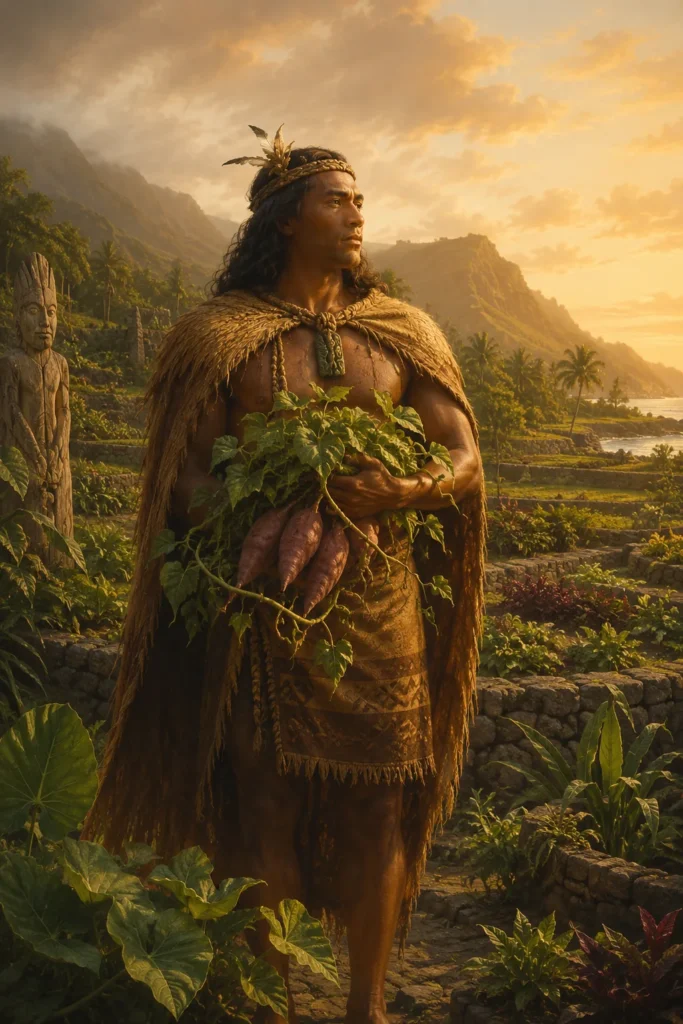
Rongo, often extended as Rongomatane or Rongo-marae-roa, is regarded in the Maori religion as the Atua of peace, cultivated food plants, especially the sweet potato (kumara), and diplomatic understanding.
He stands in contrast to his brother Tu Matauenga and is linked to central rituals for securing the harvest and concluding peace. The following account describes his academic religious-studies classification, his iconographic traces, and his role in Maori ritual life.
Rongo is regarded as the Maori Atua of peace and cultivated plants.
Rongo, the Maori god of peace, is regarded as the founder of cultivated plants and ritual diplomacy.
Rongo belongs to the sons of Ranginui and Papatuanuku, and thus to the generation of the great Atua. Unlike Tane Mahuta (forest), Tangaroa (sea), or Tu Matauenga (war), his domain is not a realm of nature in the narrower sense, but rather the cultivated plant and social peace.
Margaret Orbell points out that Rongo held a central position in ritual life, even though he acts less frequently in narrative literature than his brothers. From a religious-studies perspective this is instructive: gods with high cultic prominence are not necessarily those with the richest mythology.
Rongo embodies a “quiet” deity, whose significance is primarily ritual. The cultural support of the Maori way of life through the kumara makes him indispensable.
From a pan-Polynesian perspective, Rongo corresponds to the Hawaiian Lono, one of the four high gods of Hawai’i, who is likewise associated with peace and fertility. Beckwith (Hawaiian Mythology, 1940) documents the close correspondence. In the Hawaiian system, however, Lono is more prominently institutionalized than Rongo in Aotearoa.
Anyone wishing to understand Rongo must first take note that Maori theology does not form a self-contained doctrinal edifice. There is no fixed doctrine that would assign an Atua like the god of peace a defined place.
His reality is instead disclosed in practice: in the spoken karakia, in the deliberations on the marae, in the whakapapa recitations that bring genealogies to life.
In religious studies, this practice-oriented form of theology is recognized as an independent contribution to the field; Mary Ann Boord and Edward Tregear have set it out systematically in their religio-ethnographic studies of Polynesia.
Rongo means “sound,” “rumor,” “report,” or “message” in Maori. In epithets such as Rongomatane, the element matane is translated as “peace”; Rongo-marae-roa means “Rongo of the long marae.” The connection between “sound/message” and “peace” is semantically interesting.
Bruce Biggs interprets it to mean that the healing of social conflicts takes place through language, message, and negotiation, making Rongo the patron of diplomacy.
Further epithets include Rongo-ma-Tane (Rongo together with Tane in a shared functional field), Rongo-i-amo (Rongo who is carried), Rongo-hirea (Rongo of the fields). Each variant accentuates a particular function. The multiplicity of names shows the theological vitality of the figure across regional iwi traditions.
From a pan-Polynesian perspective, Rongo corresponds etymologically to the Hawaiian Lono (r to l via sound shift), the Tahitian Ro’o, the Samoan Logo, and the Tongan Longo. This distribution documents the proto-Polynesian root and the central position of the deity of peace and fertility across the entire Polynesian language area.
The fact that Rongo is invoked under numerous epithets is, from a linguistic-historical perspective, no coincidence but rather a sign of an oral tradition that has differentiated independently from region to region.
The linguistic depth of such Maori and Hawaiian theonyms is documented in the lexicographic works of Bruce Biggs and Hugh Clarke. Anyone wishing to understand the relationship between the individual Polynesian languages cannot bypass this research.
Rongo is rarely depicted as an independent figure in Maori art. He is symbolically linked to the kumara, the sweet potato, whose planting and harvest structured the agricultural annual cycle. The kumara is referred to as the “child of Rongo” in some iwi, expressing the close mythological connection.
In marae carvings, a post may be dedicated to Rongo, often recognizable by a calm, seated posture in contrast to the warrior pose of Tu. In ritual contexts, a kumara tuber in a bowl is a possible symbol of his presence. The whata, the elevated storage house, is also associated with Rongo.
Elsdon Best (Maori Agriculture, 1925) describes stone arrangements at the edges of some kumara fields as “mauri stones,” which, as ritualized embodiments of Rongo, placed the field under tapu. These stones were not deity images in the Western sense, but material condensations of the Rongo presence.
Over the past five decades, the carving art of the Maori and Hawaiians has experienced a remarkable revival.
Cliff Whiting, Robyn Kahukiwa, Wright Bowman, and Sam Ka’ai are among those artists who have both maintained the transmitted formal repertoire and developed it in a contemporary manner. The Atua, including Rongo, appear repeatedly in these works; their iconographic presence thus extends into current art production.
In the myth of the separation of sky and earth, Rongo pleads for reconciliation of the parents rather than separation or killing. His proposal is rejected.
After the separation and the attack by Tawhirimatea, Rongo flees to the earth mother Papatuanuku, into the realm of cultivated plants. This position explains why the kumara is under Rongo’s protection.
A further narrative tells how the kumara came from the heavens to earth. In some versions it is Rongomaui (a variant of Rongo) or one of his sons who fetches the first tubers from the realm of Whanui (the star Vega).
This narrative connects the kumara to a particular astronomical constellation: the heliacal rising of Vega traditionally marks the beginning of the kumara season.
The Vega-kumara connection is noteworthy from a religious-studies perspective: it shows that agricultural practice, astronomical observation, and mythology were understood in the Maori tradition as one interconnected system. Anne Salmond has elaborated this aspect in her research.
The narratives surrounding Rongo do not form a closed text that could be read from beginning to end. In religious-studies terms, they constitute more of a network: individual narratives illuminate one another mutually, and each iwi tradition sets its own emphases.
This networked, rhizomatic structure poses methodological difficulties for research, but at the same time grants it hermeneutic depth. Where two versions of a story diverge, neither is considered “wrong” or “corrupted”: both stand side by side as regional variants with equal standing.
The cultivation of kumara was highly ritualized. Specialized tohunga (priest-specialists) were responsible for planting and harvest. The fields (mara) were tapu during the growing season; women who were menstruating were not permitted to enter them; karakia accompanied planting and harvest.
Elsdon Best describes the ritual system in detail in Maori Agriculture (1925). The storage of kumara in the pataka (storehouses) was likewise surrounded by tapu. This intensive ritual embedding shows that agriculture in Maori culture was not primarily a technical but a religious practice. Rongo is the central point of reference.
The kumara itself has a remarkable history: it originates from South America (the Andean region) and reached Polynesia before the period of European contact.
Patrick Kirch and other researchers discuss how this trans-Pacific connection came about, probably through pre-Columbian contact between Polynesian seafarers and the South American coast. This historical fact makes the kumara a living testimony to Polynesian seafaring achievement.
In kumara cultivation, what consistently characterizes the religion of the Maori and Hawaiians is particularly evident: rite and everyday work are intertwined. While other religious systems draw a sharp boundary between the sacred and the profane, here the entire life is permeated by references to the Atua.
This religiosity anchored in the life-world itself is examined by Mason Durie, Charles Royal, Lilikala Kame’eleihiwa, and other Polynesian scholars of the current generation from a phenomenology-of-religion perspective.
Rongo was the Atua invoked when peace was made. When two tribes wanted to settle a long conflict, a ceremony took place in which Rongo was invoked, kumara was eaten, and gifts were exchanged. This ceremony was called “Hohou-rongo” in some iwi, meaning “the establishing of peace.”
Anne Salmond describes in Between Worlds (1997) the use of this practice in the 18th and 19th centuries, including in encounters with Europeans. The concept of peacemaking is not abstract-juridical but ritual-cosmological. It requires the physical presence of both parties, the communal eating of certain foods, and the invocation of Rongo.
This practice survived in modified form into the present, at least in part. In the main proceedings of the Waitangi Tribunal, certain Hohou-rongo elements are used when iwi and the Crown enter into settlement negotiations. From a history-of-religions perspective, this is a remarkable case: a pre-colonial ritual practice has become integrated into modern legal proceedings.
The fact that Rongo is regarded as Atua of peace and understanding fits well with the places where Polynesian religion continues to live: marae and heiau are simultaneously assembly and cult sites. Each has its own whakapapa, its own traditions, and its own Atua references.
A visit to a marae begins with the powhiri, the ritual by which the tangata whenua formally receive their guests, and which frames the encounter peacefully precisely in Rongo’s spirit. This is not ceremonial folklore, but lived religious practice, which in religious studies ranks among the most thoroughly documented Polynesian greeting rituals.
Rongo is invoked in protective contexts primarily through aspects of social peace and food provision. If a conflict is feared, a karakia addressed to Rongo may be spoken to dampen the conflict.
In the domain of food, Rongo is the Atua to whom the first tubers of the harvest are ritually offered before they are released for consumption.
This practice is not “magical” in the Western sense, but rather an expression of a cosmological contract: the person acknowledges the divine nature of the food and its gift character.
Hirini Mead describes in Tikanga Maori (2003) the concept of the gift (koha) as a central ethical mechanism. Rongo thus also stands for a particular economic logic that is founded not on exchange in the market sense but on reciprocal gift-giving.
Protective practices in the broader sense include the ritual first-fruit offering at water sources, at assembly houses, and at the beginning of new undertakings. A small amount of food is given away or set aside, with a brief karakia to Rongo that places the undertaking under his protection.
On the topic of protection, a conceptual clarification is worthwhile: Western understanding conceives of protection from the standpoint of the amulet, while the Polynesian understanding starts from the maintained relationship. Protection here does not rest on a magically causal effect but is relational and ritualized in structure.
Someone who is in a relationship with an Atua like Rongo and maintains that relationship is considered “protected,” not because an object exerts power, but because an existing relation is cosmologically binding. In religious anthropology this idea is discussed under the heading of “relational ontology.”
Rongo can be compared with Demeter and Ceres (Greek-Roman), Pachamama (Andean), and Saturn (in his agrarian function). The commonality is the personification of the cultivated plant and the social order that arises through agriculture.
An important difference must be noted: Rongo is not primarily an “earth mother” but a male deity; the earth-mother role is assigned in Maori theology to Papatuanuku.
Within Polynesia, the parallel to Lono in Hawai’i is particularly close. Beckwith and Valeri show that Lono was a central high god and that the annual Makahiki festival celebrated the arrival of Lono. In Aotearoa there is no festival system corresponding to the Makahiki; instead, Rongo is woven into the daily cultivation rhythm.
From a phenomenology-of-religion perspective, the Rongo-Tu opposition can be compared with peace-war polarities in other religions: Apollo and Ares, Dionysus and Apollo, Heimdall and Loki. In all cases the polarity is not static but dynamic: both poles need each other.
Rongo has gained new visibility in the Maori Renaissance. Kumara festivals, the renaissance of traditional cultivation forms (mara kai), marae kitchens, and the connection between Maori culture and food sovereignty are current topics in which Rongo functions as a cosmological point of reference.
Mason Durie’s concept of Maori well-being (Whaiora) implicitly integrates Rongo through the domain of communal food.
Rongo is also a reference point in peace work. Maori mediators in modern dispute-resolution formats draw on the traditional Hohou-rongo. The Polynesian Maori religion as a whole thus demonstrates a currency that extends far beyond purely historical references.
In international Pacific research, Rongo is the subject of recent studies on food sovereignty and the revival of local cultivation practices. Researchers such as Kelli McCormack and Mere Roberts have published interdisciplinary work on this.
The most important contributions on Rongo are found in Elsdon Best (Maori Agriculture, 1925), Margaret Orbell, Te Rangihiroa, Anne Salmond, and Hirini Mead.
From more recent times, the works of Hirini Matunga and Mason Durie on the role of Rongo in food and diplomacy are relevant. Bruce Biggs’s linguistic research opens up the etymological references.
The tradition-internal cultivation by iwi and hapu is the source of living practice. Research and tradition stand in a dialogue that characterizes the Maori religion as a living reality. Wananga and marae are places where Rongo is perceived not only as a historical subject but as a present presence.
A connection to archaeological research, such as kumara cultivation traces, pataka structures, and stone mauri finds, opens additional dimensions of Rongo research. This interdisciplinary perspective is being systematically developed in more recent studies (Atholl Anderson, Caroline Phillips).
The figure of Rongo allows a rare glimpse into how one and the same Polynesian Atua developed differently across various island groups. In the Maori tradition of New Zealand, Rongo, often called Rongomatane or Rongomaraeroa, is the Atua of the kumara, the cultivated sweet potato, and thus of peaceful cultivation.
In the narratives about the brothers, he stands opposed to the warlike and wild powers. Associated with him is a particular ritual sphere in which peace, hospitality, and the receiving of guests on the marae are negotiated.
In Hawaii the same name appears as Lono, and it is precisely here that the difference becomes instructive.
Lono is associated with rain, fertility, and the great annual Makahiki festival, a several-month period during which war and heavy labor rested, tribute was collected, and games were held. During this time, an image of Lono circled the island in a fixed sequence.
The rule of the war god Ku receded, and that of the god of peace and harvest took over the calendar.
Comparison with the Maori Rongo shows that the basic assignment to harvest peace and fertility remained stable across the Polynesian world, while the ritual form adapted to the respective social order. See also Lono.
From a source-critical perspective, this parallel is at the same time a lesson in the limits of comparison. The Hawaiian tradition concerning Lono is closely tied to the events surrounding the arrival of James Cook in 1779, who came to the islands during the Makahiki.
The older thesis that Cook was taken for Lono himself is hotly disputed in research, above all through the controversy between Marshall Sahlins and Gananath Obeyesekere. This debate has shown how strongly Western sources shape the interpretation of indigenous religion.
For the representation of Rongo this means two things. First, the Polynesian kinship of names must not be flattened into a uniform pan-Polynesian pantheon, since each island society developed the Atua independently.
Second, with every Hawaiian parallel it must be borne in mind that the sources are often recent and have been reshaped by contact with Europeans. The cautious comparison remains illuminating; the hasty one leads astray.

The cult of Rongo was closely connected in pre-colonial times with the cultivation of the kumara (sweet potato). Specialized priests, the tohunga, led seasonal rites in which planting offerings, songs, and taboo prescriptions (tapu) were meant to secure the harvest.
Beyond this, his cult marked peace settlements between rival iwi: whoever sought peace invoked Rongo and laid down their weapons.
Related key terms: Rongo Maori god of peace kumara Rongomatane Hohou-rongo Lono Whanui.
iWell Guard draws on the cultural-historical tradition of wearable protective objects, in the tradition of Polynesia / Maori and many other cultures worldwide. 41 levels, real gold, platinum, silver, crafted in Germany. 30-day right of return.
Individual experiences may vary. Not a medical device. No healing promises.