Iktomi, trickster, spider spirit and cosmic teacher of the Lakota tradition
By Ralf Ittermann · last reviewed on
Iktomi (Lakota Ikto or Iktomi) is the spider trickster of the Lakota tradition, a morally ambivalent being who is at once creator, disruptor, teacher and fool. With the extensive Iktomi narrative cycle, the Lakota belong to one of the most captivating trickster mythologies of North America.
Iktomi, the Lakota trickster, is a central figure of the North American Indigenous tradition.
Classification within Lakota Religion
Iktomi belongs to the broad class of North American trickster beings. Within Lakota theology, he is not counted among the upper Four (Sun, Moving Energy, Earth, Stone), but is a chthonic-ambivalent figure connected to the lower wakan aspects.
Sword (in the James Walker texts) counts him among the group of Wakan kuya, the subordinate sacred beings.
From a religious-studies perspective, Iktomi is the paradigmatic trickster: a being who simultaneously holds creator functions (he is depicted in some narratives as creator of humanity or as teacher of the first cultural practices) and disruptor functions (he lies, cheats, steals, violates, deceives and entices, sometimes with devastating consequences).
This dual nature was described by Paul Radin in the classic study The Trickster (1956) as the foundational structure of all Indigenous American trickster beings.
Structurally comparable beings in other Indigenous traditions include the North American Coyote, the raven-like trickster of the Northwest Coast peoples, the hare trickster of the southeastern tribes, the West African Anansi (also a spider!), and the Germanic Loki.
The strong structural convergence between Iktomi and the West African Anansi tradition (both spider tricksters) has led some scholars of religion to speculate about genetic connections, for which there is no historical evidence; these are most likely convergent developments.
Name and Etymology
The Lakota name Iktomi literally means spider. The short form Ikto roughly corresponds to the English little spider or spiderling. This linguistic reduction of the trickster figure is semantically significant: Iktomi is not a grand, awe-inspiring figure, but a small, cunning, often comic being.
In the wider Sioux dialects, variants exist: Unktomi among the Dakota of Minnesota, Ikto in contracted form, and the structurally analogous Wisaka among the Algonquian-speaking Cree. The latter is structurally similar but linguistically independent.
The Lakota verb iktomi-ya means to act like Iktomi, that is, to act cunningly, deceitfully, cautiously or playfully. This verbalization of the name shows that Iktomi is not merely a mythological figure but a behavioral category present in everyday life, used in Lakota upbringing as a negative example.
The trickster etymology is of religious-philosophical interest. In contrast to the greater wakan beings, whose names usually carry exalted meanings, Iktomi is a familiar word used in daily life.
This linguistic familiarity reflects his theological position: Iktomi is the numinosity of everyday life, of profane temptations, of small transgressions, not the highest wakan power of the Sun Dance ritual.
Description and Iconography
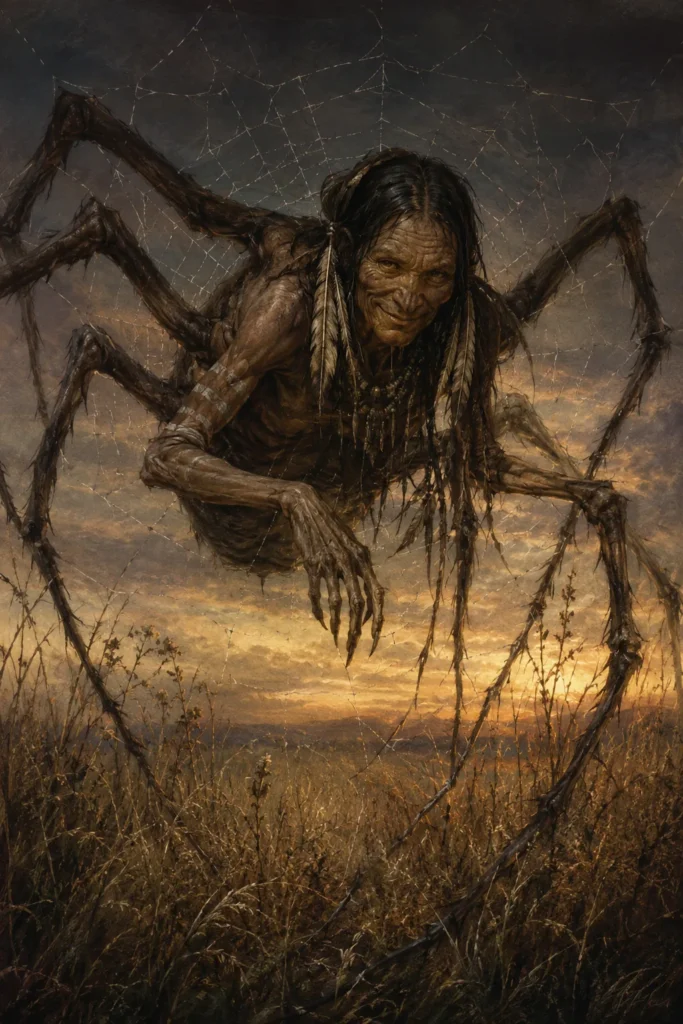
Iktomi appears in the narratives in several forms. His basic form is that of a small, often brightly colored spider living in an irregular web.
He can, however, transform into any other being, most frequently into a young warrior with long hair and fine clothing, into a wise old man, into a woman, or into various animals.
In traditional Lakota narratives, Iktomi is usually described as a wandering warrior who travels alone across the prairie, sneaks into foreign camps and plays his tricks there.
His typical trick is to disguise himself as a helpful relative in order to gain access to women, food or horses, which he then steals or uses to deceive the family.
In surviving Lakota drum paintings and shield paintings, Iktomi occasionally appears as a spider-like figure with a human face, with wide-set eyes and a cunning smile. Contemporary Lakota artists, particularly Oscar Howe and Arthur Amiotte, have depicted Iktomi multiple times in their work, often as a symbolic embodiment of morally ambivalent behavior.
In modern Lakota comics and children’s books, particularly in the works of British-American author Paul Goble, Iktomi has become a prominently featured figure for children.
Goble’s picture books Iktomi and the Boulder (1988), Iktomi and the Berries (1989) and subsequent titles are widespread in many Lakota schools as well as in non-Indigenous American schools and are among the best-known introductions of Indigenous American mythology to a broad audience.
This popular reception brings its own problems of simplification and exaggeration, but has undeniably contributed to the visibility of the Iktomi tradition.
Mythological Narratives
The Iktomi narrative cycle is one of the most extensive narrative complexes in the Lakota tradition.
James LaPointe compiled more than twenty Iktomi stories in Legends of the Lakota (1976), all beginning in a certain standard form: Iktomi went for a walk…, and then describing how he plans a trick, carries it out, and ends up being the one who is fooled.
One particularly well-known narrative describes how Iktomi outwits the buffalo: he persuades a group of buffalo to enter a sage circle and sleep there, having promised them a healing ritual.
Once the buffalo have fallen asleep, he eats them one by one, but the last buffalo is a secret wakan buffalo spirit, who outsmarts him and must finally cut him out of the buffalo’s belly and drive him away.
A second central narrative describes how Iktomi brings the Lakota their most important cultural practices: in some narratives he is said to have introduced the first use of bow and arrow, the first horseback-riding skills and even language itself.
This culture-heroic layering of the Iktomi tradition shows that the trickster is not only a disruptor but also a civilizatory creator, a dual function that appears regularly throughout the wider Indigenous American trickster complex.
Ethical and Pedagogical Function
The Iktomi narratives serve an important pedagogical function in the Lakota tradition. They are told especially around the campfire in the circle of children and serve the ethical education of the next generation.
Iktomi’s behavior is always wrong, he lies, steals, cheats, seduces, and at the end of the narrative the consequences of his behavior almost always catch up with him.
The pedagogical point is the lesson of the negative example: whoever behaves like Iktomi will suffer the same consequences. Children learn from the Iktomi stories what is right and what is wrong, without a moral commandment being directly imposed on them.
Severt Young Bear described this pedagogical function of the Iktomi stories in detail in Standing in the Light (1994) and highlighted their value for Lakota upbringing.
What is significant is the transmission of a paradoxical lesson: Iktomi is a wicked figure whose wicked deeds can at the same time be culturally generative.
Lakota ethics thus conveys an ambivalent view of moral action that is foreign to simple black-and-white morality. The Lakota concept of ethical maturity includes the ability to recognize this ambivalence and integrate it into one’s own conduct.
In modern reservation schools and in Lakota language programs, the Iktomi stories are deliberately used as a means of ethical and linguistic education.
The fact that Iktomi appears multilingual, he speaks Lakota but also the languages of other tribes and even English, depending on the narrative context, makes him a pedagogically productive figure for conveying linguistic competence.
The Lakota language programs in Pine Ridge, Cheyenne River and Rosebud use Iktomi stories as a central teaching text for the revitalization of the Lakota language, which is threatened by language loss.
Protective Practice and Apotropaic Effect
Protective practice in relation to Iktomi is subtle. Unlike clearly negative beings (such as the Wendigo), Iktomi is not warded off but treated with respectful distance. One does not speak of him too much, avoids directly invoking him, and above all protects oneself from being favored or deceived by him.
An important apotropaic practice is the use of the dreamcatcher, the dream catcher originating from Ojibwe culture, which is widespread in modern Indigenous American folklore.
Ironically, the dreamcatcher is associated with the broader spider spirit tradition, not primarily with Iktomi.
The spider web construction of the dreamcatcher catches bad dreams in its threads and lets only good dreams pass through the central opening to the sleeper.
A specific protective practice concerns Wakan-speaking about Iktomi: on cold winter days one should tell Iktomi stories, because he is then especially entertained and least inclined to complicate the life of the storyteller.
This seasonality of Iktomi narration, with the stories belonging to winter and not to summer, is a remarkable prescriptive detail of the Lakota tradition.
An interesting aspect of the Iktomi tradition is the limited ritual presence compared to other wakan beings. There is no institutionalized Iktomi cult, no specific Iktomi temples, no Iktomi priests.
Instead, Iktomi is above all a figure of the narrative tradition, of the oral tradition around the campfire. This ritual restraint toward a clearly morally problematic figure is of interest from a sociology-of-religion perspective and distinguishes the Lakota Iktomi tradition from the more broadly practiced trickster veneration of other cultures.
Parallels in Other Cultures
Iktomi is part of the pan-North American trickster tradition, in which almost every Indigenous language family has its own central trickster figure.
Structurally comparable are Coyote among the Plains and Great Basin peoples, the Raven (Yel or Raven) among the Northwest Coast peoples, the Hare (Manabozho) among the Anishinabe, and the Arctic fox among the Inuit.
Paul Radin (The Trickster, 1956), Karl Kerenyi and Carl Jung in their jointly revised study interpreted the trickster phenomenon as a universal archetype.
This archetypal interpretation is problematic from a religious-studies standpoint because it levels the cultural-historical specificity of individual trickster traditions. Nevertheless, the structural convergence is so clear that an explanation is required.
Within the North American trickster tradition, Iktomi is particularly distinctive through his spider nature. The parallel African Anansi spider tradition, which spread with the slave migration to the Caribbean and South America, represents an independent, fully developed spider trickster tradition that had no historical contact with the Lakota Iktomi tradition yet is structurally remarkably similar.
Contemporary Reception and Research
Iktomi occupies an ambivalent place in the modern Lakota self-understanding. On the one hand he is part of the traditional narrative tradition and continues to be presented in reservation schools, Lakota language programs and the oral tradition.
On the other hand, through the popular use of the dreamcatcher symbol in non-Indigenous New Age culture, he has been drawn into a commercial appropriation that is critically reflected upon in Indigenous discourse.
In academic research, the Lakota writer Vine Deloria Jr. and the Dakota ethnologist Ella Cara Deloria (in her records from 1932), the Lakota anthropologist Severt Young Bear, the contemporary Lakota author Joseph Marshall III and the scholar of religion Åke Hultkrantz have systematically described the Iktomi tradition.
The Iktomi narrative collection by James LaPointe (1976) remains an important primary source.
From a religious-studies perspective, Iktomi is a paradigmatic example of the Lakota trickster tradition and thus of the broader American trickster culture. His dual function as creator-and-disruptor, his morally ambivalent nature and his pedagogical function in ethical education make him one of the richest and most multifaceted figures in the history of Indigenous American religion.
The iWell Guard reference to the Iktomi tradition describes this figure from a religious-ethnological standpoint, without making any claims of efficacy or spiritual recommendations.
A further observation in the religious-studies discussion concerns the gender of Iktomi. In all transmitted narratives he appears primarily as a male being, but can transform into a woman without difficulty.
This gender fluidity of the trickster is a common feature of the pan-American trickster tradition and distinguishes these figures from the mostly clearly gender-defined principal deities.
The sociologist of religion Sabine Lang in Men as Women, Women as Men (1998) systematically described the phenomenon of ritual-theological gender mobility in the Indigenous American tradition and cited Iktomi as one example.
Literature and Sources
The following selection lists key works on Lakota mythology research and the North American trickster tradition.
Iktomi as a Narrative Figure in the Winter Stories of the Lakota
Iktomi, the spider figure of the Lakota, Dakota and Nakota tradition, is known above all as the hero of his own genre of narratives, referred to in scholarship as ohunkakan.
These stories were considered designated for the winter months and differed from accounts understood as true tradition. Iktomi stories were explicitly narratives in which transgression, cunning and failure could be portrayed.
Such narratives were recorded by, among others, James R. Walker, by Ella Deloria, a Dakota linguist who collected extensive material in her native language during the first half of the 20th century, and by earlier 19th-century collectors.
Ella Deloria’s work is particularly valuable because she worked as a native speaker and at the same time as an academically trained researcher, and paid careful attention to accurate linguistic representation.
In the narratives, Iktomi appears as cunning, vain and gluttonous. He devises plans to deceive others and often fails through his own excess. Research emphasizes that these stories had an educational function. By demonstrating how one should not behave, the narratives indirectly convey the norms of the community.
At the same time, in some traditions Iktomi is connected with the origin of language or with the ordering of the world, so that he is not merely a prankster.
The dual role as a culture-founding and at the same time norm-violating being corresponds to the pattern also known from Coyote in other regions, without the two figures being equated.
Literature (Selection)
- Paul Radin: The Trickster (1956)
- James LaPointe: Legends of the Lakota (1976)
- Ella Cara Deloria: Dakota Texts (1932)
- Severt Young Bear: Standing in the Light (1994)
- Joseph Marshall III: The Lakota Way (2002)
- Åke Hultkrantz: Belief and Worship in Native North America (1981)
Iktomi is regarded in the Lakota tradition not only as a cunning trickster but also as a cosmic teacher: in the narratives he participates in the ordering of the world and conveys, often through his own failure, fundamental insights about language, measure and responsibility.
His cosmic status explains why his stories are considered at once as entertainment and as instructive tradition.
As a spider spirit, Iktomi appears in the narratives of the Lakota in manifold forms, connecting the human world with the sphere of the creative primordial forces.
Related key terms: Iktomi Ikto Spider Trickster Lakota Anansi Dreamcatcher Wisaka Sword.
iWell Guard and Protective Traditions
iWell Guard connects with the cultural-historical tradition of wearable protective objects, in the tradition of Native American and many other cultures worldwide. 41 layers, real gold, platinum, silver, crafted in Germany. 30-day return policy.
Personal experiences may vary. Not a medical device. No healing promises.