Samantabhadra, a bodhisattva of the Buddhist tradition
By Ralf Ittermann · last reviewed on
Samantabhadra is a bodhisattva of the Buddhist tradition.
The Bodhisattva of universal virtue, mounted on the golden elephant. Samantabhadra is the Bodhisattva of virtue and of practical action, not wisdom like Manjushri, not compassion like Avalokiteshvara, but the perfection of all good deeds.
Riding a huge white or golden elephant with six or eight tusks, Samantabhadra symbolizes commitment to the welfare of all beings. In the *Avatamsaka Sutra* his name becomes a Mantra of universal virtue. A lesser-known yet profound force, the “yes” to enlightenment through good action.
At a glance: Samantabhadra
Type: Mahayana Buddhist Bodhisattva, embodiment of Buddhist practice and of the vows
Pantheon: Mahayana and Vajrayana Buddhism
Function: practice and action (as opposed to Manjushri’s wisdom), the spread of the Dharma, protector of those who carry the Lotus Sutra
Main attributes: white elephant with six tusks as mount, lotus blossom, wish-fulfilling jewel
Main cult sites: Mt. Emei (Sichuan, one of the four sacred mountains of Chinese Buddhism)
Tibetan identification: Kuntuzangpo (Adi-Buddha in the Nyingma system)
Historical context
Period of the texts
Samantabhadra is attested from the early Mahayana sutras (1st to 2nd century CE), appearing in the Lotus Sutra (chapter 28) as protector of those who follow the Lotus Sutra. The main flourishing of the veneration of Samantabhadra was in Chinese Buddhism, centered on Mt. Emei (from the Tang dynasty, 7th to 10th century).
In the Tibetan Nyingma tradition, Kuntuzangpo is the cosmic form of Samantabhadra, the Adi-Buddha, the primordial Buddha from whom all others arise. This is a central theological position that distinguishes the Nyingma from Gelug Buddhism.
Area of distribution
Main cult sites: Mt. Emei (Sichuan, China, one of the four sacred Buddhist mountains of China, with the gigantic Samantabhadra statue on the Golden Summit), Mindrolling and Dorje Drak (Tibet, principal Nyingma monasteries).
In Japan venerated as Fugen Bosatsu in many temples; in Korea as Bohyeon Bosal. Internationally present in every Mahayana Buddhist temple with a Bodhisattva tradition.
Source situation
Central sources: Lotus Sutra (ch. 28, Samantabhadra’s ten great vows), Avataṃsaka Sutra (Hua-yan Sutra, with the famous Bhadracarī-praṇidhāna, the ten vows of practice of Samantabhadra in the concluding chapter), Samantabhadra Sadhana texts.
Tibetan: Könchog Chidu (Nyingma practice collection), Kunzang Lama’i Shälung. Secondary literature: Williams, Mahayana Buddhism; Cleary, The Flower Ornament Scripture; Lopez, Religions of Tibet in Practice.
Name
Samantabhadra is depicted as a beautiful, youthful Bodhisattva, often clothed in green or gold, on a huge elephant with radiant white or golden hide. The elephant frequently has six or eight long tusks.
Samantabhadra sits in a royal posture, often with the hands in a gesture of prayer or Mudra. The elephant is not wild, but gentle and dignified, strength under control, virtue in action.
Characteristics
Samantabhadra is the commitment to practice. His most famous vows from the Avatamsaka Sutra are the “Ten great vows of Samantabhadra,” in which the practitioner promises not merely to seek enlightenment for themselves, but to save all beings.
These vows are recited daily by millions of Buddhists. Samantabhadra is therefore not a distant god, but an inner principle, the commitment to virtuous action for all.
Appearance and symbolism
Samantabhadra is depicted as a white or golden Bodhisattva, often in a meditative posture. His most characteristic attribute is the white elephant with six tusks, a mount of enormous strength and gentleness at once. He wears a monastic robe and Bodhisattva ornaments.
Profile: Samantabhadra
The most important aspects of Samantabhadra at a glance. The following fields summarize origin, function, appearance, veneration, symbols and cultural parallels.
Samantabhadra (“the all-beneficial one”) arises in the early Mahayana sutras as the embodiment of Buddhist practice. Together with Manjushri (wisdom) and Avalokiteshvara (compassion) he forms the triad of the central bodhisattvas.
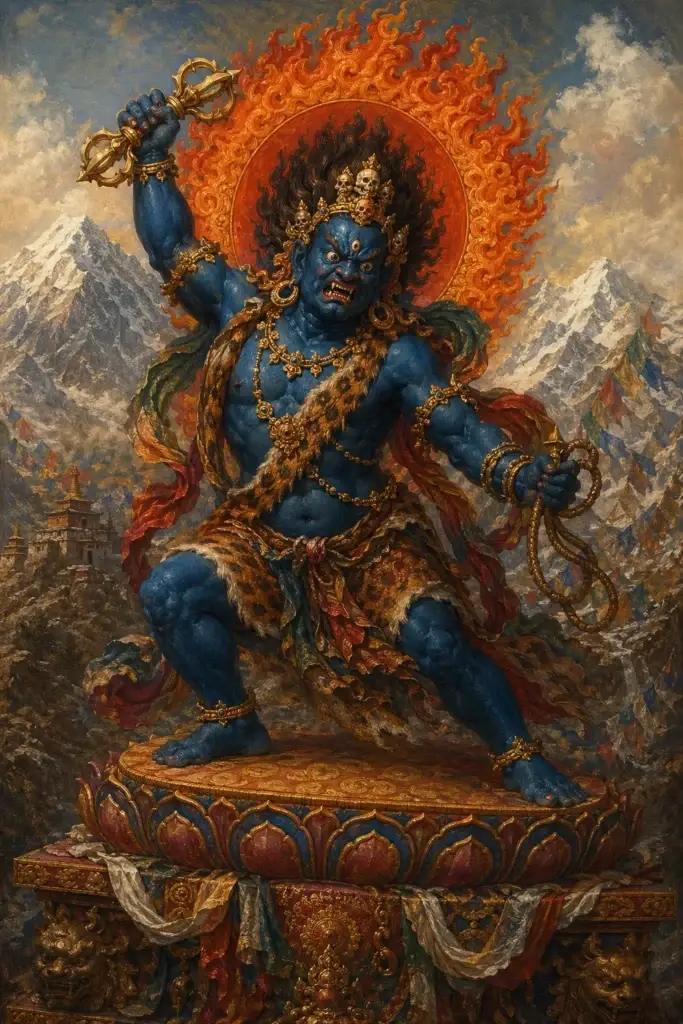
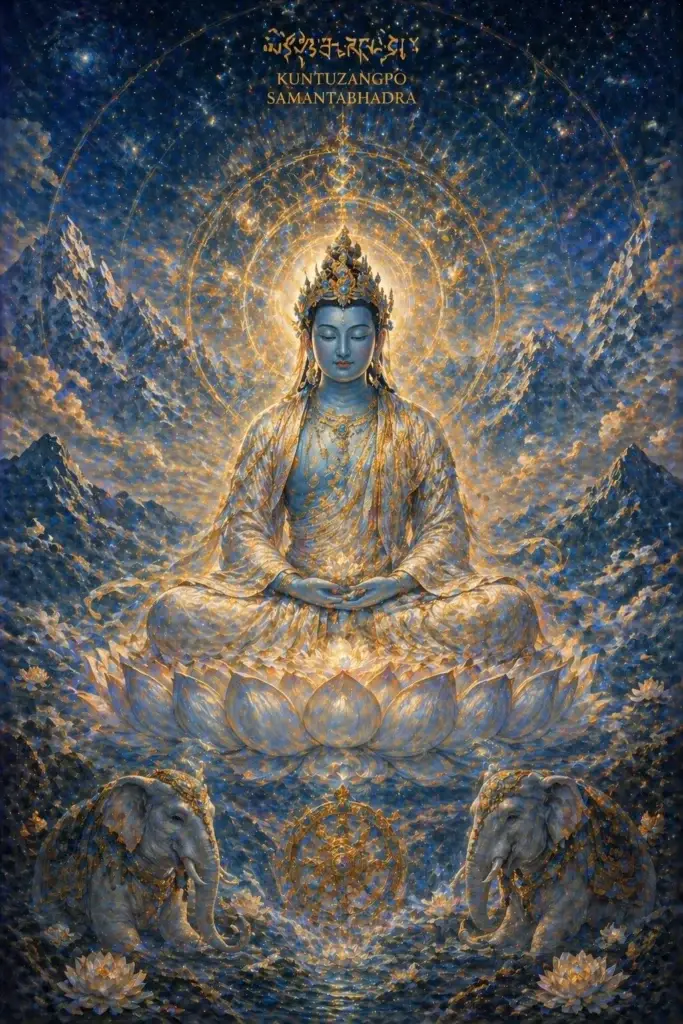
In the Tibetan Nyingma tradition, as Kuntuzangpo, he is the cosmic Adi-Buddha form: uncreated, depicted in naked union with his consort Samantabhadri, he radiant blue, she white, a symbol of the primordial unity of method and wisdom.
Embodiment of Buddhist practice (carya) as opposed to Manjushri’s pure wisdom. The Ten great vows of Samantabhadra from the Avataṃsaka Sutra are a central liturgical text of the Mahayana tradition, recited daily in many Mahayana temples.
In the Tibetan tradition, as Kuntuzangpo, he is the highest, uncreated Buddha-nature from which all other Buddhas and bodhisattvas arise. Patron of spiritual discipline in practice and of the study of the Sutra.
In classical Indian Mahayana form: a young bodhisattva with golden skin color, in lotus posture, with a white elephant with six tusks as mount (the most famous Samantabhadra symbol, the six tusks representing the six paramitas).
He wears a crown, a precious robe, and holds in his hands a lotus blossom or a wish-fulfilling jewel. In the Tibetan Nyingma tradition, as Kuntuzangpo: a naked, radiant-blue Buddha form in union with his white consort Samantabhadri (Yab-Yum), no crown, no jewelry, a symbol of primordiality.
Area of effect: Samantabhadra is venerated in every Mahayana temple, often together with Manjushri and Avalokiteshvara as a bodhisattva triad. Daily recitation of the Ten great vows takes place in many Chinese, Korean and Vietnamese monasteries.
Mt. Emei in Sichuan is one of the most important Chinese Buddhist pilgrimage destinations; on the Golden Summit stands the monumental 48-meter Samantabhadra statue (completed in 2006). In Tibetan Nyingma practice, Kuntuzangpo is the principal meditation deity of the Dzogchen tradition: Atiyoga practitioners meditate on identification with Kuntuzangpo as the original Buddha-nature of the mind.
White elephant with six tusks (main attribute), lotus blossom, wish-fulfilling jewel (Cintamani), crown, bodhisattva robe. In the Tibetan Kuntuzangpo form: Yab-Yum union with Samantabhadri, blue skin color, nakedness (a symbol of being uncreated). Sacred plants: lotus. Sacred animals: white elephant. Sacred numbers: 6 (tusks of the elephant = six paramitas), 10 (ten vows).
Manjushri (Buddhism, bodhisattva of wisdom, triad partner), Avalokiteshvara (Buddhism, bodhisattva of compassion, triad partner), Vajrapani (Buddhism, bodhisattva of power), Adi-Buddha concepts of various traditions (Vairocana, Vajradhara, Kuntuzangpo).
Functionally, Samantabhadra/Kuntuzangpo is unique among the world religions: an Adi-Buddha as uncreated Buddha-nature is a specifically Tibetan Nyingma tradition. In a broader comparison: Brahman (Hinduism, uncreated reality), Ayn Sof (Jewish Kabbalah).
Defense in everyday life
Rituals of defense
A further article with additional sources is being prepared and will appear here shortly.
Invocations
This section will be expanded with further material from the history of religion.
Amulets and protective symbols
Since Samantabhadra is regarded in the Mahayana as a benevolent bodhisattva of practice, the tradition knows no defense against him but rather a practice with him. The Avatamsaka Sutra centers on his ten great vows, which encompass veneration, confession, and the dedication of merit and are recited in East Asian monasteries to this day. Whoever calls upon him seeks to steady his own conduct, not protection from a threatening power.
Cult and veneration
Samantabhadra is intensively venerated in Tibetan Buddhism, with particular significance in Dzogchen tantra. In Chinese Buddhism he is venerated at the mountain temple on Mount Emei. Prayers focus on the purification of karmic obstacles through correct action.
Samantabhadra, parallels in other cultures
Samantabhadra resembles the Mars or Ares of antiquity, both being active forces, yet while these are warlike, Samantabhadra is peaceful and ethical.
With the Saturn of classical astrology he shares the theme of “seriousness and commitment.” In the Western esoteric tradition, Samantabhadra could be compared with the “Magus” card of the Tarot, the one who translates will into action. The elephant symbol is universal for strength, gentleness and longevity.
The ten great vows of Samantabhadra
In East Asian Mahayana Buddhism, Samantabhadra, Chinese Puxian, Japanese Fugen, is known above all through a single, highly influential text: the ten great vows. They form the conclusion of the Gandavyuha Sutra, which in the Chinese canon constitutes the final part of the extensive Avatamsaka Sutra, the Flower Garland Sutra.
In this concluding section, Samantabhadra instructs the pilgrim Sudhana and sets out the practice that constitutes a bodhisattva.
The ten vows include, among others, venerating all Buddhas, praising them, presenting offerings to them, repenting one’s own transgressions, rejoicing in the merits of others, asking the Buddhas to expound the teaching, asking them to remain in the world, always following the teaching, constantly adapting oneself to the welfare of all living beings, and finally transferring all acquired merit to the awakening of all beings.
Decisive is the reach of these vows. They are not limited to a single lifespan or a single realm of the world, but are understood as boundless, extending across countless worlds and ages. Samantabhadra thus embodies the principle of unlimited, tireless beneficial action.
The section with the ten vows is recited in East Asian monasteries to this day and is among the most widely read Mahayana texts of all.
It is a central testimony to the fact that Samantabhadra is understood not primarily as a figure of veneration, but as the epitome of an attitude in practice: the bodhisattva is less a person whom one encounters than a model of action that one follows.
Iconography: the white elephant with six tusks
In the visual arts, Samantabhadra is marked by a clearly recognizable attribute: he rides a white elephant which, in the elaborated form, bears six tusks.
This mount distinguishes him from Manjushri, who appears on a lion, and together with Manjushri he forms the classical pair of the two attendant bodhisattvas of the Buddha Shakyamuni in the East Asian triad.
The six tusks are interpreted in the tradition. A widespread explanation links them with the overcoming of the six sense fields or with the six perfections, the paramitas, which a bodhisattva practices: generosity, ethical conduct, patience, energy, concentration and wisdom.
The white elephant itself is regarded as an emblem of strength that is applied carefully and without haste, an image of patient, steady practice.
In Japan, a particular pictorial type acquired great significance: Fugen as protector of those who recite the Lotus Sutra. From the Heian period, outstanding hanging scrolls survive that show the bodhisattva sitting calmly on the elephant, with hands folded in prayer. Such images were venerated in the practice of sutra study.
A distinct form is Fugen Enmei, Samantabhadra as the prolonger of life, who was invoked in certain esoteric rituals and is at times depicted with multiple arms. This variant shows how a bodhisattva in the esoteric tradition could be connected with concrete ritual concerns without losing his core character.
Samantabhadra as the primordial Buddha in the Nyingma tradition
In Tibetan Buddhism, especially in the oldest school, the Nyingma, Samantabhadra, Tibetan Kuntu Sangpo, holds a significance that goes far beyond that of a bodhisattva. Here he is regarded as the Adibuddha, the primordial Buddha, the beginningless principle of enlightenment itself.
In this conception, Samantabhadra is not one figure among others, but the expression of the Dharmakaya, the truth body, the original, pure nature of the mind that has never been obscured.
In the art of this tradition he is mostly depicted naked and without ornament, of a deep blue color, which is meant to suggest the unconditioned, attributeless nature of the Dharmakaya. He frequently appears in union with his white companion Samantabhadri; this pair symbolizes the inseparability of emptiness and clarity, of space and awareness.
In the teachings of Dzogchen, the Great Perfection, Samantabhadra is regarded as the starting point of the transmission lineage. Enlightenment is understood here not as something to be produced, but as that which is given from the very beginning and which only needs to be recognized again; Samantabhadra is the image of this original state.
It is important to see that this is an independent interpretation that differs clearly from the East Asian conception of the practice-oriented bodhisattva. The name is the same, the religious function a different one.
Scholarship on the religious history of Tibet treats both traditions separately and warns against equating the East Asian and the Tibetan conceptions of Samantabhadra without examination.
Further links
Literature (selection)
Further standard works in the literature index.
Frequently asked questions about Samantabhadra
Who is Samantabhadra in Buddhism?
Samantabhadra (Sanskrit, the perfectly good one, Tibetan Kuntu Zangpo) is the bodhisattva of Buddhist practice and of active conduct. While Manjushri stands for wisdom and Avalokiteshvara for compassion, Samantabhadra embodies the translation of the teaching into action.
He is frequently depicted on a white elephant with six tusks. In the Avatamsaka Sutra he pronounces the famous ten great vows, which are regarded as a guide to bodhisattva practice.
What does Samantabhadra mean in Tibetan Dzogchen?
In Dzogchen, the highest teaching of the Nyingma school of Tibetan Buddhism, Samantabhadra holds a special position: there Kuntu Zangpo is not merely a bodhisattva, but the primordial Buddha (Adibuddha), the original, beginningless embodiment of the enlightened mind itself.
He is depicted naked and in a deep blue color, often in union with his female counterpart Samantabhadri. This depiction symbolizes the unveiled natural state of the mind, free of concepts, prior to all duality.