Yamaraja, God of the Hindu Tradition
By Ralf Ittermann · last reviewed on
Yamaraja is a god of the Hindu tradition.
King of the dead, the first mortal who found the way into the afterlife and became the judge of the deceased. Yamaraja, also called Yama or Dharmaraja (the judge of virtue), rules the realm of the dead not as a place of eternal punishment but as a transitional station in the cycle of rebirth.
He keeps the incorruptible book of deeds, a mirror of karma, and decides which life a soul will receive next. With his lasso he seizes those whose time has come, and with his staff he upholds the order between life and death.
Yamaraja
At a Glance: Yamaraja
Type: death deity, ruler and judge of the afterlife
Pantheon: Hinduism (Veda to Purana)
Function: ruler of the realm of the dead Yamaloka, judge after death, keeper of karma
Main attributes: Pasha (lasso/noose), Danda (staff of justice), book of deeds (Chitragupta), water buffalo
Main cult sites: Yamunotri (source of the Yamuna), Tamil Nadu (Sirkali), South and West India
Buddhist reception: Yama Dharmaraja (Tibet), Enma (Japan)
Historical Classification
Period of the Texts
The tradition concerning Yamaraja reaches from the Rigveda (circa 1500 to 1200 BCE, hymn 10.14) into the present day. The most detailed accounts are found in the Garuda Purana (probably 9th to 10th century CE), which contains central statements on eschatology and the judgment of karma.
In the Katha Upanishad (presumably 6th to 5th century BCE), Yamaraja instructs the boy Naciketas in the mysteries of immortality and death. The Mahabharata and the Manusmriti take him up regularly; in more recent writings (Bhagavata Purana, Brahma Purana) his role remains central.
Area of Diffusion
Yamaraja is venerated across the Indian subcontinent from north to south, with an emphasis in South and West India (Karnataka, Tamil Nadu, Maharashtra), where traditional temples exist. His veneration spreads with the Hindu diaspora across Southeast Asia, the Caribbean (Trinidad, Mauritius), and the Western world.
In Buddhism he is taken up as Yama Dharmaraja in Tibet and in the Bardo Thodol (Tibetan Book of the Dead); in the Japanese tradition he appears as Enma in Buddhism and in folklore.
Source Situation
Central are the Rigveda (hymn 10.14), the Atharvaveda, the Katha Upanishad, the Mahabharata (especially in the Sabha Parva and the Vana Parva), the Garuda Purana, the Brahma Purana, the Bhagavata Purana, and the Manusmriti.
Tantric and ritual-technical sources are supplemented by the Pinda Sutras and funerary Vedangas. Secondary scholarly commentaries derive from Adi Shankara and other Vedanta schools.
Name and Variants
Sanskrit: Yama (यम), literally “bridle” or “restrainer,” originally denoting the bridle of horses, later control and order. Yamaraja (यमराज) means “King Yama.” Dharmaraja (धर्मराज) means “King of Virtue” or “Judge,” a frequent epithet. Further epithets: Mrityu (death), Antaka (ender), Samvartaka (the gatherer), Kritanta (decider).
Related designations: Yamaloka (the realm of Yama), Yamaloka-pati (lord of Yamaloka), Pitra-pati (lord of the ancestors). Important family: son of Surya (the sun) and Saranyu (a goddess of water vapor), twin brother of Yami (first mortal woman and goddess of the river Yamuna).
Characteristics
Appearance
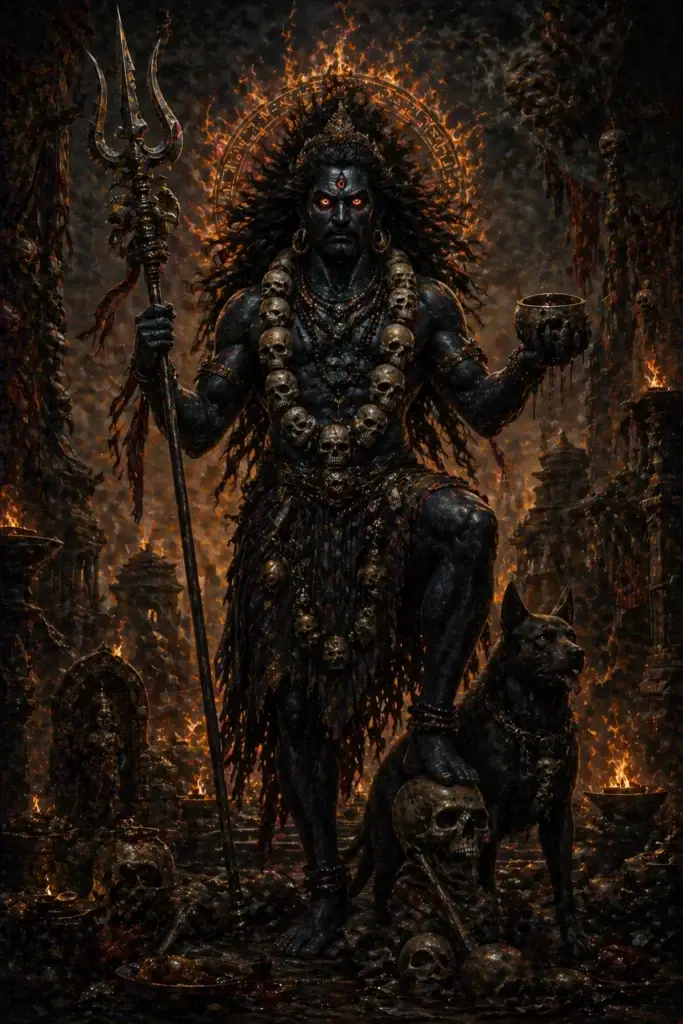
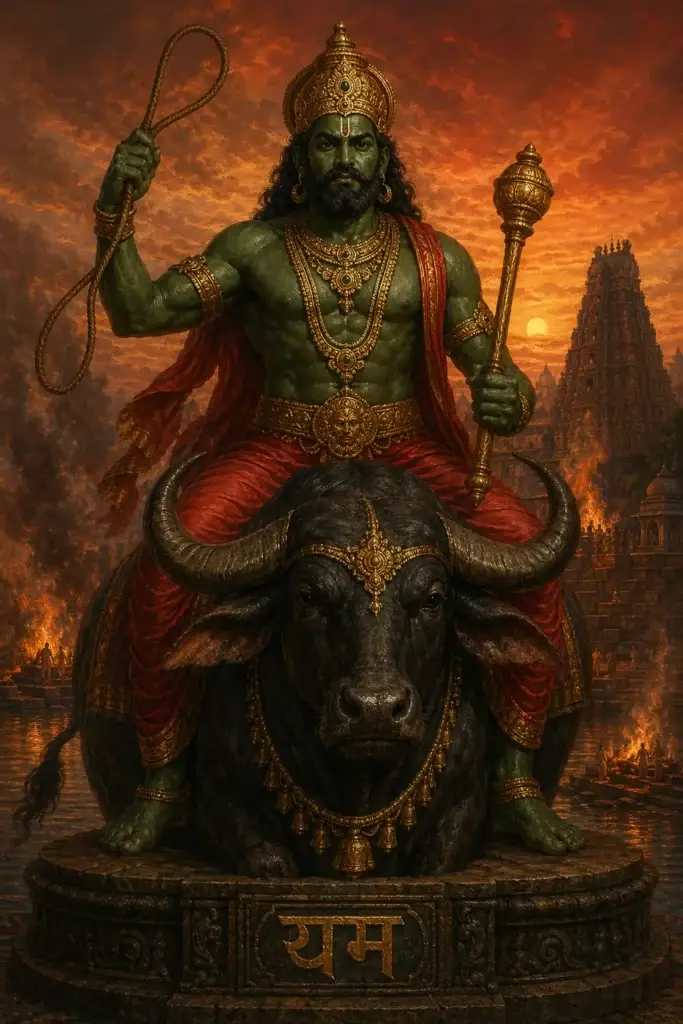
Yamaraja is usually depicted dark green or dark red, more rarely black. He wears a red or golden robe, a turban or a crown, and earrings.
In his hands he holds his characteristic lasso Pasha, the noose with which he catches the souls of the deceased, as well as the Danda, a staff or club, the symbol of his judicial authority.
His mount is the Mahisha, the water buffalo, black or blood red. At his side sits his scribe Chitragupta, who keeps the infallible book of deeds, in which every action of every being is recorded.
Nature and Activity
Yamaraja is not the embodiment of death itself, which is Mrityu or Kala (time), but the administrator and judge of the afterlife. Unlike a Western hell, Yamaloka, his realm, is not a place of punishment for eternity.
Rather, every soul presents itself to him after death to give account: Chitragupta reads from his book, Yamaraja recognizes the karma and decides in which form and in which life the soul will be reborn.
Righteous souls quickly find their next existence; souls burdened with heavy karma undergo processes of purification. Yamaraja himself is incorruptible; no sacrifice and no plea can change his verdict.
Profile: Yamaraja
The most important aspects of Yamaraja at a glance. The table summarizes origin, function, appearance, veneration, symbols, and parallels.
Son of Surya (the sun god) and Saranyu. As the first human who died, he found the way into the afterlife on his own, established an order there, and thereby became the eternal ruler of the realm of the dead.
In the Mahabharata his fatherhood is in part shared with Yudhishthira, the eldest Pandava brother.
Ruler of the realm of the dead Yamaloka, incorruptible judge after death, decider over karma and rebirth, keeper of the cosmic order (Dharma), guide of souls in the process of dying.
A dark green or dark red divine king, with turban or crown, in a robe, with Pasha (noose) and Danda (staff), riding on a black or blood-red water buffalo, accompanied by Chitragupta, the scribe.
Main cult sites in Yamunotri (source of the Yamuna, Uttarakhand), Tamil Nadu (Sirkali temple), as well as in South and West India. Veneration in accompaniment of the dying through Yama mantras, prayers at the death of a family member.
Pinda (food offerings for the deceased) is presented to the name of Yama in order to request his blessing for the journey into the afterlife. The Bhai Dooj festival (festival of brothers and sisters, in the Diwali period) celebrates the legendary embrace between Yama and his twin sister Yami.
Hades and Pluto (Greece/Rome, rulers of the underworld), Anubis and Osiris (Egypt, weighing of souls, judgment), Ereshkigal (Mesopotamia, mistress of the underworld), Hel (Germanic, daughter of Loki, mistress of Helheim), Mictlantecuhtli (Aztec, god of the realm of the dead).
The function of the karma mirror is shared most strongly with Anubis and the Egyptian weighing of the dead.
Veneration in Everyday Life
Yamaraja is less present in everyday Hindu veneration than great principal gods such as Shiva or Vishnu, yet at critical life events, above all at dying, he is invoked.
In severe illness or immediately before death, Yama mantras are recited, for example from the Yajnavalkya Smriti: “Om Yamaaya Namah” (reverence to Yama). These prayers are meant to safeguard the soul and to ask Yama for a gentle execution.
After the death of a family member the Pinda ritual is performed: balls of rice or wheat are offered to the name of the deceased, with an invocation of Yama, so that he safely guides the soul into the next life.
The Bhai Dooj festival, celebrated on the second day after Diwali, recalls a meeting between Yama and his twin sister Yami, at which they embraced and Yama promised that no brother would die through Yami.
On Bhai Dooj, sisters place a blessing on the forehead of their brothers in order to place them under Yama’s protection. Numerous family names and given names are derived from the name Yama or contain it (such as Yamuna for women, in memory of the sister).
Yamaraja, Parallels in Other Cultures
Further standard works in the literature index.
Further Links
- Hades, Greece (comparison: incorruptible judge)
- Anubis, Egypt (weighing of karma)
- Osiris, Egypt
- Yami, Hinduism (twin sister, river deity)
- Chitragupta, Hinduism (scribe and companion)
- Death Deities, sub-category
- Gods, class overview
Sources and Literature
Frequently Asked Questions about Yamaraja
Who is Yamaraja in Hinduism?
Yamaraja (Sanskrit Yama-rāja, King Yama) is the Hindu god of death and judge of the dead. He is the first mortal who died and thus the first to have found the way into the afterlife.
Yama rules over the world of the dead (Yamaloka) and keeps the book of death (Yamadharma), in which all the deeds of every human being are recorded. He is typically depicted with green or dark blue skin, rides a black buffalo, and carries a staff (Yamadanda) and a lasso cord (for catching the souls).
What is the relationship between Yamaraja and Yama?
Yama and Yamaraja are essentially the same figure; the name Yama is the older, Vedic designation (Rigveda 10.14), Yamaraja (King Yama) is the later, more honorific form.
In Hindu theology Yama is at once: firstborn human, first mortal, cosmic judge, and one of the eight world guardians (Lokapalas), warden of the southern direction. In Buddhism Yama becomes the lord of the sixth hell realm (Naraka) and has a similar judicial function. In Japan he is venerated as Enma-Ō.