The Asuras are the great counter-figures to the Devas, the Vedic and Hindu gods. According to the Puranas, both classes descend from the progenitor Prajapati (or Kashyapa) and are therefore related, not simply enemies.
Their rivalry over cosmic order, over the ambrosia amrita, over power and influence runs through the entire Indian mythology, from the Rigveda to the Puranas.
Notably, in the oldest layers of the Rigveda the term “asura” is initially a positive designation applied even to gods such as Varuna. Only gradually does the meaning shift toward the adversary.
The parallel with the Iranian-Avestan tradition is striking: there, the ahura are the good gods and the daeva the demons, exactly the reverse of the Indian development.
Vedic Rigveda Origins and the Asura-Deva Opposition
The Asura category has its roots in the Vedic tradition, documented in the Rigveda (c. 1500-1200 BCE), one of the oldest Indo-European religious texts.
In the Rigveda, asura are not primarily demonic but rather competing cosmic powers, often endowed with divine attributes. The opposition between Asura and deva (gods) is originally not a moral but a cosmic hierarchical distinction.
Early Vedic hymns describe Asura as powerful and intelligent, frequently as cosmogonic partners of the Deva in rival creation conflicts. Only in late Vedic texts and proto-Puranic collections does a moral degradation occur: Asuras are recoded as evil or inferior powers.
This reinterpretation likely reflects historical Indo-Aryan conflicts with pre-Vedic populations whose deities were stigmatized as Asura. The continuity from Vedic rivalry to Puranic demonization is a complex process in the history of theology.
Type: Counter-gods, cosmic rivals of the Devas
Origin: Descendants of the progenitor Prajapati/Kashyapa according to the Puranas
Subtypes: Daityas (from Diti), Danavas (from Danu)
Texts: Rigveda, Brahmanas, Mahabharata, Puranas
Period: Vedic to the present
Early attestations in the Rigveda (from c. 1500 BCE), where “asura” is initially used in a positive-neutral sense. The Brahmanas and Upanishads (800-500 BCE) consolidate the polarity. The epics and Puranas introduce the major Asura figures.
Indian subcontinent. Spread via Hindu and Buddhist missions to Southeast Asia. In Buddhism, Asura is retained as a realm of existence (asura-gati) and thus migrated to East Asia.
Rigveda, Atharvaveda, Brahmanas, Ramayana and Mahabharata, Puranas (Bhagavata, Vishnu, Devi), Tantras. Key narratives: Samudra Manthan, Durga-Mahishasura, Krishna avatar battles.
Sanskrit: asura, plural asurāḥ.
Subtypes: daitya (from Diti), danava (from Danu), both fathered by Kashyapa.
Etymology: disputed; related to asu “life breath”; Avestan-Iranian ahura.
Notable figures: Hiranyakashipu, Mahishasura, Vritra, Bali.
The Indo-Iranian split is unique: the same root becomes the supreme deity in Iran (Ahura Mazda), while in India it becomes the adversary of the gods.
Appearance
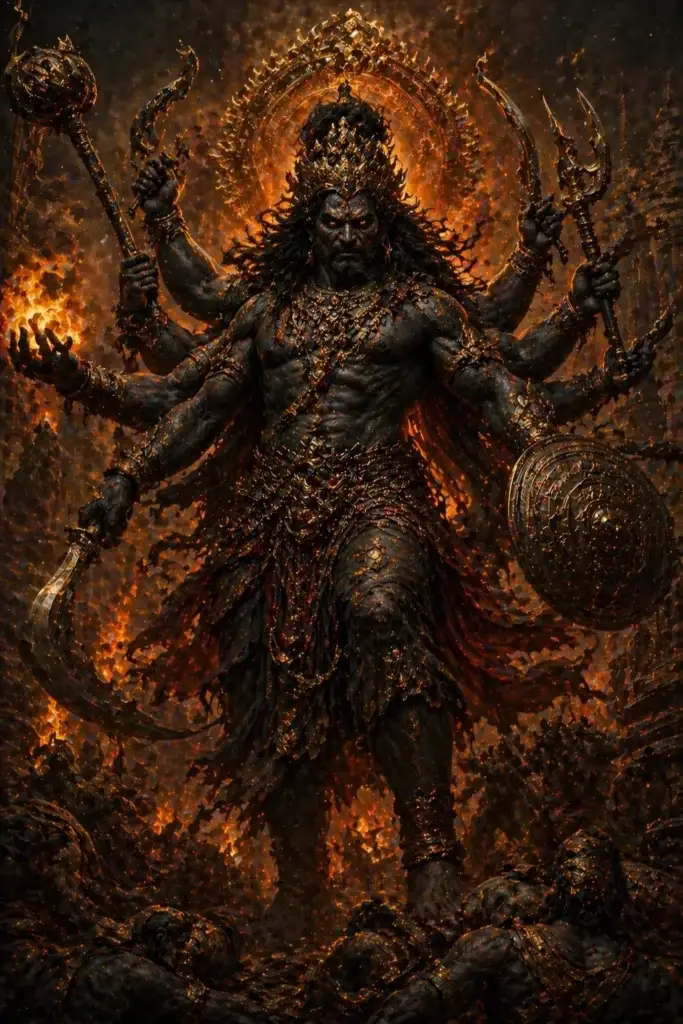
Martial, often with multiple arms and heads. Occasionally in animal form (Mahishasura as a buffalo). In iconography armored and crowned.
Behavior
Typical pattern: an Asura practices asceticism, obtains divine blessing, becomes invulnerable, and disrupts the cosmic order. The gods intervene (Vishnu avatars, Durga, Shiva) and defeat the Asura.
Sphere of Influence
Cosmic: heaven, the underworld, the three worlds. Patala is the underworld of the Asuras.
Mythological Origin
Fathered by Kashyapa with Aditi (Devas), Diti (Daityas), and Danu (Danavas). Sibling relationship with the Devas.
Mahabharata Classification and the Cosmic Wars
The Mahabharata (redacted approximately 400 BCE to 400 CE) establishes the Asura as an established cosmic class with defined characteristics and roles in supernatural hierarchies. In the Mahabharata, Asura are conceptualized less in moral terms than in functional ones: they are warriors, sorcerers, and rivals who compete with Deva for cosmic resources.
The Mahabharata specifically highlights Asura capabilities: maya (supernatural illusory art), tapasya (ascetic accumulation of power), and supernatural weapons. The texts portray Asura not as purely evil but as morally ambivalent: they can act ethically or unethically depending on their choices.
This ambivalence distinguishes the Mahabharata understanding from later Puranic versions, which introduced stronger moral Manichaeism. The cosmic wars between Deva and Asura become metaphors for ethical conflicts within humanity.
The most important aspects of the Asura at a glance.
Descendants of Kashyapa with Diti/Danu. Half-siblings of the Devas. The Indo-Iranian root connects them with the Avestan Ahura.
The cosmic order and the Devas. Challengers of the higher gods.
Martial, with multiple arms and heads; animal forms are possible. Armored, regal, equipped with powerful weapons.
They disturb cosmic order through power gained by asceticism. They occupy heaven and the underworld and must be defeated by divine avatars.
No individual warding: divine intervention is required. Vishnu avatars, Durga against Mahishasura, Shiva against Tripurasura.
Avestan Ahuras (inverted counterparts), Titans, Jotnar, Anfrit in Zoroastrianism.
Samudra Manthan
Devas and Asuras work together to churn the ocean of milk in order to obtain Amrita. Vishnu, in the guise of Mohini, deceives the Asuras and delivers the Amrita to the Devas, the source of enduring resentment.
Narasimha against Hiranyakashipu
Hiranyakashipu gains invulnerability except at twilight, neither indoors nor outdoors, and by neither man nor beast. Vishnu as Narasimha (man-lion) defeats him at the threshold.
Durga and Mahishasura
The buffalo Asura Mahishasura can only be defeated by a female power. The Devas unite their energy in Durga, who slays him after nine days of battle, commemorated as Navaratri.
Indo-Iranian split: Zoroastrianism: Ahura Mazda as supreme deity, Daevas as demons. This is the inversion of the Indian development. Both traditions trace back to a shared Indo-Iranian origin.
Buddhist reception: Asura-gati as one of the six realms of existence. Rebirth as an Asura results from envy and pride.
Modern reception: Bollywood, the literature of Amish Tripathi, and the non-fiction works of Devdutt Pattanaik. Fantasy universes adapt the Asura concept internationally.
The Buddhist Six-Realms Doctrine and the Japanese Shura Tradition
In Buddhism, Asuras were integrated into the schema of the six realms of existence (Gati), where they constitute a distinct realm category.
This Buddhist classification transformed the Hindu-Vedic Asuras into supernatural beings who are incarnated by karma into a realm between gods and humans. In this teaching, Asura are characterized by pride, aggression, and endless rivalry; they experience constant suffering through the conflicts they cause.
The Buddhist Asura-realm concept was elaborated especially in Mahayana Buddhism, where Asuras are interpreted as spiritual learners capable of liberation. In Japan, these concepts were transferred as Shura (a phonetic adaptation of the Sanskrit) and became central to Japanese Buddhist philosophy.
In Japanese aesthetics, the Shura embodied the suffering of endless battle; Shura-e (Shura painting) became a distinct artistic genre visualizing states of inner conflict.
The term asura underwent a profound transformation in the course of Indian religious history, a transformation that is central to understanding this class of beings. In the oldest strata of the Rigveda, asura is not a pejorative expression.
It designates a lordly, powerful dignity and is applied to great gods such as Varuna, Mitra, and Indra. Asura here means something like lord or holder of life force.
In the course of the Vedic period, usage shifts. Increasingly, asura becomes the antonym of deva, the heavenly god. What was originally a title of honor becomes the designation for a distinct group of powers hostile to the gods.
In the Brahmana texts this opposition is already fully developed: Devas and Asuras are two rival clans contending for dominion over the world.
Scholarship has proposed various explanations for this shift. An older hypothesis, now viewed critically, linked it to the relationship with Iranian religion, in which the cognate word ahura, as in the name Ahura Mazda, designates precisely the highest positive deity, while daeva there became the term for demons.
This mirror-image distribution is striking, but a direct historical connection remains disputed. More likely is an internal Indian development in which a folk-etymological reading of a-sura as “non-god” reinforced the semantic shift.
Even in their later, negative form, Asuras are not mere villains. They are powerful, often pious and ascetic, and their defeats at the hands of the Devas are frequently only temporary. The opposition is less one of good versus evil than of two cosmic parties.
The best-known myth in which Devas and Asuras cooperate and yet compete is the Churning of the Ocean of Milk, in Sanskrit Samudra Manthana. It is transmitted in the Mahabharata, in several Puranas, and in the Ramayana, and belongs to the most frequently depicted narratives in Indian art.
The gods, weakened and close to losing their immortality, form a pragmatic alliance with the Asuras on Vishnu’s advice. Together they intend to churn the ocean in order to obtain Amrita, the drink of immortality, along with other precious things.
The mountain Mandara serves as the churning rod, the serpent Vasuki as the churning rope. The Asuras grasp the rope at the head end, the Devas at the tail end, and both parties pull in alternation.
From the ocean there rise in succession numerous beings and objects, among them the goddess of fortune Lakshmi, the celestial horse, the wish-fulfilling tree, and finally the deadly poison Halahala, which Shiva drinks and holds in his throat. Last to appear is Dhanvantari, the physician of the gods, bearing the vessel of Amrita.
At that point the alliance breaks. Vishnu assumes the form of the enchanting woman Mohini, takes charge of the distribution, and gives the Amrita to the Devas alone.
The Asura Rahu sneaks into the row of gods, but the sun and moon betray him; Vishnu cuts off his head, which has however already touched the drink and thus became immortal.
From this episode the myth explains solar and lunar eclipses, interpreted as Rahu’s act of swallowing. The narrative presents the Asuras not as mere losers but as necessary participants in a cosmic process who are deprived of their reward through trickery, not through weakness.

The Asuras are not confined to Hinduism. Buddhism adopted this class of beings and assigned it a fixed place in its cosmology. In the Buddhist teaching of the six realms of existence into which beings are reborn according to their karma, the Asuras form their own realm, the asura-gati.
Their position is peculiar. Asuras are regarded as powerful and long-lived, in some respects similar to gods, yet their existence is defined by envy, quarrelsomeness, and constant battle.
They gaze upon the happiness of the gods and covet it without being able to attain it. In some enumerations of the realms of existence they are therefore not listed separately but are assigned in part to the gods and in part to the lower realms, a point the Buddhist tradition handles inconsistently.
A recurring motif of Buddhist texts is the war of the Asuras against the gods of the Heaven of the Thirty-Three, led by their commander Sakka, who corresponds to the Hindu Indra. This battle for the world mountain is described as an endless struggle that never comes to rest.
In terms of religious psychology, the Buddhist tradition has understood the Asura realm as a symbol of a particular state of mind: an existence governed by competition, envy, and comparison with others. Such an existence possesses power and apparent happiness, yet is inwardly torn by dissatisfaction.
In the Tibetan depiction of the Wheel of Life (Bhavachakra), the Asura realm occupies a fixed place, often shown with the wish-fulfilling tree whose roots lie with the Asuras while its fruits are harvested by the gods.
The class of Asuras comprises a number of individual figures who in the epic and Puranic literature have their own fully elaborated stories. These make clear that Asuras are by no means universally regarded as condemned, but frequently appear as figures of high religious standing.
Prahlada is the most striking example. He is the son of the Asura king Hiranyakashipu, yet at the same time a perfect devotee of Vishnu. His father therefore persecutes him by cruel means, but Prahlada is repeatedly protected through his devotion.
The narrative culminates in the appearance of Vishnu in the man-lion form Narasimha, who slays Hiranyakashipu. Prahlada himself is regarded in the tradition as an exemplary pious person, an Asura who is morally superior to the gods.
Bali, a grandson of Prahlada, is another magnanimous Asura king. Through pious deeds he had gained dominion over the three worlds. Vishnu appears as the dwarf Brahmin Vamana and requests as much land as he can measure with three steps.
Bali grants this despite being warned, and Vishnu traverses heaven and earth with two steps. Yet because of his truthfulness, Bali is not destroyed but receives dominion over the underworld and the promise of future exaltation. In Kerala his annual return is celebrated at the Onam festival.
Other Asuras, such as Mahishasura, the buffalo demon slain by the goddess Durga, or Vritra, whom Indra conquers in the Rigveda, represent the hostile side. This breadth of character, from the saintly Prahlada to the chaotic Vritra, shows that the Asura class is not a uniform moral type.
Further standard works in the literature index.
Asuras in Hindu mythology are a class of powerful supernatural beings, the cosmic adversaries of the Devas (gods). In the Rigveda they are still ambivalent (Mitra and Varuna are also called Asuras), but in later texts they are increasingly depicted as demonic.
Famous Asuras include Mahishasura (the buffalo demon, defeated by Durga), Hiranyakashipu (defeated by Narasimha), and Ravana (defeated by Rama). They represent not so much evil as untamed power.
In Hinduism, Asuras are clearly marked as adversaries of the Devas, generally in a negative light. In Buddhism, Asuras constitute one of the six realms of existence (into which beings can be reborn): positioned between gods and humans, yet characterized by envy, pride, and belligerence.
The Buddha taught that existence as an Asura is also full of suffering, since the eternal struggle for status brings no freedom. In Tibetan Buddhism, Asuras are depicted in the Bhavachakra (Wheel of Life).
Against its influence, cross-cultural tradition names these protective means:
Recommended protective means
The simplest protective means in this collection: 41 layers of fine gold 999, platinum, silver and silicon, manufactured in Ruhla, Thuringia. It requires no activation, is bound to no person, and is effective within a radius of around 50 meters, even without being worn.
Related Beings

The Gwyllion, the eerie female mountain spirits of Wales. Origin, warding off with iron and their...

The Salige Frau, the wise and benevolent mountain fairy of the Eastern Alps. Origin, her bond wit...

The Hospodáříček, the Bohemian house spirit and the house snake by the hearth. Origin, the Domovo...

Palden Lhamo: the only female protective deity in the Tibetan pantheon. A terrifying rider as gua...

Moryana, the Slavic sea and storm spirit. Origin, the sea wind of the Volga, and the religious-st...

The Näcken: naked fiddler by Scandinavian waters, who lures with music into the water. Legends, i...