Iblis, God of the Islamic Tradition
By Ralf Ittermann · last reviewed on
The Refuser, Adversary of Islam.
Iblis and the Refused Prostration
Iblis is primarily the figure of refusal in the Islamic tradition, a jinn and not a fallen angel. Seven surahs (Q 2:34; 7:11-18; 15:28-43; 17:61-65; 18:50; 20:116-123; 38:71-85) offer a coherent account: Allah creates Adam from clay, commands all angels and Iblis to prostrate; Iblis refuses, claiming he was created from fire and is therefore nobler than clay.
This sin of pride (kibr) results in his condemnation.
Iblis asks for a reprieve until the Day of Judgment and receives it, becoming the tempter of humanity. In this role he is also called al-Shaytan (“the Adversary”) or al-rajim (“the Stoned One”).
The Sufi reading (al-Hallaj, Attar) interprets his refusal paradoxically: out of love for Allah, he wished to bow only before God. This reading is considered heretical in the mainstream, yet it is theologically elaborate.
Iblis is the principal adversary figure of the Islamic tradition. His key scene, recounted in multiple places in the Quran (including Surah 2:34; 7:11, 18; 15:28, 35; 38:71, 85), is his refusal to prostrate before Adam.
When God creates the human being from clay and commands the angels to render homage, Iblis objects: he was made from fire, while Adam is merely clay. This single act of refusal makes him the leader of the Shayatin.
Structurally he differs from Satan: according to Surah 18:50, Iblis is not an angel but a jinn, yet he stood among the angels, such was his rank.
His fall is not a power struggle but an act of disobedience. His activity until the Day of Judgment is permitted by God: he may tempt human beings but not compel them.
Key Quranic Texts
Iblis appears in the Quran across several surahs. The central narrative is his refusal to prostrate before Adam: And when We said to the angels, “Prostrate before Adam”, they prostrated, except Iblis (Surah 2:34; similarly 7:11, 12; 15:28, 32; 17:61; 18:50; 20:116; 38:71, 74).
This refusal is the primal sin of the Quran and establishes Iblis as the principal adversary of human salvation.
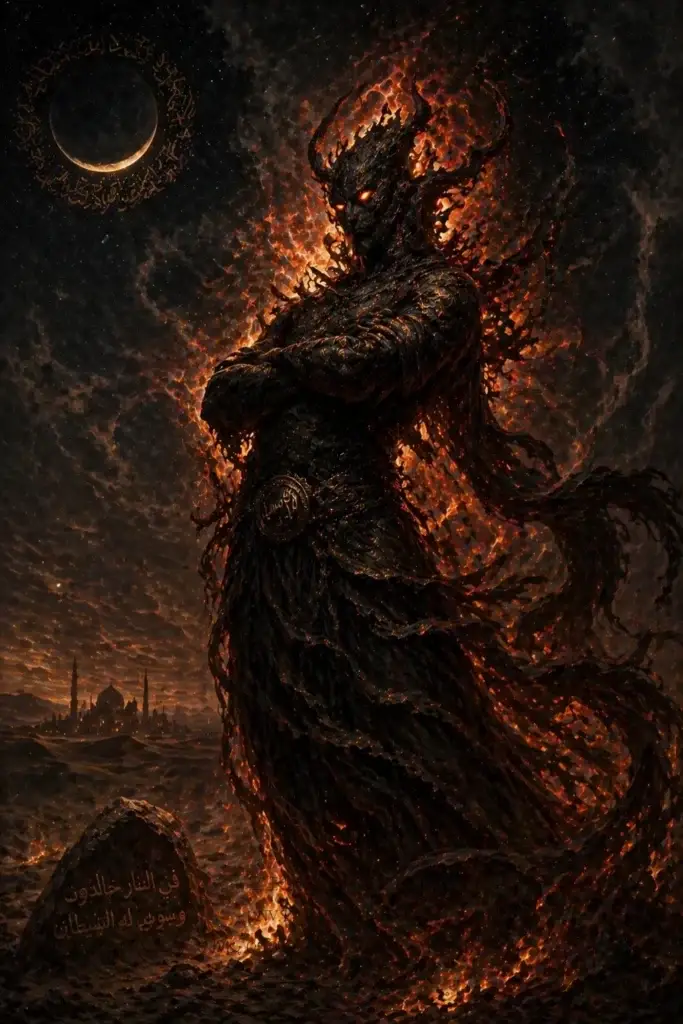
In the accompanying verses, Iblis states his reason: he was created from smokeless fire (marij min nar), while Adam was made from clay; to prostrate before a being of lesser creation was, in his view, unacceptable.
This construction in Surah 38:76 makes pride the structural cause of the fall, paralleling the Christian-Luciferian tradition of superbia.
Iblis at a Glance
Type: Adversary, leader of the Shayatin
Origin: Jinn made of smokeless fire (Surah 18:50)
Names: Iblis, Azazil (pre-Islamic), ash-Shaytan al-Rajim
Texts: Quran (numerous passages), Hadith, qisas al-anbiya
Function: Tempter, teacher of falsehood, end-times adversary
Classification
Quranic foundation established in the 7th century CE. Elaborated reception in classical Quranic exegesis (Tafsir), qisas al-anbiya (“Stories of the Prophets”), and Sufi literature (especially al-Hallaj and Ibn Arabi, with distinctive interpretations). Modern reception in Islamic theology and popular piety.
The Islamic world as a whole. Local popular piety connects Iblis narratives with regional demon motifs, including North African, Turkic-Central Asian, and Southeast Asian traditions.
Quran (Surahs 2, 7, 15, 17, 18, 20, 38, and others), Hadith collections (Bukhari, Muslim), qisas al-anbiya (al-Kisa’i, al-Tha’labi), Sufi literature (al-Hallaj, Ibn Arabi, Rumi), modern theological studies.
Names and Spellings
Arabic: Iblis, probably derived from the Greek diabolos.
Pre-Islamic / apocalyptic: Azazil (in some traditions the name Iblis bore before his sin).
Epithets: ash-Shaytan al-Rajim, “the stoned devil”; al-Khannas, “the one who withdraws”; ‘Aduw’ Allah, “enemy of God”.
The etymology from diabolos marks contact with the Christian-Jewish tradition that predates Islam. The epithets distribute different aspects: his expulsion from the presence of God, his flight when Allah is mentioned, and his enmity.
Characteristics
Appearance
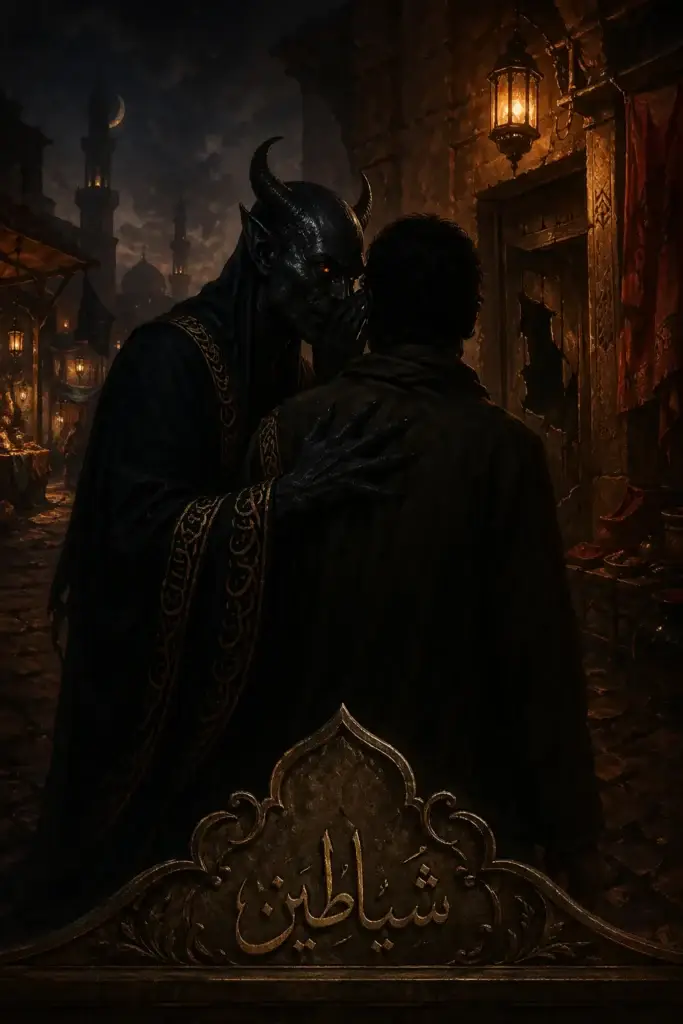
The Quran gives no physical description. Sufi literature emphasises his fiery nature. Folk tradition depicts him as terrifying, horned, and flaming. There is no canonical pictorial Islamic tradition in the strict sense.
Behaviour
He refuses to prostrate before Adam. He asks Allah for a reprieve until the Day of Judgment in order to tempt humanity. Allah grants it; Iblis thereby becomes a test, not a cosmic counter-power.
Domain of Influence
All of humanity. His preferred instrument is waswasa (whispering). He acts not through force but through whispering doubts and false thoughts.
Mythological Classification
According to Surah 18:50 he is a jinn, made of smokeless fire. This distinguishes him fundamentally from the Christian-Jewish “fallen angel“. Sufi interpretations (especially al-Hallaj) also read Iblis’ refusal as an expression of the purest tawhid-monotheism: he wished to bow before God alone, not before a creature.
Sufi Tradition and Ambivalent Readings
The Sufi tradition on Iblis forms a distinct and, from a history-of-religions perspective, fascinating layer. Mansur al-Hallaj (died 922) developed a paradoxical reading in his Kitab al-Tawasin: Iblis is the true monotheist, who by his very refusal commits himself absolutely to God, since he prostrates before no other being.
This reading was rejected by orthodox Islamic tradition as heresy and led to al-Hallaj’s execution, yet it remained alive in the Sufi tradition. Farid ud-Din Attar (died 1221) developed it further in his Mantiq at-Tair; Ibn Arabi (died 1240) integrated it into his speculative theosophy.
The contemporary scholarly treatment of this tradition is found in Peter J. Awn, Satan’s Tragedy and Redemption. Iblis in Sufi Psychology (Brill, Leiden 1983), and in Annemarie Schimmel, Mystische Dimensionen des Islam (Diederichs, Cologne 1985).
Profile: Iblis
The most important aspects of Iblis at a glance.
A jinn made of smokeless fire, holding a high position among the angels. He refused to prostrate before Adam and has since been the tempter of humanity.
All of humanity, and in particular the faithful. His whispering (waswasa) aims at doubt, disobedience, and pride.
No canonical iconography. The Sufi tradition emphasises his fiery nature. Popular imagery depicts him as horned and terrifying.
Temptation through whispering, not through compulsion. His activity is permitted by God as a testing ground; the human being retains the choice.
The ta’awwudh formula (“I seek refuge in Allah from the accursed Shaytan”), the basmala, recitation of the three protective surahs (Ikhlas, Falaq, Nas), and ruqya.
Satan, Lucifer (Christian), Azazel (Jewish), Ahriman (Zoroastrian), Mara (Buddhist).
Protection and Practical Guidance
Protective Rituals
Ta’awwudh before prayer and Quranic recitation. Basmala before every action. Daily recitation of the three protective surahs and the Throne Verse (Ayat al-Kursi). Ruqya in cases of suspected influence.
Theological Stance
Iblis is not to be feared as a cosmic counter-god; he is a creature bounded by God. The most important protection is conscious remembrance of God (dhikr). Waswasa takes hold only through negligence.
Amulets
Quranic verses in pendants (hirz, ta’widh), especially Ayat al-Kursi and the three protective surahs. The Hamsa hand and the blue eye talisman (nazar) serve as popular-religious additions, though they are theologically contested.
Parallels and Sufi Interpretation
Christian-Jewish Parallels: Satan and Azazel are the closest parallels. The key difference: Iblis is a jinn, not a fallen angel. His refusal is disobedience, not a claim to power.
Zoroastrian: Ahriman as the primordial adversary is structurally different, a dualistic counter-god rather than a creature. Nevertheless, there is motivic affinity through the fiery character.
Sufi Mysticism: Al-Hallaj (10th century) and Ibn Arabi interpret Iblis’ refusal paradoxically: it was precisely out of perfect monotheism that he did not wish to bow before Adam. Orthodox theology rejects this reading; mystical literature preserves it.
Comparative Position Relative to Satan and Lucifer
Iblis stands in structural parallel to Satan and Lucifer in the Jewish-Christian tradition, yet is not identical with them. Three differences are decisive from the perspective of religious history: first, Iblis is not unambiguously an angel in the strict Quranic sense, but a jinn who had stood among the angels (Surah 18:50).
Second, Iblis is not a fallen firstborn like Lucifer, but a being belonging to its own class (jinn).
Third, the temptation exercised by Iblis is explicitly characterized in the Quran as waswasa (whispering), that is, a non-coercive suggestion the human being can resist.
This theological construction places less of the burden of human responsibility on an external adversary than Pauline-Augustinian sin theology does, and preserves a stronger emphasis on free choice (ikhtiyar). A detailed treatment of Islamic demonology is provided in the section /jinn/.
The Narrative of the Refused Prostration in the Quran
The central Quranic reference point for Iblis is the narrative of the creation of Adam and the command to the angels to prostrate before him.
This scene is recounted in the Quran in several places, including Surahs 2, 7, 15, 17, 18, 20, and 38. God creates Adam and commands the angels to prostrate before him. All comply; only Iblis refuses.
The justification the Quran places in Iblis’ mouth is revealing. In Surah 7 and Surah 38 he states that he is better than Adam, having been created from fire while Adam was made from clay. Iblis thereby sets a hierarchy of his own devising against the divine command.
Islamic theology has interpreted this attitude over the centuries as the original sin of pride, of kibr or istikbar. Iblis does not comply because he places his own judgment above the explicit command of God.
As a consequence, Iblis is expelled from the presence of God and cursed. He petitions, however, for a reprieve until the Day of Resurrection, and God grants it. Iblis then announces that he will lead human beings astray from the right path, except for the sincere servants of God.
The Quran thereby defines the role Iblis plays until the end of time: that of the tempter who deceives the human being but cannot compel. The important theological point is that Iblis is not a counter-god. He operates within the limits God has permitted, and his reprieve is itself a divine concession.
Angel or Jinn? An Old Theological Debate
One of the oldest and most intensively conducted debates in Islamic theology concerns the nature of Iblis. The Quran explicitly calls him, in Surah 18 verse 50, one of the jinn.
Other passages, however, recount his refusal in the context of the command to the angels, raising the question of whether he was counted among them.
From this apparent contradiction, scholars developed various solutions. One school argued that Iblis had been an angel, since the command had been addressed only to the angels, and only a person addressed by the command could transgress it. According to this view, Iblis changed his nature through disobedience.
Another, later dominant school held him to be a jinn who had dwelt among the angels or attained their rank, which is why the command included him.
This solution has the advantage of preserving the explicit statement of Surah 18 while also explaining why Iblis, unlike the sinless angels, could be disobedient and have offspring, since the Quran mentions his progeny.
Behind the debate lie larger theological questions. If angels are fundamentally incapable of disobedience, then Iblis must be either an exception or not an angel. The clarification therefore touches on the doctrine of angelic sinlessness and on the question of free will.
The commentary literature, including al-Tabari, al-Zamakhshari, and al-Razi, documents this discussion in detail and records various transmitted opinions. A fully unified resolution has not emerged, but the classification as a jinn predominates in the later tradition. For the nature of these beings, see also Jinn.
Iblis and Shaytan: Names and Terminology
Two Arabic terms are used which are often both rendered in English as “devil” or “Satan”, but which have different origins and usages. Iblis is a proper name in the Quran and designates the specific figure who refused to prostrate before Adam.
Shaytan, by contrast, functions more as a category term. It can refer to Iblis, but is also used in the Quran in the plural shayatin and can denote, in general terms, any ungodly, tempting power, whether human or jinn.
The origin of the name Iblis is linguistically contested. A widespread explanation, already advanced by Muslim scholars, derives it from the Arabic root b-l-s, associated with despair and hopelessness.
Iblis would then be the one who despairs of, or must despair of, the mercy of God. Current research, however, considers a derivation from the Greek diabolos, the slanderer, to be more probable, transmitted possibly via Syriac or other Christian channels of transmission in pre-Islamic Arabia.
Shaytan, by contrast, is an Old Semitic word related to the Hebrew satan, meaning adversary. The two terms therefore point to two different lines of tradition that are brought together in the Quran.
The precise clarification of these etymologies is important for the history of religions, since it shows how the Islamic conception of the devil is assembled from older Jewish, Christian, and Arabian elements, without being simply identical with any of them. Iblis is an independent Quranic figure that takes up earlier motifs and reorganizes them.
Iblis in Islamic Mysticism
A distinctive and, for outsiders, often surprising interpretation of Iblis emerged in parts of Islamic mysticism, Sufism. While the majority tradition unambiguously condemns Iblis as an arrogant transgressor, individual mystical thinkers developed a more differentiated and, in some versions, almost paradoxical view.
The best-known representative is al-Hallaj, who was executed in the early 10th century. In his work Kitab al-Tawasin he presents Iblis as a figure who refused, out of love and pure monotheism, to prostrate before anyone other than God.
According to this reading, Iblis faced an irresolvable conflict: God commanded him to prostrate before Adam, yet Iblis wished to prostrate before God alone. His disobedience would thus be an expression of an extreme, if misdirected, fidelity to the oneness of God.
The later Persian poet and mystic Ahmad al-Ghazali, brother of the more famous theologian, held related views and saw in Iblis a teacher of absolute surrender.
This interpretation remained a minority position and was sharply rejected by orthodox theology. It is nonetheless significant for the history of religions, as it shows that the Iblis narrative in the Islamic tradition did not carry a single fixed meaning.
The majority view remained consistently that Iblis placed his own judgment above the explicit divine command and thereby embodied the essence of pride.
The mystical counter-reading, however, made Iblis a figure through whom fundamental questions about obedience, love, and the relationship between divine will and divine command were explored. It was subsequently examined in detail by Western Orientalists, above all by Louis Massignon in his research on al-Hallaj.
The Activity of Iblis and the Question of Free Will
A theologically central question concerns what Iblis is actually capable of. The Quran is clear on this point: Iblis whispers, makes evil appear attractive, raises false hopes, and leads astray, but he has no coercive power over human beings.
In Surah 14 verse 22 the Quran has him say on the Day of Judgment that he had only called to the people and they had followed him; therefore they should blame not him but themselves. The responsibility for sin thus remains with the human being.
From this statement, theologians drew the conclusion that the activity of Iblis does not cancel human free will. Iblis creates a temptation but compels nothing.
This teaching was important in order to preserve the justice of God: if the human being were helplessly at the mercy of Iblis, he could not be held responsible for his actions.
The various theological schools, including the Mutazilites and the Asharites, weighted the relationship between divine omnipotence and human responsibility differently, yet they maintained the fundamental limitedness of Iblis.
In practice this connects with the teaching of waswasa, the whispering. The tradition of piety knows numerous instructions on how the believer protects himself against these whispers: for instance, by speaking the formula of seeking refuge that asks God for assistance against the accursed Iblis, through prayer, and through the remembrance of God.
The last two surahs of the Quran, the so-called protective surahs, are recited with particular frequency in this context. In this view, Iblis remains a real but bounded adversary whose power reaches only as far as the human being allows it space. With the end of time, according to the Quran, his granted reprieve expires.
Selected Bibliography
Further standard works in the literature index.
Frequently Asked Questions about Iblis
Who is Iblis in Islam?
In Islam, Iblis is the figure corresponding to the Christian figure of Satan. According to the Quran (Surah 7:11ff), Iblis refused to prostrate before the newly created Adam out of pride, because he was created from smokeless fire while Adam was made only from clay.
He was subsequently cursed. In Islamic understanding, Iblis is not a fallen angel but a jinn, a being made of smokeless fire.
What is the difference between Iblis and Shaytan?
Iblis is the proper name of the specific figure who defied Allah. Shaytan (Arabic for Satan) is a general term for all evil spirits who tempt human beings; Iblis is the foremost among them.
In some interpretations Iblis is the leader of the Shayatin; in others, Iblis and Shaytan are practically identical. The Quran uses both terms in different contexts.