Thoth, god of the Egyptian tradition
By Ralf Ittermann · last reviewed on
Moon god, scribe of the gods, inventor of hieroglyphs and of knowledge. Thoth is the intellectual pole of Egyptian mythology, not a warlike god but the surveyor, the scribe, the magician of the word.
With the head of an ibis or a baboon, in his sanctuary of Hermopolis, Thoth stands between Horus and Set as arbiter, between heaven and earth as priest. His word is creation; his silence is mystery.
Thoth is an Egyptian scribe god of writing, wisdom and magic.
Quick overview: Thoth
Type: Major Egyptian deity, god of scribes, wisdom and the moon
Pantheon: Egypt (all dynasties), received internationally in the Hellenistic period as Hermes Trismegistos
Function: writing, science, magic, the moon, scribe of the judgment of the dead, arbiter of the gods
Main attributes: ibis head or baboon form, scribe’s palette, writing reed, crescent moon
Main cult sites: Hermopolis Magna (Khmunu), Dakka (Nubia), Tuna el-Gebel (animal cemetery)
Greek identification: Hermes Trismegistos (Hellenistic), Hermes (in simpler syncretism)
Context
Period of the texts
Thoth is attested from the Pyramid Texts (Spell 218, ca. 24th century BCE), one of the oldest Egyptian gods with continuous worship. Main flowering of Thoth theology: Middle and New Kingdom (from ca. 2050 BCE).
In the Ptolemaic period (3rd to 1st century BCE) he rose to become the chief deity of Hermopolis Magna (Khmunu, “City of Eight” after the eight primordial deities).
The Hellenistic syncretism with Hermes leads to the Hermes Trismegistos tradition (“Hermes the Thrice-Great”); the Corpus Hermeticum (1st to 3rd century CE) becomes a principal foundation of Western esotericism (Renaissance Hermeticism, alchemy). In Christian late antiquity he was received as an “Egyptian Moses”.
Area of distribution
The main cult site was Hermopolis Magna (Egyptian Khmunu, today El-Ashmunein in Middle Egypt), the largest Thoth sanctuary with its famous City of Eight theology. In addition Tuna el-Gebel (a cemetery with thousands of mummified ibises and baboons, Thoth’s sacred animals), Dakka (Nubia), Memphis (temple in the Ptah complex).
In the Ptolemaic period also Alexandria as a centre of the Hermes Trismegistos tradition. The animal mummy cemeteries of Tuna el-Gebel rank among the largest religious complexes of late dynastic Egypt.
Source material
Central sources: Pyramid Texts (Spells 218, 524, 555), Coffin Texts, Book of the Dead (Spells 17, 30, the heart-weighing chapter with Thoth as scribe), the Book of the Heavenly Cow, the City of Eight cosmogony from Hermopolis.
Hellenistic: Corpus Hermeticum (canonical collection of the Hermes Trismegistos texts), Plutarch’s De Iside et Osiride. Secondary literature: Bleeker, Hathor and Thoth (standard work); Boylan, Thot, the Hermes of Egypt; Stadler, Weiser und Wesir. Studien zu Vorkommen, Rolle und Wesen des Gottes Thot; Copenhaver, Hermetica.
Name and variants
Thoth is depicted with the head of an ibis (or, more rarely, with the head of a baboon) on a male body, often clothed in white linen. The ibis was sacred in Egypt; to kill an ibis was an offence.
Thoth often carries a scribe’s palette, papyrus scrolls or a crescent moon on his brow. The baboon or ape (Djaty) was also his companion animal and embodied his capricious yet brilliant nature. His sacred number is 8, the number of the Ogdoad.
Characteristics
Thoth is the administrator of the gods and of the cosmology. He invented writing, arithmetic, astronomy and medicine. In the Book of the Dead Thoth is the recorder of the judgment before Osiris; he writes down whether the heart of the deceased is heavier than the feather of truth (Maat).
Priests and scribes worshipped him as their patron. His temple in Hermopolis was a centre of theological speculation. In rites Thoth was invoked to improve memory, for the magic of words and for healing through knowledge.
Appearance and symbolism
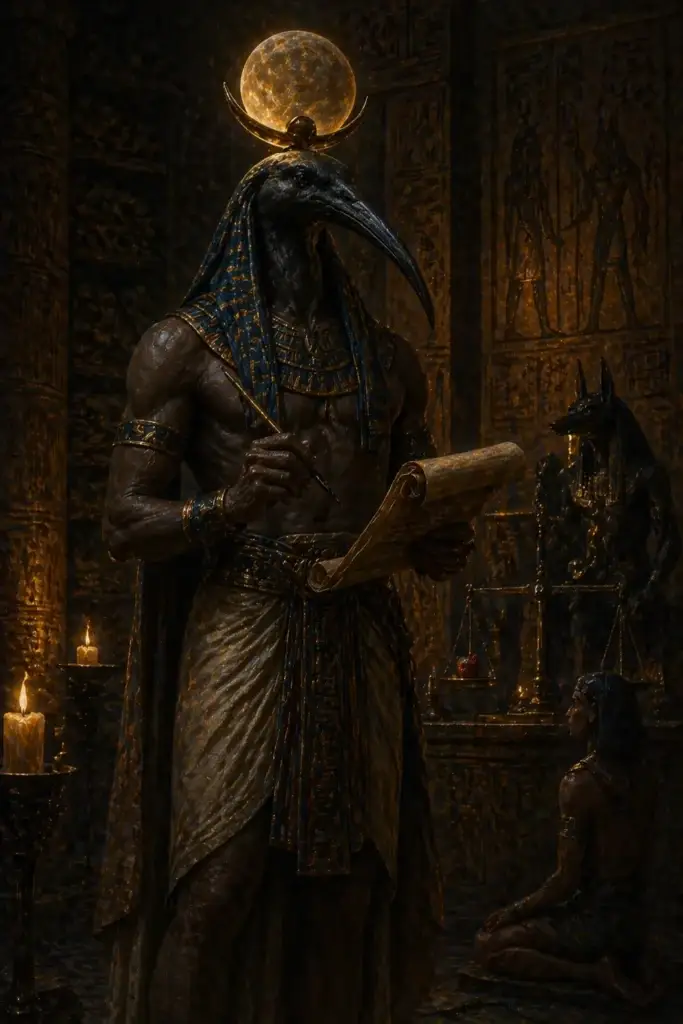
Thoth is most often depicted as an ibis, with a long, curved beak, or as an ibis-headed man. In his scribe form he wears a simple white or black crown and holds a writing reed and a papyrus scroll.
His eyes are piercing like those of a wise bird. The ibis is a bird of the wetlands and thus embodies a connection between worlds. Sometimes Thoth is depicted as a baboon, the animal of lunar wisdom. The reed of Thoth was his magical instrument.
Profile: Thoth
The most important aspects of Thoth at a glance. The following fields summarise origin, function, appearance, worship, symbols and cultural parallels.
Thoth’s genealogical position is not consistently fixed. In one tradition he is the son of Re, in another he emerged from the head of Set (when Set stole Horus’s eye). Consort of Seshat (goddess of scribes and patroness of architecture).
In Hermopolis he is the head of the Ogdoad (the Eightfold of primordial deities: four male-female pairs that personify the primal chaos).
In the Osiris myth he is a central mediator: he heals Horus’s injured eye (the Wedjat eye), records the verdict in the dispute between Horus and Set, and conducts the dead into the afterlife.
Patron of the art of writing, mathematics, astronomy, medicine and magic. He is regarded as the inventor of the hieroglyphs, of measures and weights, and of the calendar.
Scribe of the judgment of the dead: at the tribunal of Maat he records the result of the weighing of the heart; without his writing the deceased cannot enter the afterlife.
Moon god: his course across the night sky orders time. Arbiter of the gods: he mediates in the conflicts between the deities (Horus-Set, Re-Apophis). In the Hermes Trismegistos tradition he is the chief teacher of esoteric mysteries.
Two main forms:
Ibis-headed male figure: dark skin colour, scribe’s palette and writing reed in hand, long court robe. On the head often the crescent moon with the moon disc.
Baboon form: a seated baboon (often with a crescent moon on its head), one of Thoth’s sacred animals. Baboon statuettes were extremely widespread as votive offerings.
In Ptolemaic-Greek syncretism he is depicted with the cloak of Hermes and the caduceus (Hermes Trismegistos). In the animal cemeteries there are thousands of mummified ibises and baboons.
Area of influence: Thoth was invoked by all scribes and scholars; scribal schools began the day with a Thoth prayer, and every scribal profession stood under his patronage. He was central in healing and magic: medical and magical texts typically begin with an invocation of Thoth.
He was indispensable in the mortuary cult; his assistance at the tribunal of Maat was explicitly requested in the Book of the Dead (Spell 30).
At the Tuna el-Gebel cemetery, pilgrims brought their petitions, wrote them on potsherds and buried them with the animal mummies. In the Ptolemaic period the Hermes Trismegistos tradition drew Greco-Roman practitioners of esotericism from across the entire Mediterranean region.
Scribe’s palette and writing reed (his principal attribute), crescent moon with the moon disc, Wedjat eye (which he healed), Was sceptre, Ankh. Sacred animals: ibis (especially the black-and-white African ibis), baboon. Plants: persea tree, sycamore tree. Sacred number: 8 (the Ogdoad). Sacred colours: blue (the moon) and gold.
Hermes (Greece, simple syncretism), Hermes Trismegistos (Hellenistic double identification, the most famous syncretism in the history of religion), Mercurius (Rome), Nabu (Mesopotamia, god of scribes and wisdom, almost functionally identical), Sarasvati (Hinduism, goddess of knowledge), Manjushri (Buddhism, bodhisattva of wisdom), Mimir (Germanic, well of wisdom), Ogma (Celtic, inventor of the Ogham script).
Functionally, all gods of scribes and wisdom share aspects of Thoth. The connection of moon, writing and magic is present in numerous cultures.
Protective practice
Worship in everyday life
Rituals and invocations
The ibis cult of Hermopolis and Saqqara left behind countless ibis mummies. Thoth was invoked in healing and magical spells and acted at the judgment of the dead as the scribe at the weighing of the heart.
Conjurations and invocations
Textual transmission and formulas
Thoth is regarded as the patron of all writing; the spells of the Book of the Dead are called “words of Thoth”. The hermetic writings, in which Hermes Trismegistos corresponds to Thoth, and the magical papyri trace themselves back to him.
Amulets and protective symbols
Material apotropaia and archaeological evidence
Ibis and baboon amulets, Thoth-ibis figures, and amulets in the form of the scribe’s palette connected the idea of protection with knowledge and the word.
Thoth, parallels in other cultures
Thoth resembles Hermes (Greece); both are divine masters of magic, speech and writing. He recalls Odin (Scandinavia), who sacrifices for wisdom and invents a writing system.
In Jewish traditions there is a comparable figure in Enoch, the scribe of the heavenly book. The concept of the god as scribe and mediator is widespread; Thoth is a particularly systematic expression of it.
Hermopolis and the Ogdoad: the cult centre of Thoth
The most important cult centre of Thoth lay in Middle Egypt, in the city the Greeks called Hermopolis Magna and which in Egyptian was named Khmunu, “City of Eight”.
The name refers to the Ogdoad, the eightfold of four pairs of gods which, according to the Hermopolitan doctrine, embodied the primordial state before creation. In this local theology, Thoth was regarded as the ordering spirit who brought forth the world from the chaos of the Ogdoad.
Of the ancient city, what survives today is above all the ruins near the village of El-Ashmunein, whose name preserves the old Khmunu. Nearby, at Tuna el-Gebel, lay the extensive necropolis in which the sacred animals of Thoth were buried.
Hermopolis was a religious heavyweight for thousands of years. The great temple of Thoth was renewed several times; pharaohs from the New Kingdom to the Ptolemaic period had buildings erected there.
Remains of a colonnade survive from the Roman period. The Greek identification of Thoth with Hermes also made the city a hub of the hermetic tradition.
The local rootedness explains much about Thoth’s profile. As the city god of an important administrative and educational centre, he was connected from the outset with writing, calculation and administration.
The priesthood of Hermopolis cultivated a learned literature that stylised the god as the lord of knowledge. Thoth’s character as a god of scholarship is thus not to be thought of as abstract, but is closely bound to a real place and its social function.
Ibis and baboon: the sacred animals and their burials
Thoth is depicted in two animal forms: as an ibis-headed man or fully as an ibis, and as a baboon, mostly as a seated dog-headed ape. Both animals were held sacred to him, and both were mummified on a large scale.
In the catacombs of Tuna el-Gebel, archaeologists have uncovered extensive underground galleries filled with clay vessels containing mummified ibises. The numbers run into the hundreds of thousands, and by some estimates into the millions over the entire period of use.
Similar complexes exist at Saqqara and other sites. In addition, baboons were buried, whose mummies were also found at Tuna el-Gebel and at Saqqara.
These mass mummifications were part of a religious market: pilgrims acquired an animal mummy as a votive offering intended to convey their request to the god.
Research, including computed tomography, has shown that the bundles did not always contain complete animals; occasionally only parts or filling material are found. This raises questions about the practice of the temple workshops.
For the breeding of the ibises there is evidence of dedicated facilities near the temples. The logistics of keeping, killing, preparing and burying the animals were considerable and occupied specialised temple personnel. The animal cemeteries of Thoth thus belong to the most illuminating evidence for the practical religious economy of late-period Egypt.
The scribe at the judgment of the dead: Thoth in the Book of the Dead
One of the best-known scenes of Egyptian religion is the weighing of the heart, the judgment of the dead known as psychostasia.
It is described in detail in the Book of the Dead, especially in Spell 125, and depicted in numerous papyri and tomb decorations. The most famous papyrus, that of the scribe Hunefer from the New Kingdom, shows the scene in classical form.
The heart of the deceased is weighed on a scale against the feather of Maat, truth and world order. Anubis operates the scale, and the composite being Ammit waits to devour the heart should it be found too heavy.
Thoth stands beside them as scribe and records the result in writing. He announces the verdict and presents it to Osiris, the ruler of the realm of the dead.
The role is carefully chosen. Thoth is not the judge but the recorder and guarantor of correct procedure.
The tribunal thus has the structure of an Egyptian administrative matter: there is a measurement, a documentation and a submission to the highest authority. Thoth’s function as lord of writing makes him the indispensable official of this procedure.
This connection of writing, law and the afterlife shapes the entire image of Thoth. The god who is said to have invented the hieroglyphs also secures the bookkeeping over eternal life.
Anyone who could read and write in ancient Egypt thereby stood in a special relationship with this god; many scribes bore Thoth in their name or worshipped him as the patron of their profession.
From Thoth to Hermes Trismegistos: the hermetic tradition
With Greek rule over Egypt, an identification began that had far-reaching consequences. The Greeks identified Thoth with their messenger god Hermes, because both were regarded as mediators, as gods of language and scholarship. Hermopolis bore this name precisely because of this identification.
From the fusion arose the figure of Hermes Trismegistos, the “thrice-greatest Hermes”. Under this name an extensive literature was composed in Hellenistic and Roman Egypt, which is today called hermetic literature. It comprises philosophical-religious treatises, the so-called Corpus Hermeticum, as well as technical texts on astrology, alchemy and magic.
These writings were not composed by an ancient Egyptian priest but are products of the mixed culture of Greco-Roman Egypt. They combine Greek philosophy with Egyptian and other elements. Scholarship, such as the work of Garth Fowden, has worked out how strongly these texts stem from a particular milieu of late antiquity.
Its history of influence was enormous. In the Renaissance, after the translation of the Corpus Hermeticum by Marsilio Ficino in the 15th century, Hermes Trismegistos was regarded as an ancient sage who had supposedly lived before or alongside Moses. It was only Isaac Casaubon who demonstrated in 1614 that the texts are post-Christian.
This devalued the Egyptian origin, yet the hermetic tradition continued to operate in esotericism and early natural science. The ibis-headed city god of Hermopolis thus stands at the beginning of one of the most influential currents in European intellectual history.
Moon god, reckoner and arbitrator: the theological profile
Thoth’s areas of responsibility can be grouped around a few cores. First, he is a moon god. The moon with its measurable phases connected him with time reckoning, the calendar and the division of the year.
In a well-known narrative, Thoth wins additional portions of light from the moon in a game, so that the five intercalary days of the Egyptian year arise, on which, among others, Osiris and Isis are born.
From this follows the second sphere: measuring, counting and recording. Thoth is regarded as the lord of the hieroglyphs, of the art of calculation and of all sciences. He is the divine scribe who orders the words and measures time. In the temples Maat was closely associated with him, partly conceived as his companion.
The third sphere is that of the arbitrator. In the myth of the dispute between Horus and Seth over the inheritance of Osiris, Thoth appears as a mediating, balancing authority.
He heals the injured eye of Horus, the Udjat eye, and restores it. This function of healing and restoration also makes him a god who is invoked in magical spells against illness and danger.
The religious-studies classification emphasises that these responsibilities are connected: the moon, time measurement, writing, law and healing are, in Egyptian thought, aspects of a single ordering achievement. Thoth is the god who lends predictability to the cosmos and to society. Wherever something is regulated, measured, documented or arbitrated, he is responsible.
Further links
Literature (selection)
Further standard works in the literature index.
Frequently asked questions about Thoth
Who was Thoth in Egyptian mythology?
Thoth (Egyptian Djehuti) was the Egyptian god of writing, wisdom, mathematics, astronomy and the healing arts, that is, of science in the broadest sense. He was usually depicted with the head of an ibis, sometimes as a baboon.
Thoth is regarded as the inventor of the hieroglyphs, of lunar reckoning and of the calendar. At the judgment of the dead he is the recorder who writes down the result of the weighing. He is also regarded as the mediator of the gods, the wise counsellor who settles disputes.
Who was Hermes Trismegistos and what is his connection to Thoth?
Hermes Trismegistos (Hermes the Thrice-Greatest) is a late antique syncretism figure, the fusion of the Greek Hermes with the Egyptian Thoth. In Hellenistic Egypt the two were equated because both were messenger gods and mediators of wisdom.
Hermes Trismegistos is regarded as the author of the hermetic writings (Corpus Hermeticum, 1st to 3rd century), a philosophical-mystical body of teaching that continues to influence the Renaissance and esotericism (alchemy, astrology, theosophy) to this day. The Tabula Smaragdina is attributed to him.