Hermes, God of the Greek Tradition
By Ralf Ittermann · last reviewed on
Hermes is a god of the Greek tradition.
God of travellers, of thieves, of messengers and of the guidance of souls. Hermes is the mediator between worlds, between gods and humans, between heaven and earth, between life and death.
With winged shoes and the herald’s staff he crosses all boundaries. He is full of cunning, swift, eloquent and morally unbound, a god of ambiguity and of crossing boundaries.
At a glance: Hermes
Type: Greek principal deity, god of messengers and thresholds, escort of the dead
Pantheon: Greece (one of the twelve Olympians), Roman as Mercurius
Function: messenger of the gods, patron of travellers, merchants, thieves, herdsmen and orators; guide of the dead
Principal attributes: caduceus (kerykeion, winged serpent staff), winged sandals, petasos (traveller’s hat)
Principal cult sites: Pheneus (Arcadia, mythical birthplace), Athens (Hermai at every street corner), Tanagra (goat festival)
Roman counterpart: Mercurius
Historical context
Hermes is attested in Mycenaean Linear B as e-ma-a2, one of the oldest Greek gods. In Homer (8th century BCE) he already appears as a central figure, the messenger of Zeus and the escorting god of the dead (Odyssey XXIV).
The Homeric Hymn to Hermes (7th/6th century BCE) recounts his infant trickeries (the theft of Apollon’s cattle on his first day of life).
In Athens, the Hermai tradition is found from the 6th century BCE onward: at every street corner a square pillar bearing a head of Hermes and a phallus, an apotropaic protection of the threshold.
The famous Herm scandal in Athens in 415 BCE (the mass mutilation of the Hermai) before the Sicilian Expedition is regarded as a religious trauma. In the Hellenistic period he was syncretised with Thoth (Hermes Trismegistos), from which the hermetic tradition arose.
Principal cult sites: Pheneus (Arcadia, mythical birthplace on Mount Kyllene), Athens (Hermai at every street corner, a Hermes temple on the Agora), Tanagra (Boeotia, with the goat festival), Olympia (the Hermes statue by Praxiteles, one of the most famous works of Greek sculpture).
Hermai pillars were widespread throughout the entire Greek world, at crossroads, house entrances and boundaries. In the Hellenistic-Roman period the syncretism of Hermes Trismegistos spread widely in Alexandria and across the seething Mediterranean world.
Central sources: Hesiod (Theogony), Homer’s Iliad and especially the Odyssey (Book XXIV: Hermes psychopompos, „guide of souls“), the Homeric Hymn to Hermes (Hymn 4, at length), Apollodorus’ Library.
Hermetic tradition: Corpus Hermeticum (1st to 3rd century CE, late antique texts under the name of Hermes Trismegistos). Secondary literature: Burkert, Greek Religion; Brown, Hermes the Thief; Vernant, Mortals and Immortals.
Name and variants
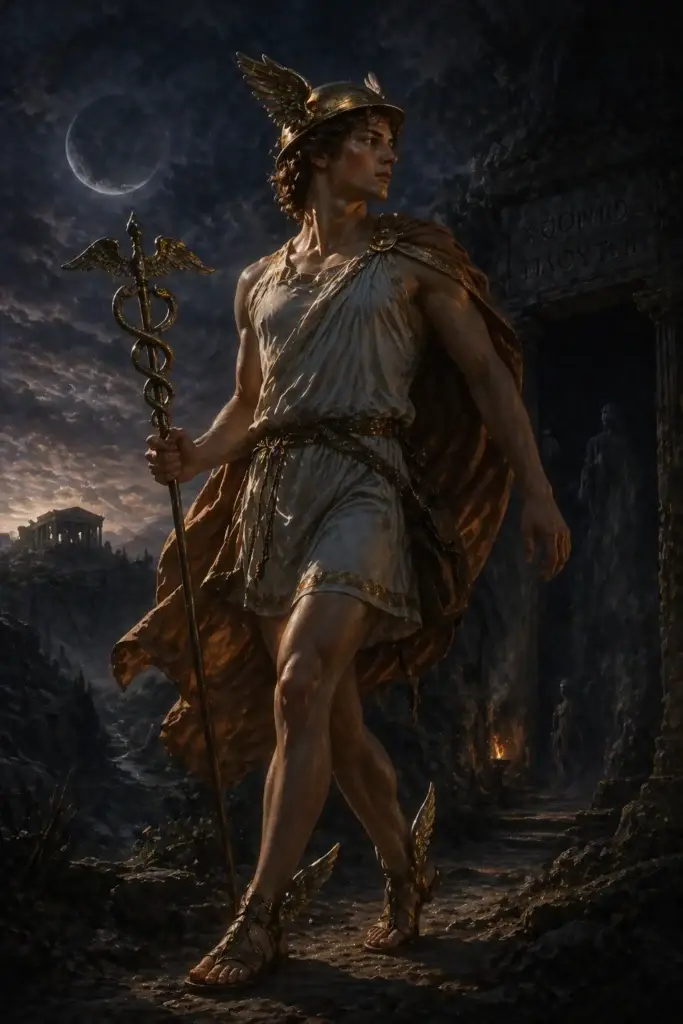
Hermes is often depicted as a young, beardless man, sometimes winged. His attributes are the winged shoes (talaria), the herald’s staff (caduceus) with two intertwined serpents, and the winged hat (petasos).
He sometimes wears a cloak (chlamys). His symbols are the tortoise (whose shell he turned into a lyre), the rooster, the goat and gold. His appearance is youthful, mobile, always in motion.
Description
Hermes is invoked by travellers, merchants and thieves. He blesses safe journeys and protects the crossing of boundaries. As psychopompos he leads souls into the underworld. In magic he is invoked to channel communication.
His festivals (Hermaia) are games and trade fairs. Eloquence and rhetoric are his domains. Hermes is not moral; he helps thieves as well as merchants, gods as well as humans. This ambiguity makes him versatile and dangerous at the same time.
Appearance and symbolism
Hermes is depicted as a youthful, muscular man with winged shoes (talaria) and a winged hat (petasos). The staff of Hermes, or caduceus, a staff with two entwined serpents and wings, is his primary identifying mark. The purse symbolises his wealth and his commerce.
The goat was his sacred animal, as was the tortoise (whose shell he turned into a lyre). Honey and wine were his libations. His colour was the gold of brilliance and of movement. Unlike other gods, Hermes is deliberately ambiguous; his smile is at once affectionate and deceiving.
Profile: Hermes
The most important aspects of Hermes at a glance. The following fields summarise origin, function, appearance, veneration, symbols and cultural parallels.
Hermes is the son of Zeus and the Pleiad Maia, born in a cave on Mount Kyllene in Arcadia.
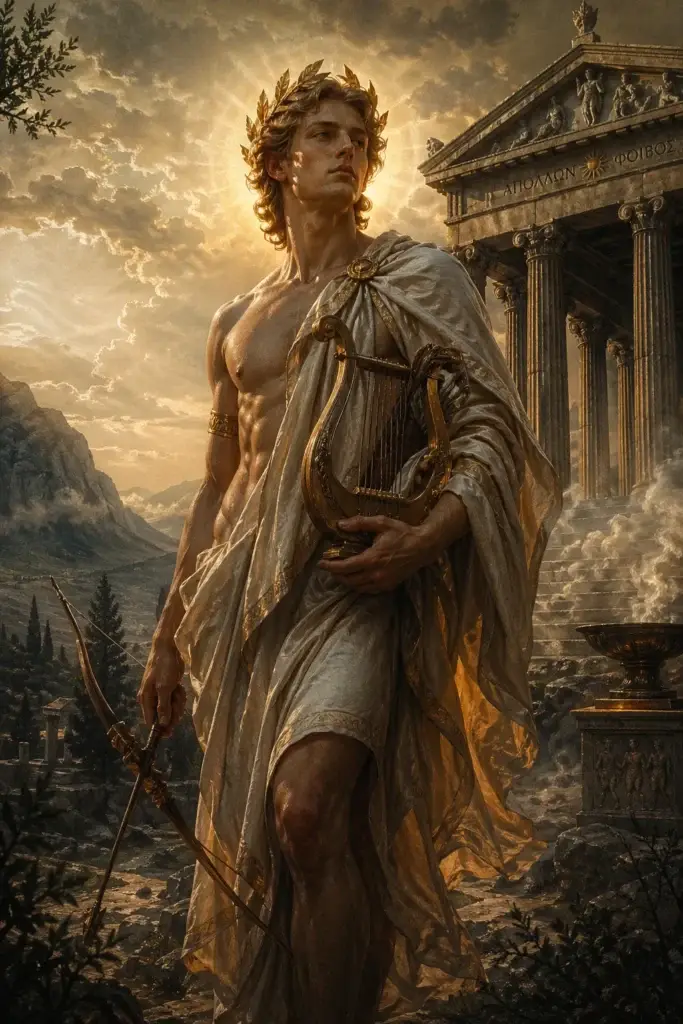
On his very first day of life he stole the cattle of his elder brother Apollon (a central myth in the Homeric Hymn), invented the lyre from a tortoise shell and sheep gut, and later traded it with Apollon in exchange for the cattle, from which the bond between the two brothers arose.
He is the father of Pan (with the nymph Dryope) and of Hermaphroditos (with Aphrodite). Within the mythical cycle he is repeatedly employed as a helper and mediator: he leads Persephone back from the underworld, escorts Priam to Achilles’ tent (Iliad 24), and fetches Io from the watch of Argos.
A multiple function is characteristic of Hermes: messenger of the gods, mediating between the three cosmic levels (Olympus, earth, underworld); god of thresholds, patron of every transition (death, thresholds, roads, language); patron of travel, protector of wanderers and merchants; Hermes psychopompos, guide of souls into the realm of Hades, handing them over to Charon; patron of thieves and the cunning; patron of herdsmen, in his old Arcadian form; patron of orators and poets.
Later, in the hermetic tradition, he was identified as the inventor of writing (syncretism with Thoth).
In archaic art still a bearded man with a traveller’s cloak, in the classical period youthful and beautiful and beardless, Praxiteles’ Hermes with the infant Dionysos (c. 340 BCE, today in Olympia) is the canonical depiction.
Characteristic attributes: caduceus / kerykeion (a winged staff with two serpents intertwining around it, a symbol of thresholds and of heralds), winged sandals (talaria), petasos (a broad-brimmed traveller’s hat, often winged), and a traveller’s cloak.
In the Hermes-herm form: a rectangular stone pillar with a head of Hermes at the top and an erect phallus on the front. Mount: none fixed; he flies with the sandals or goes on foot.
Sphere of effect: Hermes was invoked in every Greek household, through the Hermai at every house threshold and crossroads. Travellers, merchants and herdsmen prayed to him before setting out. At burials he was invoked as the escort of the soul. In public cult: Hermaia festivals in various cities (Tanagra, Pellene).
Hermes was the patron of the youthful athletes in the gymnasia. In the Hellenistic-Roman period he was central to the hermetic tradition; the Corpus Hermeticum became the main foundation of Western esotericism (Renaissance hermeticism through Marsilio Ficino, and the later alchemical tradition).
Caduceus / kerykeion (winged serpent staff), winged sandals (talaria), petasos (traveller’s hat), purse (patron of merchants), lyre (the instrument of his invention), traveller’s cloak. Sacred animals: tortoise (the material of his lyre), rooster, goat (Hermes Kriophoros, „ram bearer“), dog. Sacred plants: strawberry tree (arbutus). Sacred stones: marble in the herm pillars.
Mercurius (Rome, an almost identical adoption), Thoth (Egypt, syncretised in the Hellenistic period as Hermes Trismegistos, one of the most important syncretisms in the history of religion), Anubis (Egypt, escort of the dead, connected through the Hermanubis syncretism), Nabu (Mesopotamia, patron of scribes and messengers), Ningishzida (Mesopotamia, a serpent staff resembling the caduceus), Odin (Germanic, wanderer and escort of the dead), Janus (Rome, patron of thresholds and transitions), Papa Legba (Vodou, the loa of thresholds and the opening of gates), Lugh (Celtic, a versatile patron).
Functionally, all gods of thresholds and mediation share aspects of Hermes. The caduceus is one of the oldest symbols of healing (frequently confused with the staff of Asclepius, which has only one serpent).
Practical means of protection
Rituals of veneration
Hermes is the messenger of the gods, god of thresholds and guide of souls in Greek religion. His principal cult site is not a single sanctuary, but everywhere at crossroads, city gates and marketplaces where herm stelae (stone pillars with a head of Hermes and a phallus) stood, apotropaia for travellers and merchants.
In the cityscape of Athens, hundreds of herms flanked the public spaces (cf. Burkert, Greek Religion; Versnel, Coping with the Gods). His principal festival is the Hermaia with gymnastic contests for young men.
Invocations
The Homeric Hymn to Hermes (4), over 580 verses, is the central literary source among the hymns. Travellers invoked Hermes with the epithet prosphilēs („dear, well-disposed“).
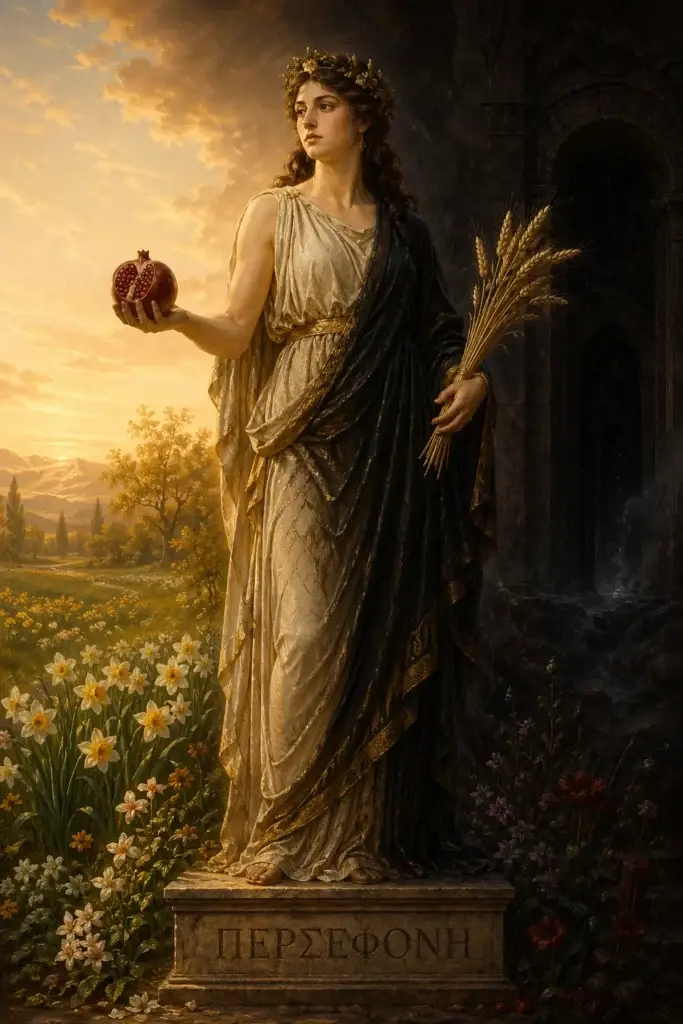
Before every serious undertaking Hermes was invoked as the god of cunning. In the myth of Demeter (Hom. Hymn 2) Hermes leads Persephone back from Hades.
Amulets and protective symbols
The kerykeion (a herald’s staff with two serpents, the model for the modern medical caduceus) as a symbol of Hermes. Winged sandals (talaria) and a traveller’s hat (petasos) on vase paintings. Herm stelae at house entrances as apotropaia against thieves and evil powers. Minted coins with a head of Hermes in Pheneos and Mantineia (Arcadia).
Hermes, parallels in other cultures
Indo-European parallels
Hermes shares all essential functions with the Roman Mercurius: messenger of the gods, god of commerce, protector of crossroads. Mercurius became the most frequently venerated god in the Roman Empire, particularly in Gaul (where he was identified with the Celtic Lugus).
In the Germanic context Mercurius was rendered as Wodan (Wednesday, Wodanstag, English Wednesday, Italian mercoledì). The structural kinship with the Indian Pushan (the Vedic god of paths) has been emphasised by Indo-Europeanists (Dumézil, West).
Near Eastern parallels
The Egyptian god of scribes and the moon, Thoth, was identified with Hermes during the Hellenistic-Roman phase of syncretism (Hermes Trismegistos = „Hermes the Thrice-Greatest“).
The Corpus Hermeticum writings (1st to 3rd century CE) are a product of this fusion of Hermes and Thoth. The Mesopotamian god of scribes, Nabu, also shares structural similarities: message, the art of writing, the role of mediator.
Late antiquity and hermeticism
From the 2nd century CE onward Hermes Trismegistos became the central figure of hermeticism, an Egyptian-Greek tradition of mysticism with alchemical, astrological and magical teachings. The Tabula Smaragdina (handed down in medieval Arabic) is regarded as a key hermetic text.
Renaissance hermeticism (Ficino, Pico della Mirandola, Bruno) shaped the European tradition of esotericism into the 19th century. To this day hermetic currents live on in astrology, alchemy and more recent esotericism.
The Hymn to Hermes: the childhood deeds of the god
The most detailed mythological source for Hermes is the Homeric Hymn to Hermes, a poem of about 580 verses that probably arose in the 6th century before our era. It depicts the deeds of the god on his first day of life and thereby sets out his entire nature.
Hermes is the son of Zeus and the nymph Maia, born in a cave of Mount Kyllene in Arcadia. Already on the day of his birth he leaves the cradle.
He finds a tortoise, kills it and builds the first lyre from its shell by stretching strings across it. Then he sets out and steals a herd of cattle belonging to his elder brother Apollon.
So as to leave no trace, he drives the cattle backwards and binds ingenious soles beneath his own feet. He sacrifices two of the cattle and divides the meat into twelve portions, an allusion to the twelve Olympian gods.
When Apollon tracks down the thief and brings Hermes before Zeus, the child denies everything with great eloquence. Zeus sees through the matter, yet the brothers are reconciled. Hermes gives Apollon the lyre and receives in return a golden staff and other privileges.
In this single narrative almost all the responsibilities of Hermes are laid out: the gift of invention, theft and cunning, eloquence, commerce and exchange, the connection to herds, music and the crossing of boundaries. The hymn is therefore not merely an entertaining story but a considered interpretation of what this god signifies.
Hermes psychopompos: the escort of the dead
One of the most important and oldest functions of Hermes is his office as psychopompos, as the escort of souls. In this role Hermes leads the deceased down from the world above into the underworld.
Homer already knows this function. In the final book of the Odyssey it is described how Hermes drives together the souls of the slain suitors with his staff and leads them into the underworld, while they twitter like startled bats.
This task follows logically from the fundamental nature of Hermes. He is the god who crosses boundaries, and no boundary is more final than that between life and death. Hermes can pass it in both directions without himself belonging to the underworld.
In some myths he also brings souls back up, for instance in the Persephone narrative, in which he is sent by Zeus to bring the daughter of Demeter back from the underworld.
The function as escort of the dead had a fixed place in religious practice. Hermes was invoked in the cult of the dead, and his image belonged to the sphere of burial. The notion that a friendly god accompanies the difficult transition softened the terrors of death.
In the visual arts Hermes psychopompos appears on vase paintings and grave reliefs, often leading a soul by the hand.
This side of Hermes shows that he was not only the cheerful trickster of the childhood narrative but also a grave figure, consoling in the encounter with death. Comparable escort functions are found with the Roman Mercurius and the Egyptian Anubis.
The herm: boundary stone, cult image and material culture
One of the most peculiar forms in which Hermes appears is the herm named after him, a cult image of characteristic form.
A herm is a square stone pillar, tapering slightly towards the top, which ends above in a head, usually that of Hermes, and on which a phallus is attached at half height. Arms and legs are absent.
Herms stood at crossroads, at boundaries, at house entrances and in public squares. Their function was manifold: they marked boundaries and transitions, protected the place and were considered to bring good fortune. In Athens they were especially numerous.
The phallus was not an obscene but an apotropaic sign, one of warding off and of fertility. The herm connects the god with his fundamental responsibility, the marking and protection of boundaries and roads.
A famous historical event shows how significant these images were. In the year 415 before our era, shortly before the departure of the Athenian fleet for the Sicilian Expedition, numerous herms in Athens were mutilated in a single night.
This so-called mutilation of the herms triggered a serious political crisis and religious dread, because the deed was regarded as an evil omen and a sacrilege against the gods.
The incident is described by Thucydides and shows that the herms were deeply rooted in the religious and political life of the city. For archaeology the herms are an important class of source, because they survive in great numbers and document the connection between the image of the god, daily life and public space.
Hermes as messenger of the gods and his attributes
The function of Hermes best known in the West is that of messenger of the gods. In this role he conveys the messages of Zeus and the other gods and mediates between the spheres.
This function is closely connected with his fundamental quality as a crosser of boundaries: whoever conveys messages moves between sender and recipient, crosses spaces and areas of responsibility.
The equipment of Hermes reflects this task. He wears winged sandals, the pedila, which carry him swiftly over land and sea. On his head he often has the winged traveller’s hat, the petasos. His most important attribute is the herald’s staff, the kerykeion, a staff around which two serpents wind.
This staff marks him as herald and mediator. It is not to be confused with the staff of Asclepius of the healing art, which bears only one serpent, although the two are often mixed up in modern symbolism.
As messenger, Hermes is also the god of language and of translation, of understanding between different parties. From this, in later times, the term hermeneutics was derived, the study of interpretation and of understanding, which is linguistically connected to Hermes.
This connection shows how comprehensively the god was interpreted: he is not only the one who carries news but the one who makes understanding possible at all.
Within the framework of the Olympian pantheon Hermes thus occupies a mediating position. He is the youngest of the great gods and the one who goes back and forth between all the others, between gods and humans, the living and the dead.
Hermes Trismegistos and the hermetic writings
A development of its own, and of far-reaching consequence, was taken by the cult of Hermes in late antiquity. In the Hellenistic period the Greek Hermes was equated with the Egyptian god Thoth, the god of writing, knowledge and wisdom.
From this fusion arose the figure of Hermes Trismegistos, the thrice-greatest Hermes, who was no longer the cheerful messenger of the gods of Homeric poetry but a bearer of secret revelation.
Under the name of this Hermes Trismegistos there arose, between the 1st and 3rd century of our era, a collection of writings, the so-called Corpus Hermeticum, together with further texts such as the Asclepius.
These writings treat questions of cosmology, of the soul, of the knowledge of God and of the ascent of the human being to the divine. They combine Greek philosophy, above all Platonic and Stoic elements, with Egyptian and other conceptions.
The hermetic writings had an extraordinarily strong effect beyond antiquity. In the Renaissance the Corpus Hermeticum was rediscovered and translated into Latin by Marsilio Ficino in the 15th century.
At that time it was held to be an ancient work of wisdom that had arisen even before Plato. Only the philologist Isaac Casaubon showed, in the early 17th century, that the texts in fact date from the imperial period.
Nevertheless the hermetic tradition deeply shaped European intellectual history and stands at the beginning of currents connected with terms such as hermeticism and alchemy. In the history of religion this process is a striking example of how a mythological god could become, through fusion and reinterpretation, a new philosophical-religious authority.
Further links
- Apollon, elder brother, partner in exchange
- Charon, ferryman, to whom Hermes hands over the dead
- Hades, lord of the realm into which Hermes escorts
- Anubis, the Egyptian counterpart (Hermanubis syncretism)
- Thoth, syncretised in the Hellenistic period (Hermes Trismegistos)
- Papa Legba, the Vodou threshold-god parallel
- Greece, pantheon overview
- Gods, class overview
Sources and literature
Further standard works in the literature index.
Frequently asked questions about Hermes
Who is Hermes in Greek mythology?
Hermes is one of the twelve Olympian gods, son of Zeus and the Pleiad Maia. He is the messenger of the gods, the god of merchants, travellers, thieves, orators and of the transitions between the worlds.
Hermes psychopompos leads the souls of the deceased into the underworld. His attributes: a winged helmet (petasos) and sandals (talaria), the staff of Hermes (kerykeion or caduceus with two winding serpents). As an infant he already stole the cattle of Apollon. His Roman counterpart is Mercury.
What is the caduceus and its modern use?
The caduceus (kerykeion) is the staff of Hermes, a messenger’s staff with two serpents intertwining around it and wings at the top. It is the symbol of the merchant, the messenger and the mediator.
It is frequently (especially in the USA) confused with the staff of Asclepius, the staff of the Greek god of healing Asclepius, which shows only one serpent without wings.
This confusion leads many medical organisations to use the caduceus mistakenly as a symbol; in reality it is the staff of the god of commerce, not that of the healer.