Seth, god of the Egyptian tradition
By Ralf Ittermann · last reviewed on
Seth is a god of the Egyptian tradition.
God of chaos, the desert and the storm. Seth is the lord of disorder, of the sand-laden wind and of the wild force that threatens every ordered world.
With his Set-animal head or hybrid animal form, he embodies the destructive energy that is needed to break what is old and to make new things possible. In ancient Egypt, Seth was not simply «evil»; rather, he was ambivalent, feared and required at once, especially as a protective god of the pharaohs against foreign powers.
Seth is an Egyptian god of chaos, the desert and storms.
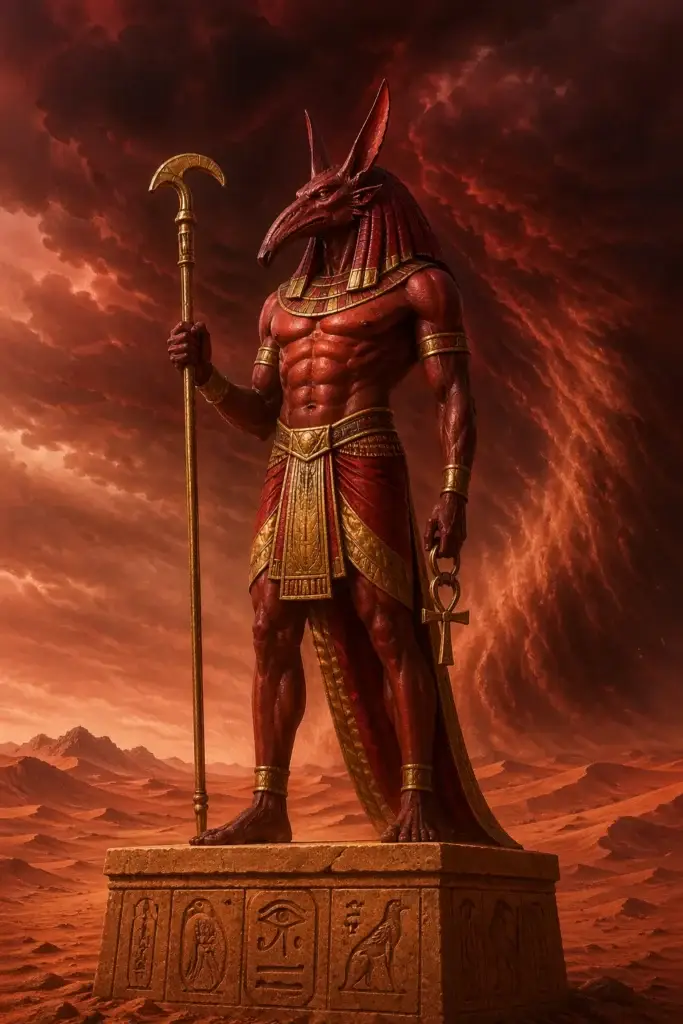
Seth
At a glance: Seth
Type: Egyptian principal deity, god of chaos, the desert and storms
Pantheon: Egypt (all dynasties, received ambivalently)
Function: desert, foreign lands, storm, chaos, but also protector of Re against Apophis
Main attributes: Seth animal (an unidentified mythical creature), Was sceptre with a forked tip
Main cult sites: Nubt (Greek Ombos, today Naqada), Avaris (capital of the Hyksos)
Greek identification: Typhon
Context
Period of the sources
Seth is attested from the pre-dynastic period (before 3000 BCE) onwards. In the Pyramid Texts he is still ambivalent; the brother-myth with Osiris and Horus dominates the literary tradition.
The Hyksos conquest (15th dynasty) leads to a re-evaluation of Seth as the chief god of the Hyksos capital Avaris. In the Late Period an increasing demonisation sets in, and Seth becomes a purely antagonistic figure. Plutarch identifies him with Typhon.
Area of diffusion
Main cult sites: Nubt (Greek Ombos, today Naqada) in Upper Egypt, one of the most famous of the early Seth sanctuaries. Avaris (today Tell el-Daba) served as the Hyksos capital (15th dynasty).
He was also venerated in the Dakhla oasis, in Bahariya and along the eastern frontier. With the demonisation of the Late Period, the cult sites contracted.
State of the sources
Central sources: the Pyramid Texts (spell 477), the Contendings of Horus and Seth (Chester Beatty Papyrus I, New Kingdom), the Apophis incantation (Seth as protector of Re), Plutarch’s De Iside et Osiride (the late, demonised form).
Secondary literature: Te Velde, Seth, God of Confusion (the standard work); Bonnet, Reallexikon; Wilkinson, Complete Gods and Goddesses.
Name and variants
Seth is depicted with the head of an unknown, donkey-like animal (possibly an aardvark or a bird-of-prey hybrid) or with a red, cleft body. As a rule, Seth does not wear a feather crown.
He carries weapons, a lance, a knife and at times a thunderbolt. His colour is red or black, the symbol of danger and of the extraordinary. In the papyri he is often shown as a hairy, wild being, set apart from the ordinary gods.
Character traits
Seth was originally the protector of the pharaohs against the Apophis serpent (the chaos beyond order). He fought day by day at Re’s side against the darkness. With the Osiris mythology, however, his ambivalence grew sharper: brother against brother, murderer against avenger (Horus).
In the temples of the New Kingdom he was still venerated as a warrior and plague god, yet the theological tendency leaned toward condemnation. Sethos I and Sethos II carried his name as an honour; later rulers had reliefs bearing his name erased.
Profile: Seth
The most important aspects of Seth at a glance. The following fields summarise origin, function, appearance, veneration, symbols and parallels.
Seth is the son of Geb (the earth god) and Nut (the sky goddess), and brother of Osiris, Isis and Nephthys.
In the central myth he kills Osiris (out of envy over the Egyptian kingship) and dismembers his body, the triggering conflict of the entire Osiris myth. He later contests the succession with his nephew Horus and is defeated after a long dispute.
Double function: god of storm, desert and chaos (demonised reception) AND protector of Re against the chaos serpent Apophis (his original function, anchored in the solar-barque mythology).
Patron of foreign lands and their languages, protective god of storm and thunder and of the barren desert. At the level of household practice, a protector against snakes and scorpions.
Anthropomorphic, with the head of the Seth animal, a mythical animal form that cannot be identified unambiguously (donkey-like? canine? oryx-like?). Also as the pure Seth animal without a human body.
Skin colour red or pink (desert, chaos). Frequently with the Was sceptre, whose tip is forked (a characteristic Seth symbol). In the Late Period he is increasingly disfigured with human traits as part of his demonisation.
Sphere of operation: Seth was venerated as the chief deity in Hyksos-period Avaris. In Ramesside times the kings cultivated a particular bond with him; Sethos I and Sethos II carried his name. Sailors and travellers invoked him as a storm god.
In personal practice he was called upon as a protection against desert demons and scorpions. With the demonisation of the Late Period, ritual curses were directed against him (Apophis rites reworked for that purpose).
Seth animal (mythical animal form), donkey or canine snout, forked Was sceptre, red-pink skin colour, storm and desert, sandstone. In later demonisation: serpent (identified with Apophis), black pigs, dirt. Open hands with claws.
Typhon (Greece, Plutarch’s identification), Loki (Germanic, the trickster brother-antagonist), Kronos (the Titan who castrates his father), Mara (Buddhism, the tempter and antagonist), Ahriman (Zoroastrianism, the cosmic counter-player). The Indo-European root in the dragon-slayer motif (Indra against Vritra, Thor against Jormungand) finds an echo in the Seth-Apophis relationship.
Defence in everyday life
Defence in everyday life
Rituals and invocations
Seth was on the one hand invoked to protect the solar barque, and on the other hand combated in execration rites, for instance through the smashing of red vessels and at the „Festival of the Victory“ over Seth.
Incantations and invocations
Textual transmission and formulae
The Contendings of Horus and Seth, the Pyramid Texts and the execration texts transmit the ambivalent figure of the desert and chaos god.
Amulets and protective symbols
Material apotropaia and archaeological evidence
Amulets of the Seth animal are rare and ambivalent in their evaluation. On protective objects Seth appears as the defender of the solar barque against the serpent Apophis; in the Late Period his images were in many cases erased.
Seth, parallels in other cultures
The struggle against Apophis
In Egyptian theology Seth fulfilled, over centuries, a protective function that in later perception was often eclipsed by his reputation as a god of misfortune.
In the Books of the Underworld Seth stands aboard the solar barque and night by night repels the chaos serpent Apophis. His untamed force, which makes him suspect in other contexts, is here precisely what preserves the cosmic order.
Religious studies read in this a fundamental pattern of Egyptian thought: order (Maat) is not secured by excluding what is dangerous, but by binding it in. Seth is the violence that is turned against the still greater violence of chaos. Only when the broader theological climate changed did this ambivalence become a problem.
Seth in the Osiris myth
The most lasting influence on the picture of Seth came from his role in the Osiris myth. Seth kills his brother Osiris, in some strands of the tradition dismembers the corpse and then enters into a long legal and power struggle with Horus, the son of Osiris.
This conflict is preserved in the Pyramid Texts, later set out in detail by Plutarch in De Iside et Osiride and in numerous temple texts.
What matters for the historical-religious classification is that the myth does not simply tell a story of good against evil. The dispute between Seth and Horus is settled before a court of gods and concludes with an orderly decision. Seth there embodies the defeated, yet not annihilated party, whose force remains available to the cosmos.
From imperial god to damnatio memoriae
The history of Seth is a history of theological change in meaning. In the Ramesside period he stood in high regard: several rulers carried his name, among them the kings with the name-form Sethos, and the Hyksos rulers of the Nile delta had associated him with their own principal god.
Seth was considered a warrior and frontier god, responsible for the desert, foreign lands and storms.
With the Late Period this evaluation shifted. Seth was increasingly identified with foreign powers experienced as threatening and was pushed to the theological margins. In some temples his names and images were subsequently erased, a form of damnatio memoriae.
Scholarship, in particular Herman te Velde in his foundational study on Seth, describes this process as an example of how political circumstances and the image of the gods were interconnected in Egypt.
Further reading and cross-links
Sources and literature
Further standard works in the literature index.
Frequently asked questions about Seth
Who was the god Seth in Egyptian mythology?
Seth (also Set, Sutekh) was the Egyptian god of the desert, of the storm, of chaos and of foreign lands.
He was depicted as a lean man with the head of a fabulous ‘Seth animal’, a creature with a long snout, upright squared ears and a forked tail, which cannot be assigned exactly to any zoological species.
Seth is ambivalent: on the one hand the murderer of his brother Osiris (the Osiris myth), on the other hand the indispensable protector of the solar barque of Re against the chaos serpent Apophis.
Why was Seth demonised only in the Late Period?
Seth had a long history as a legitimate god of the desert oases and of the Ramesside dynasty (Sety I and Sety II carried his name).
It was only in the Late Period of Egypt, especially after the conquest by the Assyrians and Persians and later by the Greeks, that Seth was increasingly demonised, as the god of foreigners, of disorder and of evil.
In Hellenistic-Roman Egypt Seth was fused with the Greek Typhon, the primordial monster of the gods. Christian authors later identified Seth with Satan.