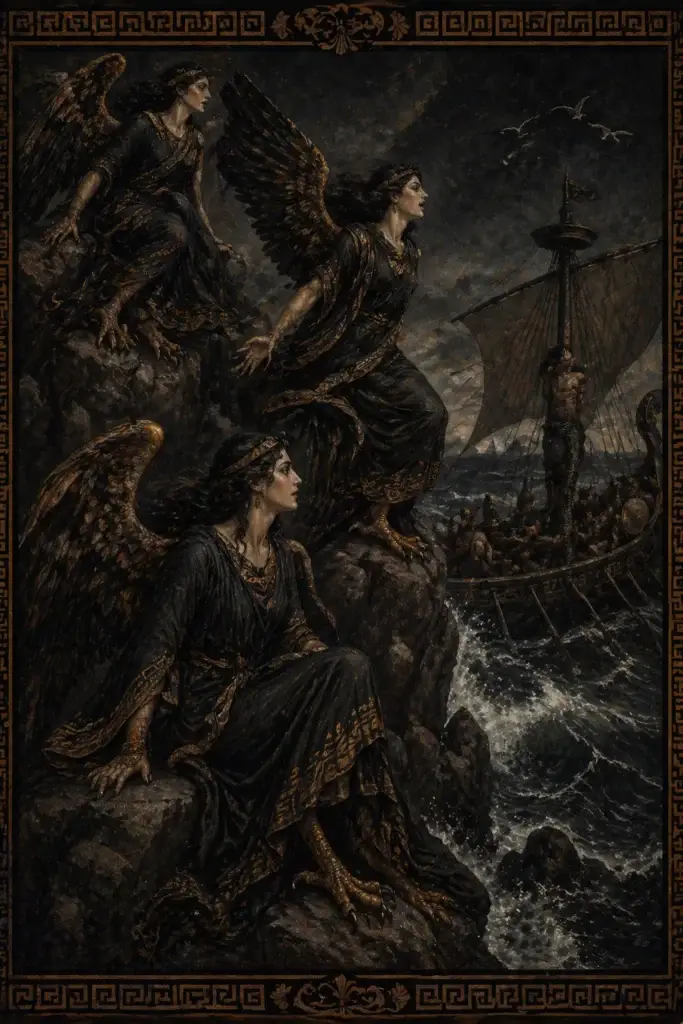
Charybdis, the Faceless Suck of Messina
By Ralf Ittermann · last reviewed on
Charybdis is a demoness of Greek tradition.
Three times a day she swallows the sea, along with every ship. The entry names her the great Suck of Messina, drawing every ship into the sea three times a day.
Charybdis is the whirlpool monster of Greek seafaring legend: three times a day she sucks in the sea and spews it out again, destroying every ship. Together with Scylla on the opposite cliff, she forms the most famous pair of dangers in the Odyssey.
She remains bodiless: no face, no limbs, only the fig tree as a landmark. Later authors call her a daughter of Poseidon and Gaia; cult evidence is lacking, she lives only in literature.
Type: sea-whirlpool demoness without bodily form
Origin: daughter of Poseidon and Gaia
Texts: Homer, Thucydides, Virgil, Ovid
Period: 8th/7th century BC to late antiquity
Appearance: suction beneath a fig tree, Strait of Messina

Source context
Period of the Texts
Present in literature from the Odyssey to late antiquity, without any cult ever forming.
Area of Diffusion
Greece, located since antiquity in the Strait of Messina.
Sources
Densely attested in Homer, Thucydides, Virgil and Ovid, yet without evidence of temples or offerings.
Name and variants
Name: Homer calls her ‘the divine Charybdis’. Later sources make her a daughter of Poseidon and Gaia.
Appearance and behaviour
Appearance
Charybdis remains bodiless: no face, no limbs, only the suction and the fig tree as a landmark. Visual art has scarcely depicted her.
Effect
Three times a day she sucks in the water and spews it out; her suction seizes ships even at a distance. Unlike the sirens, she attacks no will, only the course.
Profile: Charybdis
The whirlpool monster at a glance.
Homer’s Odyssey, followed by Thucydides, Apollonius, Virgil, Ovid.
Seafarers of the strait, three times a day in danger.
Invisible suction, fig tree as the only landmark.
Devours ships together with their crew, strictly bound to one place.
Careful course-setting, in an emergency clinging to the fig tree.
Unlike Glaukos, the helpful sea god, she knows no goodwill.
Between two shoals: Odysseus and the strait
The oldest source is the twelfth book of the Odyssey: Circe warns Odysseus of the strait where Scylla and Charybdis dwell facing each other. Odysseus crosses it twice: first passing close to Scylla, losing six companions; after the shipwreck he drifts into the whirlpool, clings to the fig tree and waits until Charybdis spits out mast and keel again.
Later authors make her a daughter of Poseidon and Gaia. Thucydides places the Strait of Messina as the setting, Virgil has Aeneas sail around her.
From myth to figure of speech
The phrase ‘between Scylla and Charybdis’ has been proverbial since Latin literature. The Strait of Messina does in fact have tidal currents, dangerous for ancient rowed ships, harmless for modern ones.
In the history of religion, Charybdis shows the difference between myth and cult: evidence of temples or offerings is entirely lacking, she remains a purely literary figure of terror. A genus of crab now bears her name.
Course-setting instead of an incantation
Against the whirlpool itself, tradition knows no amulet and no incantation, only seamanship: Circe advises rowing close past Scylla rather than losing the whole ship. As a last resort, clinging to the fig tree remained.
For the voyage in general, sailors carried an amulet, purified themselves with holy water and trusted in salt, while Apollonius has the Argonauts request divine escort and protection.
Devouring water powers in comparison
Frequently asked questions about Charybdis
Why do people say ‘between Scylla and Charybdis’?
Because every change of course in the strait led from one danger to another, the pair became a symbol of a choice between two evils, grounded in reality in the currents of the Strait of Messina.
Further links
Literature (selection)
Further standard works in the bibliography.
Whoever is caught between Scylla and Charybdis is unwittingly citing the most famous danger spot of ancient seafaring. She remains in memory as the Charybdis Odyssey scene of the twelfth book: a faceless whirlpool against which only course-setting helped, no incantation.